Should you write flies or flys? It’s a common spelling question because the word fly has more than one meaning.
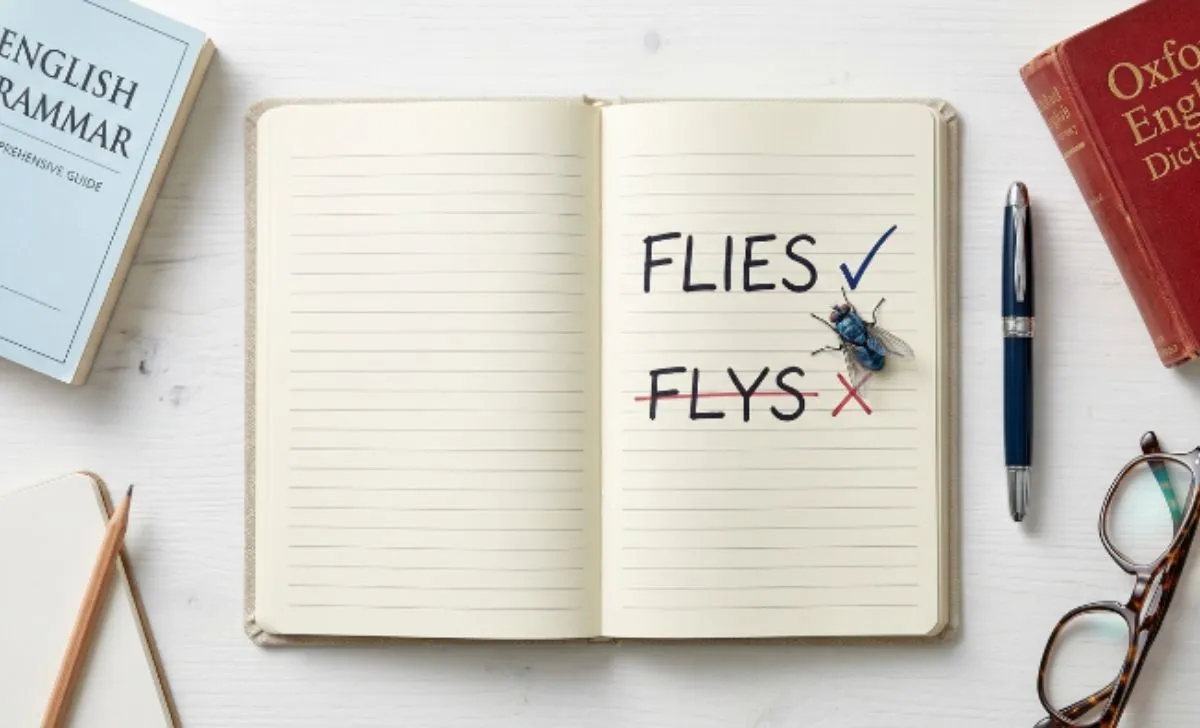
In most situations, flies is the correct spelling. It’s used as the plural of fly (the insect) and as the third-person singular form of the verb fly.
Flys is rarely correct and appears mainly in proper nouns, such as a surname or business name. Knowing the difference helps you avoid one of the most common English spelling mistakes.
Flies or Flys: Quick Answer
Flies is the correct spelling in standard English.
Flys is generally incorrect unless it’s part of a proper name.
| Spelling | Correct? | Usage |
|---|---|---|
| Flies | ✅ Yes | Plural noun and verb form |
| Flys | ❌ Usually no | Proper names only |
Quick answer: If you’re talking about insects or the verb fly, always use flies.
How to Spell and Pronounce “Flies”
Correct spelling
The standard spelling is:
Flies
It is used in two common ways:
- The plural of fly (the insect)
- The third-person singular form of the verb fly
Pronunciation
IPA: /flaɪz/
Simple pronunciation: FLYZ
The pronunciation remains the same whether flies is a noun or a verb.
What Does “Flies” Mean?
The word flies has two common meanings in English.
As the plural of fly
It refers to more than one flying insect.
Examples
- The kitchen was full of flies.
- Fruit flies are attracted to ripe bananas.
- We kept the windows closed to keep flies out.
As the verb fly
It is the present simple form used with he, she, or it.
Examples
- She flies to Dubai every month.
- The eagle flies high above the mountains.
- A rescue helicopter flies over the area each morning.
The meaning depends on the sentence, but the spelling stays the same.
Why Is “Flys” Incorrect?
The mistake happens because many people simply add -s to the word fly.
However, English spelling follows a different rule for most words ending in a consonant followed by y.
When forming the plural noun or the third-person singular verb, the y changes to i, and -es is added.
- fly → flies
- cry → cries
- try → tries
- carry → carries
That’s why flys is not accepted in standard English.
The exception
You may occasionally see Flys as:
- A surname
- A company name
- A brand name
In those cases, it’s a proper noun rather than a standard dictionary word.
Why Does “Fly” Change to “Flies”?
The change follows a common English spelling rule.
Words ending in a consonant + y
When a word ends with a consonant followed by y, change the y to i before adding -es.
| Singular | Correct Form |
|---|---|
| Fly | Flies |
| Cry | Cries |
| Try | Tries |
| Reply | Replies |
| Study | Studies |
This rule applies to many everyday English words, not just fly.
Flies vs Flys
| Feature | Flies | Flys |
|---|---|---|
| Correct spelling | ✅ Yes | ❌ Usually no |
| Standard English | ✅ Yes | ❌ No |
| Plural of fly | ✅ Yes | ❌ No |
| Third-person verb | ✅ Yes | ❌ No |
| Found in dictionaries | ✅ Yes | ❌ No (except as proper names) |
| Formal writing | ✅ Yes | ❌ No |
When Should You Use “Flies”?
Use flies whenever you’re referring to more than one fly or describing someone or something that flies.
Everyday writing
- The horse was bothered by flies all afternoon.
- Several flies landed on the picnic table.
Business or news writing
- The airline flies to more than 100 destinations worldwide.
- The drone flies automatically using GPS.
Academic writing
- Scientists studied how fruit flies respond to light.
- The bird flies long distances during migration.
No matter the context, flies is the correct spelling for standard English. If you write flys, most spell checkers and grammar tools will flag it because it doesn’t follow the standard plural or verb formation rule.
Real-Life Examples of Flies
The word flies is used every day in conversations, books, news articles, and business writing. Here are a few natural examples.
As a plural noun
- The picnic was ruined by flies.
- Farmers use nets to keep flies away from their animals.
- Fruit flies are common during the summer.
- The kitchen was clean, but a few flies still got inside.
As a verb
- She flies to London for work every month.
- The helicopter flies over the city every morning.
- A bat flies silently at night.
- Time flies when you’re enjoying yourself.
Common Mistakes to Avoid
Writing flys instead of flies
This is the most common mistake.
❌ There were several flys in the room.
✅ There were several flies in the room.
Forgetting the y → ies rule
Many words ending in a consonant + y change y to i before adding -es.
| Incorrect | Correct |
|---|---|
| Flys | Flies |
| Trys | Tries |
| Studys | Studies |
| Replys | Replies |
| Carrys | Carries |
Learning this rule will help you spell many English words correctly.
Confusing flies with flew or flown
These words belong to the same verb but have different uses.
| Verb Form | Example |
|---|---|
| Fly | Birds fly south in winter. |
| Flies | The bird flies over the lake. |
| Flew | The bird flew away yesterday. |
| Flown | The bird has flown away. |
A Simple Memory Trick
Remember this easy rule:
If a word ends in a consonant + y, change the “y” to “i” and add “-es.”
So:
- Fly → Flies
- Cry → Cries
- Try → Tries
If you remember cry → cries, you’ll also remember fly → flies.
Flies vs Flys Comparison Table
| Feature | Flies | Flys |
|---|---|---|
| Correct spelling | ✅ Yes | ❌ Usually no |
| Standard English | ✅ Yes | ❌ No |
| Plural of fly | ✅ Yes | ❌ No |
| Third-person singular of fly | ✅ Yes | ❌ No |
| Used in formal writing | ✅ Yes | ❌ No |
| Found in dictionaries | ✅ Yes | ❌ No (except proper names) |
| Recommended in school and business writing | ✅ Yes | ❌ No |
FAQs
Is flys ever correct?
Not in standard English. You may see Flys as a surname or a business name, but it isn’t the correct plural or verb form of fly.
Is the plural of fly “flies”?
Yes. The correct plural of fly is flies.
Why does fly become flies?
Because fly ends with a consonant followed by y. In English, the y changes to i, and -es is added.
How do you spell the verb form?
The third-person singular form is flies.
- She flies every weekend.
- The airplane flies at a high altitude.
Is flies a noun or a verb?
It can be both.
- Noun: The garden has many flies.
- Verb: The pilot flies across the Atlantic.
What is the past tense of fly?
The past tense is flew, and the past participle is flown.
- Yesterday, she flew to Paris.
- She has flown internationally many times.
Conclusion
The correct choice is flies in almost every situation. It’s the standard plural of fly and the correct third-person singular form of the verb fly.
Flys is not accepted in standard English unless it’s part of a proper name.
By remembering the simple consonant + y → ies rule, you’ll not only spell flies correctly but also avoid similar mistakes with words like tries, cries, and studies.
Read More:

Hi, I’m Safdar Ali, an English language teacher with 26 years of teaching experience. My expertise is in English linguistics, grammar, and the differences between British and American English.
Through Gramiffy, I share practical, research-based guides to help students, writers, and English learners improve their language skills. My goal is to make English simple, accurate, and easy for everyone to understand.