One tiny spelling mistake can make an otherwise perfect piece of writing look careless.
Imagine preparing a product description, designing a package, or writing an important document, only to hesitate over two letters: label or lable?
They look almost identical, but only one belongs in standard English.
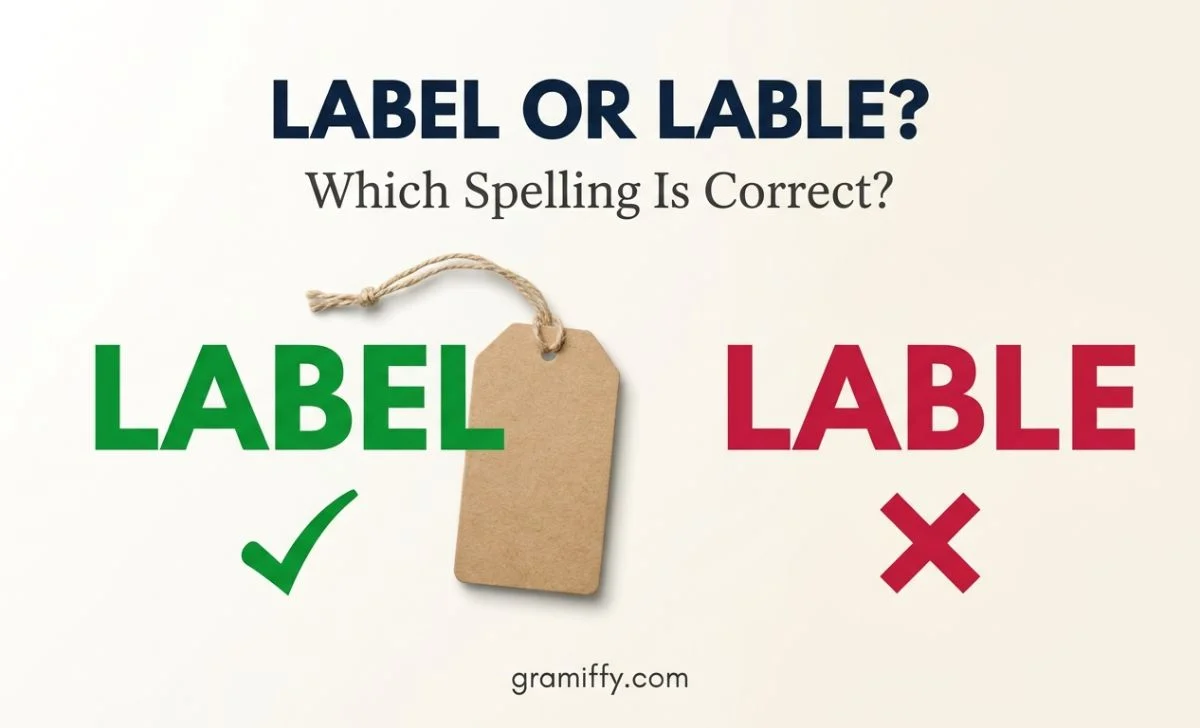
The correct spelling is label, while lable is a common mistake. But why does this confusion happen, and how can you avoid it? Let’s settle the question once and for all.
Quick Answer: Label or Lable?
Label is the correct spelling. Lable is incorrect in standard English.
A label is a tag, sticker, name, or description used to identify or provide information about something.
It can also function as a verb meaning to attach identifying information or classify someone or something.
| Spelling | Correct or Incorrect? | Explanation |
|---|---|---|
| Label | Correct | Standard English spelling |
| Lable | Incorrect | Common spelling mistake |
Correct: Please check the label before washing the shirt.
Incorrect: Please check the lable before washing the shirt.
Remember: Always write label, with an E before the final L.
What Does Label Mean?
The word label has several related meanings. It generally refers to something that identifies, describes, or classifies an object, person, or idea.
It can function as both a noun and a verb.
1. Label as a Noun
As a noun, a label is a piece of paper, fabric, plastic, or another material attached to an item to provide information.
It may display a product’s name, ingredients, price, instructions, manufacturer, or other identifying details.
Examples:
- The clothing label explains how to wash the jacket.
- Always read the food label before purchasing a product.
- The shipping label contains the customer’s delivery address.
- I removed the price label from the gift.
- The medicine bottle has a warning label.
Label can also mean a descriptive name or category assigned to someone or something.
For example:
- She dislikes the label people have given her.
- The company operates under an independent record label.
- Calling someone a failure is an unfair label.
In these examples, label refers to a description or classification rather than a physical sticker.
2. Label as a Verb
As a verb, label means to attach a tag, identify something, or describe and classify a person or object.
It is commonly used in education, business, science, packaging, and everyday communication.
Examples:
- Please label each box before moving it.
- The teacher asked students to label the diagram.
- Workers label every package before shipping.
- We should label the files according to their dates.
- People sometimes label others without understanding their circumstances.
The word can also describe assigning a particular category or identity.
For instance, a newspaper might label a decision controversial, or a researcher might label different groups for an experiment.
Why Is Lable Incorrect?
The confusion between label and lable mainly comes from the arrangement of the final two letters.
English contains many familiar words ending in -le, such as:
- Table
- Cable
- Stable
- Simple
- People
Because these spellings are familiar, some writers mistakenly assume that label follows the same pattern.
However, label ends in -el, not -le.
Compare:
- Label: L-A-B-E-L (Correct)
- Lable: L-A-B-L-E (Incorrect)
Another reason is pronunciation. When people say label quickly, its final syllable may sound similar to words with an ending such as -le. This can encourage incorrect spelling.
Fast typing, unfamiliarity with the word, and insufficient proofreading can also contribute to the mistake.
The important rule is simple: pronunciation does not always reveal the exact spelling of an English word.
Label vs Lable: Key Differences
Although the two spellings look similar, they do not have the same status in standard English.
| Feature | Label | Lable |
|---|---|---|
| Standard spelling | Yes | No |
| Accepted English word | Yes | No, as a spelling of label |
| Meaning | Tag, description, or classification | No standard meaning in this context |
| Noun usage | Correct | Incorrect |
| Verb usage | Correct | Incorrect |
| Formal writing | Acceptable | Avoid |
| Academic writing | Acceptable | Incorrect |
For example:
Correct: The teacher asked us to label the different parts of the plant.
Incorrect: The teacher asked us to lable the different parts of the plant.
The spelling mistake remains incorrect whether you use the word as a noun or a verb.
Is Label British or American English?
One interesting feature of this word is that label is spelled identically in British and American English.
Unlike colour/color, centre/center, and organise/organize, the base word does not change according to regional spelling preferences.
| English Variety | Correct Spelling | Example |
|---|---|---|
| British English | Label | Read the product label. |
| American English | Label | Read the product label. |
| Australian English | Label | Check the clothing label. |
| Canadian English | Label | Print the shipping label. |
However, some related forms do change.
Labelled or Labeled?
Both spellings are correct, but their regional preferences differ.
- Labeled: Preferred in American English.
- Labelled: Common in British English.
Examples:
American English: The workers labeled every package.
British English: The workers labelled every package.
Labeling or Labelling?
The same regional difference applies to the present participle.
- Labeling: American English.
- Labelling: British English.
Examples:
American English: The company is labeling its products.
British English: The company is labelling its products.
The important distinction is that both varieties retain the same base spelling: label.
Label or Lable in Everyday Sentences
Seeing the correct spelling in different situations can help you remember it.
Here are 12 practical examples:
- Always read the label before using a cleaning product.
- The manufacturer printed the ingredients on the food label.
- Please label your notebooks before the new school year.
- Every parcel needs a shipping label.
- The washing instructions are written on the clothing label.
- She removed the old label from the bottle.
- The teacher asked students to label the diagram.
- We use different labels to organize digital files.
- The company changed its brand label last month.
- He was unfairly given the label of a troublemaker.
- Please label all the containers before storing them.
- The warning label explains the potential risks of the product.
Notice that label works naturally as both a noun and a verb in these sentences.
Common Label Spelling Mistakes to Avoid
Even when writers know the correct base word, they sometimes make mistakes when adding endings.
Here are some common errors and their corrections:
| Incorrect | Correct |
|---|---|
| Lable | Label |
| Labled | Labeled / Labelled |
| Labling | Labeling / Labelling |
| Lables | Labels |
| Lableing | Labeling / Labelling |
| Labbelling | Labelling |
Remember that the correct form depends on the grammatical ending and, in some cases, the English variety.
For example, both labeled and labelled are correct. However, labled is not the standard spelling in either variety.
Easy Trick to Remember Label or Lable
Here’s a simple way to avoid this spelling mistake.
Remember the ending: E comes before L in label.
Break the word into two parts:
LA + BEL = LABEL
Think of the word label whenever you see a product tag, shipping sticker, or clothing information.
You can also use this simple comparison:
- Label = Correct
- Lable = Incorrect
If you’re unsure while writing, remember the final three letters: B-E-L.
This small trick can help you remember the correct letter arrangement without repeatedly checking a dictionary.
FAQs
1. Is it label or lable?
Label is the correct spelling in standard English. Lable is a common misspelling and should not be used in formal, academic, or professional writing.
2. Is lable a real English word?
Lable is not a standard English spelling of the word label. It generally appears as a typing or spelling mistake.
3. Is label spelled differently in British and American English?
No. Both British and American English use label. However, their preferred forms of related words differ. Americans generally write labeled and labeling, while British writers commonly use labelled and labelling.
4. What is the plural of label?
The plural of label is labels.
Example: The labels on these bottles are difficult to read.
5. How do you pronounce label?
Label is pronounced LAY-buhl, with two syllables.
Its IPA pronunciation is /ˈleɪ.bəl/.
The first syllable sounds like lay, while the second has a soft, unstressed vowel sound.
6. What is the difference between a label and a tag?
Both words can refer to something attached to an object to identify or describe it. However, a label often provides specific information, such as ingredients or instructions, while a tag can simply identify an item or display a name or price.
Test Your Knowledge: Label or Lable?
Let’s see whether you can identify the correct spelling in different situations.
Choose the correct option:
- Please check the product (label/lable) before buying it.
- The company (labeled/labled) every package.
- She attached a price (lable/label) to the shirt.
- We are (labelling/labling) the storage boxes.
- Every bottle needs a clear (label/lable).
Answers:
- Label
- Labeled
- Label
- Labelling
- Label
Remember that labeled and labelling follow different regional spelling conventions, but both are correct.
Final Verdict: Label or Lable?
The answer is straightforward: label is correct, while lable is incorrect in standard English.
Use label when referring to a product tag, identifying sticker, descriptive name, or the act of marking and classifying something.
The base spelling remains the same in British, American, Australian, and Canadian English.
The only regional differences appear in certain related forms, such as labeled/labelled and labeling/labelling.
If you remember one thing from this guide, make it this: Label ends in E-L, not L-E. Keep that simple rule in mind, and you’ll avoid this common spelling mistake in everyday, academic, and professional writing.
Read More:

Hi, I’m Safdar Ali, an English language teacher with 26 years of teaching experience. My expertise is in English linguistics, grammar, and the differences between British and American English.
Through Gramiffy, I share practical, research-based guides to help students, writers, and English learners improve their language skills. My goal is to make English simple, accurate, and easy for everyone to understand.