Laser and lazer sound exactly the same, so it is easy to wonder whether both spellings are correct.
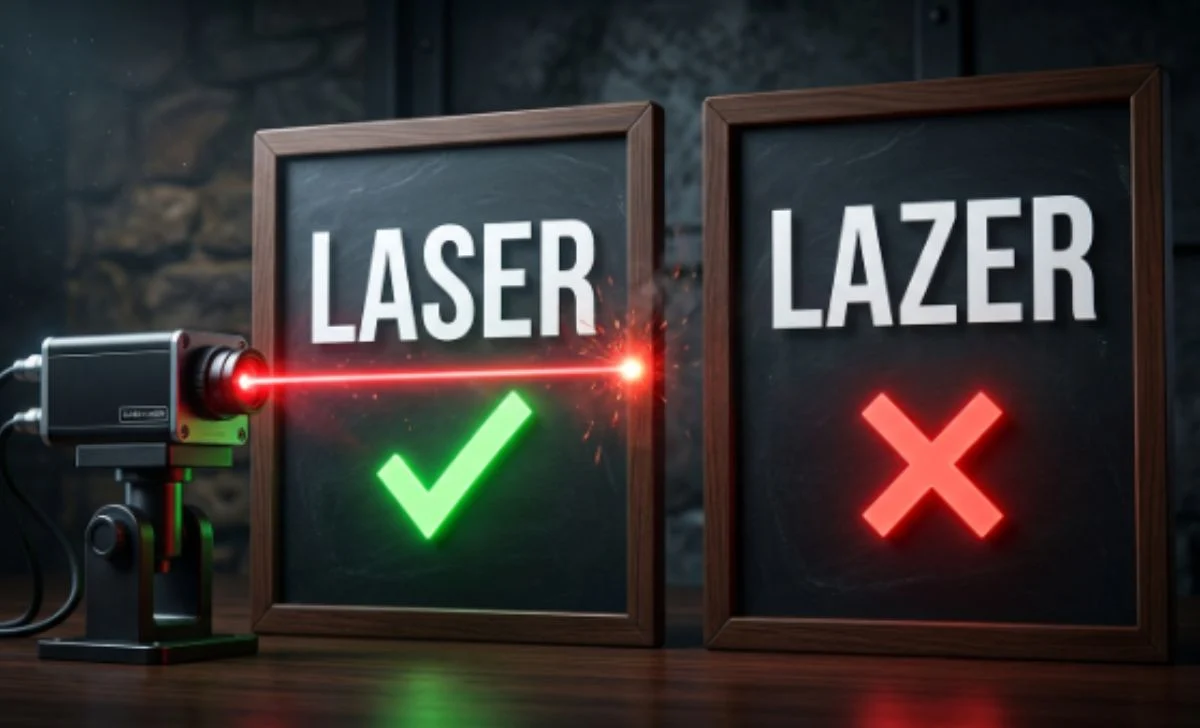
In standard modern English, laser is the correct spelling for the technology, device, or beam of concentrated light. Lazer is generally a misspelling, although it can appear in names, branding, or informal contexts.
If you’re writing an article, school assignment, technical document, or professional email, use laser.
Laser or Lazer? The Quick Answer
Laser is the standard and correct spelling.
| Word | Standard spelling? | Meaning |
|---|---|---|
| Laser | ✅ Yes | A device that produces a concentrated beam of light |
| Lazer | ❌ Usually no | Common misspelling of laser |
The simple rule
If you mean the technology or beam of concentrated light, write:
laser ✅
Not:
lazer ❌
Examples
- The doctor used a laser to treat the condition.
- The printer uses laser technology.
- A red laser beam appeared across the room.
What Does “Laser” Mean?
Laser is a noun that refers to a device that produces a narrow, concentrated beam of light.
The word laser is also used as an adjective in compounds describing things that use this technology.
As a noun
- The engineer tested the laser.
- The laser produced a bright green beam.
- Never look directly into a powerful laser.
In compound terms
You will see laser in many technical and everyday expressions:
- laser beam
- laser printer
- laser pointer
- laser treatment
- laser cutting
- laser surgery
- laser scanner
- laser technology
- laser light
The spelling remains laser in all of these expressions.
What Does “Lazer” Mean?
Lazer is generally a misspelling of laser.
It is sometimes used intentionally in:
- brand names
- product names
- usernames
- company names
- fictional names
- informal writing
But that does not make it the standard spelling of the technology.
For formal English, write:
❌ lazer printer
✅ laser printer
❌ lazer beam
✅ laser beam
❌ lazer treatment
✅ laser treatment
Why Is It “Laser” and Not “Lazer”?
The spelling comes from the original scientific acronym:
LASER = Light Amplification by Stimulated Emission of Radiation
The word was formed from the initial letters of that phrase.
Because the original term contains the letter S in Stimulated, the established spelling became laser, not lazer.
This is also why changing the s to z is not simply an alternative spelling.
How Do You Pronounce Laser?
Laser is pronounced:
/ˈleɪzər/
Simple pronunciation:
LAY-zər
The important detail is that the s in laser is pronounced like a z.
So:
laser → LAY-zər
This explains why people sometimes spell it lazer. They hear a /z/ sound and naturally assume the word should contain z.
But English spelling does not always match pronunciation letter-for-letter.
| Word | Spelling | Pronunciation |
|---|---|---|
| Laser | L-A-S-E-R | LAY-zər |
| Lazer | L-A-Z-E-R | Usually intended to sound like LAY-zər |
Singular and Plural Forms
Singular
laser
Example:
The technician adjusted the laser.
Plural
lasers
Example:
The laboratory uses several lasers.
Other forms
| Form | Example |
|---|---|
| Singular noun | laser |
| Plural noun | lasers |
| Adjective | laser |
| Common compound | laser beam |
| Related verb | lasered |
The verb laser is less common than the noun, but it can be used in contexts where something is treated or processed with a laser.
Synonyms and Related Terms
There is no perfect synonym for laser because it refers to a specific technology. However, depending on context, related terms include:
- light source
- optical device
- laser beam
- focused light
- coherent light source
- optical technology
Be careful with these terms because they do not always mean exactly the same thing.
A laser is a specific type of light-producing technology, not simply any bright light.
Antonyms
Laser does not have a true antonym because it is the name of a technology.
However, when discussing light, contrasting concepts might include:
- darkness
- ordinary light
- unfocused light
- diffuse light
These are contextual contrasts rather than dictionary antonyms.
American vs British English
There is no American-British spelling difference between laser and lazer.
Both American and British English use:
laser ✅
| Usage | American English | British English |
|---|---|---|
| Laser technology | laser | laser |
| Laser beam | laser | laser |
| Laser printer | laser | laser |
| Lazer as standard spelling | ❌ | ❌ |
So changing from laser to lazer is not like changing color to colour or organize to organise.
Those are legitimate regional spelling differences.
Laser vs lazer is different: laser is the standard spelling in both varieties.
Where Did the Word “Laser” Come From?
Laser is a modern scientific term formed from an acronym.
It comes from:
Light Amplification by Stimulated Emission of Radiation
The technology developed from scientific work on stimulated emission and related optical research during the 20th century.
The acronym LASER became a word in its own right, and lowercase laser is now standard in ordinary writing.
This origin gives us a useful spelling clue:
Stimulated → S → laser
Grammar Rules for Using “Laser”
Use “laser” as a noun
When referring to the device or technology, use laser.
- The technician switched on the laser.
- The laser produces a narrow beam.
Use “laser” in compound nouns
Many technical terms use laser before another noun.
- laser printer
- laser beam
- laser pointer
- laser scanner
- laser treatment
Use “lasers” for more than one
- The laboratory has three lasers.
- Different lasers produce different wavelengths.
Do not change “s” to “z”
The pronunciation does not justify spelling the word lazer.
Compare:
laser → pronounced with a /z/ sound
English contains many words where s can represent a /z/ sound.
So pronunciation alone is not a reliable way to choose the spelling.
Laser in Everyday Life
You may encounter lasers far more often than you realize.
Laser pointers
Teachers, presenters, and speakers sometimes use a laser pointer to highlight information on a screen.
Laser printers
A laser printer uses laser technology in the printing process and is widely used in offices and homes.
Barcode scanners
Many scanning systems use laser or optical technology to read information.
Medical treatment
Lasers are used in various medical and surgical applications.
Manufacturing
Industries use lasers for tasks such as cutting, engraving, welding, and measurement.
Communication
Laser technology also plays an important role in some optical communication systems.
Common Mistakes
Mistake 1: Writing “lazer technology”
❌ Lazer technology is changing medicine.
✅ Laser technology is changing medicine.
Mistake 2: Writing “lazer beam”
❌ The lazer beam was very bright.
✅ The laser beam was very bright.
Mistake 3: Assuming the pronunciation determines the spelling
This is probably the biggest reason people write lazer.
The word sounds like it contains a z, but the established spelling is laser.
Think of it this way:
Hear Z, write S.
Mistake 4: Treating “lazer” like a British spelling
It isn’t.
Laser is standard in both British and American English.
A Simple Memory Trick
Remember the acronym:
LASER
Light
Amplification by
Stimulated
Emission of
Radiation
The S in Stimulated gives you the S in LASER.
So:
LASER = Light + S…
Not:
LAZER
Another quick trick:
The laser has an S, even though it sounds like Z.
Practice Exercise
Choose laser or lazer.
1.
The doctor used a ______ during the procedure.
2.
He bought a red ______ pointer.
3.
The factory uses ______ technology to cut metal.
4.
The laboratory has several powerful ______.
5.
The ______ beam was visible in the dark room.
Answers
- laser ✓
- laser ✓
- laser ✓
- lasers ✓
- laser ✓
Google People Also Ask
Is it laser or lazer?
Laser is the correct standard spelling. Lazer is generally a misspelling, although it may appear in brand names or informal contexts.
Why is laser spelled with an S?
Because laser comes from the acronym Light Amplification by Stimulated Emission of Radiation. The S comes from Stimulated.
Is lazer a correct word?
Lazer is not the standard spelling for the technology. It can occur as a proper name, brand, or intentional spelling, but formal English uses laser.
Is laser British or American spelling?
Laser is standard in both British and American English.
How do you pronounce laser?
Laser is pronounced approximately LAY-zər, /ˈleɪzər/. The s sounds like z.
What is the plural of laser?
The plural is lasers.
What does LASER stand for?
LASER stands for Light Amplification by Stimulated Emission of Radiation.
Frequently Asked Questions
Is “lazer” ever acceptable?
It can be acceptable as a deliberate name, brand, username, or creative spelling. But when you’re writing about the actual technology, laser is the standard form.
Is “laser” a noun?
Yes. It is primarily a noun referring to a device or technology that produces a concentrated beam of light.
Can laser be used as an adjective?
Yes. It frequently appears in compound terms such as laser printer, laser beam, and laser treatment.
What is the past tense of laser?
Lasered can be used as the past tense when laser functions as a verb.
Example:
The material was lasered into a precise shape.
Why do people spell laser as lazer?
The most likely reason is pronunciation. The s in laser represents a /z/ sound, so people may naturally assume the word should be spelled with z.
Is “lazer” a common spelling mistake?
Yes. Lazer is a recognizable misspelling of laser, especially because the pronunciation can make the z spelling seem logical.
Final Verdict
If you’re choosing between laser vs lazer, use laser in standard English. The word refers to a technology that produces a concentrated beam of light and comes from the acronym Light Amplification by Stimulated Emission of Radiation.
Although it is pronounced with a z sound, its established spelling contains an s.
Laser = correct
Lazer = usually a misspelling
The easiest rule to remember is:
It sounds like Z, but it is spelled with S: LASER.
Read More:

Hi, I’m Safdar Ali, an English language teacher with 26 years of teaching experience. My expertise is in English linguistics, grammar, and the differences between British and American English.
Through Gramiffy, I share practical, research-based guides to help students, writers, and English learners improve their language skills. My goal is to make English simple, accurate, and easy for everyone to understand.