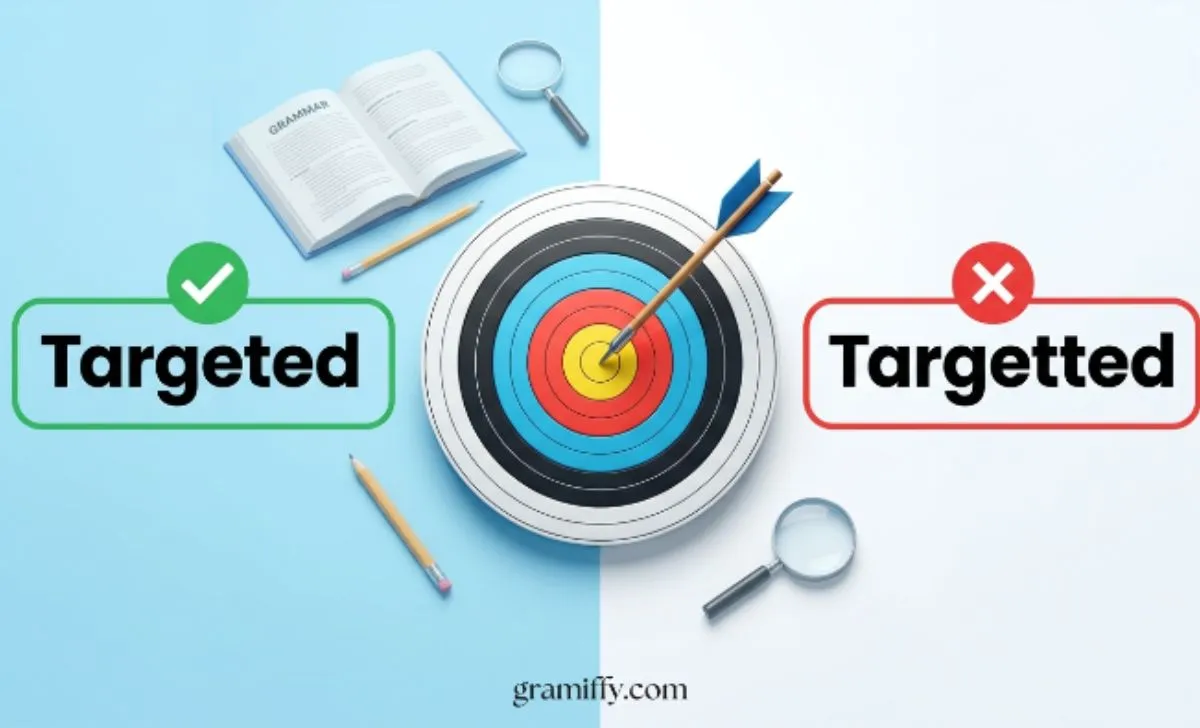
The Day I Realized I Had Been Spelling “Targeted” Wrong
A few years ago, I was proofreading one of my blog posts before publishing it. Everything looked perfect until my spell checker highlighted the word “targetted.”
At first, I ignored it because I was sure I had spelled it correctly. After all, the base word “target” ends with t, so adding -ed seemed like it should naturally become “targetted.”
Curious, I checked several dictionaries and grammar guides. To my surprise, almost every trusted source preferred “targeted” with just one extra “t.”
That simple discovery made me realize why so many writers, students, marketers, and English learners search questions like “Targetted or Targeted?”, “Is targetted correct?”, or “Why is targeted spelled with one t?”
The confusion is understandable because English spelling rules are not always consistent. Some words double the final consonant before adding -ed, while others do not. Without knowing the rule, it’s easy to choose the wrong spelling.
In this complete guide, I’ll explain everything you need to know about targetted or targeted, including the correct spelling, grammar rules, pronunciation, meaning, American and British English usage, dictionary recommendations, real life examples, marketing terms like targeted advertising and targeted audience, common mistakes, and much more. By the end, you’ll know exactly which spelling to use and why.
Targetted or Targeted: Quick Answer
If you’re looking for the short answer, here it is:
✅ Targeted is the correct and standard spelling in modern English.
❌ Targetted is generally considered a misspelling and is not recommended in professional, academic, or business writing.
Whether you’re writing an email, blog post, marketing campaign, research paper, or social media content, targeted is the spelling you should use.
Quick Comparison Table
| Spelling | Correct? | Recommendation |
|---|---|---|
| Targeted | ✅ Yes | Standard spelling |
| Targetted | ❌ No (generally) | Avoid in writing |
Quick Example
✅ Our company launched a targeted marketing campaign.
✅ The police conducted a targeted investigation.
❌ The company launched a targetted campaign.
For almost every writing situation, targeted is the safest and most widely accepted choice.
What Does “Targeted” Mean?
The word targeted describes something that is directed toward a specific person, group, goal, or objective rather than everyone.
In simple English:
Targeted means focused on a particular person, audience, place, or purpose.
It is commonly used in:
- Marketing
- Advertising
- Education
- Healthcare
- Business
- Technology
- Government
- Military discussions
- Research
Simple Definition
Targeted (adjective or past participle):
Directed at a specific person, group, object, or purpose.
Easy Examples
- The company created a targeted advertising campaign.
- Teachers provided targeted support for struggling students.
- Doctors developed targeted treatments for certain diseases.
- Police carried out a targeted operation.
- The email was targeted at existing customers.
In every example, the action is focused on a particular audience or objective.
Target Meaning in English
To understand targeted, it’s helpful to understand the base word target.
A target is:
- A person you want to reach.
- A goal you want to achieve.
- An object you aim at.
- A specific audience or customer group.
Examples:
- Sales target
- Business target
- Target audience
- Target market
- Target customer
- Target score
When you add -ed, the word becomes targeted, meaning it has already been directed toward a specific target.
Targetted or Targeted: Which Spelling Is Correct?
This is the question most people search for.
The answer is simple:
✅ Targeted is the correct spelling.
Although targetted occasionally appears on websites or in user-generated content, it is generally treated as a spelling mistake rather than a standard English word.
Trusted dictionaries, style guides, publishers, and professional editors overwhelmingly recommend targeted.
Comparison Table
| Feature | Targeted | Targetted |
|---|---|---|
| Standard English | ✅ Yes | ❌ No |
| Dictionary preference | ✅ Yes | ❌ Rare or not preferred |
| Academic writing | ✅ Recommended | ❌ Avoid |
| Business writing | ✅ Recommended | ❌ Avoid |
| SEO writing | ✅ Recommended | ❌ Avoid |
If your goal is clear, professional communication, always choose targeted.
Why Is “Targeted” the Correct Spelling?
Many people think the word should become targetted because target ends with the letter t.
However, English spelling follows specific word-formation rules.
The verb target simply takes the suffix -ed without doubling the final consonant.
That produces:
- Target
- Targets
- Targeting
- Targeted
This spelling has become the accepted standard across dictionaries, publishers, universities, and businesses.
Is “Targetted” Ever Correct?
This is another common Google search.
The short answer is:
Not in standard modern English.
You may occasionally find targetted in:
- Old documents
- Typographical errors
- Informal online posts
- User generated content
However, it is not the preferred spelling in reputable dictionaries or professional writing.
If you’re writing:
- A school assignment
- A university paper
- A business report
- A blog article
- Website content
- Marketing copy
- An email
always use:
✅ Targeted
Why Do People Write “Targetted”?
The confusion happens because English contains many verbs that double the final consonant before adding -ed.
Examples include:
- Stop → Stopped
- Plan → Planned
- Admit → Admitted
- Refer → Referred
People naturally assume target follows the same rule.
Fortunately, it doesn’t.
That is why many writers accidentally type:
❌ Targetted
instead of:
✅ Targeted
Verb Forms of “Target”
Understanding every form of the verb makes spelling much easier.
| Verb Form | Correct Word |
|---|---|
| Base verb | Target |
| Third-person singular | Targets |
| Present participle | Targeting |
| Past tense | Targeted |
| Past participle | Targeted |
Notice that every official form uses targeted, never targetted.
Targeted in Everyday English
The word targeted appears in many situations beyond grammar lessons.
For example, businesses use targeted advertising to reach potential customers.
Teachers provide targeted instruction to students who need additional support.
Doctors may recommend targeted treatments designed for specific medical conditions.
Technology companies create targeted recommendations based on user preferences.
Governments sometimes introduce targeted policies to help particular communities.
Although these contexts are very different, the meaning remains the same:
something carefully directed toward a specific goal or audience.
Common Situations Where “Targeted” Is Used
| Situation | Example |
|---|---|
| Marketing | Targeted advertising |
| Business | Targeted campaign |
| Education | Targeted instruction |
| Healthcare | Targeted therapy |
| Technology | Targeted recommendations |
| Email Marketing | Targeted email campaigns |
| Social Media | Targeted content |
| Government | Targeted assistance |
| Research | Targeted study |
| Security | Targeted investigation |
This widespread usage is another reason why learning the correct spelling is so important.
Pronunciation of Targeted
Before learning the grammar rules, it’s helpful to know how the word is pronounced. Surprisingly, many English learners know the correct spelling but aren’t sure how to say it naturally.
The word targeted is pronounced:
TAR-guh-tid
IPA (International Phonetic Alphabet):
/ˈtɑːrɡɪtɪd/ (British English)
/ˈtɑːrɡətɪd/ (American English)
Although American and British speakers may pronounce some vowels slightly differently, the pronunciation is almost identical.
Pronunciation Table
| Word | Pronunciation | IPA |
|---|---|---|
| Target | TAR-git | /ˈtɑːrɡɪt/ |
| Targeting | TAR-git-ing | /ˈtɑːrɡɪtɪŋ/ |
| Targeted | TAR-guh-tid | /ˈtɑːrɡɪtɪd/ |
Notice that there is no pronunciation difference between the correct spelling and the common misspelling targetted. The difference exists only in writing.
American vs British English: Targetted or Targeted
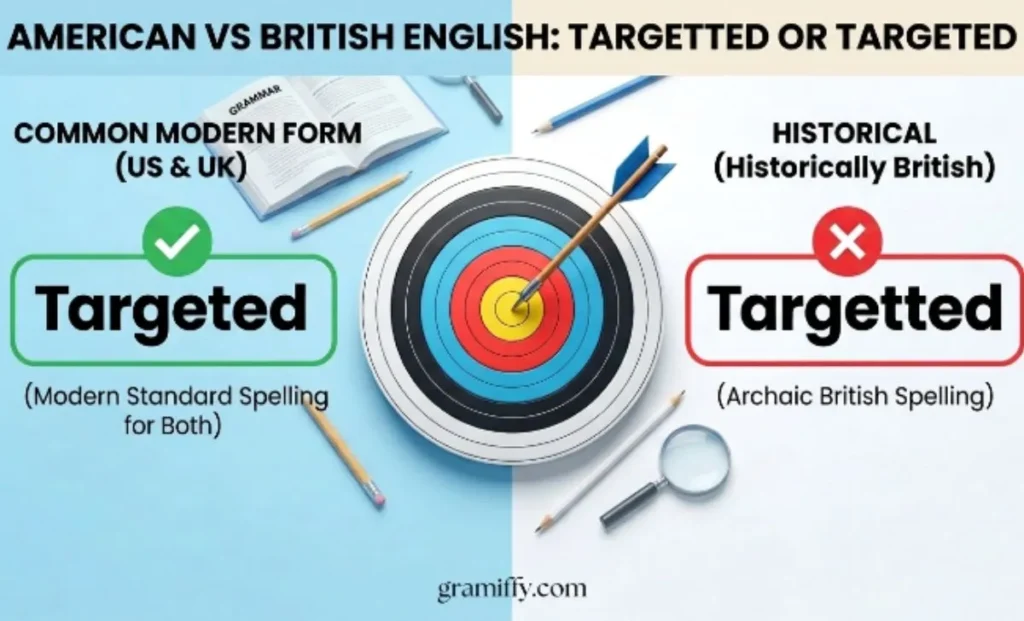
One of the biggest misconceptions is that targetted might be the British spelling while targeted is the American spelling.
This is not true.
Unlike words such as:
- Colour vs Color
- Honour vs Honor
- Jewellery vs Jewelry
- Travelling vs Traveling
both American English and British English overwhelmingly use the spelling:
✅ Targeted
There is no officially recognized British spelling “targetted.”
Comparison Table
| Feature | American English | British English |
|---|---|---|
| Preferred spelling | Targeted | Targeted |
| Targetted accepted? | No | No |
| Meaning | Same | Same |
| Pronunciation | Almost identical | Almost identical |
Whether you’re writing for readers in the United States, the United Kingdom, Canada, Australia, or New Zealand, targeted is the correct choice.
Why Do People Think “Targetted” Is British?
The confusion usually comes from other British spelling patterns.
For example:
| American | British |
|---|---|
| Traveled | Travelled |
| Labeled | Labelled |
| Modeled | Modelled |
| Canceled | Cancelled |
Because British English often doubles the letter l, many people assume it also doubles the t in target.
However, target does not follow that pattern.
Both major varieties of English write:
✅ Targeted
not
❌ Targetted
The Origin of the Word “Target”
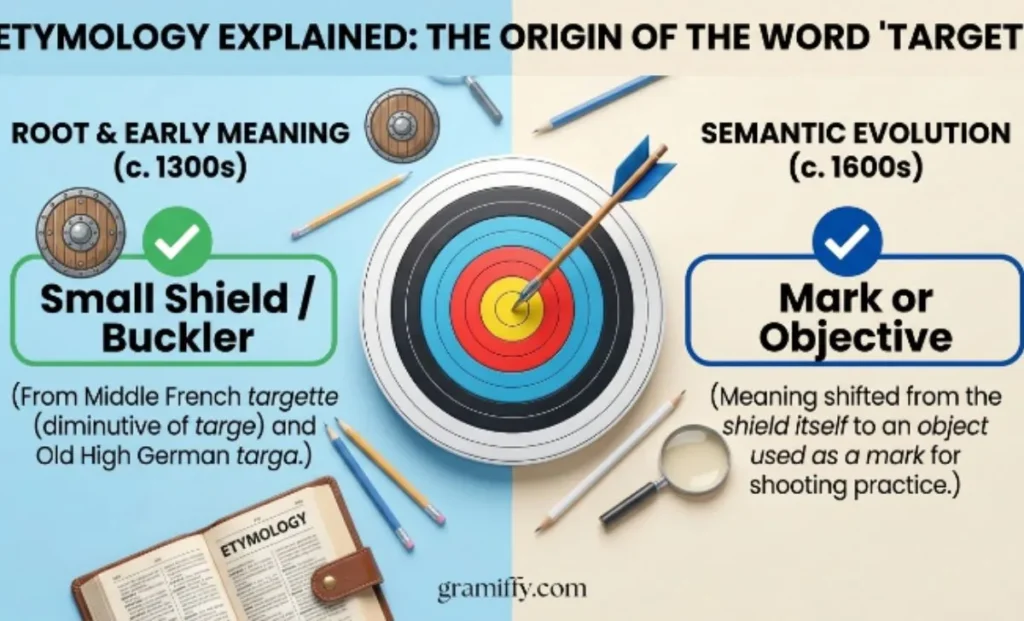
Understanding where the word came from makes its spelling easier to remember.
The word target entered English several centuries ago and originally referred to a shield or object used for aiming practice.
Over time, its meaning expanded.
Today, target can mean:
- A goal
- An objective
- A person or group being focused on
- An intended audience
- Something chosen for attention or action
Modern English uses the word in many fields, including business, education, healthcare, sports, technology, and marketing.
How the Word “Targeted” Developed
As English evolved, writers naturally formed the past tense and past participle by adding -ed to target.
The accepted form became:
- Target
- Targeting
- Targeted
Professional publishers, dictionaries, universities, and style guides standardized this spelling, which is why it appears consistently in modern English.
Why Doesn’t “Target” Become “Targetted”?
This is one of the most searched questions related to this keyword.
The answer lies in English spelling rules.
Many learners notice verbs like:
- Stop → Stopped
- Admit → Admitted
- Refer → Referred
These verbs double the final consonant before adding -ed.
So why doesn’t target become targetted?
Because target follows a different spelling pattern.
English only doubles the final consonant under certain conditions.
The Double Consonant Rule Explained
In general, a final consonant is doubled before adding -ed when:
- The word has one syllable and ends in a consonant.
Example:
| Base Word | Past Tense |
|---|---|
| Stop | Stopped |
| Drop | Dropped |
| Plan | Planned |
Or when a multi-syllable word has the stress on the final syllable.
Examples:
| Base Word | Past Tense |
|---|---|
| Admit | Admitted |
| Prefer | Preferred |
| Refer | Referred |
The verb target does not meet this condition because the primary stress falls on the first syllable, not the last.
That is why the correct spelling is:
✅ Targeted
instead of:
❌ Targetted
Grammar Rule Summary
| Question | Answer |
|---|---|
| Base word | Target |
| Past tense | Targeted |
| Past participle | Targeted |
| Double the final “t”? | No |
| Correct spelling | Targeted |
What Do Major Dictionaries Recommend?
Leading English dictionaries consistently recommend targeted as the standard spelling.
You will find targeted in trusted references published by:
- Merriam Webster
- Cambridge University Press
- Oxford University Press
- Collins Dictionary
These dictionaries are widely used by:
- Schools
- Universities
- Publishers
- Journalists
- Editors
- Professional writers
If you want your writing to look professional, following these standard references is the safest approach.
Targeted in Professional Writing
The word targeted appears frequently in many professional fields.
Marketing
- Targeted advertising
- Targeted campaigns
- Targeted promotions
Business
- Targeted strategy
- Targeted investment
- Targeted communication
Education
- Targeted instruction
- Targeted learning
- Targeted intervention
Healthcare
- Targeted therapy
- Targeted treatment
- Targeted medicine
Technology
- Targeted recommendations
- Targeted notifications
- Targeted content
Using the correct spelling is especially important in these industries because accuracy builds credibility.
Sentence Examples Using “Targeted”
Here are some natural examples from different contexts.
Business
- The company launched a targeted marketing campaign for young professionals.
- Our sales team developed a targeted strategy to reach new customers.
Education
- The teacher provided targeted support to students who needed extra practice.
- Schools often use targeted interventions to improve learning outcomes.
Healthcare
- Researchers developed targeted treatments for specific diseases.
- Doctors recommended a targeted therapy plan.
Technology
- The app delivers targeted recommendations based on user behavior.
- Customers receive targeted notifications according to their preferences.
Everyday English
- Police carried out a targeted investigation.
- The charity offered targeted financial assistance.
- The speaker delivered a targeted message to business owners.
Common Grammar Mistakes
Many writers accidentally make these errors.
Mistake 1
❌ Targetted
✅ Targeted
Mistake 2
❌ Targetted advertising
✅ Targeted advertising
Mistake 3
❌ Targetted audience
✅ Targeted audience
Mistake 4
❌ Targetted campaign
✅ Targeted campaign
Targetted vs Targeted: What’s the Difference?
If you’ve reached this point, you already know that targeted is the correct spelling. However, many people still wonder whether targetted has a different meaning or whether both words can be used interchangeably.
The simple answer is no.
Both spellings are intended to express the same idea—something directed toward a particular person, group, place, or objective. The difference is not in meaning but in correctness and standard usage.
Comparison Table
| Feature | Targeted | Targetted |
|---|---|---|
| Standard English spelling | ✅ Yes | ❌ No |
| Meaning | Directed toward a specific target | Same intended meaning |
| Dictionary preference | ✅ Preferred | ❌ Not preferred |
| Academic writing | ✅ Use | ❌ Avoid |
| Business writing | ✅ Use | ❌ Avoid |
| Marketing writing | ✅ Use | ❌ Avoid |
| SEO content | ✅ Use | ❌ Avoid |
| Professional emails | ✅ Use | ❌ Avoid |
For almost every writing situation, targeted is the only spelling you should use.
When Should You Use “Targeted”?
Because the word simply means focused on a particular target, it fits naturally into many different contexts.
You can use targeted whenever something is designed, planned, or directed toward a specific goal or audience.
Examples include:
- targeted advertising
- targeted audience
- targeted marketing
- targeted learning
- targeted treatment
- targeted campaign
- targeted support
- targeted communication
- targeted research
- targeted investment
Targeted Advertising
One of the most common phrases you’ll encounter is targeted advertising.
Instead of showing the same advertisement to everyone, businesses display ads to people who are most likely to be interested.
Example:
The company used targeted advertising to reach customers interested in fitness products.
Targeted Advertising Benefits
| Benefit | Explanation |
|---|---|
| Better audience reach | Ads appear to relevant people |
| Higher engagement | More users interact |
| Better conversion | Increased sales opportunities |
| Lower advertising costs | Less wasted spending |
Targeted Marketing
Another popular expression is targeted marketing.
This means creating marketing campaigns for a specific group instead of the general public.
Example:
The startup focused on targeted marketing for university students.
Examples of Targeted Marketing
| Industry | Example |
|---|---|
| Education | Students |
| Healthcare | Patients with specific conditions |
| Travel | Adventure travelers |
| Technology | Small businesses |
| Fashion | Teenagers |
| Finance | First time investors |
Targeted Audience
A targeted audience is the particular group a business or organization wants to reach.
For example:
A toy company might target:
- Parents
- Children
- Teachers
A software company may target:
- Developers
- Designers
- Business owners
Example sentence:
Knowing your targeted audience helps create more effective content.
Targeted Email Campaigns
Businesses often send targeted emails instead of one general email to everyone.
For example:
- Welcome emails
- Discount offers
- Birthday promotions
- Product recommendations
Example:
Customers received targeted emails based on their previous purchases.
Targeted Content
Content creators frequently develop targeted content for specific readers.
Examples:
- Beginner guides
- Expert tutorials
- Student resources
- Small business advice
Instead of writing for everyone, they write for one audience.
Targeted Communication
Organizations use targeted communication to deliver information to people who actually need it.
Examples include:
- Emergency alerts
- Employee updates
- Customer notifications
- Educational announcements
Targeted Learning
Schools and universities often provide targeted learning.
This means instruction is customized for students who need extra support.
Example:
The teacher created a targeted learning plan for struggling readers.
Targeted Support
Many organizations provide targeted support rather than general assistance.
Examples include:
- Academic support
- Financial assistance
- Career coaching
- Mental health services
- Technical help
Targeted Treatment
In healthcare, doctors may recommend targeted treatment for specific medical conditions.
Rather than using one treatment for every patient, targeted therapies focus on particular diseases or biological processes.
Example:
Researchers continue developing targeted treatments for various cancers.
Targeted Strategy
Businesses also use the phrase targeted strategy.
This means creating a plan for achieving a particular objective.
Example:
The company adopted a targeted strategy to increase customer retention.
Common Phrases With “Targeted”
| Phrase | Meaning |
|---|---|
| Targeted advertising | Ads shown to a selected audience |
| Targeted marketing | Marketing aimed at specific customers |
| Targeted campaign | Campaign focused on one audience |
| Targeted audience | Intended group of people |
| Targeted message | Message created for a specific audience |
| Targeted learning | Personalized education |
| Targeted therapy | Specialized medical treatment |
| Targeted support | Focused assistance |
| Targeted content | Content created for one audience |
| Targeted communication | Information sent to selected people |
Synonyms of Targeted
Although no synonym is identical in every situation, these words often express a similar idea.
Synonyms Table
| Synonym | Best Used For |
|---|---|
| Focused | Education, business |
| Directed | General writing |
| Intended | Plans and goals |
| Aimed | Marketing and communication |
| Specific | Everyday English |
| Customized | Products and services |
| Personalized | Customer experiences |
| Tailored | Business communication |
| Specialized | Healthcare and education |
| Purposeful | General writing |
Antonyms of Targeted
Opposite words help clarify the meaning.
| Antonym | Meaning |
|---|---|
| General | Not directed at one group |
| Broad | Covers many people |
| Universal | Intended for everyone |
| Random | Without a specific focus |
| Unfocused | Lacking direction |
| Generic | Not customized |
| Non-specific | No particular audience |
Targeted vs General
This comparison helps explain the meaning more clearly.
| Targeted | General |
|---|---|
| Specific audience | Everyone |
| Personalized | Standard |
| Higher relevance | Less personalized |
| Better engagement | Wider reach |
| Customized approach | One-size-fits-all |
Real Life Examples
Business
The company introduced a targeted campaign to attract small business owners.
Education
Teachers used targeted instruction to improve reading skills.
Healthcare
Scientists are researching targeted therapies for rare diseases.
Technology
Streaming platforms recommend targeted content based on viewing history.
Government
The government announced targeted financial support for affected communities.
Daily Conversation
She gave me targeted advice that solved my problem quickly.
Commonly Confused Words
Some learners confuse targeted with similar-looking words.
| Word | Meaning |
|---|---|
| Target | Goal or objective |
| Targeting | Directing toward someone |
| Targeted | Already directed toward a target |
| Target | Noun or verb depending on context |
Common Spelling Mistakes with Targeted
Even experienced writers occasionally misspell targeted because English spelling rules can be inconsistent. Most mistakes happen when people assume every verb ending in -t should double the final consonant before adding -ed.
Here are the mistakes you should avoid.
Mistake 1: Writing Targetted
❌ The company launched a targetted advertising campaign.
✅ The company launched a targeted advertising campaign.
Mistake 2: Writing Targetting
Many people also make this mistake.
❌ The company is targetting younger customers.
✅ The company is targeting younger customers.
Notice that the present participle also uses only one extra “t.”
Mistake 3: Mixing Both Spellings
Incorrect:
The company targeted one audience but later targetted another.
Correct:
The company targeted one audience but later targeted another.
Consistency matters in professional writing.
Mistake 4: Assuming Spell Check Is Wrong
Sometimes writers ignore spell-check suggestions because they believe targetted looks more logical.
In reality, modern spell checkers flag targetted because dictionaries recognize targeted as the standard spelling.
Why Native English Speakers Rarely Write “Targetted”
One reason targeted looks natural to native speakers is that they encounter it constantly.
You’ll see it in:
- Newspapers
- Business reports
- University textbooks
- Marketing articles
- Government publications
- Scientific journals
- News websites
- Company websites
Because readers see targeted every day, the alternative spelling immediately looks unusual.
Targeted in Different Types of Writing
One of the strengths of this word is its flexibility. It works naturally in many writing styles.
Academic Writing
Researchers often describe:
- targeted studies
- targeted interventions
- targeted research
- targeted analysis
Example:
The researchers conducted a targeted analysis of student performance.
Business Writing
Companies frequently use phrases like:
- targeted strategy
- targeted investment
- targeted growth
- targeted communication
Example:
The business adopted a targeted strategy to increase customer retention.
Marketing Writing
Perhaps no industry uses this word more than marketing.
Examples include:
- targeted ads
- targeted promotions
- targeted email campaigns
- targeted messaging
- targeted content
Example:
A targeted email campaign generated significantly higher engagement than a general newsletter.
Technology
Technology companies often personalize user experiences.
Examples:
- targeted recommendations
- targeted notifications
- targeted search results
- targeted content delivery
Example:
The platform provides targeted recommendations based on previous searches.
Healthcare
Modern medicine increasingly relies on personalized approaches.
Examples:
- targeted therapy
- targeted medicine
- targeted treatment
- targeted screening
Example:
Doctors recommended targeted therapy after reviewing the patient’s condition.
Education
Teachers frequently create learning plans for different students.
Examples:
- targeted instruction
- targeted support
- targeted assessment
- targeted learning activities
Example:
Students received targeted support before their final exams.
Daily Life Examples
The easiest way to remember the correct spelling is to see it in natural conversation.
Everyday Sentences
- My teacher gave me targeted feedback that improved my writing.
- Our manager shared a targeted plan for increasing sales.
- The charity provided targeted assistance to families in need.
- Police carried out a targeted investigation after receiving new evidence.
- The app sends targeted notifications based on my interests.
- We designed a targeted campaign for local customers.
- The coach developed targeted exercises to improve my performance.
- The government announced targeted financial support for small businesses.
- Our website attracts visitors through targeted SEO strategies.
- The recruiter contacted targeted candidates with relevant experience.
Incorrect vs Correct Examples
| Incorrect | Correct |
|---|---|
| Targetted marketing | Targeted marketing |
| Targetted audience | Targeted audience |
| Targetted emails | Targeted emails |
| Targetting customers | Targeting customers |
| Targetted campaign | Targeted campaign |
| Targetted strategy | Targeted strategy |
| Targetted advertising | Targeted advertising |
| Targetted support | Targeted support |
| Targetted treatment | Targeted treatment |
| Targetted communication | Targeted communication |
Professional Writing Tips
If you’re writing for work, school, or publication, these simple habits will help.
Always:
✔ Check trusted dictionaries when unsure.
✔ Proofread before publishing.
Avoid:
✘ Targetted
✘ Mixing spellings in the same article
Quick Grammar Checklist
| Question | Correct Answer |
|---|---|
| Correct spelling | Targeted |
| Common mistake | Targetted |
| Present participle | Targeting |
| Past tense | Targeted |
| Past participle | Targeted |
| Formal writing | Targeted |
| Business writing | Targeted |
| Academic writing | Targeted |
FAQs
Is Targetted a Real Word?
It occasionally appears in older texts or user-generated content, but it is not the standard spelling in modern English. Most dictionaries and style guides recommend targeted.
Is Targeted Correct?
Yes. Targeted is the correct spelling in both American and British English.
Which Spelling Should Students Use?
Students should always write targeted, especially in assignments, exams, research papers, and academic writing.
Which Spelling Should Bloggers Use?
Bloggers and content creators should consistently use targeted because it is the accepted standard and matches user expectations.
Which Spelling Should Businesses Use?
Businesses should always use targeted in:
- Reports
- Emails
- Advertisements
- Marketing campaigns
- Product descriptions
- Websites
Professional communication depends on correct spelling.
Is There Any Difference in Meaning?
No.
Both spellings are intended to express the same meaning, but only targeted is considered standard English.
Why Is “Targeted” So Common in Marketing?
Marketing focuses on reaching specific customers rather than everyone.
That’s why you’ll often hear phrases like:
- targeted audience
- targeted campaign
- targeted content
- targeted email
- targeted advertising
Each describes communication aimed at a clearly defined group.
Can I Use “Targetted” in Formal Writing?
No.
If you want your writing to appear professional and credible, use targeted.
Is “Targeted” Used in British English?
Yes.
British English and American English both use targeted as the preferred spelling.
Does Google Prefer “Targeted”?
People search for both spellings because of the confusion, but authoritative content should explain the difference and consistently use targeted as the correct form while mentioning targetted only for comparison.
Final Comparison Table
| Feature | Targeted | Targetted |
|---|---|---|
| Correct spelling | ✅ | ❌ |
| Used in dictionaries | ✅ | Rare/Not preferred |
| Used by publishers | ✅ | ❌ |
| Used in education | ✅ | ❌ |
| Used in business | ✅ | ❌ |
| Used in marketing | ✅ | ❌ |
| Used in professional writing | ✅ | ❌ |
| Recommended for SEO | ✅ | ❌ |
People Also Ask
These are some of the most common questions people search for about targetted or targeted. The answers are written in a featured snippet style to help you quickly find the information you need.
Is “Targeted” or “Targetted” Correct?
Targeted is the correct spelling in modern English. It is the standard form used in American English, British English, dictionaries, academic writing, business communication, and professional publishing. Targetted is generally considered a misspelling and should be avoided.
Why Is It Spelled “Targeted” Instead of “Targetted”?
The verb target follows the standard English pattern of adding -ed without doubling the final t. Although some English verbs double the last consonant before adding -ed, target is not one of them.
Is “Targetted” Ever Accepted?
You may occasionally find targetted in old documents, online forums, or user-generated content, but it is not the preferred spelling in modern English.
If you’re writing professionally, always use targeted.
Is “Targeted” Used in British English?
Yes.
One of the biggest myths is that targetted is the British spelling. It isn’t.
Both American and British English use:
✅ Targeted
Is “Targetting” Correct?
No.
Just as targetted is incorrect, targetting should also be avoided.
Correct forms include:
- Target
- Targets
- Targeting
- Targeted
Targeted vs Similar Words
Sometimes learners confuse targeted with other words beginning with target. Here’s a quick comparison.
| Word | Meaning |
|---|---|
| Target | A goal, objective, or person at whom something is directed |
| Targets | Present tense verb or plural noun |
| Targeting | The act of directing toward a specific goal |
| Targeted | Directed toward a specific audience or objective |
Each form has a different grammatical role, but only targeted is the correct past tense and past participle.
Memory Trick to Remember the Correct Spelling
If you often forget whether it’s targeted or targetted, try this simple trick:
Think of “marketed.”
Both words end in -eted.
- Market → Marketed
- Target → Targeted
Neither doubles the final t.
This simple comparison makes the correct spelling much easier to remember.
Quick Grammar Cheat Sheet
| Question | Answer |
|---|---|
| Correct spelling | Targeted |
| Incorrect spelling | Targetted |
| Present tense | Target |
| Present participle | Targeting |
| Past tense | Targeted |
| Past participle | Targeted |
| American English | Targeted |
| British English | Targeted |
Related Grammar Topics
If you’re learning English spelling, you may also find these commonly confused words helpful:
| Common Confusion | Correct Form |
|---|---|
| Travelled or Traveled | Depends on regional English |
| Labelled or Labeled | Depends on regional English |
| Cancelled or Canceled | Depends on regional English |
| Focused or Focussed | Focused is generally preferred |
| Targetted or Targeted | Targeted |
Learning these patterns will improve both your grammar and your confidence as a writer.
Who Should Use “Targeted”?
The correct spelling is important for many different people.
Students
Assignments, essays, reports, and exams should always use targeted.
Bloggers
Using the correct spelling improves professionalism and builds reader trust.
Copywriters
Marketing copy often includes phrases such as:
- targeted audience
- targeted campaign
- targeted messaging
- targeted content
Using the standard spelling maintains credibility.
Business Professionals
Reports, proposals, presentations, emails, and client communications should consistently use targeted.
Best Practices for Using “Targeted”
Follow these simple guidelines whenever you write.
Do
- Use targeted in all formal writing.
- Proofread before publishing.
- Follow trusted dictionaries and style guides.
- Keep the spelling consistent throughout your document.
Don’t
- Use targetted in professional writing.
- Assume British English uses a different spelling.
- Ignore spell-check suggestions without checking reliable sources.
Final Summary Table
| Topic | Answer |
|---|---|
| Correct spelling | Targeted |
| Common misspelling | Targetted |
| Meaning | Directed toward a specific goal or audience |
| American English | Targeted |
| British English | Targeted |
| Formal writing | Use targeted |
| Academic writing | Use targeted |
| Business writing | Use targeted |
| Marketing writing | Use targeted |
Final Thoughts
English spelling can be confusing, especially when similar words follow different patterns. It’s easy to understand why many people type targetted after all, verbs like stopped, planned, and admitted double their final consonant before adding -ed.
However, target follows a different rule. In modern English, the correct past tense and past participle are targeted, not targetted.
Whether you’re writing a school assignment, a business report, a blog post, an email, or a marketing campaign, targeted is the spelling you should use with confidence.
It’s the form recommended by major dictionaries, trusted by editors, and recognized by readers around the world.
Whenever you’re unsure, remember this simple rule:
Target → Targeted
No extra t required.
Mastering this small spelling difference will make your writing clearer, more professional, and more credible whether you’re a student, writer, marketer, or English learner.
Read More:

I am Constance Hale, an, editor, and writing expert dedicated to helping people write with clarity and confidence. Through my articles on Gramiffy.com, I simplify grammar, spelling, and language usage for readers of all levels. My goal is to make English writing more engaging, accurate, and enjoyable.