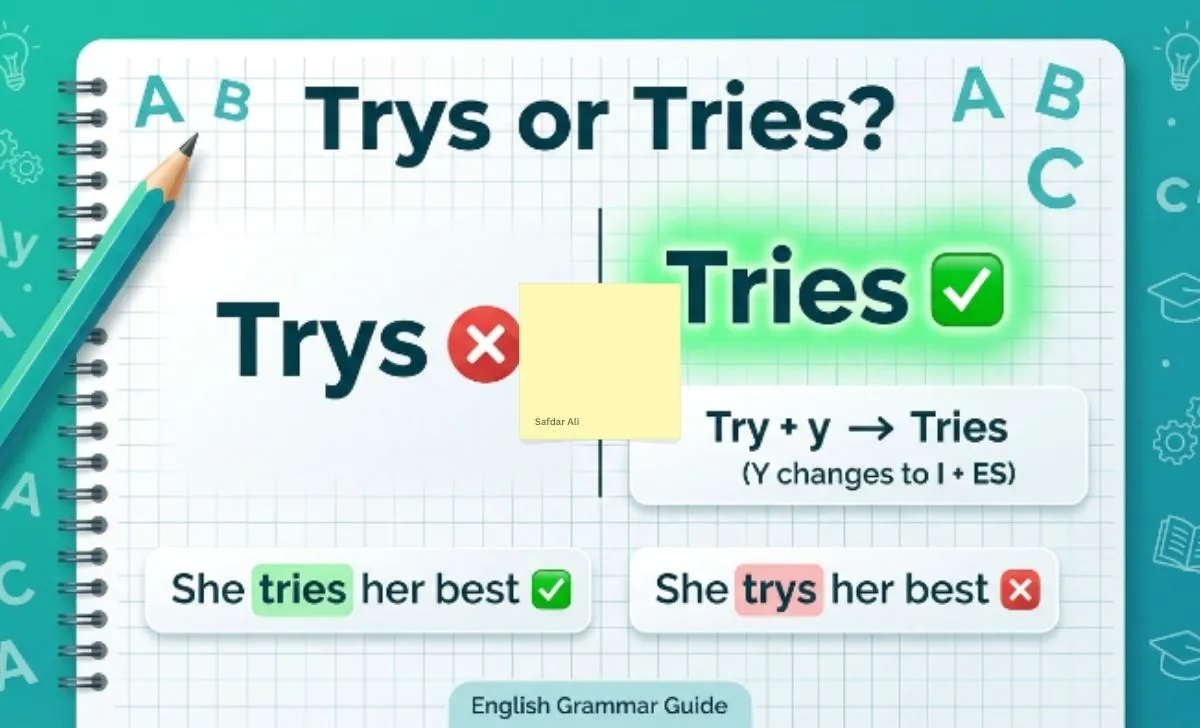
Have you ever paused while writing and wondered whether it should be “trys or tries”? This is one of the most common English spelling mistakes made by learners, students, and even native speakers in casual writing.
The confusion happens because English often feels simple—just add “s” for present tense. But verbs ending in “y” follow a special rule, and that is where most people make mistakes.
Many users search this keyword because they want a quick correct answer, a simple grammar rule, and easy examples they can remember while writing emails, essays, or social media posts.
They are not just asking for spelling—they want to understand why one form is correct and the other is wrong.
In this guide, you will learn the correct spelling, the grammar rule behind it, common mistakes, memory tricks, and real-life examples. By the end, you will never confuse “trys” and “tries” again.
Quick Answer
Correct spelling: ✔ tries
Incorrect spelling: ✘ trys
When the subject is he, she, or it, the verb “try” becomes “tries” in present tense.
Simple Rule
👉 try → tries
👉 cry → cries
👉 fly → flies
Examples
✔ He tries to learn English every day.
✔ She tries her best in exams.
✔ It tries to work properly after update.
❌ He trys to learn English. (Wrong)
Why “Try” Becomes “Tries” (Grammar Rule Explained)
This rule comes from English Grammar and specifically from Third Person Singular Present.
The Rule
When a verb ends in consonant + “y”, we:
- Remove “y”
- Add “ies”
Examples
- try → tries
- cry → cries
- carry → carries
- study → studies
Why “Trys” is Wrong
“Trys” ignores this rule and incorrectly adds just “s”, which does not follow standard English grammar rules.
Origin of the Confusion (Why People Write “Trys”)
The mistake happens because:
- Many verbs simply add “s” (play → plays)
- Learners apply the same rule to all verbs
- “Try” looks like a normal verb, but it follows a special pattern
This is a common issue in ESL (English learning) and writing practice.
British English vs American English
Good news: there is no difference between British and American English for this rule.
Both follow the same grammar system:
| Base Verb | Correct Form | Incorrect Form |
|---|---|---|
| try | tries | trys ❌ |
| cry | cries | crys ❌ |
| study | studies | studys ❌ |
So whether you write in the UK, US, Canada, or Australia, the rule remains the same.
Which Form Should You Use?
Always use “tries” in:
- Academic writing
- Emails
- Job applications
- Exams
- Blogs and articles
- Social media posts
❌ Never use “trys” in any formal or informal correct English writing.
Common Mistakes with Trys or Tries
Mistake #1: Adding “s” directly
❌ She trys hard
✔ She tries hard
Mistake #2: Ignoring “y → ies” rule
❌ He trys to help
✔ He tries to help
Mistake #3: Overgeneralizing verb rules
❌ Every verb just gets “s”
✔ Verbs ending in “y” change differently
Trys or Tries in Real-Life Examples
Email Example
✔ I hope he tries to complete the task today.
Academic Example
✔ The student tries to improve his writing skills.
Social Media Example
✔ She always tries her best 💪
Formal Report Example
✔ The system tries to reconnect automatically.
Memory Trick (Easy Way to Remember)
👉 Think of it like this:
“Y changes to I before ES”
✔ try → tries
✔ cry → cries
✔ fly → flies
Once you remember this pattern, you will never make this mistake again.
Trys or Tries – Google Trends Insight
Search data shows:
- “tries” = correct form used globally
- “trys” = mostly searched as a mistake query
- High traffic comes from English learners (ESL users)
This shows strong educational intent, not native usage confusion.
Trys vs Tries Comparison Table
| Feature | Tries | Trys |
|---|---|---|
| Correct? | ✔ Yes | ✘ No |
| Grammar Rule | Follows English rule | Breaks rule |
| Usage | Standard English | Incorrect form |
| Formal writing | Accepted | Not accepted |
| Example | She tries | She trys ❌ |
FAQs
1. Is it trys or tries?
✔ The correct spelling is tries.
2. Why is “trys” wrong?
Because English grammar changes “y” to “ies” in third-person singular form.
3. Is “trys” ever correct?
No, it is not correct in standard English.
4. Why does try become tries?
Because verbs ending in consonant + “y” follow a spelling rule.
5. Can I use trys in informal writing?
No, it is still considered incorrect.
6. What is the rule called?
It is part of third-person singular present tense rule.
7. How can I remember it easily?
Remember: Y → I + ES rule
Conclusion
The difference between trys or tries is simple once you understand the rule. The correct spelling is always “tries,” while “trys” is a common spelling mistake caused by misunderstanding English verb patterns.
The key rule is easy to remember: when a verb ends in “y” after a consonant, change it to “ies.” This applies not only to “try,” but also to many other verbs like cry, fly, and study.
Whether you are writing emails, academic essays, blog posts, or social media captions, using the correct form “tries” makes your English more professional and accurate.
By learning this small but powerful rule, you improve your grammar skills and avoid one of the most common English mistakes made by learners worldwide.
Read More Blogs :

I am Bryan A. Garner a lexicographer, and language expert passionate about clear and effective writing.
I contribute grammar, spelling, and usage guides on Gramiffy.com to help readers improve their English skills. Through my work, I aim to make language rules simple, practical, and easy to understand.