Dining and dinning look almost identical, but they have completely different meanings. If you’ve ever hesitated before writing “dining room” or wondered whether dinning is simply another spelling, you’re not alone.
The correct choice depends on what you are trying to say.
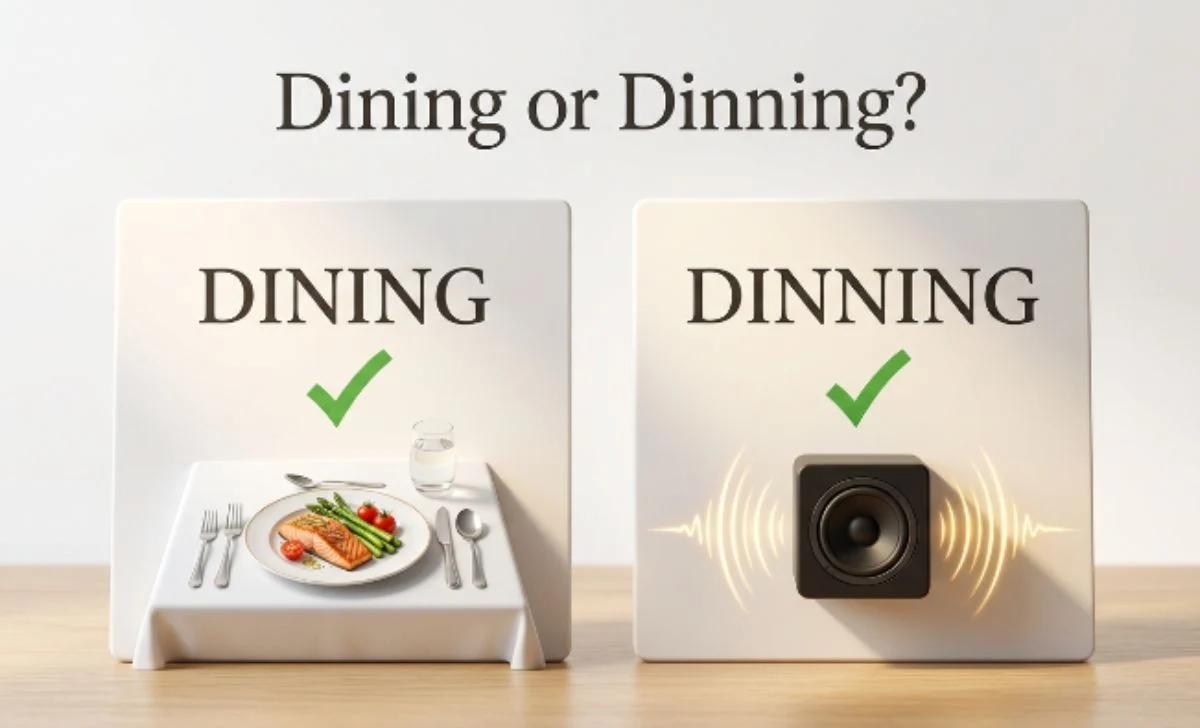
Dining is the standard word when you mean eating a meal, especially in phrases such as dining room, fine dining, or dining table.
Dinning is the present participle of the verb din, meaning making a loud, unpleasant, or continuous noise.
So:
Dining = eating
Dinning = making a loud noise
That one-letter difference changes the entire meaning.
The Fastest Answer
Use dining when talking about meals, restaurants, or eating.
Use dinning when talking about loud or repeated noise.
| Word | Meaning | Example |
|---|---|---|
| Dining | Eating a meal | We were dining at a restaurant. |
| Dinning | Making a loud, persistent noise | The machines were dinning in the factory. |
The most common expressions are:
dining room
dining table
fine dining
dining experience
Not:
❌ dinning room
❌ dinning table
What Does Dining Mean?
Dining is the present participle or gerund form of dine.
Dine means to eat a meal, especially in a formal or enjoyable setting.
Therefore:
dine → dining
Examples:
We are dining at a new Italian restaurant tonight.
They were dining with their friends.
The hotel offers an excellent dining experience.
The word appears frequently in restaurant, hospitality, travel, and everyday English.
What Does Dinning Mean?
Dinning comes from the verb din.
A din is a loud, unpleasant, or continuous noise.
Therefore:
din → dinning
Examples:
The construction workers were dinning all morning.
The children were dinning loudly in the hallway.
The machines kept dinning throughout the night.
This spelling is much less common than dining, which is why people sometimes assume dinning is a mistake.
It is not a mistake when it comes from din.
Dining vs Dinning: Side-by-Side
| Feature | Dining | Dinning |
|---|---|---|
| Root verb | dine | din |
| Meaning | Eating | Making a loud noise |
| Part of speech | Gerund/present participle | Present participle |
| Common usage | Very common | Relatively uncommon |
| Example | Dining at a restaurant | Dinning machines |
| Common phrase | Dining room | Rarely used as a noun modifier |
The difference comes from the verbs dine and din, not simply from a spelling rule.
Why Is It “Dining” and Not “Dinning”?
This is where English spelling can be confusing.
The verb dine ends in a silent e:
dine
When we add -ing, the final silent e is normally dropped:
dine + ing → dining
The same pattern appears in:
make → making
write → writing
use → using
hope → hoping
But din is a short verb ending in a consonant-vowel-consonant pattern.
When adding -ing, the final consonant is doubled:
din + ing → dinning
This is the same pattern seen in:
run → running
sit → sitting
stop → stopping
So both spellings follow standard English spelling rules.
Pronunciation
Dining
Dining is pronounced approximately:
DYE-ning
IPA:
/ˈdaɪnɪŋ/
Dinning
Dinning is pronounced approximately:
DIN-ing
IPA:
/ˈdɪnɪŋ/
Unlike some confusing word pairs, these two are not homophones.
You can hear the difference:
dining → DYE-ning
dinning → DIN-ing
The first vowel changes the sound completely.
Singular and Plural Forms
Neither dining nor dinning normally functions as a regular countable noun requiring singular and plural forms.
Dining
The noun dining generally refers to the activity or experience of eating.
Dining is one of my favorite activities.
You would not normally pluralize it as dinings in ordinary English.
Dinning
Dinning is a verb form.
The base noun is din, which is generally used as an uncountable noun when referring to loud noise.
The din was unbearable.
Not:
❌ The dins were unbearable.
In special contexts, dins can occur, but it is uncommon.
Dining as a Noun, Adjective, and Verb Form
Dining can have several grammatical roles.
As a gerund
Dining outdoors is enjoyable.
Here, dining functions as a noun.
As part of a verb phrase
They are dining at the hotel.
Here, it is part of the present continuous tense.
As a modifier
The dining room is beautifully decorated.
We bought a new dining table.
This flexibility is one reason dining appears so often in everyday English.
Dinning as a Verb Form
Dinning is normally the present participle of din.
Examples:
The alarm was dinning in the background.
The engines were dinning loudly.
The noise kept dinning in my ears.
It describes a sound that is loud, continuous, or irritating.
British vs American English
There is no spelling difference between British and American English for dining and dinning.
Both varieties use:
dining
and:
dinning
The meanings are also the same.
| English variety | Eating | Making a loud noise |
|---|---|---|
| American English | dining | dinning |
| British English | dining | dinning |
| Canadian English | dining | dinning |
| Australian English | dining | dinning |
The distinction is based on meaning and spelling rules, not regional preference.
Word Origins
Origin of Dining
Dine entered English through Old French and ultimately traces back to Latin disjejunare, associated with breaking a fast or taking a meal.
Over time, dine developed its modern meaning of eating a meal, often with an implication of a more formal or enjoyable meal.
From dine comes:
dining
Origin of Dinning
Din is an old English word referring to a loud, continuous, or confused noise.
Its history goes back to Old English dyn, meaning a loud sound or noise.
From the verb din comes:
dinning
The two words therefore have completely different histories.
Common Phrases With Dining
You will frequently see dining in these expressions:
Dining room
We have a large dining room.
Dining table
The plates are on the dining table.
Fine dining
The city is famous for fine dining.
Dining experience
The restaurant offers a memorable dining experience.
Outdoor dining
The café provides outdoor dining during summer.
Casual dining
This restaurant specializes in casual dining.
These phrases all refer to eating.
Common Phrases With Dinning
Dinning is much less common, but it can appear when describing noise.
Examples include:
dinning machinery
dinning sounds
dinning engines
dinning in my ears
However, native speakers often choose alternatives such as making noise, roaring, clattering, or banging, depending on the situation.
Everyday Examples
Restaurant
We are dining at the new restaurant tonight.
Home
The family was dining together.
Hotel
Guests can enjoy fine dining at the hotel.
Furniture
We bought a new dining table.
Construction
The workers were dinning with heavy machinery all day.
Factory
The machines kept dinning throughout the shift.
Loud children
The children were dinning loudly in the next room.
The context makes the correct spelling clear.
Common Mistakes
Mistake 1: Writing “dinning room”
❌ We painted the dinning room.
✅ We painted the dining room.
The room is used for eating, so use dining.
Mistake 2: Writing “dinning table”
❌ The plates are on the dinning table.
✅ The plates are on the dining table.
Mistake 3: Assuming “dinning” is always wrong
Not true.
The machines were dinning loudly.
This is grammatically possible because dinning comes from din.
Mistake 4: Using dining for noise
❌ The engines were dining all night.
✅ The engines were dinning all night.
If you mean making a loud noise, dinning is the relevant spelling.
Mistake 5: Confusing “dine” and “din”
Remember:
dine = eat
din = loud noise
Therefore:
dining = eating
dinning = making noise
Synonyms for Dining
Depending on context, synonyms for dining include:
- eating
- having a meal
- having dinner
- feasting
- eating out
- taking a meal
For example:
We were dining at the restaurant.
could become:
We were eating at the restaurant.
Synonyms for Dinning
Depending on the context, alternatives include:
- roaring
- booming
- clattering
- banging
- ringing
- resounding
- making noise
- thundering
For example:
The machines were dinning loudly.
could become:
The machines were roaring loudly.
The exact synonym depends on the type of sound.
A Simple Memory Trick
Use this easy rule:
DINE = EAT → DINING
Think of the E in dine as disappearing when you add -ing:
dine → dining
For dinning, remember:
DIN = NOISE → DINNING
If you can hear a loud din, you need the double n:
din → dinning
Practice Exercise
Choose dining or dinning.
1.
We are _____ at a restaurant tonight.
2.
The _____ room needs new chairs.
3.
The construction equipment was _____ all morning.
4.
They enjoyed _____ outdoors.
5.
We bought a new _____ table.
6.
The engines were _____ loudly.
Answers
- dining
- dining
- dinning
- dining
- dining
- dinning
People Also Ask
Is it dining or dinning?
Both are correct words, but they have different meanings. Dining means eating a meal, while dinning means making a loud or continuous noise.
Is “dinning room” correct?
No. The correct phrase is dining room.
Is “dinning table” correct?
No. The correct phrase is dining table.
What is the difference between dine and din?
Dine means to eat a meal. Din means a loud, unpleasant, or continuous noise.
Is dinning a real word?
Yes. Dinning is the present participle of din, meaning making a loud or continuous noise.
Why is dining spelled with one n?
Because dine loses its final silent e before -ing:
dine → dining
Why does din have two n’s in dinning?
Because din follows the consonant-doubling pattern when adding -ing:
din → dinning
FAQs
Should I write dining room or dinning room?
Always write dining room when you mean a room where meals are eaten.
Is fine dining correct?
Yes. Fine dining refers to a more formal or upscale style of eating at a restaurant.
What is the plural of dining?
Dining is generally used as a mass noun or gerund and does not normally have a plural form.
What is the past tense of dine?
The past tense is dined.
We dined at the restaurant yesterday.
What is the past tense of din?
The past tense is dinned.
The alarm dinned loudly throughout the night.
Is dining an adjective?
It can function as a modifier in phrases such as dining room and dining table, although grammatically it originates as the present participle/gerund of dine.
Final Verdict
The difference between dining and dinning is simple once you remember their root verbs.
Dining = eating
Dinning = making a loud noise
If you’re talking about restaurants, meals, furniture, or eating, choose dining:
dining room
dining table
fine dining
dining experience
If you’re describing a loud or continuous sound, dinning can be correct:
The machines were dinning all day.
The safest memory trick is:
Dine → dining
Din → dinning
One letter changes the meaning completely, so don’t let the similar spellings fool you.
Read More:

Hi, I’m Safdar Ali, an English language teacher with 26 years of teaching experience. My expertise is in English linguistics, grammar, and the differences between British and American English.
Through Gramiffy, I share practical, research-based guides to help students, writers, and English learners improve their language skills. My goal is to make English simple, accurate, and easy for everyone to understand.