Two words can look almost identical and still lead your sentence in completely different directions. Purposed and proposed are a good example.
One is about an intention or firm decision; the other is usually about putting an idea in front of other people.
The confusion is understandable because the two words are historically related, and in a few constructions their meanings can even overlap.
But in ordinary modern English, they do different jobs. If you are talking about a new plan, policy, idea, or suggestion, proposed is almost certainly the word you need.
If you mean that someone intended, resolved, or determined to do something, purposed may be correct.
There is another reason this pair is tricky: purposed is a real English word, even though many people rarely encounter it.
It isn’t simply a misspelling of proposed. Understanding that small distinction can save you from using the wrong word—and can also explain some unusual-looking sentences you’ll find in older or formal English.
Quick Answer: Purposed vs Proposed
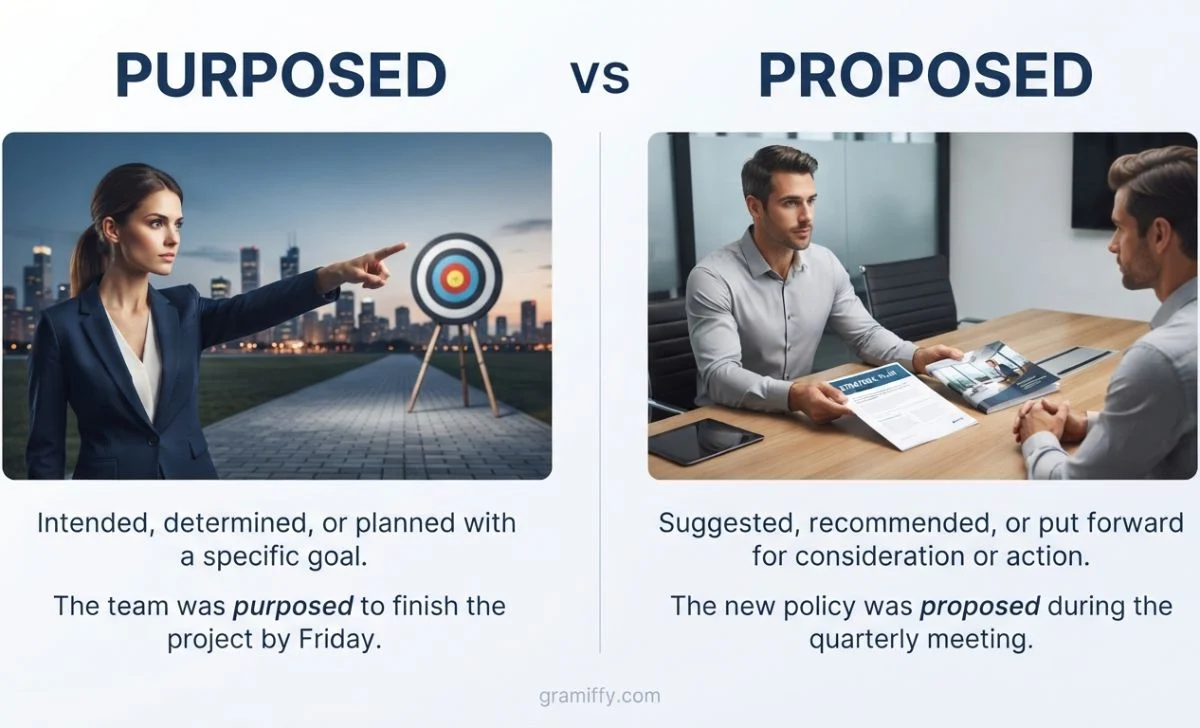
Proposed means suggested, put forward, or offered for consideration.
Purposed means intended, resolved, or determined.
| Word | Meaning | Example |
|---|---|---|
| Purposed | Intended, resolved, or determined | He purposed to finish the work. |
| Proposed | Suggested or put forward | He proposed a new plan. |
The easiest shortcut is:
Proposed = suggested
Purposed = intended
For example:
The committee proposed a new policy.
The committee put the policy forward for consideration.
She purposed to complete the project.
She intended or resolved to complete it.
The Simple Test That Usually Works
When you’re unsure which word to use, replace it with a simpler word.
Choose proposed if you could use:
- suggested
- recommended
- put forward
- offered
Choose purposed if you could use:
- intended
- resolved
- determined
- planned
Consider these sentences:
The company proposed a shorter working week.
The company suggested it.
He purposed to change his career.
He intended or resolved to do it.
This test won’t cover every historical or literary use, but it works extremely well for ordinary modern English.
Is “Purposed” a Real Word?
Yes. Purposed is a legitimate English word.
It is the past tense and past participle of the verb purpose. As a verb, purpose can mean to intend, resolve, or determine to do something.
For example:
She purposed to finish the book before the end of the month.
In modern conversation, many people would probably say:
She intended to finish the book before the end of the month.
That doesn’t make purposed incorrect. It simply means the word is much less common and can sound formal, literary, or old-fashioned depending on the context.
This is why saying that purposed is simply an incorrect version of proposed misses the point. The two words have different histories and different established meanings.
Why Do Purposed and Proposed Look So Similar?
The resemblance isn’t accidental.
Purpose and propose are historically related. Purpose entered English through Old French forms connected with proposer, and the words once had more overlap in meaning than they generally do today.
English gradually developed a clearer distinction between them.
Propose became strongly associated with putting something forward:
propose an idea
propose a solution
propose a change
propose a plan
Meanwhile, purpose developed its familiar noun sense of an aim, reason, or intended result:
the purpose of the meeting
the purpose of the machine
the purpose of the rule
As a verb, purpose retained the sense of intending or resolving:
He purposed to leave.
So the similarity between purposed and proposed has a genuine historical explanation. They aren’t merely two unrelated words that happen to share several letters.
How to Use “Purposed” Correctly
The verb purpose is uncommon compared with the noun purpose, but it can still be used correctly.
Purposed to + verb
This is one of the clearest constructions.
He purposed to finish the project before winter.
She purposed to change her way of life.
In both examples, purposed means intended or resolved.
For everyday writing, however, these alternatives may sound more natural:
He intended to finish the project before winter.
She decided to change her way of life.
Purposed in the sense of deliberate
The word can also describe something that was intentional rather than accidental.
The omission was purposed, not accidental.
This use is uncommon and can sound formal.
Purposed for
You may also encounter:
The building was purposed for community meetings.
The meaning is understandable, but modern writers will often choose:
The building was designed for community meetings.
or:
The building was intended for community meetings.
Those alternatives are generally more natural in contemporary prose.
How to Use “Proposed” Correctly
Proposed is much more common in modern English.
Use it when someone puts an idea, plan, change, or suggestion forward for consideration.
A plan
The manager proposed a new plan for the department.
Proposed a change
The government proposed several changes to the system.
A solution
The engineer proposed a simpler solution.
Proposed changes
This is an especially common construction:
The proposed changes will take effect next year.
Here, proposed tells us that the changes have been suggested but are not necessarily final or approved.
Proposed a toast
She proposed a toast to the newly married couple.
In this expression, proposed means offered or suggested.
When Proposed Can Also Mean Intended
Here’s where the distinction becomes slightly more interesting.
Propose can sometimes mean intend when it is followed by an infinitive.
For example:
I propose to leave at noon.
This can mean:
I intend to leave at noon.
Because of this meaning, the following sentences can overlap:
She proposed to finish the report by Friday.
She purposed to finish the report by Friday.
Both can express an intention.
However, purposed to is considerably less common and has a more formal or literary feel. In ordinary modern writing, intended to is usually the clearest choice.
There is also an important difference when a person follows proposed to:
He proposed to Sarah.
Most readers will understand this as a marriage proposal.
So don’t assume that every occurrence of proposed to means “intended to.”
Purposed vs Proposed: Common Mistakes
❌ The mayor purposed a new tax reform.
✅ The mayor proposed a new tax reform.
The mayor suggested the reform, so proposed is the appropriate word.
❌ The committee purposed several changes.
✅ The committee proposed several changes.
The committee put the changes forward for consideration.
❌ I purposed a toast to our guests.
✅ I proposed a toast to our guests.
The established expression is propose a toast.
❌ He proposed in his heart never to give up.
✅ He purposed in his heart never to give up.
Here, the intended meaning is resolved or determined, so purposed works in this formal expression.
❌ The purposed changes will be discussed tomorrow.
✅ The proposed changes will be discussed tomorrow.
The changes have been suggested or put forward, so proposed is the natural choice.
Purposed vs Proposed Examples
The quickest way to see the distinction is through real sentence patterns.
| Example | Correct word | Reason |
|---|---|---|
| The board ___ a merger. | proposed | It suggested a merger. |
| He ___ to move abroad. | purposed / proposed | Both can express intention. |
| The ___ highway extension is controversial. | proposed | It has been put forward for consideration. |
| She ___ a toast to the hosts. | proposed | This is the standard expression. |
| He ___ in his heart to remain faithful. | purposed | He resolved or determined to do so. |
| The council rejected the ___ changes. | proposed | The changes had been suggested. |
| She ___ to finish the book. | purposed / proposed | Both can express intention, though purposed is less common. |
| The old building was ___ for another use. | purposed | It was intended for that use, although designed or intended may sound more natural. |
Purpose, Propose, Proposal, and Repurpose
Several related words can make this spelling comparison even more confusing.
Purpose
As a noun, purpose means the reason for something or the goal it is intended to achieve.
The purpose of this meeting is to discuss the budget.
As a verb, it can mean to intend or resolve.
They purposed to complete the work.
Propose
Propose usually means to suggest or put something forward.
I propose a different approach.
It can also mean to intend in certain constructions:
I propose to leave tomorrow.
Proposal
A proposal is something that has been suggested or put forward.
The board rejected the proposal.
Remember:
propose = verb
proposal = noun
Purposeful
Purposeful means showing clear intention or determination.
She gave him a purposeful look.
Repurposed
Repurposed means given a new or different use.
The old factory was repurposed as a cultural center.
This is a completely different use from proposed.
Purpose-built
Purpose-built means specifically designed or constructed for a particular use.
The hospital has a purpose-built research facility.
Is “Purposed” Archaic?
Calling purposed simply “archaic” is too broad.
The word is still recognized and used, but it is uncommon in contemporary everyday English. Depending on the context, it can sound formal, literary, religious, or old-fashioned.
That distinction is useful.
A word can be perfectly valid without being a natural choice for everyday conversation.
For example, instead of:
I purposed to contact him yesterday.
most modern writers would probably say:
I intended to contact him yesterday.
But if you’re reading an older text and encounter purposed, there’s no reason to assume it is a spelling error.
What Does “Purposed in His Heart” Mean?
One familiar occurrence of purposed appears in the phrase “purposed in his heart.”
The expression is associated particularly with older English Bible translations.
In this context, purposed means resolved, determined, or firmly decided.
The phrase therefore describes an inward decision rather than an idea being presented to other people.
That is a useful example of the central distinction:
purposed → inward intention or resolve
proposed → something put forward
How to Remember Purposed vs Proposed
You don’t need a complicated grammar rule.
Just remember:
PROPOSE = PUT FORWARD
and:
PURPOSE = AIM OR INTENTION
So:
The committee proposed a new policy.
They put the policy forward.
But:
He purposed to follow the policy.
He intended or resolved to do so.
For most everyday sentences, another shortcut works just as well:
Suggested → proposed
Intended → purposed
Purposed or Proposed: Quick Quiz
Choose the correct word.
- The board ______ a merger with another company.
- He ______ to spend a year abroad.
- The ______ highway extension has caused controversy.
- She ______ a toast to the guests.
- He ______ in his heart never to give up.
- The committee ______ several changes to the policy.
- She ______ to complete the project before Friday.
- The old warehouse was ______ for use as a community center.
Answers
- proposed — the board suggested a merger.
- purposed or proposed — both can express intention.
- proposed — the extension has been put forward.
- proposed — propose a toast is the standard expression.
- purposed — it means resolved or determined.
- proposed — the committee put the changes forward.
- purposed or proposed — both can express intention, although purposed is less common.
- purposed — it was intended for a particular use.
FAQs
Is “purposed” a correct word?
Yes. Purposed is the past tense and past participle of the verb purpose. It can mean intended, resolved, or determined.
What is the difference between purposed and proposed?
Proposed usually means suggested or put forward, while purposed means intended, resolved, or determined.
Can “purposed” mean “proposed”?
Not usually. The words have distinct modern meanings, although propose can also mean intend in constructions such as propose to leave.
Is “purposed” still used today?
Yes, but it is relatively uncommon. It is more likely to appear in formal, literary, historical, or religious contexts than in casual conversation.
Is “purposed” a misspelling of “proposed”?
No. Purposed is a genuine English word with its own meaning and grammatical history.
Can you say “purposed a plan”?
That is not the normal modern construction. If you mean suggested a plan, use proposed a plan.
What does “purposed to” mean?
Purposed to means intended or resolved to.
He purposed to finish the work.
means:
He intended to finish the work.
What does “proposed to” mean?
It depends on what follows it.
She proposed to leave early.
Here, proposed to can mean intended to leave early.
But:
He proposed to her.
usually means he asked her to marry him.
Which is more common: purposed or proposed?
Proposed is much more common in modern English. Purposed is valid but comparatively rare.
Conclusion: Purposed or Proposed?
The choice becomes simple once you focus on the meaning.
Use proposed when someone suggests or puts something forward:
The committee proposed a new policy.
Use purposed when someone intends, resolves, or determines to do something:
She purposed to finish the work.
There is some overlap because propose can also mean intend, particularly in the construction propose to + verb. But in ordinary modern writing, proposed is the word you’ll encounter far more often.
So when you’re stuck, ask yourself:
Does it mean “suggested”? → proposed.
Does it mean “intended” or “resolved”? → purposed.
That one distinction will get you through most cases.
Read More:

Hi, I’m Safdar Ali, an English language teacher with 26 years of teaching experience. My expertise is in English linguistics, grammar, and the differences between British and American English.
Through Gramiffy, I share practical, research-based guides to help students, writers, and English learners improve their language skills. My goal is to make English simple, accurate, and easy for everyone to understand.