You typed “echoes.” Then you second-guessed yourself and wondered if it should be “echos.” If so, you’re in good company — this is one of the most commonly misspelled plurals in English, and once you see why, you’ll never doubt it again.
Quick Answer
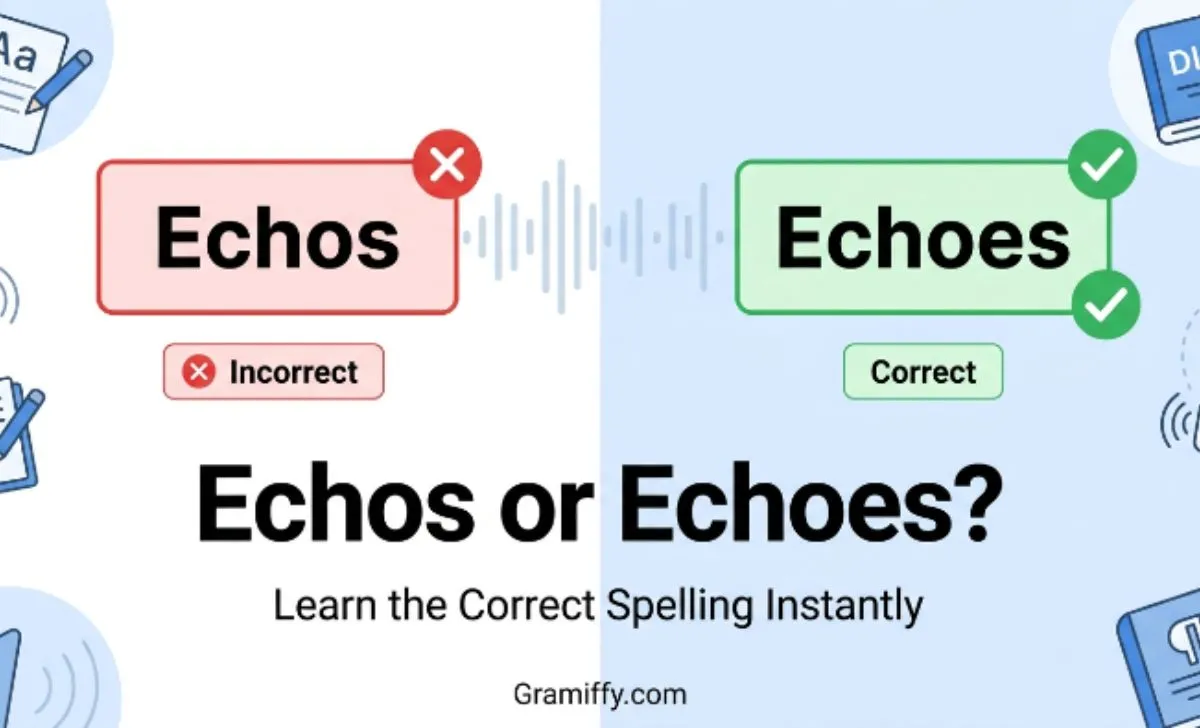
Echoes is the correct plural of echo. Echos is a common misspelling and should be avoided in any formal, academic, or professional writing.
| Singular | Echo |
| Plural | Echoes ✅ (not Echos ❌) |
| British & American English | Same spelling — Echoes |
| Formal writing | Echoes |
One echo, many echoes.
Why “Echo” Becomes “Echoes” — The Actual Rule
Most style guides just tell you to memorize this, but there’s a real pattern underneath it, and understanding it will help you with more than just this one word.
The general rule: nouns ending in a consonant + -o usually take -es in the plural (echo → echoes, hero → heroes, potato → potatoes). Nouns ending in a vowel + -o, or that are shortened/borrowed words, more often just take -s (radio → radios, photo → photos, piano → pianos).
Why the exceptions exist: many of the -os words are relatively modern loanwords or clipped forms — photo is short for photograph, piano was borrowed from Italian, radio came in with 20th-century technology.
Newer and imported words tend to resist the older -es pattern. Echo, by contrast, entered English centuries earlier (via Latin echo, from Greek ēchō, meaning “sound” or “reflected sound,” tied to the mythological nymph Echo), so it settled into the older, more established pluralization pattern alongside hero and potato.
There’s no foolproof shortcut that covers every -o word in English — you do have to know some by sight — but knowing why the split exists makes the exceptions much easier to remember instead of feeling random.
Correct vs. Incorrect Examples
✅ The mountains returned our echoes. ✅ The recording contained unwanted echoes. ✅ Her speech contained echoes of earlier debates.
❌ The mountains returned our echos. ❌ The recording contained unwanted echos.
Beyond the Literal Sound: How “Echoes” Is Used Idiomatically
“Echo” pulls a lot of weight figuratively, and this is where a lot of learners run into it in real writing — not just describing sound bouncing off a canyon wall.
- Echo chamber — an environment (often social media) where people only encounter opinions that match their own, reinforcing existing beliefs rather than challenging them.
- Echoes of [something] — traces or reminders of a past event, style, or idea showing up in something new. “The design carries echoes of 1960s modernism.”
- To echo someone’s sentiment — to repeat or agree with what someone else said. “Several board members echoed her concerns.”
- A hollow echo — used figuratively for something that seems to repeat without real substance behind it.
Note the verb form here too: echo → echoes → echoed → echoing. “Echoes” is only the noun plural when it follows an article or number (“the echoes,” “three echoes”); as a verb it’s the third-person singular present (“she echoes his views”).
Common Mistakes
| Mistake | Fix |
|---|---|
| We heard strange echos. | We heard strange echoes. |
| We heard many echo. | We heard many echoes. |
| Her voice echoes through the hall yesterday. | Her voice echoed through the hall yesterday. |
Words That Follow the Same Pattern (and Ones That Don’t)
Take -es (like echo): Hero → Heroes · Potato → Potatoes · Tomato → Tomatoes · Volcano → Volcanoes/Volcanos (both used)
Take -s instead: Photo → Photos · Piano → Pianos · Radio → Radios · Halo → Halos
There’s no single spelling trick that resolves every case — English absorbed these words from different sources at different times, which is exactly why the split exists. When in doubt on a specific word, a quick dictionary check is faster and more reliable than guessing from the pattern.
FAQs
Is “echos” ever correct?
No. “Echos” is not considered correct in standard modern English. It may appear as a typo or informal shorthand, but the standard plural of echo is echoes.
Is “echoes” the same in British and American English?
Yes. “Echoes” is the standard plural in both British and American English. There is no regional spelling difference, unlike colour/color or centre/center.
What’s the plural of “echo” when used as a verb?
As a verb, echoes is the third-person singular present tense:
The canyon echoes every shout.
The past tense is echoed:
Her voice echoed through the hall.
Why do some “-o” words take “-s” and others take “-es”?
It largely depends on the word’s history and how it entered English. Older, established words such as echo → echoes and hero → heroes often take -es, while many later loanwords and shortened forms take -s, such as photo → photos and piano → pianos.
The Simple Rule to Remember
Think of go → goes. Echo follows the same pattern: echo → echoes.
One echo, many echoes.
Conclusion
When it comes to “echos” or “echoes,” the correct spelling in standard modern English is echoes. Whether you are writing in British English or American English, the plural form of echo remains the same.
For example, you can say, “The echoes filled the valley” or “The cave produced several echoes.” The spelling echos is generally considered a misspelling and should be avoided in formal writing, academic work, professional communication, and published content.
As a verb, echoes is also correct for the third-person singular present tense, as in “The canyon echoes every sound.” Remember the simple rule: echo → echoes. Choosing echoes will ensure your writing follows standard English spelling and grammar conventions.

I am Bryan A. Garner a lexicographer, and language expert passionate about clear and effective writing.
I contribute grammar, spelling, and usage guides on Gramiffy.com to help readers improve their English skills. Through my work, I aim to make language rules simple, practical, and easy to understand.