Have you ever written wierd and paused because the word suddenly looked… weird? That tiny spelling mistake catches even confident English writers.
The culprit is an old spelling rule many of us learned: “I before E, except after C.” Yet weird boldly ignores that rule, leaving wierd looking strangely tempting.
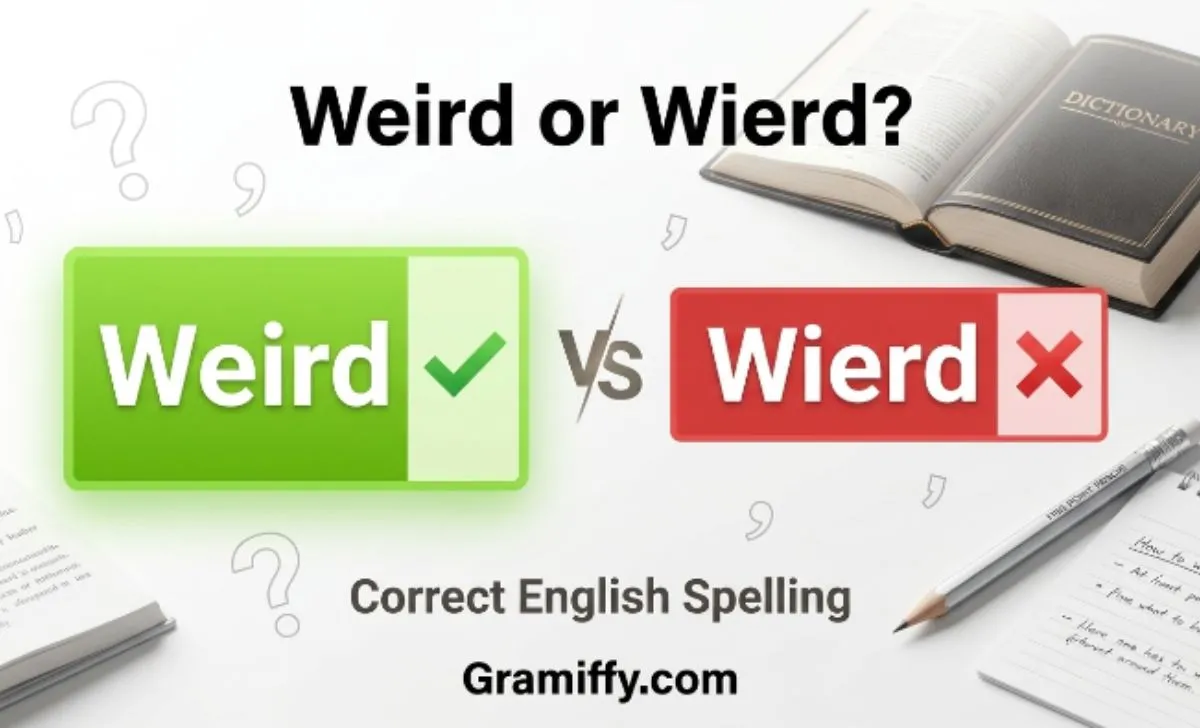
So, which spelling is actually correct? The answer is simple: weird is the standard spelling, while wierd is a common misspelling.
But there is more to this unusual word than its tricky letters. In this guide, we’ll explore its meaning, origin, pronunciation, British and American usage, common mistakes, and easy ways to remember the correct spelling.
Quick Answer: Weird or Wierd?
Weird is the correct spelling.
Wierd is a misspelling and should not be used in standard written English.
| Spelling | Correct? | Meaning |
|---|---|---|
| weird | ✅ Yes | Strange, unusual, odd, or unexpected |
| wierd | ❌ No | Common misspelling of weird |
Correct examples
- That’s a weird noise.
- I had a weird dream last night.
- Something weird happened at school.
- He has a weird sense of humor.
- This is a weird situation.
Incorrect example
- ❌ That’s a wierd noise.
The correct version is:
- ✅ That’s a weird noise.
What Does Weird Mean?
Weird is an adjective that describes something strange, unusual, unexpected, or different from what is considered normal.
The exact meaning depends on the context. Something can be weird because it is surprising, unfamiliar, mysterious, funny, uncomfortable, or simply different.
Weird Definition
According to standard English usage, weird means:
Strange, unusual, unexpected, or different from what is considered normal.
It can describe people, behavior, situations, experiences, sounds, smells, ideas, dreams, and many other things.
Simple definition
Weird = strange or unusual.
Examples
- A weird sound = an unusual sound
- A weird dream = an unusual or strange dream
- A weird person = someone whose behavior seems unusual
- A weird idea = an unusual or unexpected idea
- A weird situation = a strange or unexpected situation
How Do You Pronounce Weird?
Weird is usually pronounced like:
/wɪrd/
It sounds roughly like “weerd.”
The spelling can make the pronunciation seem confusing, especially for English learners.
Example
That’s weird.
The word weird has one syllable.
It does not sound like “wired.”
A useful pronunciation comparison is:
- weird → /wɪrd/
- word → /wɜːrd/ in many accents
- wired → /waɪərd/
Pronunciation can vary slightly between English accents, but the spelling weird remains the same.
Why Is Weird Spelled Weird?
The spelling of weird is partly explained by its history.
The word comes from the Old English wyrd, which originally referred to fate, destiny, or what was destined to happen.
Over time, the word changed in meaning and spelling. Its association with the supernatural became especially famous through Shakespeare’s “weird sisters” in Macbeth. These characters are traditionally understood as the three witches.
Later, weird developed its modern meaning of something strange, unusual, or supernatural.
This history helps explain why the spelling does not fit the simple spelling rule many people learn in school.
Weird and the “I Before E” Rule
One major reason people spell weird incorrectly is the familiar spelling rule:
“I before E, except after C.”
The rule suggests that ie is normally written in that order, while ei appears after c.
For example:
- believe
- friend
- piece
- receive
- ceiling
However, English spelling contains many exceptions and patterns that make the rule unreliable as a universal rule.
Weird is one of the famous exceptions.
The correct spelling is:
w-e-i-r-d
not:
w-i-e-r-d
So even though wierd may look more logical according to the rule, weird is the established standard spelling.
Why Do People Spell Weird as Wierd?
There are several reasons.
The “I Before E” Rule
The biggest reason is the spelling rule taught to many English learners.
People remember:
I before E
and naturally write:
wierd
But weird does not follow that pattern.
Pronunciation Can Be Confusing
The pronunciation of weird does not make its spelling obvious. When people hear the word, they may not know whether the middle letters should be ie or ei.
English Has Many Spelling Exceptions
English spelling developed from several languages and historical changes. As a result, pronunciation and spelling do not always match perfectly.
Words such as weird, height, foreign, and their demonstrate why memorizing individual spellings is sometimes necessary.
A Simple Memory Trick for Weird
The easiest way to remember the spelling is:
“Weird is weird because it breaks the rule.”
Remember that weird itself is unusual.
You can also break the word into:
WE + IRD
Or simply remember:
W-E-I-R-D
The key is to remember that the middle is EI, not IE.
Weird spelling trick
Think:
WEIrd
not:
WIErd
If you frequently make this mistake, writing weird several times can help reinforce the correct spelling.
Weird vs. Wierd: Comparison
| Feature | Weird | Wierd |
|---|---|---|
| Standard spelling | ✅ Yes | ❌ No |
| Dictionary-standard word | ✅ Yes | ❌ No |
| Meaning | Strange or unusual | — |
| Correct in formal writing | ✅ Yes | ❌ No |
| Common online misspelling | No | ✅ Yes |
| British English | ✅ Yes | ❌ No |
| American English | ✅ Yes | ❌ No |
The important point is simple: use weird in every standard English context.
Is Wierd a Real Word?
No. Wierd is generally considered a misspelling of weird, not a separate standard English word.
You may occasionally see wierd online, in informal writing, user-generated content, or spelling-error discussions. Its appearance does not make it a correct alternative spelling.
If you are writing an essay, article, email, application, website, school assignment, or professional document, use weird.
Is Weird the Same in British and American English?
Yes.
There is no standard British-American spelling difference between weird and weird.
Both British and American English use:
weird
The same spelling is also standard in other major varieties of English, including Canadian and Australian English.
Compare this with words that genuinely have regional spelling differences:
| British English | American English |
|---|---|
| colour | color |
| favourite | favorite |
| organise | organize |
| centre | center |
| travelling | traveling |
| weird | weird |
So you do not need to change weird depending on your audience.
Weird as an Adjective
The most common grammatical use of weird is as an adjective.
An adjective describes a noun.
Examples
- a weird story
- a weird sound
- a weird dream
- a weird experience
- a weird idea
- a weird person
- a weird situation
You can also use weird after linking verbs such as be, seem, feel, and look.
Examples
- That sounds weird.
- The situation seems weird.
- This feels weird.
- He looks weird in that costume.
- The whole experience was weird.
Comparative and Superlative Forms of Weird
Because weird is an adjective, it can be compared with other things.
The common forms are:
- weird
- weirder
- weirdest
Examples
This story is weird.
That story is even weirder.
That was the weirdest thing I’ve ever seen.
In informal English, these forms are very common.
Weird as a Noun
Weird has also had noun-related uses in older English, especially in connection with fate or destiny.
For modern everyday English, however, weird is primarily used as an adjective.
The historical noun sense is important because it explains the word’s connection with the Old English wyrd and the expression the Weird Sisters.
Common Expressions With Weird
Here are some common phrases containing weird.
That’s weird
Used when something seems strange or unexpected.
That’s weird. I thought the store was open today.
Weird feeling
Used for an unusual or difficult-to-explain feeling.
I have a weird feeling that something is wrong.
Weird dream
Used for an unusual dream.
I had a really weird dream last night.
Weird situation
Used for a strange or unexpected circumstance.
It was a weird situation, but everything worked out.
Weird sense of humor
Used to describe humor that is unusual or unconventional.
She has a weird sense of humor.
Weird-looking
Used to describe something that looks unusual.
That’s a weird-looking building.
Weird Synonyms
Several words can have a similar meaning to weird, although their meanings are not always identical.
| Synonym | Meaning |
|---|---|
| strange | Unusual or unfamiliar |
| unusual | Different from what is normal |
| odd | Strange or unexpected |
| peculiar | Unusual or distinctive |
| bizarre | Very strange |
| unusual | Not common or ordinary |
| eccentric | Unconventional, especially about a person |
| uncanny | Strange in a mysterious way |
| abnormal | Different from what is typical |
| mysterious | Difficult to explain or understand |
Examples
That’s a strange sound.
That’s an odd sound.
That’s a weird sound.
All three sentences are possible, but weird often sounds more informal and conversational.
Weird Antonyms
Words with opposite or contrasting meanings include:
- normal
- ordinary
- usual
- familiar
- conventional
- typical
- expected
- common
Example
The first meeting was normal, but the second one was weird.
Here, normal and weird create a clear contrast.
Common Spelling Mistakes With Weird
The most common mistake is reversing ei to ie.
| Incorrect | Correct |
|---|---|
| wierd | weird |
| wierdly | weirdly |
| wierdest | weirdest |
| wierder | weirder |
| wierdness | weirdness |
The same spelling pattern should remain when adding common suffixes.
Correct forms
- weird
- weirder
- weirdest
- weirdly
- weirdness
Do not change weird into wierd when adding a suffix.
Weird vs. Wierd in Sentences
Here are more examples showing the correct spelling.
Example 1
❌ I saw a wierd light in the sky.
✅ I saw a weird light in the sky.
Example 2
❌ She told me a wierd story.
✅ She told me a weird story.
Example 3
❌ That movie was really wierd.
✅ That movie was really weird.
Example 4
❌ He has a wierd habit.
✅ He has a weird habit.
Example 5
❌ It feels wierd being here.
✅ It feels weird being here.
Example 6
❌ That’s the wierdest thing I’ve ever seen.
✅ That’s the weirdest thing I’ve ever seen.
Weird vs. Wierd in Formal Writing
In formal writing, spelling accuracy matters.
Use weird in:
- academic essays
- school assignments
- business emails
- reports
- articles
- websites
- applications
- professional documents
- social media posts
Avoid wierd because readers will normally recognize it as a spelling mistake.
Even if the meaning is obvious, a spelling error can make your writing look less polished.
Does Spell Check Accept Wierd?
Most modern spell-checking tools will identify wierd as a spelling error and suggest weird.
However, spell-checking should not be your only method of checking writing. Some errors can be missed by software, especially when a misspelled word resembles another valid word.
Weird in Everyday English
Weird is extremely common in everyday conversation because it is a flexible word.
People use it to describe:
- unusual behavior
- strange experiences
- unexpected events
- unusual sounds
- unfamiliar smells
- strange dreams
- unconventional ideas
- mysterious situations
For example:
Why is the door open? That’s weird.
This coffee tastes weird.
I had a weird dream.
He said something weird yesterday.
The word is usually informal but is not limited to informal writing. It can appear in many kinds of standard English.
Weird Can Be Positive, Negative, or Neutral
The meaning of weird depends heavily on context.
Negative
That was a weird thing to say.
The speaker may think the behavior was inappropriate or uncomfortable.
Neutral
It’s weird to see the city so empty.
The situation is unusual, but not necessarily bad.
Positive or playful
She makes the weirdest jokes, and they’re hilarious.
Here, weird can suggest something unusual in an entertaining way.
So weird does not always mean “bad.”
Weird vs. Strange
Weird and strange are close in meaning, but they are not always interchangeable in tone.
Strange can sound more neutral or formal:
The results were strange.
Weird is often more conversational:
The results were weird.
Both can be correct, but the choice depends on tone and context.
Weird vs. Odd
Odd is another common synonym.
Compare:
That’s an odd question.
That’s a weird question.
Both mean the question is unusual. However, weird can sometimes suggest something more noticeably strange or unexpected.
Weird vs. Unusual
Unusual is generally more neutral.
She has an unusual hobby.
This simply says the hobby is uncommon.
She has a weird hobby.
This can suggest that the hobby seems strange to the speaker.
Therefore, unusual is often safer when you want to avoid a judgmental tone.
Weird Word Origin
The history of weird is particularly interesting.
Modern weird comes from Old English wyrd, which was associated with fate, destiny, or what was destined to happen.
The word continued to develop through Middle English.
Its association with supernatural beings became especially famous through Shakespeare’s Macbeth, where the three witches are called the Weird Sisters.
The word eventually moved away from its older meaning of fate and developed the modern sense of something strange, uncanny, or unusual.
This historical development is one reason the modern spelling may seem unusual to English learners.
Why the “I Before E” Rule Is Not Reliable
The traditional rhyme is often taught as:
“I before E, except after C.”
It can be useful for some words, but it is not a complete rule for English spelling.
Consider:
- weird
- their
- foreign
- height
- either
- seize
- leisure
- protein
These words show that English spelling contains many patterns and exceptions.
Therefore, it is better to treat “I before E” as a helpful spelling guideline rather than an absolute rule.
Related Words People Often Misspell
If you struggle with weird, you may also encounter these common spelling mistakes:
| Common mistake | Correct spelling |
|---|---|
| beleive | believe |
| recieve | receive |
| freind | friend |
| peice | piece |
| thier | their |
| seperate | separate |
| occured | occurred |
| definately | definitely |
| accomodate | accommodate |
| wierd | weird |
Learning common spelling patterns can help, but individual words still need to be memorized when they do not follow the expected pattern.
Weird vs. Wierd: How to Remember the Difference
Use one of these simple techniques.
Memory trick 1: Weird is weird
Weird is weird because it breaks the “I before E” rule.
This is probably the easiest trick to remember.
Memory trick 2: Remember “WEI”
Think:
WEI + RD = WEIRD
Not:
WIE + RD = WIERD
Memory trick 3: Write it repeatedly
Write:
weird, weird, weird, weird
A few repetitions can help build visual memory.
Memory trick 4: Use it in a sentence
That is a weird idea.
Using the correct spelling in context makes it easier to remember.
Frequently Asked Questions
Is “wierd” correct?
No. Wierd is a common misspelling. The correct spelling is weird.
What is the correct spelling: weird or wierd?
Weird is correct.
Why is weird spelled with EI?
The spelling reflects the word’s historical development and established English spelling conventions. It is one of the well-known exceptions to the commonly taught “I before E” guideline.
Is weird an adjective?
Yes. Weird is primarily an adjective in modern English.
That is a weird story.
What is the plural of weird?
As an adjective, weird does not have a plural form.
You can say:
- weird things
- weird people
- weird ideas
The adjective remains weird.
What is the comparative form of weird?
The comparative form is weirder.
This movie is weirder than the first one.
What is the superlative form of weird?
The superlative form is weirdest.
That was the weirdest dream I’ve ever had.
Is weird spelled differently in British English?
No. British English uses weird, just like American English.
Is wierd ever acceptable?
Not in standard English. It may appear as an error, username, name, typo, or other nonstandard usage, but it is not the standard spelling of the adjective.
Does weird mean bad?
Not necessarily. Weird means strange or unusual. Depending on the context, it can be negative, neutral, or playful.
Is weird a formal word?
Yes. Weird is a standard English word, although it is often more conversational than alternatives such as unusual or peculiar.
What is the easiest way to remember weird?
Remember:
“Weird is weird because it breaks the rule.”
The middle of the word is EI:
W-E-I-R-D
Quick Practice Quiz
Choose the correct spelling in each sentence.
1. That is a very ___ noise.
A. wierd
B. weird
Answer: B. weird
2. I had a ___ dream last night.
A. weird
B. wierd
Answer: A. weird
3. Something ___ happened yesterday.
A. wierd
B. weird
Answer: B. weird
4. He has a ___ sense of humor.
A. weird
B. wierd
Answer: A. weird
5. That was the ___ thing I’ve ever seen.
A. wierdest
B. weirdest
Answer: B. weirdest
Weird or Wierd: Final Verdict
There is no real spelling choice between weird and wierd.
Weird is correct. Wierd is a misspelling.
The confusion mainly comes from the familiar “I before E” spelling rule. Because weird contains ei, many writers instinctively reverse the letters and produce wierd.
The easiest solution is to memorize the correct form:
W-E-I-R-D
Remember the phrase:
Weird is weird because it breaks the rule.
Whether you’re writing an academic assignment, professional email, blog post, or casual message, use weird. It is the standard spelling in both British and American English and has no accepted regional alternative.
Once you remember that the middle of the word is EI, the weird vs. wierd confusion becomes much easier to avoid.
Read More: