Have you ever typed “imputting” and wondered whether it was actually correct?
You are not alone. The confusion becomes even more understandable because inputting and imputing are both real words, while imputting is not the standard spelling.
The problem is that these three forms look and sound surprisingly similar:
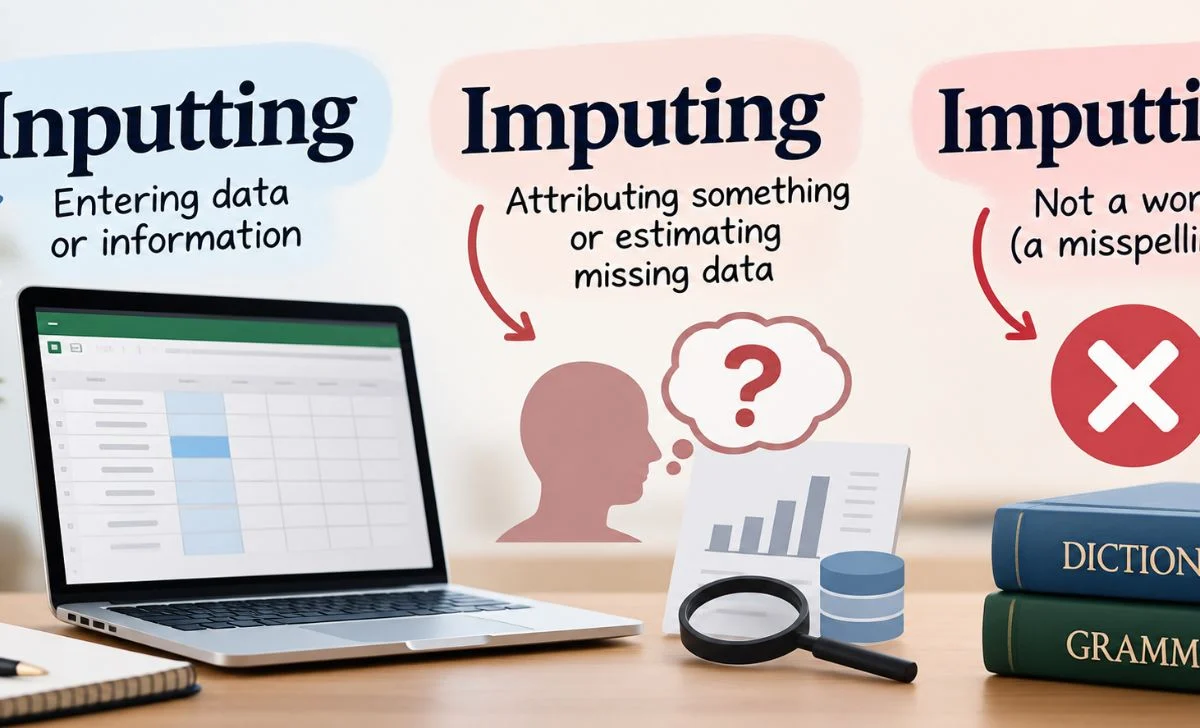
- Inputting = entering information or data
- Imputing = attributing something to someone or estimating missing data
- Imputting = a misspelling
So if you are writing about computers, forms, spreadsheets, or data entry, the word you need is inputting.
Quick Answer
Inputting is the correct word when you mean entering information into a computer, system, form, database, or other process.
Imputing is also a correct word, but it has a different meaning. It usually means attributing a quality, motive, fault, or responsibility to someone or something. In statistics, it can also refer to estimating or filling in missing data.
Imputting is not the standard spelling of either word.
| Word | Correct? | Meaning | Example |
|---|---|---|---|
| Inputting | Yes | Entering data or information | She is inputting the figures. |
| Imputing | Yes | Attributing something or estimating missing data | The analyst is imputing missing values. |
| Imputting | No | Common misspelling | ❌ She is imputting the data. |
Inputting vs Imputing: What’s the Difference?
The easiest way to remember the difference is to focus on the words they come from.
Inputting
Inputting comes from the verb input.
It means entering information into a system, device, form, database, or process.
She spent the afternoon inputting customer information into the database.
Imputing
Imputing comes from the verb impute.
It means attributing something to someone or something, such as a fault, motive, quality, or responsibility.
The article avoided imputing dishonest motives to the company.
In statistics and data science, impute has another established use. It can mean estimating or filling in missing values.
The software is imputing missing values in the dataset.
This is where the two words can become especially confusing. Someone working with data may encounter both inputting data and imputing missing values in the same context.
Why Is “Imputting” Wrong?
The confusion comes from combining parts of two different words:
input + ting → inputting
impute + ing → imputing
The incorrect form imputting looks as though it belongs somewhere between the two.
It has the “imput-” beginning of imputing but the doubled t found in inputting.
That creates a spelling trap:
- ✅ inputting
- ✅ imputing
- ❌ imputting
If you mean entering information, keep the n:
input → inputting
If you mean attributing something or estimating missing values, use:
impute → imputing
Why Does “Inputting” Have Two Ts?
This is one of the details that makes the spelling confusing.
The base verb is input, and its standard present participle is inputting.
The final t is doubled before -ing:
input → inputting
Compare it with:
- put → putting
- sit → sitting
- run → running
- stop → stopping
So inputting is not an unusual typo or a questionable variation. The double t is part of the standard spelling.
The important point is that the spelling is inputting, not imputting.
Why Do People Write “Imputting”?
There is no single explanation that applies to every writer, but the spelling is easy to produce because inputting and imputing are visually and phonetically close.
In fast speech, the n in input can sound closer to m because of the following p sound. This kind of sound change is known as assimilation.
That can make input sound somewhat like imput in casual speech.
Once the sound is misheard, it is easy to create a spelling such as imputting, especially if the writer is also familiar with imputing.
However, the correct spelling depends on the meaning:
Entering information → inputting
Attributing something → imputing
How to Use “Inputting” Correctly
Use inputting when someone is entering information into a system or process.
Examples
- She is inputting customer data into the CRM.
- Please finish inputting the survey results before lunch.
- The assistant spent two hours inputting invoices.
- Manually inputting hundreds of rows can take a long time.
- He is responsible for inputting the figures into the spreadsheet.
Inputting in a Sentence
Inputting incorrect information can affect the final report.
Here, inputting means entering information.
How to Use “Imputing” Correctly
Use imputing when you mean attributing something to a person or thing.
This could involve assigning a motive, fault, quality, or responsibility.
Examples
- The writer was careful not to be imputing dishonest motives to the politician.
- It would be unfair to keep imputing bad intentions to her actions.
- The report avoids imputing responsibility without evidence.
Imputing in Statistics
In statistics and data analysis, imputing can have a more technical meaning.
It refers to estimating or filling in missing data based on available information.
For example:
The analyst is imputing missing values before running the model.
This is completely different from:
The analyst is inputting the values into the spreadsheet.
The first describes estimating missing data. The second describes entering data.
Inputting vs Imputing Examples
Seeing the two words side by side makes the difference easier to remember.
Example 1: Entering data
She is inputting the customer’s address into the system.
Here, information is being entered.
Example 2: Attributing a motive
The critic was accused of imputing motives that the author never expressed.
Here, a motive is being attributed to someone.
Example 3: Missing data
The researcher is imputing missing values in the dataset.
Here, missing information is being estimated.
Example 4: Entering the results
The researcher is inputting the results into the database.
Here, the researcher is simply entering information.
Inputting or Imputting: Common Mistakes
❌ She is imputting the survey results.
✅ She is inputting the survey results.
The intended meaning is entering information, so inputting is correct.
❌ The software is inputting missing values.
✅ The software is imputing missing values.
If the software is estimating or filling in missing values, imputing is the appropriate word.
❌ The article was imputting bad intentions to him.
✅ The article was imputing bad intentions to him.
Here, the meaning is attributing bad intentions, so the correct form is imputing.
A Simple Memory Trick
Use this shortcut:
INPUT = information goes in
You are inputting data.
IMPUTE = attribute or estimate
You are imputing a motive or missing value.
And remember:
“Imputting” mixes the two spellings and should be avoided.
Quick Quiz
Choose inputting, imputing, or imputting.
1. Please finish ______ the survey results before lunch.
2. The critic was accused of ______ motives the author never had.
3. The software is ______ missing values in the dataset.
4. She spent the morning ______ customer information into the CRM.
5. Is “imputting” the correct spelling?
Answers
- Inputting
- Imputing
- Imputing
- Inputting
- No. Imputting is not the standard spelling.
FAQs
Is inputting or imputting correct?
Inputting is correct when you mean entering information into a system, form, computer, or database. Imputting is not the standard spelling.
Is imputing a real word?
Yes. Imputing is the present participle of impute. It can mean attributing something to someone or something. In statistics, it can also mean estimating missing data.
What is the difference between inputting and imputing?
Inputting means entering information.
Imputing means attributing something or, in statistics, estimating missing information.
Which word is used for computers and data entry?
Use inputting when you mean entering data into a computer, database, spreadsheet, form, or other system.
She is inputting the data into the spreadsheet.
Which word is used for missing data?
In statistics and data analysis, imputing can refer to estimating or filling in missing values.
The program is imputing missing values.
Why do people spell inputting as imputting?
The two words are very similar in sound and appearance. In casual speech, the n in input may also sound closer to m before the p sound. These similarities can contribute to the misspelling.
Are input and impute the same word?
No. Input and impute have different meanings and histories.
Input refers to something put into a system or process.
Impute means to attribute something to someone or something. In statistics, it can also refer to estimating missing data.
Conclusion
If you mean entering information, use:
If you mean attributing something or estimating missing data, use:
✅ Imputing
Avoid:
❌ Imputting
The easiest rule is:
Input → inputting → data goes in
Impute → imputing → attribute or estimate
Once you connect each spelling to its meaning, the confusion becomes much easier to avoid.
Read More:

Hi, I’m Safdar Ali, an English language teacher with 26 years of teaching experience. My expertise is in English linguistics, grammar, and the differences between British and American English.
Through Gramiffy, I share practical, research-based guides to help students, writers, and English learners improve their language skills. My goal is to make English simple, accurate, and easy for everyone to understand.