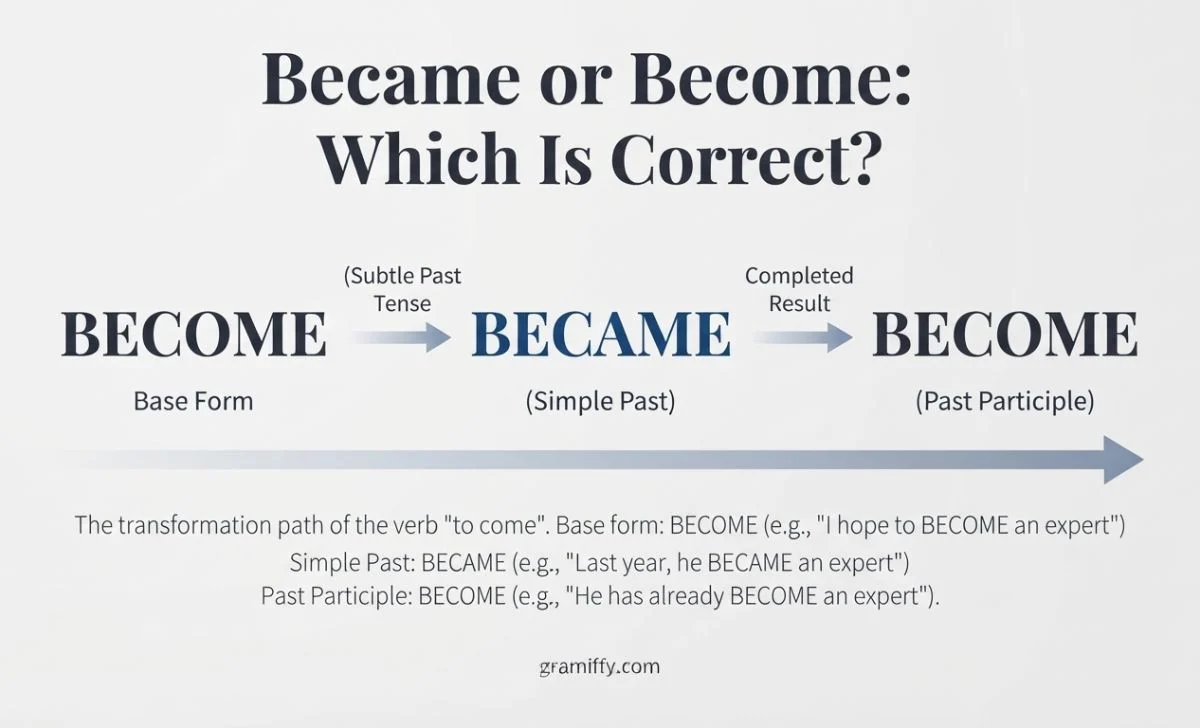
Became and become are two forms of the same irregular verb, but choosing between them depends on the tense and grammatical structure of your sentence.
The good news is that the difference becomes simple once you know what each form does.
The basic rule is this: became is the simple past form of “become,” while become is used as the base form and as the past participle.
You will also see becomes in the present tense with he, she, and it, and becoming as the -ing form.
For example:
She became a doctor in 2020.
She has become a successful doctor.
She becomes nervous before exams.
The verb is the same, but the form changes according to the sentence.
Quick Answer
Use became when you are talking about a completed change or event in the past.
He became a teacher last year.
Use become:
- after to: I want to become a teacher.
- after modal verbs: She will become a doctor.
- as the past participle with has, have, or had: She has become a doctor.
- in the present tense with I, you, we, and they: They become tired after work.
The third-person singular present form is becomes:
He becomes frustrated easily.
The basic pattern
| Form | Use | Example |
|---|---|---|
| become | Base form | I want to become a writer. |
| become | Present with I/you/we/they | They become nervous easily. |
| becomes | Present with he/she/it | She becomes nervous easily. |
| became | Simple past | She became a writer in 2020. |
| become | Past participle | She has become a successful writer. |
| becoming | -ing form | She is becoming more confident. |
Became: The Simple Past Form
Became is the simple past form of become.
Use it when describing a change, development, or transition that happened in the past.
Examples of “became”
- He became a doctor in 2018.
- She became interested in photography at university.
- The weather became colder overnight.
- The company became profitable last year.
- They became close friends during college.
The important point is that became stands on its own as the past-tense verb.
She became famous in 2019.
Not:
❌ She become famous in 2019.
And not:
❌ She has became famous.
The second example requires the past participle become, not became.
Become: The Base Form
Become is the base form of the verb.
It appears in several common grammatical structures.
After “to”
Use become after to when forming an infinitive.
I want to become a writer.
She hopes to become a doctor.
They plan to become business owners.
Not:
❌ I want to became a writer.
Become After Modal Verbs
After modal verbs such as will, can, may, might, should, and could, use the base form become.
She will become a great leader.
He may become famous.
You could become more confident with practice.
The situation might become complicated.
Not:
❌ She will became a great leader.
The modal verb already carries the grammatical information, so the main verb stays in its base form.
Become as the Present-Tense Form
Become is also used in the present tense with I, you, we, and they.
I become nervous before interviews.
You become more experienced over time.
We become stronger through practice.
They become more confident each year.
But with he, she, or it, the form changes to becomes.
She becomes nervous before interviews.
The weather becomes colder in winter.
This is why comparing only became and become can sometimes be misleading.
Becomes: The Third-Person Singular Form
Becomes is the present-tense form used with he, she, and it, or with a singular noun.
He becomes angry quickly.
She becomes more confident every day.
The problem becomes harder to solve.
The road becomes narrow after the bridge.
Compare:
They become tired.
He becomes tired.
The difference is simply subject-verb agreement.
Become as the Past Participle
One of the most important rules is that become, not became, is the past participle.
It is used with has, have, and had.
Present perfect
She has become a successful entrepreneur.
They have become close friends.
Past perfect
She had become interested in science before entering university.
By 2020, the company had become one of the largest employers in the region.
A very common mistake is:
❌ She has became a successful entrepreneur.
The correct form is:
✅ She has become a successful entrepreneur.
Remember:
has/have/had + become
not:
has/have/had + became
Became vs. Has Become
Both forms can describe a change, but they present that change differently.
Simple past: became
Use became when you are describing a completed past event.
The company became profitable in 2022.
The sentence places the change in a specific past period.
Present perfect: has become
Use has become when the past change is connected to the present or when the exact time is not the focus.
The company has become highly profitable.
The focus is on its current situation.
Compare:
She became a manager in 2023.
She has become one of the company’s most important managers.
The first sentence focuses on when the change happened. The second emphasizes the present result.
Became or Become: Common Mistakes
1. “Has became” vs. “has become”
❌ She has became more confident.
✅ She has become more confident.
After has or have, use the past participle become.
2. “Will became” vs. “will become”
❌ He will became a doctor.
✅ He will become a doctor.
After will, use the base form become.
3. “Did became” vs. “did become”
❌ When did she became interested in art?
✅ When did she become interested in art?
After did, use the base form of the verb.
4. “He become” vs. “he became”
❌ He become angry yesterday.
✅ He became angry yesterday.
The sentence describes a completed event in the past, so became is required.
5. “She become” vs. “she becomes”
❌ She become tired after work.
✅ She becomes tired after work.
This is a present-tense statement with a singular third-person subject, so use becomes.
Why Is “Becomed” Incorrect?
Becomed is not the standard past-tense or past-participle form of become.
That’s because become is an irregular verb.
Regular verbs usually form their simple past by adding -ed:
- walk → walked
- work → worked
- play → played
But irregular verbs do not follow this pattern.
The forms of become are:
become → became → become
For example:
I want to become a doctor.
She became a doctor.
She has become a doctor.
So:
❌ becomed
❌ has became
✅ become
✅ became
✅ has become
Become, Became, or Becoming?
These three forms have different grammatical functions.
Become
Base form or past participle:
I want to become a pilot.
She has become more confident.
Became
Simple past:
She became a pilot in 2021.
Becoming
The -ing form, used in continuous constructions or as a gerund.
She is becoming more confident.
Becoming a doctor requires years of study.
The pattern is:
become → became → become → becoming
“Becoming” Can Also Mean Attractive or Suitable
There is another use of becoming that is worth knowing.
As an adjective, becoming can mean flattering, attractive, or suitable, especially when describing someone’s appearance or clothing.
That color is very becoming on you.
She wore a becoming dress.
This adjective meaning is different from the ordinary verb phrase becoming meaning “changing into” or “starting to be.”
The Subjunctive: “Become,” Not “Becomes”
There is one advanced construction where become may appear after a singular subject even though ordinary present-tense grammar would normally require becomes.
This occurs with the mandative subjunctive, particularly after words such as recommend, insist, and require, and after expressions such as it is essential that.
For example:
It is essential that she become certified before the deadline.
The board recommended that he become the new director.
Not:
❌ It is essential that she becomes certified.
In these constructions, the verb remains in its base form.
This is more common in formal writing, particularly in American English, although the construction is also found elsewhere.
British vs. American English
There is no spelling difference between become, became, and becoming in British and American English.
There can, however, be differences in preferences for the simple past and present perfect, particularly when talking about recent events.
For example, both of these can be grammatical:
I just became a manager.
I’ve just become a manager.
British English generally uses the present perfect more widely in certain contexts involving recent events, while American English often permits the simple past in situations where British English would commonly use the present perfect.
This is a usage tendency rather than a rule that makes one form universally correct and the other incorrect.
How to Remember Become vs. Became
Use this simple three-step pattern:
Now / base form → become
Past → became
Has/have/had → become
For example:
I want to become a teacher.
I became a teacher last year.
I have become a teacher.
You can also remember the irregular pattern as:
Become → Became → Become
The middle form changes, but the first and third forms are both become.
Quick Quiz
Choose the correct form.
1. She _ a doctor in 2020.
Answer: became
The sentence describes a completed event in the past.
2. She has _ a successful doctor.
Answer: become
Use the past participle after has.
3. I want to _ a better writer.
Answer: become
Use the base form after to.
4. He _ nervous before every exam.
Answer: becomes
This is a present-tense statement with he.
5. They _ more confident with experience.
Answer: become
Use the base form with they in the present tense.
6. The company will _ profitable next year.
Answer: become
Use the base form after will.
7. By the time she arrived, he had _ the team’s leader.
Answer: become
Use the past participle after had.
8. It is important that he _ more responsible.
Answer: become
The base form is used in the mandative subjunctive.
FAQs
Is “became” the past tense of “become”?
Yes. Became is the simple past form of become.
She became a teacher last year.
Is “become” present or past?
Become can have more than one grammatical function. It is the base form used in the present with I, you, we, and they, and it is also the past participle used with has, have, and had.
They become tired easily.
They have become tired.
Is “became” or “become” correct after “has”?
Use become.
✅ She has become successful.
❌ She has became successful.
Is “became” correct after “did”?
No. After did, use the base form become.
✅ When did she become interested?
❌ When did she became interested?
Is “will became” correct?
No. After will, use become.
✅ He will become a doctor.
❌ He will became a doctor.
What is the past participle of “become”?
The past participle is become.
The three principal forms are:
become – became – become
Is “becomed” a word?
No, becomed is not the standard form of the verb. Become is irregular, so its past forms are became and become, not becomed.
What is the difference between “became” and “has become”?
Became is the simple past and usually presents the change as a completed past event.
Has become is the present perfect and emphasizes a change connected to the present or its current result.
She became manager in 2022.
She has become an important part of the company.
Conclusion: Became or Become?
The easiest way to remember the difference is:
Become = base form / past participle
Became = simple past
Becomes = present tense with he, she, or it
Becoming = -ing form
Remember the irregular pattern:
Become → Became → Become
Use became for a completed past change:
He became a teacher in 2020.
Use become after to, modal verbs, and has/have/had:
She wants to become a teacher.
She will become a teacher.
She has become a teacher.
Once you recognize the tense and the structure around the verb, choosing between became and become becomes much easier.
Read More:

Hi, I’m Safdar Ali, an English language teacher with 26 years of teaching experience. My expertise is in English linguistics, grammar, and the differences between British and American English.
Through Gramiffy, I share practical, research-based guides to help students, writers, and English learners improve their language skills. My goal is to make English simple, accurate, and easy for everyone to understand.