Have you ever typed “Can I barrow your car?” and immediately felt that something looked wrong? You’re not alone.
Barrow and borrow are easy to confuse because they differ by only one letter, and in some accents their pronunciation can sound very similar.
But they are not alternative spellings of the same word.
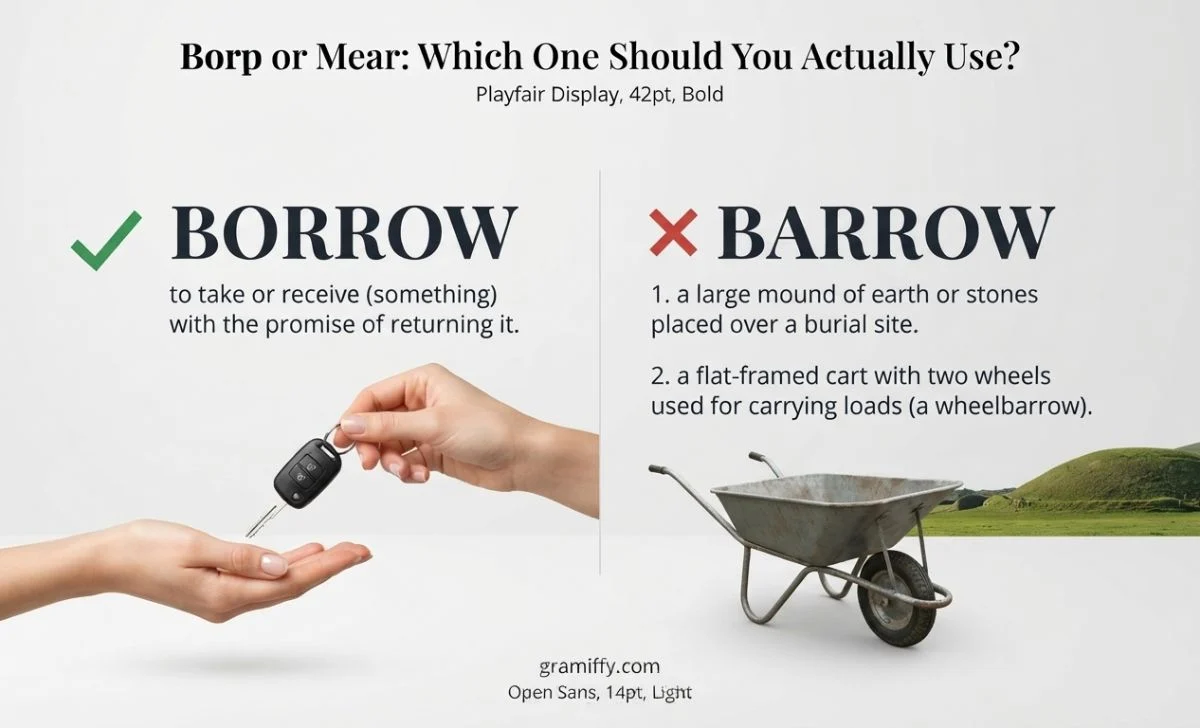
Borrow is the word you need when you take something temporarily and intend to return it. Barrow is a noun with two main historical meanings: a cart or handcart and an ancient mound, especially a burial mound.
So if you want to ask a friend for their car, charger, book, or money, the correct word is borrow.
Let’s look at the difference between barrow and borrow, including their meanings, examples, origins, and the common mistakes that cause people to mix them up.
Quick Answer
Borrow is a verb meaning to take or receive something from someone temporarily, usually with the intention of returning it.
Can I borrow your car?
Barrow is mainly a noun. It can refer to:
- a handcart or wheelbarrow
- an ancient mound, especially a burial mound
The farmer pushed a barrow through the field.
Archaeologists discovered an ancient barrow nearby.
Easy rule to remember
Borrow = take temporarily and return it.
Barrow = cart or ancient mound.
If you mean take something and give it back later, use borrow.
Borrow: Take Something and Return It
Borrow is a verb meaning to receive or take something from another person or organization with permission, normally with the expectation that it will be returned.
Examples of “borrow”
- Can I borrow your phone?
- I need to borrow your car tonight.
- She borrowed a book from the library.
- He borrowed $200 from his brother.
- We borrowed some chairs from the neighbors.
The important idea is temporary use followed by return.
Borrow vs. lend
One of the most common mistakes is confusing borrow with lend.
The person receiving something borrows it.
The person giving something temporarily lends it.
Can I borrow your laptop?
Can you lend me your laptop?
A useful way to remember this is:
I borrow something from you.
You lend something to me.
Borrow Has More Than One Meaning
Although the everyday meaning involves temporarily receiving something, borrow also has several specialized uses.
Borrow money
You can borrow money from a person, bank, or financial institution.
She borrowed $5,000 from the bank.
In this context, the money normally has to be repaid according to agreed terms.
Borrow a word
In linguistics, a language can borrow a word from another language.
For example:
English has borrowed many words from French.
A word adopted from another language is often called a loanword or borrowed word.
Borrow in golf
In golf, borrow can refer to the amount a golfer allows for the slope of a putting green when aiming a putt.
This is a specialized use and is much less common than the everyday meaning.
Borrow in construction
A borrow pit is a location where soil, gravel, or other material is excavated for use elsewhere.
This is a technical term, not the normal everyday meaning of borrow.
Barrow: A Cart or Handcart
Barrow is a noun that can refer to a handcart or small cart, especially one traditionally pushed or carried by people.
The word is closely associated with wheelbarrow, a familiar type of one-wheeled cart used for moving soil, bricks, gardening materials, and other heavy objects.
Examples of “barrow”
- He pushed a barrow full of bricks across the yard.
- The gardener loaded the barrow with soil.
- The trader sold vegetables from a small barrow.
In everyday modern English, you’re much more likely to encounter wheelbarrow than barrow by itself.
Barrow: An Ancient Mound
Barrow also has another important meaning: an ancient mound, especially one associated with a burial.
This sense appears frequently in archaeology and historical writing.
For example:
Archaeologists excavated a Bronze Age barrow.
The ancient barrow contained human remains and pottery.
In British archaeological terminology, you may encounter terms such as round barrow, referring to a type of prehistoric burial mound.
This meaning has nothing to do with borrowing something.
Barrow vs. Borrow: The Difference at a Glance
| Word | Part of Speech | Meaning | Example |
|---|---|---|---|
| Borrow | Verb | Take something temporarily with the intention of returning it | Can I borrow your pen? |
| Barrow | Noun | A cart or handcart | He pushed the barrow across the yard. |
| Barrow | Noun | An ancient mound, especially a burial mound | They excavated an ancient barrow. |
The simplest distinction is:
Borrow = receive temporarily
Barrow = cart or mound
Why Do People Confuse Barrow and Borrow?
The two words are easy to mix up for several reasons.
1. They differ by only one letter
Compare them:
BARROW
BORROW
The only difference is a → o.
That makes a typing mistake particularly easy.
2. They sound similar
In some accents, barrow and borrow are pronounced very similarly, while in others the vowel sounds are more clearly distinct.
When people hear a word rather than see it written, this can make the spelling harder to remember.
3. They have similar-looking patterns
Both words contain -arrow/-orrow patterns and have two syllables in common pronunciations.
That visual similarity makes them natural candidates for spelling confusion.
Common Mistakes With Barrow and Borrow
Incorrect: Can I barrow your car?
❌ Can I barrow your car?
Correct: Can I borrow your car?
✅ Can I borrow your car?
Here, the meaning is take the car temporarily and return it, so borrow is required.
Incorrect: He borrowed a wheelbarrow?
This sentence can actually be correct.
He borrowed a wheelbarrow from his neighbor.
Here, borrowed is the verb, while wheelbarrow is the noun.
This is a useful example because both words can appear in the same sentence without being interchangeable.
Correct: Archaeologists found a barrow.
Archaeologists found an ancient barrow.
Here, barrow means an ancient mound.
Borrow vs. Barrow in a Sentence
Compare these examples:
Can I borrow your bicycle?
The speaker wants to use the bicycle temporarily.
He pushed a barrow full of tools.
Here, barrow refers to a cart.
The archaeologists examined a Bronze Age barrow.
Here, barrow refers to an ancient mound.
The meaning makes the correct spelling clear.
Are Barrow and Borrow Related?
Despite their similar spelling and pronunciation, barrow and borrow have different word histories.
Borrow comes from Old English borgian, associated with obtaining something on the understanding that it will be repaid or returned.
The cart sense of barrow has a different Old English history, associated with carrying.
The mound sense of barrow is also historically distinct and is connected with an Old English word meaning a mound or hill.
So the modern similarity between the words should not be taken as evidence that they are simply two forms of the same word.
British vs. American English
There is no major British-American spelling difference between barrow and borrow.
Both forms are used in British and American English, but their meanings determine which word is appropriate.
Borrow is common in both varieties:
Can I borrow your charger?
Barrow is much less common in everyday conversation, although wheelbarrow is familiar in both varieties. The archaeological sense of barrow is also well established, particularly in discussions of prehistoric sites.
Barrow or Borrow: How to Remember
Use this simple memory trick:
Borrow has “O” for “obtain temporarily”
Think:
B = Borrow
O = Obtain
When you obtain something temporarily and plan to return it, you borrow it.
For example:
Can I borrow your book?
For barrow, think of a barrow as a cart or an ancient mound.
If the sentence involves a car, book, phone, charger, tool, or money, you probably need borrow.
If it involves a cart or archaeological mound, you probably need barrow.
Quick Quiz: Barrow or Borrow?
Test yourself.
1. Can I ___ your laptop for an hour?
Answer: borrow
You are taking the laptop temporarily and intend to return it.
2. The gardener filled the ___ with soil.
Answer: barrow
Here, barrow means a cart.
3. She ___ $500 from her brother.
Answer: borrowed
The verb is borrow.
4. Archaeologists excavated an ancient ___.
Answer: barrow
Here, barrow means an ancient mound.
5. Can you ___ me your umbrella?
Answer: lend
This sentence tests the related word lend. The person giving the umbrella lends it; the person receiving it borrows it.
FAQs
Is “barrow” a misspelling of “borrow”?
No. Barrow is a real English word. It can mean a cart or an ancient mound. However, if you mean take something temporarily and return it, borrow is the correct word.
Is “borrow” a noun or a verb?
Borrow is primarily a verb. It means to take or receive something temporarily with the expectation of returning it.
I need to borrow your pen.
Is “barrow” a verb?
In modern standard English, barrow is normally used as a noun, not as the everyday verb borrow.
What is the difference between borrow and lend?
Borrow describes the person receiving something temporarily.
Lend describes the person giving it temporarily.
I borrowed a book from Sarah.
Sarah lent me a book.
Is a wheelbarrow the same as a barrow?
A wheelbarrow is a type of barrow or handcart. Barrow can be used more generally for a small cart, although the standalone word is less common in modern everyday English.
What is a barrow in archaeology?
In archaeology, a barrow is an artificial mound, especially one built over a burial. The term is commonly used when discussing prehistoric burial sites.
Are barrow and borrow pronounced the same?
They can sound very similar, depending on the speaker’s accent. In some varieties of English, the difference between their vowel sounds is clearer than in others.
Final Answer: Barrow or Borrow?
If you’re talking about taking something temporarily and returning it, use borrow.
If you’re talking about a cart or an ancient mound, use barrow.
Borrow = take temporarily
Barrow = cart or ancient mound
So:
❌ Can I barrow your car?
✅ Can I borrow your car?
The two words may look and sound similar, but their meanings are completely different.
Once you connect borrow with temporarily receiving something and barrow with a cart or archaeological mound, the distinction becomes much easier to remember.
Read More:

Hi, I’m Safdar Ali, an English language teacher with 26 years of teaching experience. My expertise is in English linguistics, grammar, and the differences between British and American English.
Through Gramiffy, I share practical, research-based guides to help students, writers, and English learners improve their language skills. My goal is to make English simple, accurate, and easy for everyone to understand.