Thumb in and thumb out can both be correct phrases, but they describe different positions or actions depending on the context. There isn’t a single grammar rule that makes one phrase universally correct.
If you’re talking about hitchhiking or signaling, thumb out is the familiar expression. If you’re talking about making a fist for boxing, keeping the thumb outside the fingers is standard technique.
In body-language discussions, however, thumb in and thumb out can describe different positions without having one fixed meaning.
So the real question isn’t “Which phrase is correct?” but “What are you describing?”
Here’s how the two expressions work in the most common contexts.
Quick Answer
Thumb out usually means that the thumb is extended or positioned outside the hand or fingers.
She stood beside the road with her thumb out.
In boxing, the thumb should be positioned outside the curled fingers, rather than trapped inside the fist.
Thumb in means that the thumb is tucked or positioned inward.
He kept his thumb in his pocket.
The correct phrase depends on what you’re describing.
At a glance
| Phrase | Basic meaning | Common context |
|---|---|---|
| Thumb out | Thumb extended or positioned outside | Hitchhiking, gestures, fist technique |
| Thumb in | Thumb tucked or positioned inward | Hand position, pockets, some gestures |
| Both | Can be correct depending on context | Describing physical position |
1. Hitchhiking: Thumb Out
The most familiar use of thumb out is the traditional hitchhiking gesture.
A person extends their arm toward the road and raises their thumb to signal that they want a ride.
She stood by the highway with her thumb out, waiting for a car to stop.
He had his thumb out as he tried to get a ride.
In this context, thumb out is the natural expression.
What about “thumb in”?
Thumb in does not describe the standard hitchhiking gesture. If the thumb is tucked into the palm rather than extended, the gesture is no longer the conventional hitchhiking signal.
So:
Thumb out = standard hitchhiking gesture
2. Boxing: Keep the Thumb Outside the Fist
In boxing and other striking sports, thumb position is an important part of making a fist safely.
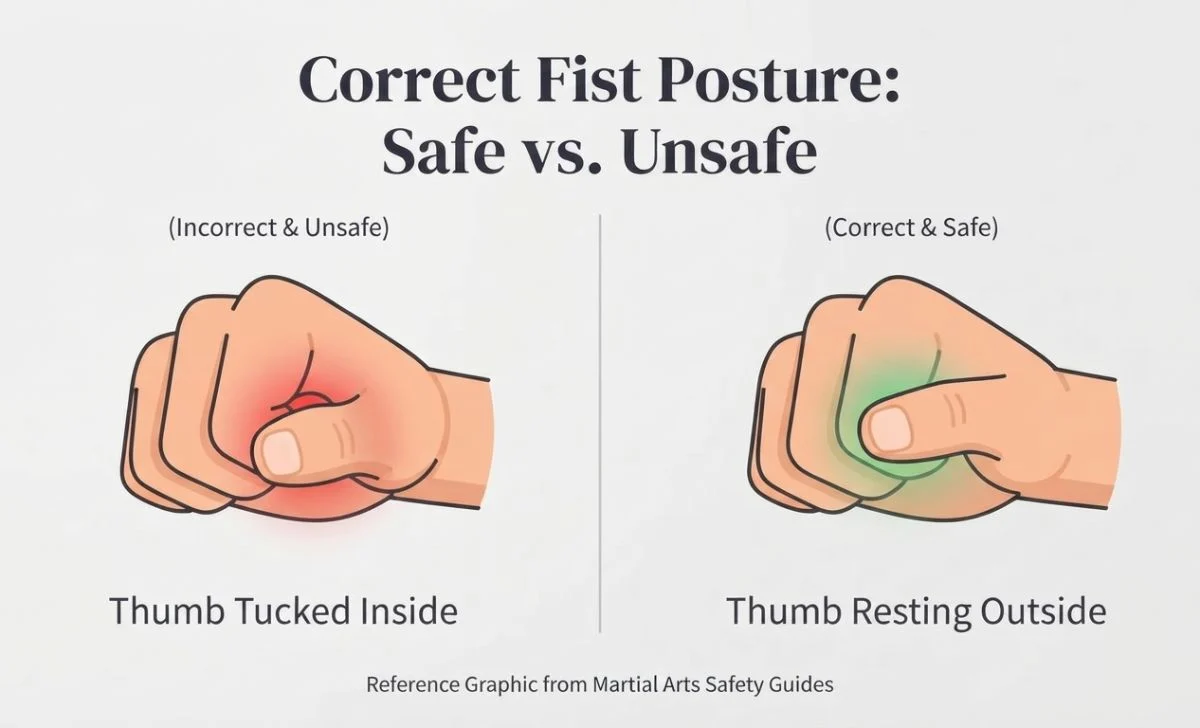
When making a conventional punching fist, the thumb is generally positioned outside the curled fingers, rather than being trapped underneath or inside them.
A simplified description is:
Correct: fingers curled into the palm, thumb positioned outside and across the fingers.
Incorrect: thumb tucked inside the curled fingers.
Why does this matter?
A punch generates substantial force. If the thumb is positioned incorrectly, it can be exposed to awkward pressure or impact.
Proper hand wrapping, fist formation, and punching technique are therefore important for reducing the risk of hand and thumb injuries.
For beginners, the practical rule is straightforward:
Keep the thumb outside the curled fingers when making a punching fist.
Example
The coach reminded him to keep his thumb out when making a fist.
Here, thumb out means the thumb is positioned outside the fingers rather than trapped inside the fist.
Important safety note
Hand and wrist injuries can occur even with proper technique. Anyone learning boxing should follow instruction from a qualified coach and use appropriate hand wraps and protective equipment.
3. Everyday Hand Position: Thumb In or Thumb Out
Outside of specific gestures and sports, the phrases can simply describe the physical position of your thumb.
For example:
He stood with his thumbs in his pockets.
This means the thumbs were tucked inside the pockets.
You could also describe a hand position in which the thumb is extended:
Her thumb was out as she held the object.
Here, out simply describes the thumb’s physical position.
This is why neither thumb in nor thumb out is automatically “correct.” The phrase needs to match the position you’re describing.
4. Body Language: Don’t Assume Too Much
You may also encounter thumb in and thumb out in discussions of body language.
Some popular body-language guides associate visible or extended thumbs with confidence or openness and tucked thumbs with nervousness, restraint, or insecurity.
However, these interpretations should be treated cautiously.
A person’s thumb position can have many ordinary explanations. Someone might tuck a thumb into a pocket because they’re cold, holding something, resting their hand, or simply standing comfortably.
So it is better to describe the observable gesture than to treat one thumb position as proof of a person’s emotional state.
For example:
He stood with his thumb tucked into his pocket.
is a straightforward description.
By contrast:
His thumb was tucked in, so he was definitely insecure.
goes beyond what the gesture alone can establish.
Thumb In vs. Thumb Out: Examples
Here are some examples showing how the meaning changes with context.
She stood beside the road with her thumb out.
Keep your thumb out of the inside of the fist when punching.
Thumb in a pocket
He stood with his thumb in his pocket.
Thumb tucked inward
She held the object with her thumb in, close to her palm.
In each case, the phrase describes a physical position rather than a spelling or grammar distinction.
Why Do People Search for “Thumb In or Thumb Out”?
The phrase can refer to several different situations, which is why the search query can be confusing.
Someone searching thumb in or thumb out might be asking:
- Which thumb position is used for hitchhiking?
- How should the thumb be positioned when making a fist?
- What does thumb position mean in body language?
- Should the thumb be inside or outside the fingers?
- Is thumb in or thumb out the correct phrase?
The answer depends on the context.
For hitchhiking, the familiar gesture is thumb out.
For boxing, the conventional instruction is to keep the thumb outside the curled fingers.
Thumb In or Thumb Out: Quick Reference
| Situation | Phrase / Position | Explanation |
|---|---|---|
| Hitchhiking | Thumb out | Thumb extended as a signal for a ride |
| Boxing fist | Thumb outside | Keeps the thumb positioned outside the curled fingers |
| Thumb in pocket | Thumb in | Thumb is tucked inside the pocket |
| General hand position | Either | Depends on the position being described |
| Body-language interpretation | Context dependent | A single thumb position doesn’t reliably establish someone’s emotions |
Common Mistakes
Mistake 1: Using “thumb in” for hitchhiking
❌ She stood by the road with her thumb in.
If you mean the conventional hitchhiking signal, use:
✅ She stood by the road with her thumb out.
Mistake 2: Confusing thumb position with the entire fist
When describing boxing technique, thumb out does not mean that the thumb should be dramatically sticking straight away from the hand.
It means the thumb should remain outside the curled fingers, in a position that helps protect it during a punch.
Mistake 3: Treating body language as a fixed code
A tucked thumb does not automatically mean that someone is nervous or insecure.
Context matters, and a single gesture is not enough to determine someone’s thoughts or feelings.
Is “Thumb In” or “Thumb Out” More Correct?
Neither phrase is universally more correct.
They describe different physical positions.
If the thumb is extended outward, thumb out is appropriate.
If the thumb is tucked inward, thumb in can be appropriate.
The important thing is to match the phrase to the situation.
For specific uses, however, there are conventional forms:
Hitchhiking: thumb out
Boxing: thumb outside the curled fingers
Thumb inside a pocket: thumb in
British vs. American English
There is no significant British-American spelling difference between thumb in and thumb out.
Both expressions are understandable in British and American English.
Any difference is more likely to come from the particular activity or context rather than from regional English.
How to Remember Thumb In vs. Thumb Out
Think about the direction of the thumb.
Thumb OUT = thumb is extended or positioned outside.
Thumb IN = thumb is tucked or positioned inward.
For the two most common situations:
Hitchhiking → thumb out
Punching → thumb outside the fingers
This simple association makes the distinction easy to remember.
Quick Quiz
1. A person is trying to hitchhike. Which position is standard?
Answer: Thumb out.
The extended thumb is the familiar hitchhiking signal.
2. When making a conventional punching fist, where should the thumb be?
Answer: Outside the curled fingers.
It should not be trapped inside the fist.
3. “He stood with his thumb _ his pocket.”
Answer: in
The thumb is inside the pocket.
4. Is “thumb in” always incorrect?
Answer: No.
It can correctly describe a thumb that is tucked or positioned inward.
5. Does a tucked thumb automatically prove someone is nervous?
Answer: No.
Body-language interpretations depend on context, and a single gesture is not a reliable way to determine someone’s emotional state.
FAQs
Which is correct: thumb in or thumb out?
Both can be correct. The correct phrase depends on the physical position or context. Thumb out describes an extended or outward thumb, while thumb in describes a thumb positioned inward or tucked away.
Should your thumb be in or out when making a fist?
For a conventional punching fist, the thumb should be outside the curled fingers, rather than trapped inside them. Proper technique and protective equipment are important when punching.
Is the hitchhiking gesture thumb in or thumb out?
The familiar hitchhiking gesture is thumb out.
What does “thumb in” mean?
It generally means that the thumb is tucked inward or positioned inside something, depending on the context.
For example:
He kept his thumb in his pocket.
What does “thumb out” mean?
It generally means that the thumb is extended or positioned outside the hand or fingers.
For example:
She stood by the road with her thumb out.
Does thumb position have a fixed meaning in body language?
No. Body-language interpretations are highly context-dependent. A thumb position by itself should not be treated as reliable evidence of a person’s emotional state.
Is there a British or American difference between “thumb in” and “thumb out”?
No significant regional difference exists. Both expressions are used in British and American English.
Final Answer: Thumb In or Thumb Out?
Thumb in and thumb out are both valid expressions. The correct one depends on what you’re describing.
Use thumb out for the familiar hitchhiking gesture and, in boxing, to describe keeping the thumb outside the curled fingers.
Use thumb in when the thumb is tucked inward, such as when it is inside a pocket.
The easiest rule is:
Thumb out = extended or outside.
Thumb in = tucked or inside.
So there isn’t one universally correct answer. The context determines which phrase you need.
Read More:

Hi, I’m Safdar Ali, an English language teacher with 26 years of teaching experience. My expertise is in English linguistics, grammar, and the differences between British and American English.
Through Gramiffy, I share practical, research-based guides to help students, writers, and English learners improve their language skills. My goal is to make English simple, accurate, and easy for everyone to understand.