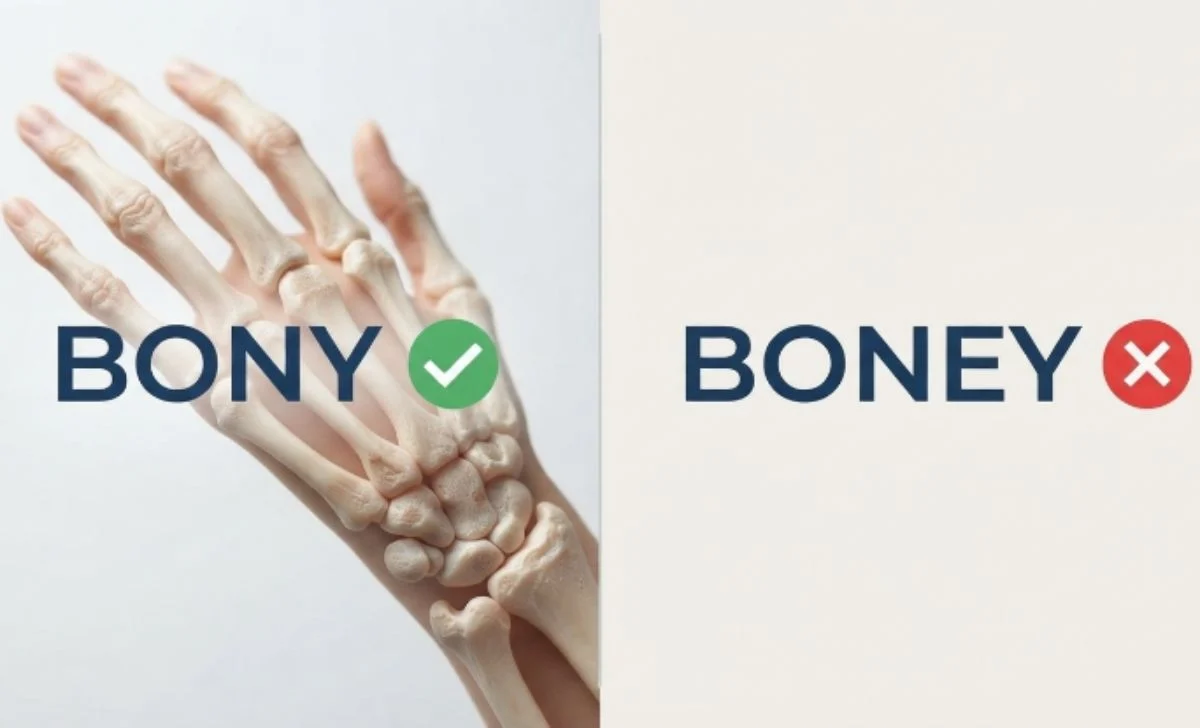
Quick answer: Bony is the standard and much more common spelling when you mean “having prominent bones,” “containing bones,” or “related to bones.”
Boney is a less common variant, but it is not usually the preferred spelling in standard English.
If you have ever wondered whether to write bony or boney, the difference is mainly about standard spelling and usage. In most situations, bony is the word you want.
At a Glance
| Word | Correct? | Meaning | Commonness |
|---|---|---|---|
| Bony | Yes | Having prominent bones; consisting of or relating to bone | Very common |
| Boney | Sometimes used as a variant | Same or similar meaning as bony | Much less common |
What Does Bony Mean?
Bony is an adjective meaning having a noticeable amount of bone, having prominent bones, or relating to bones.
Examples
- The old man’s hands were bony.
- She has a bony face.
- The fish contains several bony parts.
- His shoulders looked unusually bony.
- The doctor examined the bony structure of the joint.
The word bony can describe someone’s physical appearance as well as anatomical structures.
What Does Boney Mean?
Boney can be found as a spelling variant of bony, but it is far less common.
In standard modern English, bony is generally the preferred spelling.
For example:
She has a bony face.
is the normal choice.
Although boney may appear in dictionaries or historical and informal usage, using it instead of bony can look unusual to many readers.
Bony vs Boney: What’s the Difference?
The two words can have essentially the same meaning, but bony is the standard and overwhelmingly more common spelling.
Use bony when you mean:
- having prominent bones
- thin or angular in appearance
- relating to bones
- containing bones
Use boney only when a particular source, name, or established usage specifically calls for it.
For ordinary English writing, bony is the safer choice.
Why Is It Spelled Bony?
Bony is formed from the noun bone with the suffix -y.
bone + y = bony
The spelling changes slightly because the final e of bone is dropped before adding -y.
Compare:
- bone → bony
- stone → stony
- ice → icy
- spice → spicy
This is why boney is not normally the preferred spelling.
Bony as a Description of Appearance
One of the most common uses of bony is to describe a person or animal whose bones are particularly noticeable.
Examples
- He had a bony face with sharp features.
- The dog looked thin and bony.
- Her bony hands rested on the table.
- His knees looked bony beneath his trousers.
Depending on context, bony can be neutral, descriptive, or slightly negative.
Bony in Anatomy and Biology
Bony is also commonly used when discussing the structure of the body.
Examples include:
- bony structure
- bony tissue
- bony prominence
- bony framework
- bony skeleton
Example sentences
- The skull provides a strong bony structure around the brain.
- The doctor noticed a small bony prominence near the joint.
- The skeleton forms the body’s bony framework.
Is Boney Wrong?
Not necessarily.
Boney is an attested variant spelling, but it is uncommon compared with bony. In everyday modern English, especially in formal or professional writing, bony is normally the better choice.
So if you are writing an essay, article, email, school assignment, or website content, choose:
Bony
rather than:
Boney
unless you have a specific reason to use the variant.
Common Mistakes
Incorrect or unusual:
He had a very boney face.
Standard:
He had a very bony face.
Incorrect or unusual:
The doctor examined the boney structure.
Standard:
The doctor examined the bony structure.
Incorrect or unusual:
His hands were extremely boney.
Standard:
His hands were extremely bony.
Bony vs Bone
Don’t confuse bony with bone.
Bone is a noun referring to the hard parts that make up the skeleton.
Bony is an adjective describing something related to, consisting of, or noticeably showing bones.
Compare:
- The bone was broken.
- He has a bony wrist.
Bony vs Boneless
These words have opposite ideas in some contexts.
Bony means containing or showing bones.
Boneless means having the bones removed or lacking bones.
Examples:
- The fish was quite bony.
- We ordered boneless chicken.
- The animal had a bony skeleton.
- The meat was completely boneless.
Pronunciation
Bony is pronounced approximately:
BOH-nee
/ˈbəʊni/ in British English
/ˈboʊni/ in American English
Boney, when pronounced as the spelling variant of bony, is generally pronounced the same way.
So the main difference is spelling and usage, not pronunciation.
British vs American English
There is no major British-American spelling difference here.
Both British and American English commonly use:
bony
The spelling boney is much less common in both varieties.
Therefore, if you are writing for an international audience, bony is the clearest choice.
Synonyms for Bony
Depending on the context, possible synonyms include:
- skeletal
- thin
- angular
- gaunt
- lean
- osseous
- bone-related
However, these words are not always interchangeable.
For example, osseous is a technical medical term meaning relating to bone, while bony is much more general.
A Simple Memory Trick
Remember:
BONE → BONY
Drop the final e and add -y:
bone + y = bony
Think:
Bone becomes bony.
This makes it easy to remember that bony is the standard spelling.
Quick Practice
Choose the correct word:
- The man’s face looked very ___.
- A) bony
- B) boney
- The doctor examined the ___ structure.
- A) boney
- B) bony
- The fish was quite ___.
- A) bony
- B) boney
Answers
- Bony
- Bony
- Bony
Frequently Asked Questions
Is bony or boney correct?
Bony is the standard and much more common spelling. Boney exists as a less common variant, but it is usually not the preferred choice.
Is boney a real word?
Yes. Boney can be found as a variant spelling of bony, although it is considerably less common.
What does bony mean?
Bony means having prominent bones, consisting of or containing bones, or relating to bones.
Is bony an adjective?
Yes. Bony is an adjective.
For example:
He has a bony face.
How do you spell bony?
The standard spelling is B-O-N-Y: bony.
Is bony a negative word?
Not necessarily. Bony is primarily descriptive, but when describing someone’s appearance, it can sometimes sound negative depending on the context.
Does bony mean skinny?
Not exactly. Bony can describe someone whose bones are particularly noticeable, which may occur because they are very thin, but the two words do not have exactly the same meaning.
Final Verdict: Bony or Boney?
Bony is the correct standard choice for most English writing.
Boney is an uncommon variant and may occasionally appear, but it is not normally the spelling you should choose.
Remember:
BONE → BONY
If you mean “having prominent bones” or “related to bones,” bony is the spelling to use.
Read More:

Hi, I’m Safdar Ali, an English language teacher with 26 years of teaching experience. My expertise is in English linguistics, grammar, and the differences between British and American English.
Through Gramiffy, I share practical, research-based guides to help students, writers, and English learners improve their language skills. My goal is to make English simple, accurate, and easy for everyone to understand.