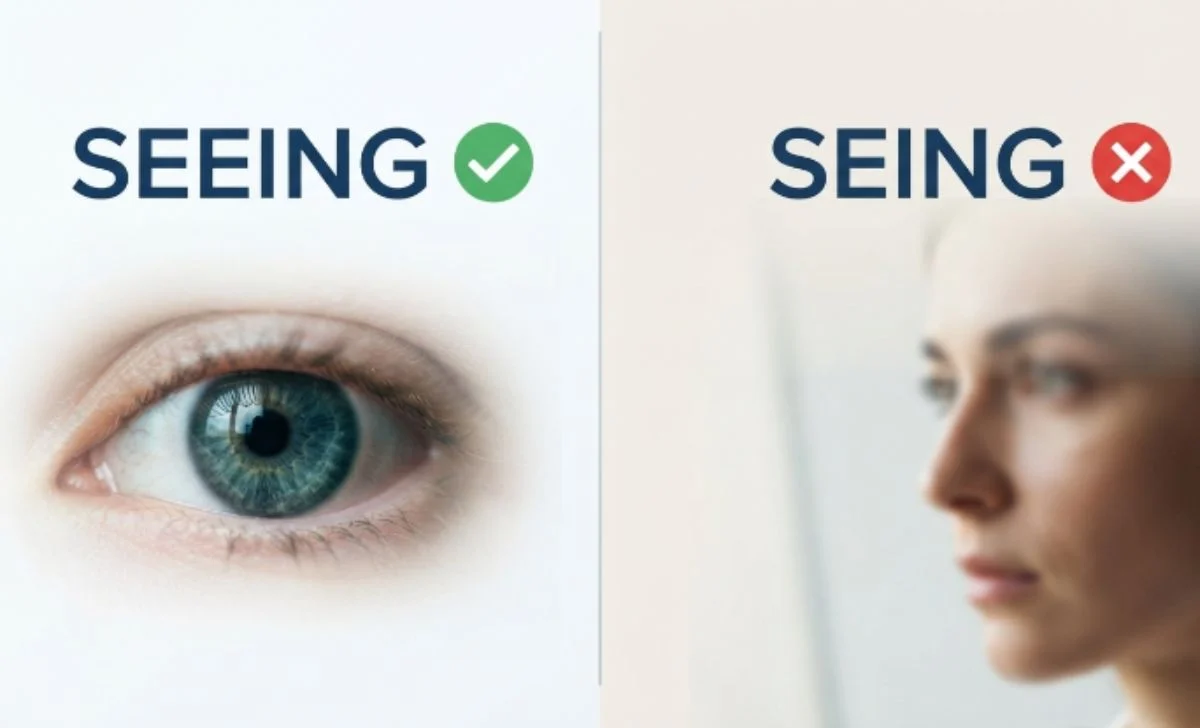
Seing or seeing? If you are unsure which spelling is correct, the answer is simple: seeing is the correct spelling in standard English.
Seing is a common misspelling of seeing.
The confusion happens because the verb see becomes seeing when we add -ing. It may seem natural to remove an e before adding -ing, but see is different from verbs such as write or make.
Seeing = correct
Seing = incorrect
For example:
- Correct: I am seeing a doctor tomorrow.
- Incorrect: I am seing a doctor tomorrow.
Quick Answer: Seing or Seeing?
Seeing is the correct spelling.
The word seeing is the present participle and gerund form of the verb see.
Seing is a misspelling and should not be used in standard English.
| Spelling | Correct? | Example |
|---|---|---|
| seeing | Yes | I am seeing my friend today. |
| seing | No | I am seing my friend today. |
| see | Yes | I can see the mountains. |
| saw | Yes | I saw him yesterday. |
| seen | Yes | I have seen that movie. |
The easiest rule to remember is:
See + ing = seeing
What Does Seeing Mean?
Seeing is the -ing form of the verb see.
The verb see can mean to notice something with your eyes, understand something, meet someone, or experience something.
Examples
- I am seeing a bird outside.
- She is seeing her doctor tomorrow.
- We are seeing a movie tonight.
- He is seeing things differently now.
- I look forward to seeing you again.
The meaning changes according to the context.
Why Is Seeing Spelled With Two Es?
This is the main reason people write seing.
With many English verbs ending in e, the final e is removed before adding -ing.
For example:
- make → making
- write → writing
- take → taking
- dance → dancing
So it is understandable to assume:
see → seing
But see does not follow that pattern.
The word already ends in ee, so both e’s remain when -ing is added:
see + ing = seeing
Therefore:
seeing ✓
seing ✗
See + Ing = Seeing
A simple way to understand the spelling is to look at the word formation:
SEE + ING
Combine them:
SEEING
Nothing is removed.
Compare:
see + ing → seeing
But:
make + ing → making
The difference is important.
With make, the final silent e disappears.
With see, the two e’s remain.
Is Seing a Word?
No. Seing is not the standard spelling of the English word.
It is usually a spelling mistake caused by incorrectly applying the common rule that removes a final e before -ing.
If you mean the -ing form of see, always use:
seeing
For example:
I am seeing my dentist tomorrow.
Not:
I am seing my dentist tomorrow.
Seeing as a Present Participle
Seeing can function as the present participle of see.
It is commonly used with forms of be to create continuous tenses.
Present Continuous
I am seeing what you mean.
Past Continuous
She was seeing a specialist at the time.
Future Context
We will be seeing them tomorrow.
The word remains seeing in each case.
Seeing as a Gerund
Seeing can also work as a gerund, meaning it functions like a noun.
For example:
Seeing is believing.
Here, seeing acts as the subject of the sentence.
Another example:
I enjoy seeing new places.
In this sentence, seeing follows the verb enjoy and functions as a gerund.
Again, the spelling is always seeing, not seing.
Common Meanings of Seeing
1. Looking at Something
I am seeing a beautiful sunset.
Here, seeing means visually noticing something.
2. Meeting Someone
I am seeing John this evening.
Here, seeing means meeting someone.
3. Visiting a Professional
She is seeing a doctor tomorrow.
Here, seeing means visiting or consulting a doctor.
4. Understanding
Now I am seeing the problem.
Here, seeing means understanding.
5. Dating
She is seeing someone new.
Here, seeing can mean being romantically involved with someone.
Seeing vs Looking
Seeing and looking are related, but they are not identical.
See usually describes something that enters your visual awareness.
I can see the mountain.
Look describes deliberately directing your eyes toward something.
Look at the mountain.
Compare:
I am seeing a bird.
I am looking at a bird.
The first focuses on perception. The second focuses on the action of directing your attention.
Seeing vs Watching
Seeing can also be confused with watching.
See often means noticing or perceiving something.
Watch usually means deliberately observing something for a period of time.
For example:
I can see a television from here.
But:
I am watching television.
Similarly:
I saw a movie last night.
In some contexts, especially informal American English, see a movie is completely natural.
Common Phrases With Seeing
Here are some common expressions containing seeing:
- seeing someone
- seeing things
- seeing clearly
- seeing the difference
- seeing the point
- seeing the problem
- seeing the future
- seeing the world
- seeing someone tomorrow
- seeing is believing
- look forward to seeing you
- nice seeing you
- seeing what happens
Examples
I can finally see the difference.
I am seeing my family this weekend.
Seeing is believing.
I look forward to seeing you again.
“Seeing Is Believing” — Why Is It Seeing?
The famous expression is:
Seeing is believing.
Not:
Seing is believing.
Here, seeing is a gerund functioning as a noun.
It means that experiencing or observing something yourself can make it easier to believe.
The spelling remains seeing because it comes from see + ing.
Why Do People Spell Seeing as Seing?
There are several possible reasons.
1. Applying the Wrong -ing Rule
Many learners know that words ending in silent e often drop the e before -ing:
write → writing
They may then apply the same rule to see:
see → seing
But this is incorrect.
2. Pronunciation
Seeing is pronounced as a single word, which can make the second e less noticeable in speech.
3. Typing Quickly
Because seeing is a common word, it is easy to accidentally omit one of the two e’s while typing.
Whatever the reason, the standard spelling is seeing.
Seeing vs Seing Examples
Example 1
Correct:
I am seeing my friend tomorrow.
Incorrect:
I am seing my friend tomorrow.
Example 2
Correct:
She enjoys seeing new places.
Incorrect:
She enjoys seing new places.
Example 3
Correct:
I am seeing what you mean now.
Incorrect:
I am seing what you mean now.
Example 4
Correct:
We look forward to seeing you.
Incorrect:
We look forward to seing you.
The Verb Forms of See
Learning the complete word family can make the spelling easier to remember.
| Verb Form | Word | Example |
|---|---|---|
| Base form | see | I see the car. |
| Third-person singular | sees | She sees the problem. |
| Present participle | seeing | I am seeing the doctor. |
| Past tense | saw | I saw him yesterday. |
| Past participle | seen | I have seen that film. |
Notice that seeing has two consecutive e’s.
The spelling pattern is:
see → seeing
Pronunciation of Seeing
Seeing is pronounced approximately:
/ˈsiːɪŋ/
It sounds roughly like:
SEE-ing
The word contains the long ee sound followed by the -ing sound.
See
/siː/
Seeing
/ˈsiːɪŋ/
Although the spelling contains three consecutive vowels (eei), the pronunciation is straightforward.
Seeing vs Seen
Do not confuse seeing with seen.
Seeing is the -ing form:
I am seeing the doctor.
Seen is the past participle:
I have seen the doctor.
Compare:
She is seeing a movie.
She has seen that movie.
Both are correct, but they are different forms of the verb.
Seeing vs Saw
Saw is the simple past tense of see.
I saw him yesterday.
Seeing is the present participle or gerund.
I am seeing him tomorrow.
These forms should not be mixed up.
| Form | Example |
|---|---|
| see | I see him. |
| saw | I saw him. |
| seen | I have seen him. |
| seeing | I am seeing him. |
American vs British English
There is no spelling difference between British and American English for seeing.
Both use:
seeing
The incorrect spelling seing is not a British alternative or an American alternative.
| British English | American English |
|---|---|
| seeing | seeing |
| see | see |
| saw | saw |
| seen | seen |
So regardless of your audience, use seeing.
Common Mistakes to Avoid
Mistake 1: Writing Seing
Incorrect:
I am seing him tomorrow.
Correct:
I am seeing him tomorrow.
Mistake 2: Removing an E From See
The final e rule does not mean every word ending in e loses that letter before -ing.
With see, keep both e’s:
see + ing = seeing
Mistake 3: Writing “Seing Is Believing”
Incorrect:
Seing is believing.
Correct:
Seeing is believing.
Mistake 4: Confusing Seeing With Seen
Incorrect:
I am seen him.
Correct:
I am seeing him.
Or:
I have seen him.
The correct form depends on the tense.
A Simple Memory Trick
Remember:
SEE has two E’s, and SEEING keeps them both.
Think:
SEE + ING = SEEING
You can also remember the phrase:
Seeing is believing.
The double e is right there in seeing.
Never change it to seing.
When to Use Seeing
Use seeing when:
- describing the action of seeing
- forming a continuous tense with see
- using see as a gerund
- talking about meeting someone
- talking about visiting a professional
- describing understanding or perception
Examples
I am seeing my doctor tomorrow.
She is seeing the problem clearly now.
I enjoy seeing new places.
We are seeing our relatives this weekend.
Seeing the results changed his mind.
Synonyms for Seeing
Depending on the context, seeing can have different alternatives.
Looking or Observing
- viewing
- observing
- watching
- noticing
- looking at
Understanding
- understanding
- realizing
- recognizing
- perceiving
When It Means Meeting
- meeting
- visiting
- consulting
The best synonym depends on the meaning of the sentence.
Word Origin of See
The verb see is a very old English word. It comes from Old English sēon, meaning to perceive with the eyes.
It is related to similar words in other Germanic languages.
Because see is an old irregular verb, its forms do not always follow the simple patterns learners might expect.
Its principal forms are:
see → saw → seen
and its -ing form is:
seeing
Is Seing Ever Correct?
For standard modern English, seing should be treated as a misspelling of seeing.
If you are writing an article, email, assignment, professional document, or social media post, use:
seeing
not:
seing
There are contexts where a sequence of letters resembling seing could occur in another language or as part of a name, but that does not make it the standard English spelling of the verb form.
Frequently Asked Questions
Is seing or seeing correct?
Seeing is correct. Seing is a misspelling.
Why is seeing spelled with two e’s?
Because the base verb is see, and its -ing form is formed as:
see + ing = seeing
The two e’s in see remain.
Is “seing” a word?
Not as the standard English -ing form of see. Use seeing instead.
What is the -ing form of see?
The -ing form of see is seeing.
Why isn’t see changed to seing?
Although many verbs ending in silent e drop the e before -ing, see is not spelled that way. Its standard form is seeing.
Is “seeing is believing” correct?
Yes.
Seeing is believing.
It is a standard English expression.
What is the past tense of see?
The simple past tense is saw.
I saw him yesterday.
What is the past participle of see?
The past participle is seen.
I have seen him before.
Is seeing a verb?
Seeing is the present participle of the verb see. It can also function as a gerund when it acts like a noun.
Is seeing the same in British and American English?
Yes. Both British and American English use seeing.
Quick Practice Quiz
Choose the correct word.
1. I am ______ my doctor tomorrow.
A. seing
B. seeing
Answer: B — seeing
2. ______ is believing.
A. Seing
B. Seeing
Answer: B — Seeing
3. She enjoys ______ new places.
A. seeing
B. seing
Answer: A — seeing
4. We are ______ a movie tonight.
A. seing
B. seeing
Answer: B — seeing
5. I am ______ what you mean now.
A. seeing
B. seing
Answer: A — seeing
Final Verdict: Seing or Seeing?
Seeing is the correct spelling. Seing is a misspelling.
Remember:
SEE + ING = SEEING
The two e’s in see stay when you add -ing.
So write:
I am seeing my friend tomorrow.
Not:
I am seing my friend tomorrow.
If you remember just one thing, remember this:
See has two e’s, and seeing keeps both.
Read More:

Hi, I’m Safdar Ali, an English language teacher with 26 years of teaching experience. My expertise is in English linguistics, grammar, and the differences between British and American English.
Through Gramiffy, I share practical, research-based guides to help students, writers, and English learners improve their language skills. My goal is to make English simple, accurate, and easy for everyone to understand.