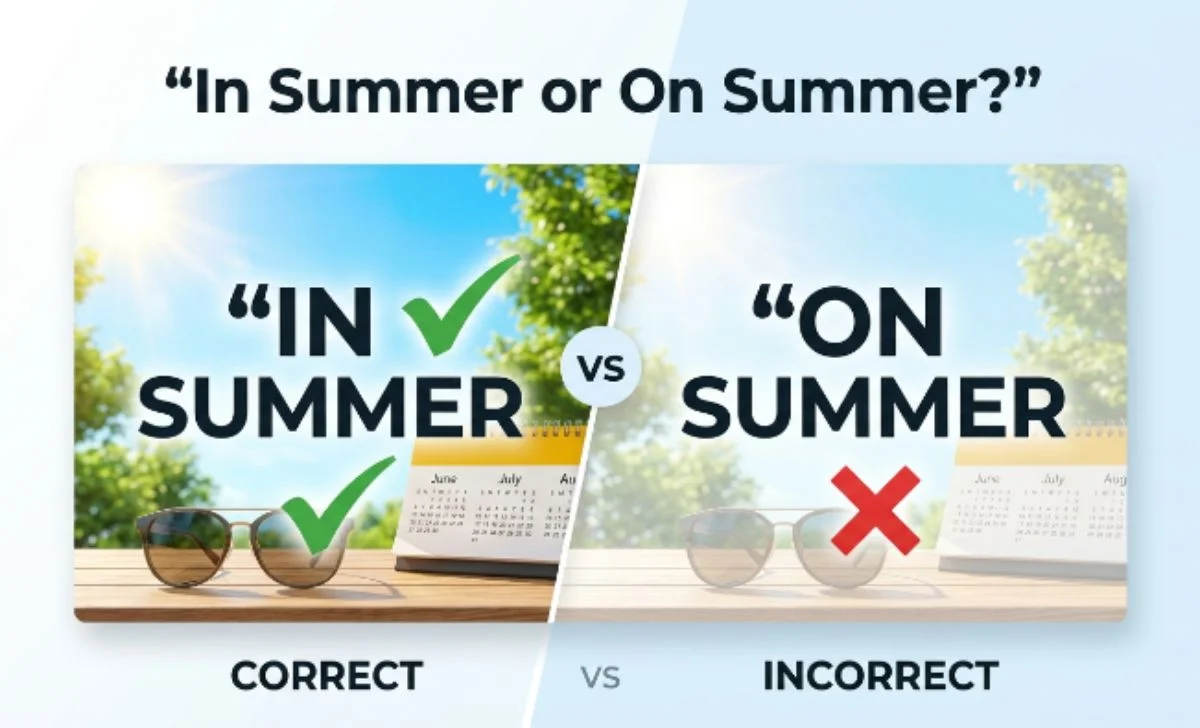
Do you say “in summer” or “on summer”? If you’re talking about the season, the standard expression is in summer.
We use in with seasons because a season is treated as a period of time rather than a particular day.
On is normally used with specific days and dates, such as on Monday or on July 15. So, “I travel in summer” is correct, while “I travel on summer” is not standard English.
The choice can also vary slightly between British and American English, especially when speakers use the summer.
In Summer or On Summer: Quick Answer
In summer is the correct expression when you mean the summer season.
- In summer ✅
- On summer ❌
Examples
- We usually go on vacation in summer.
- It gets very hot in summer.
- Many students take courses in summer.
- I enjoy swimming in summer.
On is not normally used directly before summer when referring to the season.
Why Do We Say “In Summer”?
English uses in for longer periods of time, including:
- Months: in June
- Years: in 2026
- Seasons: in summer
- Parts of the day: in the morning
A season covers a period of several months, so in is the natural preposition.
Compare:
We visit our relatives in summer.
Here, summer refers to the whole season, not one particular day.
When to Use “In Summer”
Use in summer when you’re talking about something that generally happens during the summer season.
General habits
- I wake up earlier in summer.
- We eat more fresh fruit in summer.
- The days are longer in summer.
For weather
- Temperatures rise in summer.
- It often rains heavily in summer in this region.
- The beaches become crowded in summer.
For activities
- We go hiking in summer.
- Children often play outside in summer.
- She takes swimming lessons in summer.
In Summer vs In the Summer
Both in summer and in the summer are correct, but usage differs somewhat by variety and context.
In summer
In summer is especially common in British English.
Examples:
- We usually travel in summer.
- The weather is pleasant in summer.
- Flowers bloom everywhere in summer.
In the summer
In the summer is very common in American English and is also completely natural in British English.
Examples:
- We usually travel in the summer.
- I worked at a restaurant in the summer.
- The town is busy in the summer.
The article the does not make the phrase grammatically wrong. Both forms can refer to the same season.
Why “On Summer” Is Usually Wrong
On is generally associated with particular days and dates rather than seasons.
We say:
- on Monday
- on Friday
- on July 4
- on my birthday
- on Christmas Day
But we say:
- in summer
- in winter
- in spring
- in autumn
So:
❌ I go swimming on summer.
✅ I go swimming in summer.
The problem is not the word summer itself. It is the mismatch between the preposition on and the time period being described.
Prepositions Used With Seasons
The same pattern applies to all four seasons.
| Season | Correct Expression | Example |
|---|---|---|
| Spring | in spring | Flowers appear in spring. |
| Summer | in summer | We travel in summer. |
| Autumn | in autumn | Leaves change color in autumn. |
| Winter | in winter | It gets cold in winter. |
You can also use in the before each season:
- in the spring
- in the summer
- in the autumn
- in the winter
British vs American English
The preposition does not change between British and American English: both varieties use in with a season.
The main difference is often whether speakers include the.
| British English | American English |
|---|---|
| in summer | in the summer |
| in winter | in the winter |
| in spring | in the spring |
| in autumn | in the fall |
For example:
British: We often visit the coast in summer.
American: We often visit the coast in the summer.
Both are standard.
Common Mistakes With Summer
On summer
❌ We have long holidays on summer.
✅ We have long holidays in summer.
At summer
❌ Many tourists arrive at summer.
✅ Many tourists arrive in summer.
In the summer season
This is grammatically possible, but often unnecessary.
Instead of:
We travel more in the summer season.
A more natural sentence is:
We travel more in summer.
or:
We travel more in the summer.
Real-Life Examples
School and education
- Schools often close in summer.
- I usually read more books in the summer.
- The university offers special classes in summer.
Travel
- Hotel prices can increase in summer.
- We plan our family trip in the summer.
- Tourists visit the mountains in summer.
Work
- Business can become busier in summer.
- Our company hires seasonal workers in the summer.
Everyday conversation
- What do you like doing in summer?
- I prefer staying indoors in the summer because of the heat.
- We usually eat outside in summer.
Quick Rule to Remember
Think of time prepositions this way:
- At → a point in time: at noon
- On → a day or date: on Monday
- In → a longer period: in July, in 2026, in summer
So when summer means the season, choose in.
In summer ✅
On summer ❌
Frequently Asked Questions
Is it “in summer” or “on summer”?
In summer is correct when referring to the summer season. On summer is not standard English for this meaning.
Is “in the summer” correct?
Yes. In the summer is completely correct and very common, particularly in American English.
Do British people say “in summer”?
Yes. In summer is a common British English expression.
Do Americans say “in summer”?
Americans commonly say in the summer, although in summer can also occur in appropriate contexts.
Can I say “on a summer day”?
Yes. Here, on is connected to day, not summer.
Example:
We met on a summer day.
Is “during summer” correct?
Yes. During summer means throughout or at some point during the summer period.
Example:
Many people travel during summer.
What is the correct preposition for seasons?
Use in when referring generally to a season:
- in spring
- in summer
- in autumn
- in winter
Conclusion
When summer refers to the season, the correct preposition is in: in summer. You can also say in the summer, and both forms are standard.
On is used with specific days and dates, so on summer is not the normal English expression. The same rule applies to the other seasons: in spring, in autumn, and in winter.
If you’re unsure, remember the basic pattern: in for seasons, on for days and dates, and at for specific points in time.
Read More:

Hi, I’m Safdar Ali, an English language teacher with 26 years of teaching experience. My expertise is in English linguistics, grammar, and the differences between British and American English.
Through Gramiffy, I share practical, research-based guides to help students, writers, and English learners improve their language skills. My goal is to make English simple, accurate, and easy for everyone to understand.