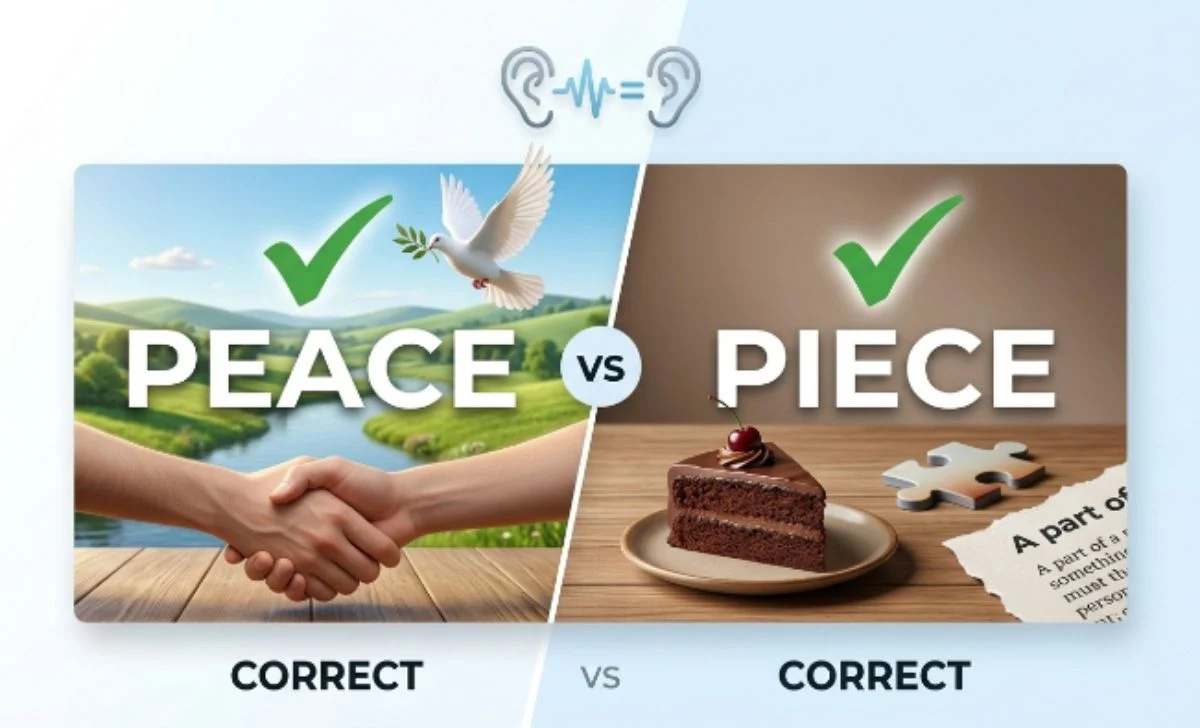
Peace and piece sound exactly the same, but they mean completely different things. This makes them easy to confuse when writing, especially for English learners.
Peace is related to calm, harmony, or the absence of conflict, while piece usually means a part of something that has been divided or separated.
For example, you can make peace with someone, but you can also eat a piece of cake. Once you connect each spelling with its meaning, the difference becomes much easier to remember.
Peace vs Piece: Quick Answer
Peace means a state of calm, harmony, or freedom from conflict.
Piece means a part or portion of something.
| Word | Meaning | Example |
|---|---|---|
| Peace | Calm, harmony, or no conflict | The two countries signed a peace agreement. |
| Piece | A part or portion of something | Can I have a piece of cake? |
Quick rule: Think peace = calm and piece = part.
What Does Peace Mean?
Peace is a noun that describes a state without fighting, violence, conflict, or disturbance. It can also describe a feeling of inner calm.
Common meanings of peace
- Absence of war or conflict
- Agreement between people or groups
- Calmness and quiet
- Freedom from worry or disturbance
Examples
- The countries finally agreed to a peace treaty.
- Everyone wants to live in peace.
- She enjoys the peace and quiet of the countryside.
- He found peace after resolving the argument.
- The organization works to promote world peace.
What Does Piece Mean?
Piece is usually a noun meaning a part of something larger.
It can refer to a physical portion, an individual item, or even a work of art or writing.
Common meanings of piece
- A part of something
- A portion of food
- An individual item
- A work of art, music, or writing
Examples
- I would like a piece of cake.
- She broke the chocolate into small pieces.
- He gave me a piece of useful advice.
- The museum displayed a beautiful piece of artwork.
- I read an interesting piece about climate change.
Peace vs Piece: Key Differences
The two words are homophones, meaning they have the same pronunciation but different spellings and meanings.
| Feature | Peace | Piece |
|---|---|---|
| Part of speech | Noun | Noun |
| Pronunciation | /piːs/ | /piːs/ |
| Main meaning | Calm or absence of conflict | A part or portion |
| Plural | Usually uncountable; peaces is uncommon | Pieces |
| Common phrase | Peace and quiet | A piece of cake |
| Example | We want peace. | I need a piece. |
When to Use Peace
Use peace when talking about harmony, calmness, or the absence of fighting.
Common expressions
- World peace
- Peace treaty
- Peace talks
- Peace agreement
- Peace and quiet
- Keep the peace
- Make peace
- Rest in peace
Real-life examples
- The leaders met for peace talks.
- I just want some peace and quiet.
- They decided to make peace after their argument.
- The police were called to keep the peace.
- The memorial included the words “Rest in peace.”
When to Use Piece
Use piece when you mean a part, portion, or individual example of something.
Common expressions
- A piece of cake
- A piece of paper
- A piece of advice
- A piece of information
- A piece of furniture
- A piece of evidence
- A piece of art
- A piece of music
Real-life examples
- Please give me a piece of paper.
- She offered me a piece of cake.
- That’s an excellent piece of advice.
- The detective found an important piece of evidence.
- He wrote a beautiful piece of music.
Why Are Peace and Piece Confused?
The main reason is pronunciation. Peace and piece are pronounced the same:
/piːs/
You cannot tell which word someone means just by hearing it. Context determines the meaning.
For example:
I need a piece of paper.
Here, piece means a portion or individual sheet.
But:
I need some peace and quiet.
Here, peace means calmness.
The spelling becomes important when you write the sentence.
A Simple Memory Trick
Use this shortcut:
Peace = calm
Piece = part
You can also remember:
A piece is a part.
Both piece and part refer to something that makes up a larger whole.
For peace, think of a dove, quiet surroundings, or the absence of conflict.
Common Mistakes With Peace and Piece
Using piece when you mean peace
❌ The countries are trying to achieve piece.
✅ The countries are trying to achieve peace.
They are discussing an end to conflict, so peace is correct.
Using peace when you mean piece
❌ Can I have a peace of cake?
✅ Can I have a piece of cake?
You’re asking for a portion of cake, so piece is correct.
Confusing “piece of advice”
The correct expression is:
✅ a piece of advice
Not:
❌ a peace of advice
Advice is normally uncountable, so we don’t usually say an advice. Instead, we can refer to a piece of advice.
Peace vs Piece: Common Phrases
| With Peace | With Piece |
|---|---|
| World peace | Piece of cake |
| Peace treaty | Piece of paper |
| Peace talks | Piece of advice |
| Peace and quiet | Piece of information |
| Keep the peace | Piece of evidence |
| Make peace | Piece of furniture |
| Rest in peace | Piece of art |
Learning these fixed expressions is one of the easiest ways to avoid confusing the two words.
Frequently Asked Questions
Is peace and piece the same word?
No. Peace and piece are different words with different meanings, although they have the same pronunciation.
What is the difference between peace and piece?
Peace means calm, harmony, or freedom from conflict. Piece means a part or portion of something.
Is it “a piece of cake” or “a peace of cake”?
The correct expression is a piece of cake.
Is it “peace of mind” or “piece of mind”?
The correct phrase is peace of mind, meaning a feeling of calm or freedom from worry.
Is “piece and quiet” correct?
No. The correct expression is peace and quiet.
How do you pronounce peace and piece?
Both are pronounced /piːs/, like the word “pees.”
Is peace a noun?
Yes. Peace is primarily a noun.
Is piece a noun?
Yes. Piece is commonly used as a noun. It can also be used as a verb, as in to piece something together.
Conclusion
Peace and piece are homophones, so they sound the same but have different meanings and spellings. Use peace for calm, harmony, or the absence of conflict.
Use piece for a part, portion, or individual item. The quickest memory trick is simple: peace = calm; piece = part. So you want peace of mind, but you want a piece of cake.
Once you connect each spelling with its meaning, this common homophone confusion becomes easy to avoid.
Read More:

Hi, I’m Safdar Ali, an English language teacher with 26 years of teaching experience. My expertise is in English linguistics, grammar, and the differences between British and American English.
Through Gramiffy, I share practical, research-based guides to help students, writers, and English learners improve their language skills. My goal is to make English simple, accurate, and easy for everyone to understand.