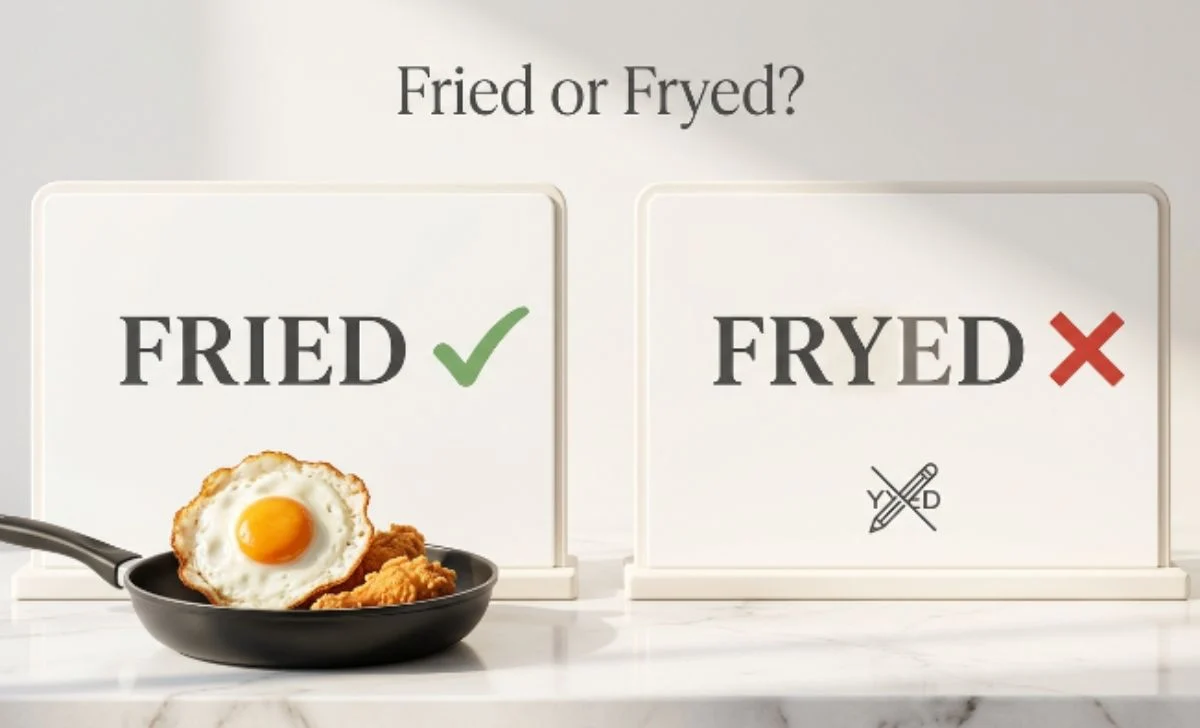
Fried or fryed? If you’ve ever stopped while writing a sentence like “I ___ an egg,” the answer is simple: fried is the correct spelling.
Fried is the past tense and past participle of fry, meaning to cook food in hot oil or fat. Fryed is a common spelling mistake.
The confusion happens because many English verbs simply add -ed in the past tense. But fry ends in a consonant followed by y, so it follows a different spelling rule:
fry → fried
The y changes to i before -ed.
This same pattern appears in words such as:
try → tried
cry → cried
carry → carried
So if you’re talking about food that has been cooked in oil, the correct word is always fried.
The Quick Answer
Fried = correct
Fryed = incorrect
Examples:
I fried two eggs for breakfast.
She fried the chicken in hot oil.
We had fried rice for dinner.
Incorrect:
❌ I fryed two eggs.
Correct:
✅ I fried two eggs.
| Word | Correct? | Meaning |
|---|---|---|
| fried | Yes | Past tense/past participle of fry |
| fryed | No | Common spelling error |
What Does Fried Mean?
Fried is the past tense and past participle of the verb fry.
To fry means to cook food in hot oil, fat, or another cooking medium.
For example:
I fried an egg this morning.
They fried the potatoes until they were crispy.
She has fried the chicken already.
The word can also appear as an adjective:
fried chicken
fried rice
fried eggs
fried potatoes
deep-fried fish
In these phrases, fried describes food that has been cooked by frying.
Why Is “Fryed” Wrong?
The mistake comes from applying the most common English past-tense pattern:
verb + -ed
A learner might think:
fry + ed = fryed
But verbs ending in consonant + y usually change y to i before adding -ed.
Therefore:
fry → fried
The same rule gives us:
cry → cried
dry → dried
try → tried
study → studied
carry → carried
This is why fryed is not the standard spelling.
Fry → Fried: The Spelling Rule
Here’s the rule in its simplest form:
Consonant + y → change y to i + ed
So:
fry → fried
try → tried
cry → cried
dry → dried
marry → married
But there is an important exception.
When a verb ends in vowel + y, the y stays.
For example:
play → played
enjoy → enjoyed
stay → stayed
Why?
Because play ends in ay, and ay contains a vowel before the y.
So:
fry → fried
but:
play → played
Fried vs Fryed: Side-by-Side
| Feature | Fried | Fryed |
|---|---|---|
| Standard English? | Yes | No |
| Root verb | fry | fry |
| Past tense | Correct | Incorrect |
| Past participle | Correct | Incorrect |
| Used as adjective | Yes | No |
| Example | fried chicken | ❌ fryed chicken |
There is no standard modern-English situation in which fryed should replace fried.
Grammar Forms of Fry
The verb fry is irregular in spelling but regular in its basic grammatical pattern.
| Form | Word | Example |
|---|---|---|
| Base form | fry | I fry eggs. |
| Third-person singular | fries | She fries eggs. |
| Present participle | frying | He is frying eggs. |
| Past tense | fried | He fried an egg. |
| Past participle | fried | The eggs were fried. |
Notice the spelling changes:
fry → fries
fry → frying
fry → fried
Why Is It “Fried” but “Frying”?
This can confuse learners because the spelling rules are different.
Past tense
The y changes to i:
fry + ed → fried
Present participle
The y stays:
fry + ing → frying
So:
fried
but:
frying
Not:
❌ fryed
and not:
❌ friing
Pronunciation
Fried is pronounced:
FRYED
IPA:
/fraɪd/
It sounds like the word “fry” followed by a d sound.
Interestingly, the incorrect spelling fryed would usually be intended to represent the same pronunciation. The problem is the spelling, not the sound.
Singular and Plural Forms
Fried is not normally a noun, so it does not have a regular singular/plural distinction.
Instead, the noun describing the food changes.
For example:
one fried egg
two fried eggs
Here, fried remains unchanged while egg becomes plural.
Similarly:
one fried potato
several fried potatoes
The adjective fried does not become frieds.
Fried as an Adjective
Fried is commonly used as a past participle functioning as an adjective.
Examples:
fried chicken
fried rice
fried onions
fried fish
fried potatoes
fried noodles
In these expressions, fried tells us how the food was prepared.
Fried vs Deep-Fried
These terms are related but not always identical.
Fried is a broad term for cooking food in hot oil or fat.
Deep-fried usually means the food is completely or mostly submerged in hot oil.
For example:
The potatoes were fried in a pan.
The chicken wings were deep-fried in oil.
Both involve frying, but the cooking method can differ.
British vs American English
There is no spelling difference between British and American English.
Both use:
fried
And both reject:
❌ fryed
Examples:
British English:
We had fried fish for dinner.
American English:
We had fried fish for dinner.
The spelling is identical.
Word Origin
The verb fry comes through Middle English and Old French, ultimately tracing back to Latin frigere, meaning to roast, fry, or parch.
The modern English forms developed over centuries.
The spelling fried follows the established English pattern for verbs ending in consonant + y.
So the modern relationship is:
fry → fried
rather than:
fry → fryed
Common Phrases With Fried
You’ll frequently see fried in food-related expressions:
- fried chicken
- fried rice
- fried egg
- fried fish
- fried potatoes
- fried onions
- fried noodles
- fried vegetables
- fried cheese
- deep-fried food
- stir-fried vegetables
- pan-fried fish
Examples:
We ordered fried rice.
She made fried eggs for breakfast.
The restaurant serves excellent fried chicken.
Common Mistakes
Mistake 1: Writing “fryed”
❌ I fryed the eggs.
✅ I fried the eggs.
This is the most common mistake with this word.
Mistake 2: Writing “friied”
❌ The potatoes were friied.
✅ The potatoes were fried.
Only one i is needed.
Mistake 3: Writing “fried” for the present tense
❌ I fried eggs every morning.
If you mean a regular present habit, use:
I fry eggs every morning.
If you’re talking about something you did in the past:
I fried eggs yesterday.
Mistake 4: Confusing fried and frying
I am frying the eggs now.
I fried the eggs earlier.
Frying describes an action happening now or around the present time.
Fried describes a completed action or the resulting food.
Everyday Examples
Breakfast
I fried two eggs this morning.
Restaurant
We ordered fried chicken and rice.
Dinner
She fried the vegetables in a little oil.
Cooking
The onions were fried until golden brown.
Past action
He fried the fish before serving it.
Present action
He is frying the fish now.
These examples show why context and tense matter.
Synonyms and Related Words
There isn’t always a perfect synonym for fried, but depending on the cooking method, you might use:
- cooked
- sautéed
- pan-fried
- deep-fried
- stir-fried
- browned
- crisped
These words are not always interchangeable.
For example, deep-fried describes a particular technique, while fried is broader.
A Simple Memory Trick
Remember this:
Fry has a consonant before Y → change Y to I
So:
fry → fried
Think of these together:
cry → cried
try → tried
fry → fried
They all follow the same pattern.
A second shortcut:
You fry food, and you fried food.
Never:
❌ You fryed food.
Practice Exercise
Choose the correct word.
1.
I _____ an egg for breakfast yesterday.
A. fryed
B. fried
2.
She is _____ potatoes right now.
A. frying
B. fried
3.
We ordered _____ chicken.
A. fryed
B. fried
4.
He _____ the fish in a large pan.
A. fried
B. fryed
5.
The restaurant serves _____ rice.
A. fried
B. fryed
Answers
- fried
- frying
- fried
- fried
- fried
People Also Ask
Is it fried or fryed?
Fried is the correct spelling. Fryed is incorrect.
Why is fry spelled fried in the past tense?
Because verbs ending in a consonant followed by y generally change y to i before -ed.
fry → fried
Is fryed a word?
No. Fryed is not the standard English past tense or past participle of fry.
What is the past tense of fry?
The past tense is fried.
She fried the eggs.
What is the past participle of fry?
The past participle is also fried.
The eggs have been fried.
Is fried an adjective?
Yes. Fried can function as an adjective:
fried chicken
fried rice
fried eggs
Is frying correct?
Yes. Frying is the present participle of fry.
The cook is frying the fish.
FAQs
How do you spell fried?
The correct spelling is fried: F-R-I-E-D.
Is “fryed chicken” correct?
No. The correct phrase is fried chicken.
Why doesn’t fried keep the y?
Because fry ends in a consonant + y. The y changes to i before -ed.
What is the difference between fried and frying?
Fried is the past tense/past participle of fry. Frying is the present participle.
She fried the eggs.
She is frying the eggs.
Is fried the same in British and American English?
Yes. Both British and American English spell it fried.
What is the third-person form of fry?
The third-person singular is fries.
He fries eggs every morning.
Final Verdict
If you’re choosing between fryed or fried, there is no real contest:
FRIED = correct
FRYED = incorrect
The spelling follows a simple English rule:
fry → fried
The y changes to i before -ed.
The same pattern appears in:
try → tried
cry → cried
dry → dried
And remember that the present participle is different:
fry → frying
So you can confidently write:
I fried an egg.
We ordered fried chicken.
She is frying potatoes.
Once you remember the y → i rule, you’ll never need to hesitate over fried again.
Read More:

Hi, I’m Safdar Ali, an English language teacher with 26 years of teaching experience. My expertise is in English linguistics, grammar, and the differences between British and American English.
Through Gramiffy, I share practical, research-based guides to help students, writers, and English learners improve their language skills. My goal is to make English simple, accurate, and easy for everyone to understand.