When I search for the right eye care professional, I often come across three confusing terms: optometrist, ophthalmologist, and optician. Many people use these words as if they have the same meaning, but each professional has a different role in protecting and improving eye health.
I may wonder whether I should visit an optometrist for blurry vision, glasses, contact lenses, or whether an ophthalmologist is needed for a serious eye problem or surgery.
This confusion is common because all of these professionals work in the field of eye care, but their training, responsibilities, and services are different.
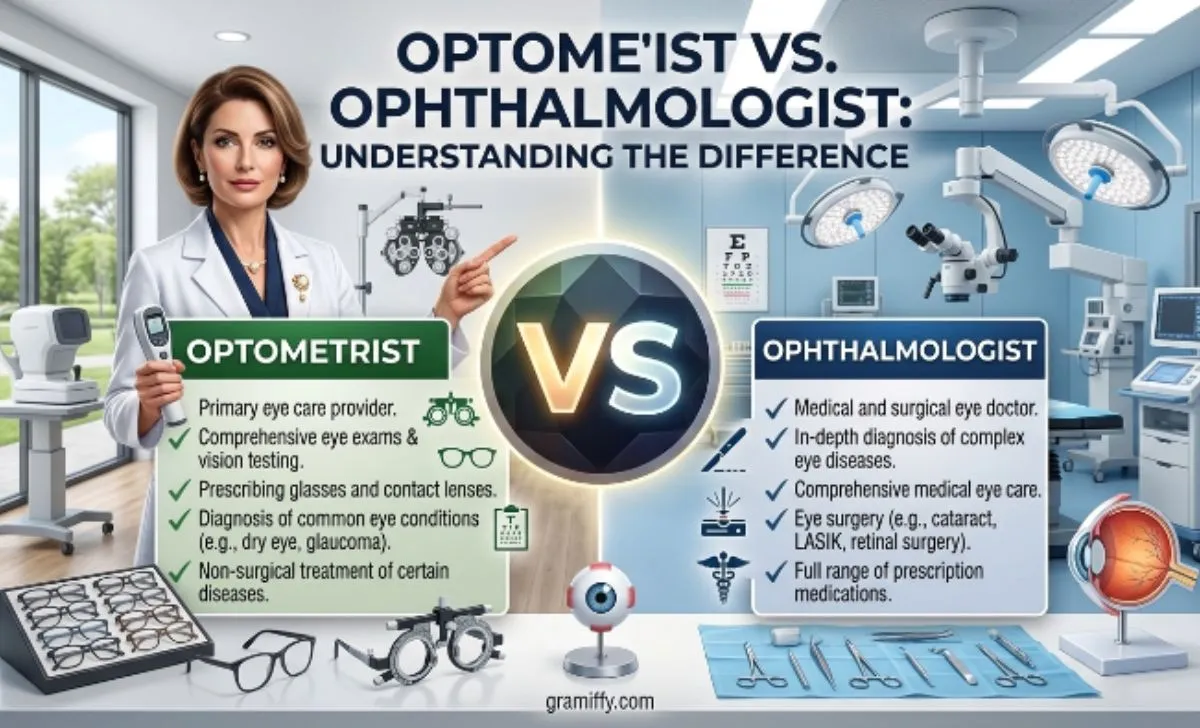
The basic difference is simple: an optometrist focuses on vision care, eye examinations, and corrective lenses, while an ophthalmologist is a medical doctor who diagnoses eye diseases and performs eye surgery.
In this guide, I will explore the differences between an optometrist and an ophthalmologist, explain their roles, compare their education and services, and help you understand which eye specialist is the right choice for different situations.
Optometrist vs Ophthalmologist: Quick Answer
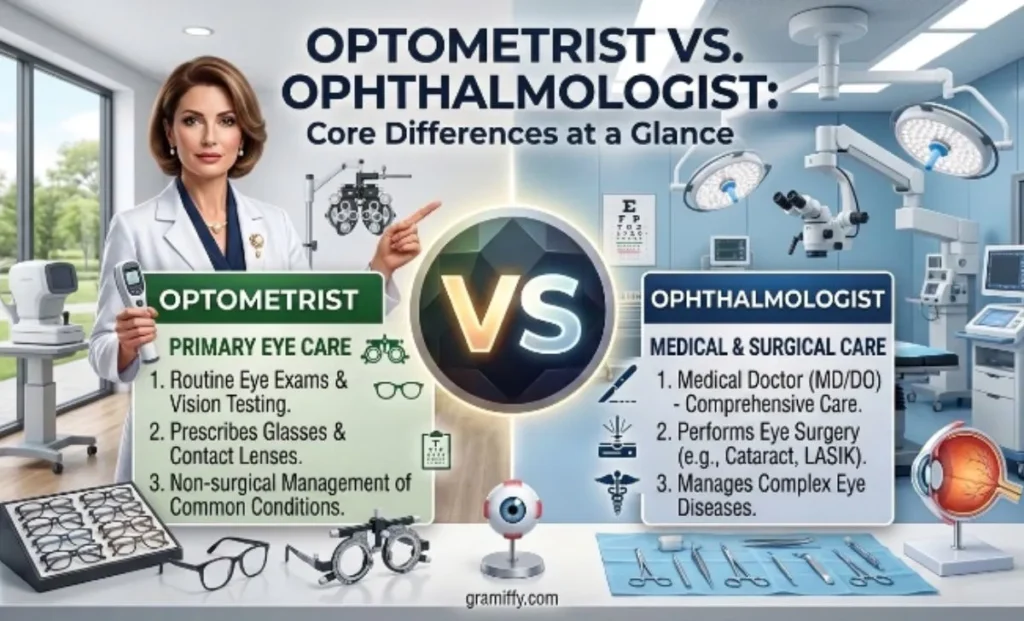
The short answer is:
| Optometrist | Ophthalmologist |
|---|---|
| Provides primary eye care | Provides medical and surgical eye care |
| Performs eye exams | Diagnoses and treats complex eye diseases |
| Prescribes glasses and contact lenses | Performs eye surgery |
| Usually earns an optometry degree | Earns a medical degree plus specialized training |
| Treats many common vision problems | Treats serious eye conditions |
An easy way to remember the difference:
Optometrist = Vision care and routine eye health
Ophthalmologist = Medical eye specialist and eye surgeon
Both professionals play important roles in maintaining eye health. The right choice depends on your specific needs.
For example:
- Need a routine eye exam? → Optometrist
- Need glasses or contact lenses? → Optometrist
- Have cataracts, glaucoma, or need eye surgery? → Ophthalmologist
- Have a serious eye injury or complex eye condition? → Ophthalmologist
What Does an Optometrist Mean?
An optometrist is an eye care professional who examines vision, provides vision correction, and manages many common eye conditions.
Optometrists are usually the first professionals people visit when they experience changes in their vision. They perform comprehensive eye examinations, check eye health, identify vision problems, and recommend appropriate solutions.
Unlike ophthalmologists, optometrists are not medical doctors in most countries. However, they receive specialized training in eye care and play an important role in detecting eye problems early.
Optometrist Definition
Optometrist (noun):
A healthcare professional trained to examine eyes, test vision, prescribe corrective lenses, and manage certain eye conditions.
The word comes from the field of optometry, which focuses on measuring vision and maintaining eye health.
What Does an Optometrist Do?
Optometrists provide many essential eye care services.
Their responsibilities commonly include:
Performing Eye Examinations
One of the main roles of an optometrist is conducting eye exams.
During an eye examination, an optometrist may check:
- Visual clarity
- Eye coordination
- Depth perception
- Eye pressure
- General eye health
- Signs of possible eye diseases
Regular eye exams can help detect problems before they become serious.
Prescribing Glasses and Contact Lenses
Optometrists commonly prescribe:
- Eyeglasses
- Contact lenses
- Specialty lenses
- Vision correction solutions
They measure how well a person sees and determine the correct prescription.
For example:
- A person with blurry distance vision may need glasses for nearsightedness.
- Someone who struggles with reading may need lenses for farsightedness.
- A person with age-related vision changes may need multifocal lenses.
Diagnosing Common Eye Problems
Optometrists can identify and manage many common vision conditions, including:
- Nearsightedness (myopia)
- Farsightedness (hyperopia)
- Astigmatism
- Age-related vision changes
- Dry eyes
- Minor eye infections
- Some forms of eye allergies
If they discover a serious condition requiring advanced treatment, they may refer the patient to an ophthalmologist.
Monitoring Eye Health
Optometrists also monitor changes in eye health over time.
Regular visits can help detect warning signs of conditions such as:
- Glaucoma
- Cataracts
- Retinal problems
- Other eye diseases
Early detection is important because many eye conditions develop slowly without obvious symptoms.
Optometrist Education and Training
The education required to become an optometrist varies by country.
Generally, optometrists complete:
- University-level education
- Specialized optometry training
- Clinical experience
- Professional licensing requirements
Their training focuses on:
- Vision science
- Eye anatomy
- Eye examinations
- Contact lenses
- Vision correction
- Common eye conditions
Although optometrists are highly trained eye care professionals, their education differs from that of medical doctors.
What Does an Ophthalmologist Mean?
An ophthalmologist is a medical doctor who specializes in eye health, eye diseases, and eye surgery.
Ophthalmologists receive extensive medical training that allows them to diagnose, treat, and manage a wide range of eye conditions.
They can provide many of the same services as optometrists, but they also have the authority and training to perform surgical procedures.
Ophthalmologist Definition
Ophthalmologist (noun):
A medical doctor who specializes in diagnosing and treating eye diseases, performing eye surgery, and providing advanced eye care.
Because ophthalmologists are physicians, they can treat both vision problems and medical conditions affecting the eyes.
What Does an Ophthalmologist Do?
Ophthalmologists provide advanced eye care services.
Diagnosing Eye Diseases
Ophthalmologists diagnose and treat many serious eye conditions, including:
- Cataracts
- Glaucoma
- Retinal diseases
- Corneal disorders
- Eye injuries
- Diabetic eye disease
- Macular degeneration
They use specialized equipment and medical knowledge to manage complex eye problems.
Performing Eye Surgery
One of the biggest differences between optometrists and ophthalmologists is surgical ability.
Ophthalmologists can perform procedures such as:
- Cataract surgery
- LASIK and other vision correction procedures
- Retinal surgery
- Glaucoma surgery
- Corneal procedures
These treatments require advanced medical and surgical training.
Managing Complex Eye Conditions
Ophthalmologists often treat patients who need specialized care.
For example:
- A person with advanced glaucoma may need medication, laser treatment, or surgery.
- Someone with cataracts may require a surgical procedure.
- A patient with a serious eye injury may need emergency medical treatment.
Ophthalmologist Education and Training
Ophthalmologists follow a longer medical training pathway.
Generally, they complete:
- A medical degree
- General medical training
- Specialized ophthalmology training
- Clinical practice
- Professional licensing
Their training includes:
- Eye diseases
- Medical diagnosis
- Surgery
- Eye anatomy
- Advanced treatments
- Patient care
This medical background allows them to provide both non-surgical and surgical eye care.
Optician vs Optometrist vs Ophthalmologist
Many people confuse optician, optometrist, and ophthalmologist because all three work in the field of eye care. However, their roles are different.
A simple way to understand their relationship is:
Ophthalmologist → Medical treatment and eye surgery
Optometrist → Vision testing and primary eye care
Optician → Glasses and lens preparation
Each professional supports different parts of the eye care process.
What Does an Optician Do?
An optician is an eye care professional who helps people choose and prepare eyeglasses and other vision correction products.
Unlike optometrists and ophthalmologists, opticians usually do not diagnose eye diseases or perform eye examinations. Instead, they work with prescriptions provided by optometrists or ophthalmologists.
Optician Definition
Optician (noun):
A trained professional who prepares, fits, and adjusts eyeglasses and other optical devices based on a prescription.
Services Provided by Opticians
Opticians commonly help with:
- Selecting eyeglass frames
- Measuring facial features for proper fitting
- Adjusting glasses
- Replacing lenses
- Explaining lens options
- Repairing eyewear
Example Sentences
- The optician helped her choose a new pair of glasses.
- He visited an optician after receiving a prescription from his eye doctor.
- The optician adjusted the frames to make them more comfortable.
Key Differences Between Optometrist and Ophthalmologist
Although both optometrists and ophthalmologists care for the eyes, their education, responsibilities, and treatment abilities are different.
The biggest differences involve:
- Medical training
- Diagnosis abilities
- Treatment options
- Surgery
- Scope of practice
Education and Training Comparison
The education pathway is one of the clearest differences between these two professions.
Optometrist Training
Optometrists complete specialized training in optometry.
Their education usually focuses on:
- Vision testing
- Eye examinations
- Corrective lenses
- Contact lenses
- Basic eye disease management
- Vision science
They become experts in evaluating vision and providing primary eye care.
Ophthalmologist Training
Ophthalmologists complete medical training because they are physicians.
Their education generally includes:
- Medical school
- Medical residency
- Ophthalmology specialization
- Surgical training
- Advanced disease management
This medical background allows them to treat complex eye conditions and perform surgery.
Education Comparison Table
| Category | Optometrist | Ophthalmologist |
|---|---|---|
| Professional type | Eye care specialist | Medical doctor |
| Main degree | Optometry degree | Medical degree + ophthalmology training |
| Medical school | Usually no | Yes |
| Surgical training | No or limited | Extensive |
| Primary focus | Vision and routine eye care | Medical and surgical eye treatment |
Services Comparison
Both professionals provide important eye care services, but their responsibilities are not identical.
Services an Optometrist Provides
Optometrists commonly provide:
- Comprehensive eye exams
- Vision testing
- Glasses prescriptions
- Contact lens prescriptions
- Vision correction advice
- Monitoring of eye health
- Management of certain common eye conditions
Services an Ophthalmologist Provides
Ophthalmologists commonly provide:
- Complete eye examinations
- Diagnosis of eye diseases
- Prescription medications
- Eye disease management
- Eye surgery
- Emergency eye treatment
- Advanced medical procedures
Treatment and Surgery Differences
One of the most important differences between optometrists and ophthalmologists is their ability to perform surgery.
Optometrist Treatment
Optometrists mainly focus on non-surgical care, including:
- Vision correction
- Contact lenses
- Eye health monitoring
- Management of some eye conditions
Depending on the country and local regulations, some optometrists may also provide limited medical treatments.
Ophthalmologist Treatment
Ophthalmologists can provide both medical and surgical treatment.
They may perform procedures such as:
- Cataract surgery
- LASIK vision correction
- Glaucoma procedures
- Retina surgery
- Corneal surgery
Their medical training allows them to manage more complex conditions.
Optometrist vs Ophthalmologist Comparison Table
| Feature | Optometrist | Ophthalmologist |
|---|---|---|
| Main role | Primary eye care provider | Medical eye specialist |
| Checks vision | Yes | Yes |
| Prescribes glasses | Yes | Yes |
| Prescribes contact lenses | Yes | Yes |
| Diagnoses eye diseases | Many common conditions | Complex conditions |
| Performs surgery | Usually no | Yes |
| Treats serious eye diseases | Limited | Yes |
| Medical doctor | Usually no | Yes |
| Emergency eye care | Limited | Yes |
Which Eye Doctor Should You Visit?
Choosing between an optometrist and ophthalmologist depends on your symptoms and needs.
Visit an Optometrist For:
An optometrist is usually the right choice for:
- Routine eye exams
- Getting glasses
- Getting contact lenses
- Vision changes
- Blurry vision
- Basic eye health checks
- Regular monitoring
Example:
Someone who notices that road signs look blurry may visit an optometrist for a vision test and glasses prescription.
Visit an Ophthalmologist For:
An ophthalmologist is usually the better choice for:
- Eye surgery
- Serious eye diseases
- Cataracts
- Glaucoma
- Retina problems
- Severe eye injuries
- Complex vision problems
Example:
Someone diagnosed with cataracts may need an ophthalmologist for evaluation and possible surgery.
When Should You See Both?
Sometimes, patients benefit from care from both professionals.
For example:
A person may visit an optometrist for regular eye examinations and glasses. If the optometrist notices signs of a serious condition, they may refer the patient to an ophthalmologist for specialized treatment.
This teamwork creates a complete eye care system where each professional contributes their expertise.
Eye Care Team Comparison
| Professional | Main Responsibility |
|---|---|
| Optician | Makes and adjusts glasses |
| Optometrist | Tests vision and provides primary eye care |
| Ophthalmologist | Treats eye diseases and performs surgery |
Types of Eye Conditions They Treat
Understanding which professional treats which eye condition can help you make a better decision when seeking eye care. While both optometrists and ophthalmologists work with vision and eye health, their level of involvement depends on the complexity of the condition.
An optometrist usually handles routine vision problems and many common eye conditions. An ophthalmologist manages more serious diseases, advanced treatments, and surgical procedures.
Conditions Commonly Managed by Optometrists
Optometrists often provide the first level of care for many vision-related issues.
Nearsightedness (Myopia)
Myopia is a common vision condition where distant objects appear blurry, while nearby objects remain clearer.
Optometrists diagnose myopia through eye examinations and usually correct it with:
- Glasses
- Contact lenses
- Vision correction advice
Example:
A student who cannot clearly read a classroom board may visit an optometrist for a vision test.
Farsightedness (Hyperopia)
Hyperopia affects the ability to see nearby objects clearly.
Optometrists can identify this condition and recommend suitable corrective lenses.
Example:
Someone who struggles to read small text may need an eye examination and prescription lenses.
Astigmatism
Astigmatism occurs when the eye does not focus light evenly, which can cause blurry or distorted vision.
Optometrists commonly manage astigmatism with:
- Prescription glasses
- Specialized contact lenses
Presbyopia
Presbyopia is an age-related vision change that makes it harder to focus on nearby objects.
It commonly affects adults as they get older.
Optometrists often help manage presbyopia through:
- Reading glasses
- Multifocal lenses
- Contact lens options
Dry Eyes
Dry eye occurs when the eyes do not produce enough tears or when tears evaporate too quickly.
Optometrists may recommend:
- Lubricating eye drops
- Lifestyle changes
- Further evaluation if needed
Conditions Commonly Treated by Ophthalmologists
Ophthalmologists specialize in diagnosing and treating more complex eye diseases.
Cataracts
A cataract occurs when the natural lens of the eye becomes cloudy, affecting vision.
Symptoms may include:
- Blurry vision
- Difficulty seeing at night
- Increased sensitivity to light
An ophthalmologist can evaluate cataracts and perform cataract surgery when necessary.
Glaucoma
Glaucoma refers to a group of eye diseases that can damage the optic nerve.
Because glaucoma may develop slowly, regular eye examinations are important.
Ophthalmologists may use:
- Prescription medications
- Laser treatments
- Surgical procedures
to manage the condition.
Retinal Diseases
The retina is the light-sensitive layer at the back of the eye.
Ophthalmologists treat conditions affecting the retina, including:
- Retinal tears
- Retinal detachment
- Certain retinal disorders
These conditions often require specialized medical care.
Macular Degeneration
Macular degeneration affects the central part of vision and is more common with aging.
Ophthalmologists help diagnose and manage this condition using advanced medical treatments.
Diabetic Eye Disease
People with diabetes may develop eye complications over time.
Ophthalmologists monitor and treat diabetes-related eye problems to help protect vision.
Eye Injuries
Serious eye injuries require medical evaluation.
An ophthalmologist may treat:
- Eye trauma
- Foreign objects in the eye
- Damage requiring surgery
When to See an Optometrist or Ophthalmologist
Choosing the right eye specialist depends on the situation.
Visit an Optometrist If You Need:
- A routine eye examination
- New glasses
- Contact lenses
- A vision prescription
- A basic eye health check
- Monitoring of common vision problems
Visit an Ophthalmologist If You Need:
- Eye surgery
- Treatment for serious eye disease
- Specialized medical care
- Management of complex conditions
- Emergency treatment for severe eye problems
British English vs American English
The terms optometrist and ophthalmologist are used in both British and American English. However, the broader language around eye care professionals can vary slightly between regions.
Unlike some spelling differences between British and American English, these professional titles remain mostly the same.
Usage Differences
American English
In American English, people commonly use:
- Optometrist
- Ophthalmologist
- Eye doctor
The term eye doctor is a general expression that may refer to either an optometrist or an ophthalmologist.
For example:
- “I need to see an eye doctor for a vision test.”
- “My ophthalmologist recommended surgery.”
British English
British English also uses:
- Optometrist
- Ophthalmologist
- Eye doctor
However, people may also commonly use the term optician when talking about glasses and eyewear services.
For example:
- “I need to visit the optician to get new glasses.”
- “The ophthalmologist treated my eye condition.”
British English vs American English Comparison Table
| Feature | British English | American English |
|---|---|---|
| Vision testing professional | Optometrist | Optometrist |
| Medical eye specialist | Ophthalmologist | Ophthalmologist |
| Glasses provider in daily speech | Optician | Optician / Optical store |
| General term | Eye doctor | Eye doctor |
Which Term Should You Use?
The correct term depends on what you mean.
Use:
- Optometrist → when discussing vision tests, glasses, or routine eye care.
- Ophthalmologist → when discussing medical treatment or eye surgery.
- Optician → when discussing glasses fitting, adjustments, or eyewear.
For professional and academic writing, use the specific term instead of the general phrase eye doctor.
Word Origin and History
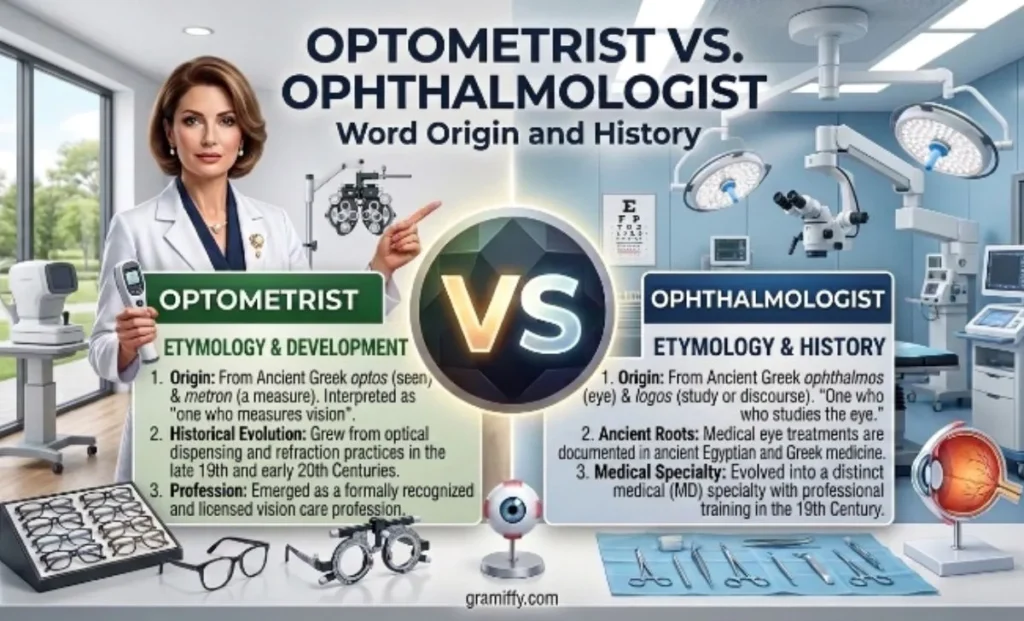
The history of these words explains why they refer to different areas of eye care.
Origin of “Optometrist”
The word optometrist comes from two Greek-based elements:
- Opto- meaning “vision” or “sight”
- -metry meaning “measurement”
The word originally referred to someone who measures vision.
Over time, optometry developed into a specialized healthcare profession focused on vision testing, correction, and primary eye care.
Origin of “Ophthalmologist”
The word ophthalmologist comes from the Greek word:
ophthalmos, meaning “eye.”
The suffix -logist means a specialist or person who studies a particular field.
Therefore, an ophthalmologist is literally an eye specialist.
The term reflects the profession’s focus on diagnosing and treating diseases of the eye.
Origin of “Optician”
The word optician comes from the same optical family of words related to vision and sight.
Historically, opticians focused on creating and fitting optical devices. Today, they continue to specialize in eyewear preparation and fitting.
Synonyms and Related Medical Terms
The words optometrist and ophthalmologist have specific meanings, so they do not have many direct synonyms. However, several related terms are commonly used when discussing eye care professionals and vision health.
Understanding these related words helps you communicate more accurately and avoid confusion.
Optometrist Related Terms
Eye Care Professional
Eye care professional is a broad term that includes anyone who provides services related to vision and eye health.
It may include:
- Optometrists
- Ophthalmologists
- Opticians
Example:
- An eye care professional can help identify vision problems early.
Vision Specialist
A vision specialist is a general term for someone who focuses on eyesight and visual health.
The term may refer to an optometrist or another eye care provider depending on the context.
Example:
- She visited a vision specialist because her eyesight had changed.
Primary Eye Care Provider
An optometrist is often described as a primary eye care provider because many people visit them first for routine eye care.
They provide:
- Vision testing
- Eye examinations
- Glasses prescriptions
- Contact lens services
Example:
- The optometrist served as his primary eye care provider for many years.
Ophthalmologist Related Terms
Eye Physician
An eye physician refers to a doctor who specializes in medical care for the eyes.
Because ophthalmologists are medical doctors, this term can describe their role.
Example:
- The eye physician recommended further testing.
Eye Surgeon
An eye surgeon is a common term for an ophthalmologist who performs surgical procedures.
Examples include:
- Cataract surgery
- Laser eye procedures
- Retinal surgery
Example:
- The eye surgeon explained the procedure before treatment.
Medical Eye Specialist
A medical eye specialist is a general description of an ophthalmologist who treats eye diseases and performs advanced procedures.
Example:
- The patient was referred to a medical eye specialist.
Eye Care Vocabulary
Learning related eye care terms makes this topic easier to understand.
| Term | Meaning |
|---|---|
| Vision | The ability to see |
| Eye examination | A professional assessment of eye health and eyesight |
| Prescription | The measurement used for corrective lenses |
| Contact lenses | Thin lenses placed directly on the eye |
| Glasses | Corrective lenses worn in frames |
| Retina | The light-sensitive layer at the back of the eye |
| Cornea | The clear front surface of the eye |
| Lens | The structure that focuses light inside the eye |
| Optic nerve | The nerve that sends visual information to the brain |
| Cataract | Clouding of the eye lens |
| Glaucoma | A group of diseases that can damage the optic nerve |
Common Collocations
Collocations are words that naturally appear together in English. Learning common eye care collocations helps your writing sound more natural and professional.
Common Optometrist Collocations
| Collocation | Meaning |
|---|---|
| Visit an optometrist | Go for eye care services |
| Optometrist appointment | Scheduled visit with an optometrist |
| Optometrist examination | Eye testing performed by an optometrist |
| Optometrist prescription | Vision prescription provided by an optometrist |
| Licensed optometrist | Qualified and certified optometrist |
Examples
- I need to schedule an optometrist appointment next week.
- She visited an optometrist for a routine eye examination.
- A licensed optometrist checked his vision.
Common Ophthalmologist Collocations
| Collocation | Meaning |
|---|---|
| See an ophthalmologist | Visit an eye medical specialist |
| Ophthalmologist appointment | Scheduled medical eye visit |
| Ophthalmologist consultation | Medical discussion with an eye specialist |
| Ophthalmologist surgeon | Specialist who performs eye surgery |
| Ophthalmologist treatment | Medical care provided by an ophthalmologist |
Examples
- The doctor referred him to an ophthalmologist.
- She had an ophthalmologist consultation after developing vision problems.
- The ophthalmologist recommended surgery.
Common Eye Care Collocations
| Collocation | Meaning |
|---|---|
| Eye exam | Professional check of vision and eye health |
| Eye disease | Medical condition affecting the eyes |
| Eye health | Overall condition of the eyes |
| Vision problems | Difficulties with seeing clearly |
| Corrective lenses | Glasses or contacts used to improve vision |
| Eye surgery | Surgical treatment involving the eyes |
Examples
- Regular eye exams can help detect problems early.
- Good eye health is important at every age.
- Corrective lenses can improve vision quality.
Grammar Rules and Usage Tips
Using optometrist and ophthalmologist correctly requires understanding how these professional titles work in sentences.
Use “an” Before Optometrist and Ophthalmologist
Both words begin with vowel sounds, so they use the article an.
Correct:
- She visited an optometrist.
- He consulted an ophthalmologist.
Incorrect:
- She visited a optometrist.
- He consulted a ophthalmologist.
Use Singular and Plural Forms Correctly
Singular
- An optometrist
- An ophthalmologist
Plural
- Optometrists
- Ophthalmologists
Examples:
- The optometrist performed an eye exam.
- Many optometrists provide contact lens services.
- The ophthalmologist treated the condition.
- Several ophthalmologists attended the medical conference.
Use Specific Terms Instead of “Eye Doctor” When Necessary
The phrase eye doctor is understandable, but it is less precise.
For general conversation:
✅ I need to see an eye doctor.
For professional writing:
✅ I need to see an ophthalmologist for cataract treatment.
✅ I visited an optometrist for a vision examination.
Common Mistakes
Many people use these terms incorrectly because they assume all eye professionals perform the same tasks.
Mistake 1: Thinking Optometrists and Ophthalmologists Are the Same
❌ An optometrist and ophthalmologist have identical training.
✅ They both work in eye care but have different education and responsibilities.
Mistake 2: Calling an Optician an Eye Doctor
❌ An optician diagnoses eye diseases.
✅ An optician mainly prepares and adjusts glasses and eyewear.
Mistake 3: Visiting the Wrong Specialist
❌ Going to an optometrist for immediate eye surgery.
✅ Seeing an ophthalmologist for surgical treatment.
Mistake 4: Using “Optometrist” for Every Eye Problem
Optometrists handle many eye care needs, but serious diseases may require an ophthalmologist.
Mistake 5: Using “Ophthalmologist” When Only Glasses Are Needed
For routine vision testing and glasses, an optometrist is often the appropriate choice.
Real Life Examples
Everyday Situations
Example 1: Getting New Glasses
Situation:
A person notices blurry vision while reading.
Correct choice:
Visit an optometrist.
Why?
An optometrist can perform an eye examination and provide a glasses prescription.
Example 2: Cataract Treatment
Situation:
An older adult develops cloudy vision caused by cataracts.
Correct choice:
Visit an ophthalmologist.
Why?
An ophthalmologist can evaluate the condition and perform surgery if needed.
Example 3: Contact Lenses
Situation:
Someone wants to start wearing contact lenses.
Correct choice:
Visit an optometrist.
Why?
Optometrists commonly provide contact lens examinations and prescriptions.
Example 4: Serious Eye Injury
Situation:
A person experiences a severe eye injury.
Correct choice:
Visit an ophthalmologist or emergency medical service.
Why?
Serious injuries may require medical treatment or surgery.
Academic and Professional Examples
- Researchers studied how optometrists contribute to primary eye care.
- The hospital hired additional ophthalmologists to manage complex eye diseases.
- The patient received a referral from an optometrist to an ophthalmologist.
- Healthcare systems depend on cooperation between opticians, optometrists, and ophthalmologists.
Memory Tricks
Simple memory techniques can help you remember the difference.
Memory Trick 1: Focus on the Word
Optometrist → Optometry → Measuring vision
Think:
“Optometrist checks how well you see.”
Memory Trick 2: Remember “Ophthalmo”
The word ophthalmologist contains ophthalmo, which comes from a Greek word related to the eye.
Think:
“Ophthalmologist = eye medical specialist.”
Memory Trick 3: Remember the Care Level
Optician → Glasses
Optometrist → Vision
Ophthalmologist → Disease and Surgery
This simple order covers most situations.
FAQs
1. What is the main difference between an optometrist and an ophthalmologist?
The main difference is their level of training and the type of eye care they provide. An optometrist focuses on vision testing, glasses, contact lenses, and many common eye conditions. An ophthalmologist is a medical doctor who can diagnose complex eye diseases and perform eye surgery.
2. Is an optometrist a medical doctor?
In most countries, an optometrist is not a medical doctor. However, optometrists receive specialized training in eye care and vision science.
3. Is an ophthalmologist a doctor?
Yes. An ophthalmologist is a medical doctor who completes specialized training in eye health, diseases, and surgery.
4. Should I visit an optometrist or ophthalmologist for glasses?
For glasses and routine vision testing, an optometrist is usually the right choice. They can examine your vision and provide a prescription for corrective lenses.
5. Should I visit an ophthalmologist for contact lenses?
Usually, an optometrist can help with contact lenses. However, an ophthalmologist may become involved if you have an eye disease or a complex vision condition.
6. Can an optometrist diagnose eye diseases?
Yes. Optometrists can detect and manage many common eye conditions. If they identify a serious problem, they may refer the patient to an ophthalmologist.
7. Can an optometrist perform surgery?
Generally, optometrists do not perform major eye surgeries. Surgical procedures are usually performed by ophthalmologists.
8. Can ophthalmologists prescribe glasses?
Yes. Ophthalmologists can prescribe glasses and contact lenses, but they mainly focus on medical and surgical eye care.
9. What does an optician do?
An optician prepares, fits, and adjusts glasses and other optical products based on a prescription from an optometrist or ophthalmologist.
10. Is an optician the same as an optometrist?
No. An optician and optometrist have different roles. An optometrist examines eyes and provides vision care, while an optician focuses on eyewear preparation and fitting.
11. Who should I see for blurry vision?
For general blurry vision, start with an optometrist. They can perform an eye examination and determine whether you need glasses or further medical care.
12. Who should I see for cataracts?
An ophthalmologist is the appropriate specialist for cataracts because they can diagnose the condition and perform cataract surgery if needed.
13. Who treats glaucoma?
Both optometrists and ophthalmologists may be involved in glaucoma care. However, ophthalmologists often manage advanced glaucoma cases and surgical treatments.
14. Who treats retinal problems?
Retinal conditions are usually managed by ophthalmologists, especially specialists who focus on retinal diseases and surgery.
15. Are optometrists and ophthalmologists equally qualified?
They are qualified in different areas. Optometrists specialize in vision care, while ophthalmologists specialize in medical and surgical eye care.
16. Which eye professional should I visit for an eye exam?
Both optometrists and ophthalmologists can perform eye examinations. For a routine exam, an optometrist is often the first choice.
17. What is the difference between an eye doctor and an ophthalmologist?
“Eye doctor” is a general term that may refer to an optometrist or ophthalmologist. An ophthalmologist specifically refers to a medical doctor specializing in eye care.
18. Can an optometrist refer me to an ophthalmologist?
Yes. If an optometrist detects a condition requiring advanced medical treatment, they can refer you to an ophthalmologist.
19. How often should I visit an eye care professional?
The recommended frequency depends on your age, health, vision needs, and risk factors. Regular eye examinations help detect problems early.
20. What happens during an optometrist appointment?
An optometrist may check:
- Vision clarity
- Eye coordination
- Eye pressure
- Eye health
- Need for glasses or contact lenses
21. What happens during an ophthalmologist appointment?
An ophthalmologist may perform:
- Medical eye examinations
- Disease diagnosis
- Treatment planning
- Surgical evaluation
22. Can an ophthalmologist treat vision problems?
Yes. Ophthalmologists can treat vision problems, but they also handle more complex medical conditions.
23. Are optometrists cheaper than ophthalmologists?
The cost depends on location, insurance, services, and the complexity of treatment. Routine vision care is often less expensive than specialized medical procedures.
24. Can children visit an optometrist?
Yes. Children can visit optometrists for vision testing and eye health checks.
25. When should children see an ophthalmologist?
Children may need an ophthalmologist if they have serious eye conditions, eye injuries, or specialized treatment needs.
Practice Quiz
Test your knowledge of optometrist vs ophthalmologist.
1. Who usually provides glasses prescriptions?
A. Optician
B. Optometrist
C. Surgeon
Answer: B. Optometrist
2. Who can perform eye surgery?
A. Optometrist
B. Ophthalmologist
C. Optician
Answer: B. Ophthalmologist
3. Who mainly adjusts and prepares glasses?
A. Optician
B. Ophthalmologist
C. Optometrist
Answer: A. Optician
4. Which professional is a medical doctor?
A. Optometrist
B. Ophthalmologist
C. Optician
Answer: B. Ophthalmologist
5. Someone needs a routine eye exam. Who should they usually visit first?
A. Optometrist
B. Eye surgeon
C. Optician
Answer: A. Optometrist
Final Comparison Table
| Feature | Optometrist | Ophthalmologist | Optician |
|---|---|---|---|
| Main role | Primary eye care | Medical eye care | Eyewear services |
| Eye exams | Yes | Yes | No |
| Glasses prescription | Yes | Yes | No |
| Contact lenses | Yes | Yes | No |
| Diagnoses eye diseases | Many common conditions | Complex conditions | No |
| Performs surgery | Usually no | Yes | No |
| Medical doctor | Usually no | Yes | No |
| Makes glasses | No | No | Yes |
Final Verdict
The choice between an optometrist and ophthalmologist depends on your eye care needs.
Choose an optometrist for routine vision care, eye examinations, glasses, contact lenses, and many common vision problems. They are often the first eye care professional people visit.
Choose an ophthalmologist for serious eye diseases, medical treatment, advanced diagnosis, and eye surgery. Because ophthalmologists are medical doctors, they can provide a higher level of specialized care.
Remember this simple rule:
Optometrist = Vision care
Ophthalmologist = Medical eye care and surgery
Optician = Glasses and eyewear
All three professionals work together to support healthy vision. Understanding their differences helps you choose the right person for your specific eye care needs.
Conclusion
Understanding the difference between an optometrist and ophthalmologist removes a common source of confusion in eye care. Although both professionals help people maintain healthy vision, their education, responsibilities, and services are different.
An optometrist is usually the best choice for regular eye examinations, vision testing, glasses, and contact lenses. An ophthalmologist is the right specialist for complex eye diseases, advanced treatments, and surgical procedures.
The term eye doctor is often used broadly, but choosing the more specific professional can make your eye care experience more effective. Whether you need a simple vision check or specialized medical treatment, knowing the difference between these eye care experts helps you make a better decision.
Good eye health depends on regular care, early detection, and choosing the right specialist when needed.
Read More:

I am Constance Hale, an, editor, and writing expert dedicated to helping people write with clarity and confidence. Through my articles on Gramiffy.com, I simplify grammar, spelling, and language usage for readers of all levels. My goal is to make English writing more engaging, accurate, and enjoyable.