
The words prison and jail are often used interchangeably, but they do not mean the same thing. Both refer to places where people are held under legal authority, yet each serves a different purpose within the criminal justice system.
Understanding this distinction is important for students, writers, journalists, English learners, and anyone who wants to use legal vocabulary accurately.
Many people search for prison vs jail because they are unsure which word fits a particular situation. For example, should someone who has just been arrested be described as being in jail or prison?
Is a county jail the same as a state prison? Does British English use these words in the same way as American English? These questions create confusion because television shows, movies, and casual conversations often use both terms as if they were identical.
In reality, the difference usually depends on the stage of the legal process, the expected length of detention, and the type of correctional facility involved.
A jail is generally intended for temporary detention, while a prison is designed for people serving longer sentences after a court conviction.
Although legal systems vary from one country to another, this distinction applies in most English-speaking regions, particularly in the United States.
This guide explains the difference between prison and jail in simple English. Along the way, you’ll learn their meanings, legal definitions, origins, grammar rules, British and American usage, synonyms, antonyms, common collocations, practical examples, frequently asked questions, and expert writing tips.
By the end of the article, you’ll know exactly when to use each word with confidence.
Prison vs Jail: Quick Answer
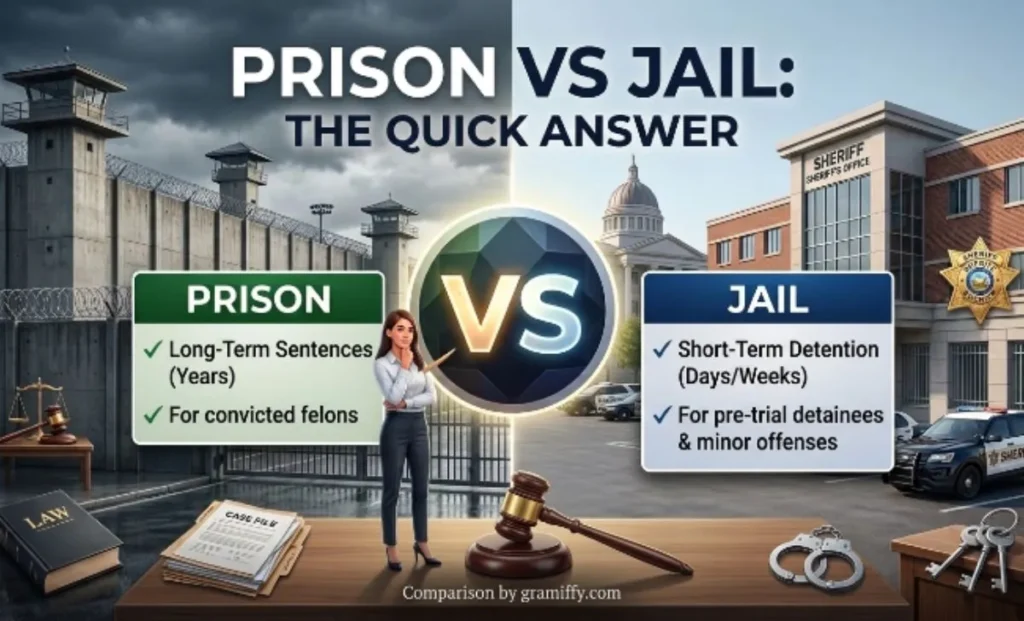
If you only need a short explanation, remember this rule:
- A jail is usually a local facility used for temporary detention.
- A prison is generally a state or federal facility where people serve longer court-ordered sentences after a conviction.
In most situations, people stay in jail after an arrest, while waiting for trial, while waiting for sentencing, or while serving a shorter sentence. By contrast, people usually enter prison after a judge orders a longer sentence following a criminal conviction.
Although the terms are closely related, they are not interchangeable in legal English. Choosing the correct word makes your writing more accurate and helps readers understand the legal situation immediately.
Prison vs Jail Comparison Table
| Feature | Prison | Jail |
|---|---|---|
| Primary purpose | Long-term confinement | Temporary detention |
| Typical length of stay | Usually years | Usually days, weeks, or months |
| Legal stage | After conviction | Before trial or for shorter sentences |
| Managed by | State or federal authorities | Local authorities |
| Rehabilitation programs | Common | Usually limited |
| Security levels | Multiple | Generally fewer |
Quick Examples
Jail
- Police took the suspect to jail after the arrest.
- She remained in jail until her bail hearing.
- Lawyers visited their clients at the county jail.
Prison
- The judge sentenced him to eight years in prison.
- She completed several educational courses while in prison.
- The state prison introduced a new rehabilitation program.
Quick Memory Trick
A simple way to remember the difference is:
Arrest → Jail → Court → Prison
This sequence does not describe every legal case, but it works as an easy memory aid. If a person receives a longer sentence after a court conviction, they may move from jail to prison.
What Does Prison Mean?
A prison is a secure correctional facility where people serve longer sentences after being convicted by a court. Unlike a jail, a prison is built for long-term confinement and often provides structured programs that support education, vocational training, healthcare, counseling, and rehabilitation.
Modern prisons are designed not only to maintain security but also to prepare people for a successful return to society. As a result, many correctional systems include opportunities for learning new skills, completing academic courses, receiving medical care, and participating in rehabilitation programs.
Prison Definition
Prison (noun):
A secure correctional institution where people serve longer court-ordered sentences after a criminal conviction.
Main Characteristics of a Prison
A prison generally:
- Holds people serving longer sentences.
- Operates under state or federal authority.
- Uses different security classifications.
- Provides educational and vocational programs.
- Offers healthcare and mental health services.
- Supports rehabilitation and reintegration initiatives.
- Maintains long-term housing arrangements.
Types of Prisons
Not every prison operates in the same way. Many countries classify prisons according to security requirements.
Minimum Security Prison
Minimum-security prisons usually have fewer physical restrictions and place a stronger emphasis on education, employment, and rehabilitation.
Medium Security Prison
Medium-security prisons provide greater supervision while continuing to offer educational and rehabilitation opportunities.
Maximum Security Prison
Maximum-security prisons house individuals who require the highest level of security. These facilities use stricter movement controls and enhanced safety procedures.
Example Sentences
- The judge sentenced him to ten years in prison.
- She completed a vocational training course while in prison.
- The prison introduced new mental health services.
- Visitors must follow strict security procedures before entering the prison.
- The government announced funding to improve prison facilities.
- Researchers studied rehabilitation programs in several state prisons.
What Does Jail Mean?
A jail is a local detention facility where people usually stay for a shorter period. It plays an important role during the early stages of the criminal justice process and is commonly used after an arrest or before a court reaches a final decision.
People may stay in jail while waiting for trial, waiting for sentencing, or serving a relatively short sentence. Because many people enter and leave every day, jails generally experience a much higher turnover than prisons.
Jail Definition
Jail (noun):
A local detention facility used for temporary confinement during legal proceedings or for shorter court-ordered sentences.
Main Characteristics of a Jail
A jail typically:
- Is managed by local authorities.
- Holds people temporarily.
- Receives new arrivals every day.
- Supports court-related detention.
- Houses people serving shorter sentences.
- Processes regular releases and transfers.
- Has a higher turnover than prisons.
Types of Jails
Although people often think of jails as one type of facility, several different forms exist.
County Jail
A county jail serves one or more local communities and is commonly found in the United States. It holds people awaiting court proceedings or serving shorter sentences.
City Jail
A city jail is operated by a municipality and usually holds people for a brief period before release or transfer.
Holding Cell
A holding cell is a secure room inside a police station or detention facility where someone may stay temporarily while authorities complete legal or administrative procedures.
Example Sentences
- Police took the suspect to jail after the arrest.
- She remained in jail until the court hearing.
- The county jail expanded its medical services.
- Lawyers met with their clients in the local jail.
- Family members visited him while he was in jail.
- The jail processes hundreds of new arrivals every month.
Key Differences Between Prison and Jail
Although prison and jail both refer to correctional facilities, they are designed for different purposes. Understanding these differences makes it much easier to choose the correct word in speaking and writing.
The distinction is based on four main factors:
- Purpose
- Length of stay
- Legal status
- Management
Let’s examine each one in detail.
Purpose
The primary purpose of a jail is temporary detention. People may stay there after an arrest, while waiting for trial, while waiting for sentencing, or while serving a relatively short sentence.
A prison, by contrast, is intended for people serving longer sentences after a court has convicted them. Many prisons also provide education, vocational training, counseling, healthcare, and rehabilitation programs.
Length of Stay
One of the easiest ways to distinguish the two facilities is by considering how long someone usually stays there.
People generally remain in jail for a short period. Depending on the legal situation, that stay may last a few hours, several days, a few weeks, or a few months.
People in prison usually serve much longer sentences that may last several years or, in some cases, even longer.
Legal Status
The legal status of the person is another important difference.
Many people in jail are still going through the legal process. Some are waiting for trial, some are waiting for sentencing, and others are serving shorter court-ordered sentences.
People in prison have generally been convicted by a court and are serving longer sentences.
Management
Management also differs.
Jails are commonly operated by local governments, such as counties or municipalities.
Prisons are usually managed by state or federal correctional authorities.
Services and Programs
Because prisons house people for longer periods, they often provide more structured services.
These may include:
- Academic education
- Vocational training
- Mental health support
- Medical care
- Rehabilitation programs
- Career preparation
- Reentry planning
Jails also provide essential services, but their shorter-term role usually limits the range of long term programs.
Prison vs Jail: Detailed Comparison Table
| Feature | Prison | Jail |
|---|---|---|
| Purpose | Long-term confinement | Temporary detention |
| Typical stay | Years | Days, weeks, or months |
| Court status | Usually after conviction | Often before trial or sentencing |
| Managed by | State or federal government | Local government |
| Security | Multiple security levels | Usually lower security |
| Education programs | Common | Limited |
| Rehabilitation | Extensive | Limited |
| Population turnover | Lower | Higher |
| Daily admissions | Fewer | More frequent |
Word Origin and History

Understanding where these words come from makes their meanings easier to remember.
Origin of “Prison”
The word prison comes from the Old French word prisoun, which developed from the Latin word prehensio, meaning a seizure or act of taking someone into custody.
The word entered Middle English several centuries ago and gradually became the standard term for a secure place where courts send people to serve longer sentences.
Today, prison remains the preferred legal term in many English-speaking countries.
Origin of “Jail”
The word jail also comes from Old French.
It developed from jaiole (or related historical spellings), meaning a cage or place of confinement.
Interestingly, gaol was once the standard spelling in British English. Over time, however, jail became the dominant spelling in American English, while modern British English gradually shifted toward using prison in everyday and official communication.
As a result, gaol now appears mainly in historical texts, older legal documents, and discussions of language history.
Why Do People Confuse These Words?
Several reasons explain the confusion.
First, television shows and movies often use prison and jail interchangeably, even when legal professionals would choose one term over the other.
Second, different countries organize their correctional systems differently.
Finally, everyday conversations usually focus on the general idea of legal custody instead of the technical legal distinction.
Because of these factors, many people assume the words always mean exactly the same thing.
British English vs American English
Although both varieties of English recognize the words prison and jail, their usage differs.
Understanding these regional differences helps you write naturally for your audience.
Usage Differences
American English
American English clearly distinguishes between jail and prison.
A jail usually refers to a local detention facility used before trial or for shorter sentences.
A prison usually refers to a state or federal correctional institution where people serve longer sentences after conviction.
Examples
- The suspect remained in jail until the trial.
- The judge sentenced her to six years in prison.
- The county jail houses people awaiting court hearings.
- The federal prison offers vocational education programs.
British English
British English generally prefers the word prison.
Although jail is still understood, it appears much less often in modern newspapers, official documents, and everyday conversation.
Instead, British speakers commonly use prison in situations where Americans might choose either prison or jail.
Examples
- He was sent to prison for five years.
- She was released from prison last month.
- The prison service announced several reforms.
- Visitors must follow prison regulations.
British English vs American English Comparison
| Feature | British English | American English |
|---|---|---|
| Preferred everyday word | Prison | Prison and jail |
| Use of “jail” | Less common | Very common |
| Legal distinction | Less noticeable | Clearly defined |
| Official terminology | Mainly prison | Prison and jail |
| Historical spelling | Gaol (historical) | Jail |
Which Word Should You Use?
The correct choice depends on both the legal situation and your audience.
Use jail when referring to temporary detention in American English.
Use prison when discussing longer sentences after conviction.
If you’re writing for an international audience, briefly explaining the distinction helps avoid confusion.
For British readers, prison is usually the more natural choice.
Criminal Justice Process
Understanding the criminal justice process makes the difference between prison and jail much easier to remember. Although every legal case follows its own path, most cases move through a similar sequence of events.
Knowing where each facility fits within this process helps you choose the correct word in conversations, news articles, essays, and professional writing.
Step 1: Arrest
The process usually begins when law enforcement officers arrest a person because they believe a crime has been committed.
After the arrest, officers explain the legal reason for taking the person into custody and begin the necessary administrative procedures.
Step 2: Booking
After the arrest, the person goes through booking.
During booking, authorities typically:
- Record personal information.
- Take fingerprints and photographs.
- Document the alleged offense.
- Create an official record.
- Collect personal belongings for safekeeping.
Depending on the local system, booking may take place at a police station or a local jail.
Step 3: Temporary Detention
After booking, the person may remain in jail while waiting for the next stage of the legal process.
The length of this stay depends on several factors, including the seriousness of the case, court schedules, and bail decisions.
Step 4: Court Proceedings
The court then reviews the case.
Depending on the circumstances, the judge may:
- Release the person.
- Grant bail.
- Schedule another hearing.
- Continue the legal proceedings.
- Reach a verdict after trial.
Not everyone who enters a jail later goes to prison.
Step 5: Sentencing
If the court finds someone guilty and orders a longer sentence, that person may be transferred to prison.
However, if the sentence is short or another legal outcome applies, the person may never enter a prison.
Criminal Justice Process at a Glance
| Stage | Typical Location |
|---|---|
| Arrest | Police custody |
| Booking | Police station or jail |
| Bail hearing | Court |
| Trial | Court |
| Sentencing | Court |
| Long-term sentence | Prison |
Simple Timeline
Arrest → Booking → Jail → Court → Prison (if a longer sentence is imposed)
This timeline is a helpful learning tool, although legal procedures differ from one country to another.
Synonyms and Related Words
Expanding your vocabulary helps you avoid repetition and communicate more naturally. While prison and jail have different meanings, several related words appear frequently in legal, academic, and news writing.
Prison Synonyms
| Word | Meaning | Common Context |
|---|---|---|
| Correctional facility | General term for a secure institution | Formal writing |
| Correctional institution | Official or legal term | Government reports |
| Penitentiary | A prison, especially in North America | American English |
| Secure facility | Protected correctional institution | General usage |
Examples
- The correctional facility introduced new education programs.
- Researchers visited several correctional institutions.
- The federal penitentiary expanded its vocational training.
- The secure facility upgraded its security systems.
Jail Synonyms
| Word | Meaning | Common Context |
|---|---|---|
| County jail | Local detention facility | American English |
| City jail | Municipal detention facility | Local government |
| Holding cell | Temporary secure room | Police stations |
| Detention center | Temporary detention facility | General legal writing |
Examples
- Lawyers met their client at the county jail.
- Officers placed the suspect in a holding cell.
- The detention center expanded its healthcare services.
- The city jail introduced new visitor guidelines.
Related Legal Terms
These words often appear in discussions about correctional facilities.
| Term | Meaning |
|---|---|
| Inmate | A person living in a correctional facility |
| Prisoner | A person whose freedom has been legally restricted |
| Detainee | A person held temporarily by legal authorities |
| Custody | Legal supervision or control |
| Bail | Temporary release under legal conditions |
| Remand | Court-ordered detention until a future hearing |
| Correctional officer | Staff member responsible for supervising correctional facilities |
| Rehabilitation | Programs that support successful reintegration into society |
Example Sentences
- The inmate completed a vocational training course.
- The detainee appeared before the judge the next morning.
- The court granted bail after reviewing the evidence.
- The correctional officer explained the facility’s rules.
- Rehabilitation programs can help people prepare for life after release.
Antonyms
Although prison and jail do not have direct opposites, several words express the opposite idea of legal confinement.
These words commonly appear in legal documents, academic writing, and everyday English.
Common Antonyms
| Word | Meaning |
|---|---|
| Freedom | Living without confinement |
| Liberty | Personal freedom protected by law |
| Release | Permission to leave legal custody |
| Independence | Living without legal restrictions |
Example Sentences
- She regained her freedom after completing her sentence.
- The court approved his release.
- Liberty remains an important legal principle.
- He rebuilt his independent life after leaving prison.
Antonyms Comparison Table
| Correctional Term | Opposite Idea |
|---|---|
| Confinement | Freedom |
| Detention | Release |
| Custody | Liberty |
| Incarceration | Independence |
Common Collocations
Collocations are words that naturally occur together. Learning these combinations makes your English sound more fluent and professional.
Common Prison Collocations
| Collocation | Meaning |
|---|---|
| Prison sentence | A longer sentence ordered by a court |
| Prison cell | A room inside a prison |
| Prison officer | A staff member who supervises people in prison |
| Prison population | The total number of people living in prisons |
| Prison reform | Efforts to improve correctional systems |
| State prison | A prison operated by a state government |
| Federal prison | A prison operated by the federal government |
Examples
- The judge imposed a lengthy prison sentence.
- The prison officer completed additional training.
- Lawmakers discussed prison reform during the meeting.
- Researchers studied changes in the prison population.
Common Jail Collocations
| Collocation | Meaning |
|---|---|
| Jail time | Time spent in jail |
| Jail cell | A room inside a jail |
| County jail | A local detention facility |
| Jail release | The process of leaving jail |
| Local jail | A jail managed by local authorities |
| Jail records | Official records maintained by a jail |
Examples
- The court ordered thirty days of jail time.
- Family members waited outside for the jail release.
- Lawyers reviewed the jail records before the hearing.
- The local jail recently expanded its medical services.
Grammar Rules and Usage Tips
Knowing the difference between prison and jail is only the first step. You should also understand how native English speakers use these words in everyday conversations, academic writing, news reports, and legal documents.
The following grammar rules will help you choose the correct word naturally.
Use in prison for Longer Sentences
Use in prison when referring to someone serving a longer court-ordered sentence after a conviction.
Correct Examples
- She is in prison for armed robbery.
- He spent twelve years in prison.
- The government introduced new education programs in prison.
- Many people continue their studies while in prison.
Use in jail for Temporary Detention
Use in jail when referring to temporary detention or a shorter sentence.
Correct Examples
- He is in jail while waiting for trial.
- She remained in jail until the judge made a decision.
- His lawyer visited him in jail.
- They stayed in jail for several weeks before the hearing.
Use go to prison Correctly
The expression go to prison usually refers to entering a prison after sentencing.
Examples
- He went to prison after the court announced the verdict.
- She may go to prison if the appeal is unsuccessful.
Use go to jail Correctly
The phrase go to jail usually refers to temporary detention or a shorter sentence.
Examples
- Police took the suspect to jail.
- He went to jail while waiting for his court hearing.
Common Prepositions
Native English speakers often use these combinations.
| Expression | Example |
|---|---|
| In prison | She is in prison. |
| In jail | He is in jail. |
| Sent to prison | The judge sent him to prison. |
| Taken to jail | Police took the suspect to jail. |
| Released from prison | She was released from prison. |
| Released from jail | He was released from jail. |
Grammar Tip
When you describe where someone is being held, use in.
When you describe moving someone to a correctional facility, use to.
Examples
- She is in prison.
- He is in jail.
- The court sent him to prison.
- Officers took the suspect to jail.
Common Mistakes
Many English learners confuse prison and jail because both words describe places where people remain in legal custody. However, understanding a few common mistakes will make your writing much more accurate.
Mistake 1: Using prison Before Trial
❌ The suspect remained in prison before the trial.
✅ The suspect remained in jail before the trial.
Reason
People usually stay in jail while waiting for court proceedings.
Mistake 2: Using jail for a Long Sentence
❌ She spent twenty years in jail.
✅ She spent twenty years in prison.
Reason
Long-term sentences are generally served in prisons.
Mistake 3: Treating Both Words as Perfect Synonyms
❌ Prison and jail always mean the same thing.
✅ Prison and jail describe different types of correctional facilities.
Reason
Although they are related, each word has a specific legal meaning.
Mistake 4: Ignoring Regional Differences
Many writers forget that British and American English use these words differently.
American English usually distinguishes between jail and prison, while British English often uses prison more broadly.
Mistake 5: Using the Wrong Legal Context
❌ The prisoner waited in prison before the first hearing.
✅ The person remained in jail before the first hearing.
Reason
Temporary detention usually takes place in jail rather than prison.
Real Life Examples
Seeing these words in real situations makes the difference much easier to remember.
Everyday English
These examples reflect how people naturally speak in daily life.
- My cousin works at the local jail.
- She was released from prison last year.
- His lawyer visited him in jail yesterday.
- They discussed prison reform during dinner.
- The local jail is only a few miles away.
News Writing
Journalists use these words carefully because legal accuracy matters.
- Police confirmed that the suspect remains in jail while the investigation continues.
- The court transferred the individual to prison after sentencing.
- Officials announced improvements to several state prisons.
- The county jail introduced new healthcare services.
- The report examined prison overcrowding across the country.
Academic Writing
Researchers and textbooks usually distinguish clearly between prisons and jails.
- The study compared rehabilitation programs in state prisons.
- Researchers examined healthcare services in local jails.
- Another report analyzed correctional policies in different countries.
- Universities continue to study prison education programs.
Legal Writing
Legal professionals choose precise terminology.
- The judge ordered the defendant to remain in jail until the next hearing.
- The court imposed a seven-year prison sentence.
- The individual received credit for time spent in jail before sentencing.
- The correctional facility followed all legal procedures.
Memory Tricks
Simple memory techniques can help you remember the correct word within seconds.
Trick 1: Remember the Timeline
The legal process often follows this order:
Arrest → Jail → Court → Prison
This sequence works well as a learning tool, even though every legal case is different.
Trick 2: Think About Time
If the stay is short, think jail.
If the stay is long, think prison.
Trick 3: Ask One Simple Question
Before choosing a word, ask yourself:
Is the person waiting for a court decision or serving a longer sentence?
If they are waiting, jail is usually the correct choice.
If they are serving a longer sentence after conviction, prison is generally the correct choice.
FAQs
What is the biggest difference between prison and jail?
A jail usually holds people temporarily, while a prison is intended for longer court-ordered sentences.
Is jail always used before trial?
Not always. Although many people stay in jail before trial, others may serve shorter sentences there after conviction.
Can someone move from jail to prison?
Yes. If a court imposes a longer sentence, the person may be transferred from jail to prison.
Are prisons larger than jails?
In many cases, yes. Prisons generally accommodate more people and offer additional rehabilitation programs.
Which word should students use in essays?
Use jail for temporary detention and prison for longer sentences after conviction.
Is “go to jail” grammatically correct?
Yes. It is a common English expression.
Is “go to prison” grammatically correct?
Yes. It correctly describes entering prison after sentencing.
Which word is more common in British English?
Prison is generally more common.
Which word is more common in American English?
American English regularly uses both prison and jail, depending on the legal situation.
What is a correctional facility?
A correctional facility is a general term that includes prisons, jails, and similar secure institutions.
Practice Quiz
Choose the correct answer.
1. The suspect remained in ______ before the trial.
A. Prison
B. Jail
Answer: B. Jail
2. The judge sentenced her to eight years in ______.
A. Jail
B. Prison
Answer: B. Prison
3. Which facility usually holds people temporarily?
A. Prison
B. Jail
Answer: B. Jail
4. Which facility usually houses people serving longer sentences?
A. Jail
B. Prison
Answer: B. Prison
5. True or False
Prison and jail always mean exactly the same thing.
Answer: False
Final Comparison Table
| Feature | Prison | Jail |
|---|---|---|
| Purpose | Long-term confinement | Temporary detention |
| Typical stay | Usually years | Usually days or months |
| Legal stage | After conviction | Before trial or short sentences |
| Management | State or federal | Local authorities |
| Rehabilitation | Extensive | Limited |
| British English | Preferred term | Less common |
| American English | Used for long-term facilities | Used for temporary detention |
Conclusion
Understanding the difference between prison and jail makes both spoken and written English more accurate. While the two words are closely related, they describe different correctional facilities and different stages of the criminal justice process.
A useful way to remember the distinction is simple: people often enter jail first, and they may later move to prison if a court orders a longer sentence. Although legal systems vary across countries, this guideline works well in most everyday situations, especially in American English.
Whether you are writing an assignment, reading the news, preparing for an English exam, or improving your vocabulary, knowing when to use prison and jail will help you communicate with greater confidence and precision.
Read More: