I was writing an email when I typed stoped and instantly wondered if it looked right. If you’ve had the same doubt, you’re not alone.
Many students, writers, bloggers, professionals, and English learners search for stoped or stopped because the two spellings look similar.
However, only one is correct in standard English. In this guide, you’ll learn the correct spelling, the grammar rule behind it, common mistakes to avoid, and real-life examples that make the difference easy to remember.
Quick Answer
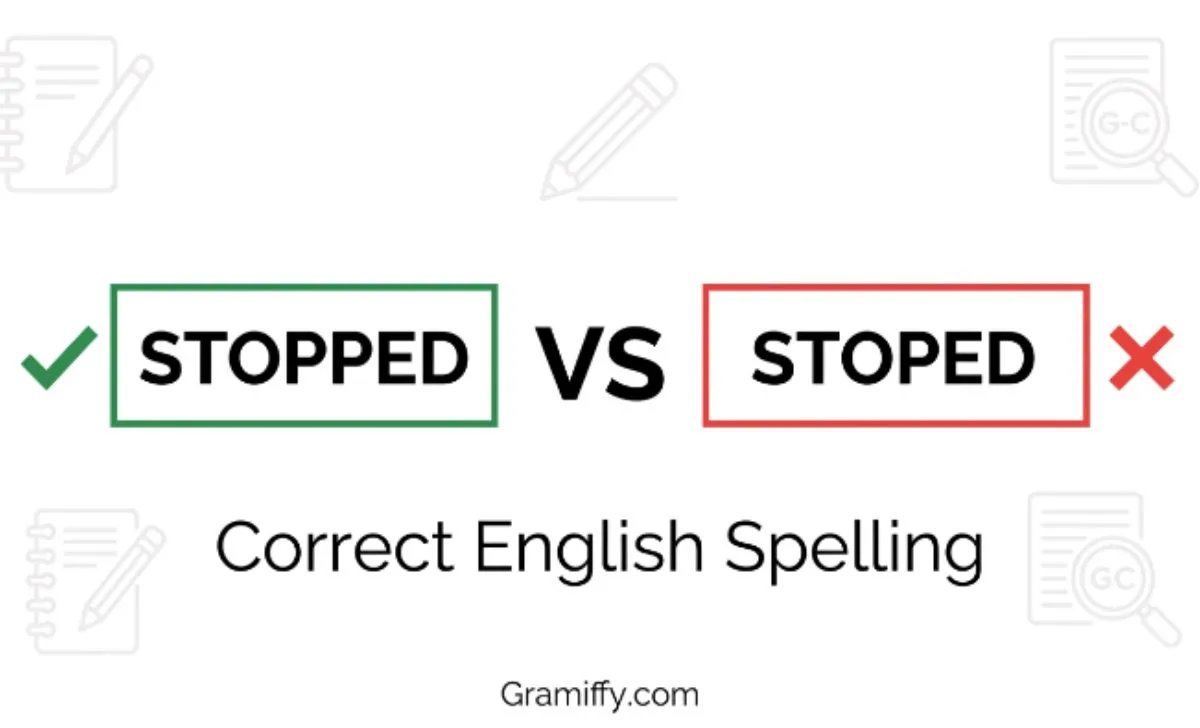
Stopped is the correct spelling.
Stoped is incorrect and should not be used in standard English writing. The verb stop follows the double-consonant rule. Because it ends in a consonant-vowel-consonant (CVC) pattern, the final p is doubled before adding -ed.
Correct Example
✅ The bus stopped outside the school.
✅ She stopped talking when the meeting began.
✅ The rain stopped before sunset.
Incorrect Example
❌ The bus stoped outside the school.
❌ She stoped talking when the meeting began.
❌ The rain stoped before sunset.
Why Is “Stopped” Correct and “Stoped” Wrong?
Many spelling mistakes happen when writers apply the wrong grammar rule.
The Double-Consonant Rule
When a short, one-syllable verb ends in:
- A consonant
- A vowel
- Another consonant
the final consonant usually doubles before adding -ed or -ing.
Examples:
| Base Verb | Correct Form |
|---|---|
| Stop | Stopped |
| Drop | Dropped |
| Shop | Shopped |
| Plan | Planned |
| Slip | Slipped |
Since stop follows this pattern, the correct past tense is stopped.
Featured Snippet Answer
Which is correct: stoped or stopped?
Stopped is the correct spelling. The word follows the English double-consonant rule, which requires doubling the final p before adding -ed. The spelling stoped is incorrect.
What Does Stopped Mean?
Stopped is the past tense and past participle form of the verb stop.
Common Meanings
The word can mean:
- Ceased moving
- Ended an action
- Came to a halt
- Paused temporarily
- Prevented something from continuing
Simple Usage Examples
- The car stopped at the traffic light.
- He stopped working after dinner.
- The music stopped suddenly.
- We stopped for coffee.
- The machine stopped functioning.
The Origin of Stopped
Understanding a word’s history often makes spelling easier to remember.
Word History
The verb stop came into English through Old French and became widely used in Middle English. Over time, English spelling rules developed, including the rule that doubles the final consonant in certain short verbs before adding suffixes.
Examples include:
- Stop → Stopped
- Drop → Dropped
- Shop → Shopped
- Plan → Planned
Why the Confusion Happens
Many verbs simply add -ed.
Examples:
- Walk → Walked
- Talk → Talked
- Jump → Jumped
Because of this, some writers incorrectly assume that stop becomes stoped. However, stop follows a different spelling rule.
British English vs American English
Unlike words such as colour/color or centre/center, there is no regional spelling difference here.
Comparison Table
| English Variety | Correct Form |
|---|---|
| American English | Stopped |
| British English | Stopped |
| Canadian English | Stopped |
| Australian English | Stopped |
| Indian English | Stopped |
The spelling stoped is not standard in any major English variety.
Stoped or Stopped vs Other Variations
Writers often search for similar verb forms when learning English grammar.
Spelling Comparison Table
| Spelling | Correct or Incorrect | Usage | Region |
|---|---|---|---|
| Stopped | Correct | Past tense of stop | Worldwide |
| Stoped | Incorrect | Spelling error | None |
| Stopping | Correct | Present participle | Worldwide |
| Stops | Correct | Present tense | Worldwide |
| Stop | Correct | Base verb | Worldwide |
Which Spelling Should You Use?
US Audience
Always use stopped in essays, emails, articles, and business documents.
UK Audience
British English follows the same rule and uses stopped.
International Writing
Whether your audience is global or local, stopped remains the accepted spelling.
Academic Writing
Schools, colleges, universities, and academic journals require stopped.
Social Media Usage
Even in casual writing, using stopped improves credibility and professionalism.
Common Mistakes with Stoped or Stopped
Many English learners struggle with double-consonant words.
Frequent Errors
Common mistakes include:
- Stoped instead of stopped
- Droped instead of dropped
- Shoped instead of shopped
- Planed instead of planned
Corrected Examples
| Incorrect | Correct |
|---|---|
| She stoped running. | She stopped running. |
| The bus stoped here. | The bus stopped here. |
| We stoped for lunch. | We stopped for lunch. |
| He stoped speaking. | He stopped speaking. |
Stoped or Stopped in Everyday Examples
Emails
- The shipment stopped moving during delivery.
- The software stopped responding.
Social Media
- My phone stopped working today.
- The livestream stopped unexpectedly.
News Writing
- Traffic stopped after the accident.
- Operations stopped because of severe weather.
School Writing
- The experiment stopped when the power failed.
- The student stopped reading after class.
Business Writing
- Production stopped for maintenance.
- The meeting stopped at noon.
Google Trends & Usage Data
The keyword stoped or stopped receives searches because many people are unsure about the correct spelling.
Popular Countries
The keyword is commonly searched in:
- United States
- United Kingdom
- Canada
- Australia
- India
Why People Search This Keyword
People search this term because they:
- Want the correct spelling
- Need help with English grammar
- Are writing essays or emails
- Want to avoid spelling mistakes
- Are learning verb forms and past tense rules
Related Grammar Rules
Learning related grammar patterns helps improve writing accuracy.
Similar Spelling Mistakes
These commonly confused spellings follow similar rules:
- Planed or Planned
- Droped or Dropped
- Shoped or Shopped
- Refered or Referred
- Occured or Occurred
Helpful Grammar Tips
- Look for a consonant-vowel-consonant pattern.
- Double the final consonant before adding -ed.
- Read the word aloud.
- Use a grammar checker when proofreading.
- Consult a trusted dictionary if unsure.
FAQs
Is stoped a real word?
No. Stoped is considered a spelling mistake in standard English.
Which spelling is correct, stoped or stopped?
Stopped is the correct spelling.
Why does stopped have two Ps?
The word follows the English double-consonant rule, which requires doubling the final consonant before adding -ed.
What is the past tense of stop?
The past tense of stop is stopped.
Is stopped used in American English?
Yes. American English uses stopped.
Is stopped used in British English?
Yes. British English also uses stopped.
How do I know when to double a consonant?
Double the final consonant when a short verb ends in a consonant-vowel-consonant pattern.
Can I use stoped in academic writing?
No. Academic writing requires the correct spelling stopped.
Conclusion
The answer is simple: stopped is correct, while stoped is incorrect. The word follows a common English grammar rule that doubles the final consonant before adding -ed.
This same rule applies to words like dropped, planned, and shopped. Whether you’re writing an essay, email, blog post, business report, or social media update, always use stopped.
Remembering this simple spelling rule will help you avoid common writing mistakes and improve your confidence in English grammar.

I am Bryan A. Garner a lexicographer, and language expert passionate about clear and effective writing.
I contribute grammar, spelling, and usage guides on Gramiffy.com to help readers improve their English skills. Through my work, I aim to make language rules simple, practical, and easy to understand.