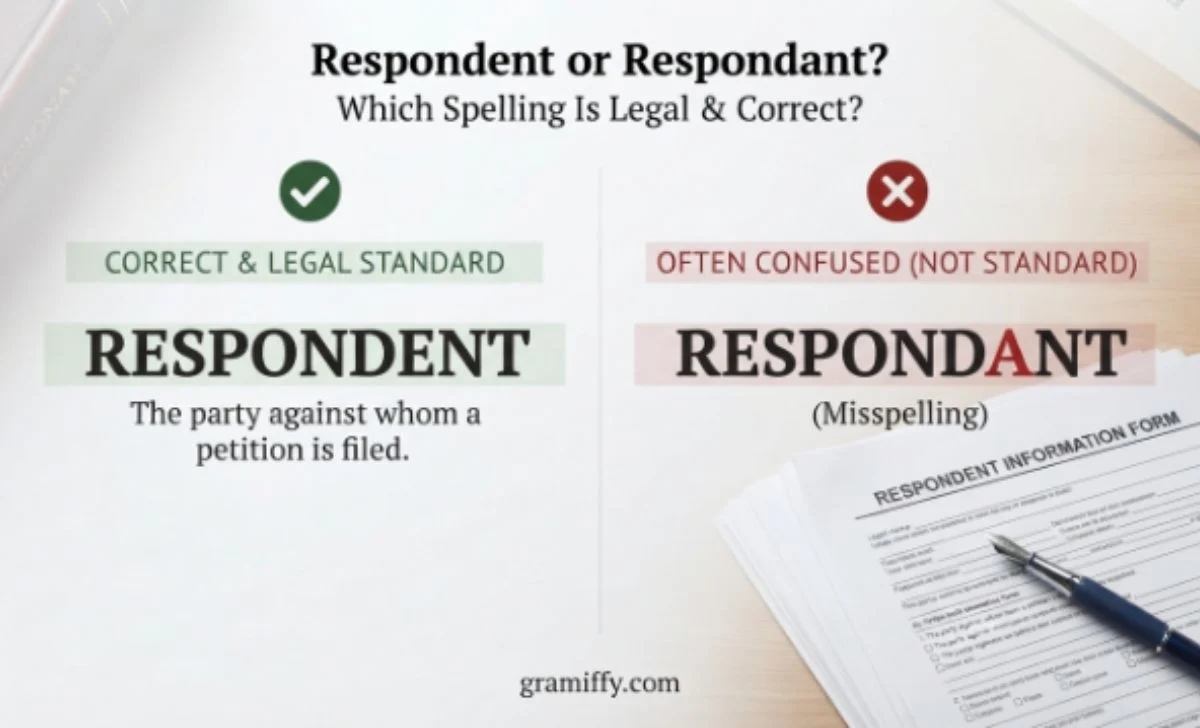
Short answer: the correct spelling is respondent, with an “e”. Respondant is a common misspelling and is not accepted as a standard form.
Use respondent in surveys, research, business writing and legal documents.
Quick rule: respond + -ent = respondent. If you can hear “respond” inside the word, the ending is -ent.
In this guide
- What “respondent” means in each context
- Why the spelling is “-ent”, not “-ant”
- Tricky -ent/-ant words that are exceptions
- Respondent vs participant vs subject
- Respondent in legal cases
- Plural, possessive and word family
- Common mistakes
- Example sentences
- Quiz
- FAQ
What Does “Respondent” Mean?
Dictionaries give a few related senses, and the right one depends on the setting. Merriam-Webster defines it as one who responds, including one who maintains a thesis in reply and one who answers in legal proceedings.
Cambridge lists two main senses: a person who answers a request for information, and the person a petition is filed against in a court case.
| Context | Meaning | Example |
|---|---|---|
| Surveys and research | A person who answers questions | Most respondents said they preferred email. |
| Everyday use | Anyone who replies to a question, letter or message | Vocabulary.com notes that a respondent can answer a question, letter, email or survey. |
| Court cases (trial level) | The party a petition is filed against | The respondent filed a reply to the petition. |
| Appeals | The opposing party to the appellant | Wikipedia notes that respondent can also mean the appellee in an appeal. |
| Psychology | Respondent conditioning is another name for classical or Pavlovian conditioning | Wikipedia lists this among the uses of the term. |
| US Senate impeachment trials | The side opposite the management | Wikipedia notes that the two sides are called the management and the respondent. |
The shared idea is simple: a respondent is someone who responds.
Why Is It “Respondent” and Not “Respondant”?
1. It follows the word it comes from
Respondent comes from the Latin verb respondere, meaning to answer or reply. It sits in the same family as respond and response, and the “e” comes from the Latin verb form.
2. The Latin verb pattern predicts “-ent”
One Latin-roots resource explains the general pattern. Derivatives of Latin first-conjugation verbs tend to end in -ant, while those from other verb types end in -ent. Since respondere ends in -ere, the pattern predicts -ent. I’ve applied the rule to respondere myself, so verify it against a dictionary before you publish.
3. Why so many people write “-ant”
The confusion is mostly about sound. In everyday speech the endings -ent and -ant are nearly identical, and English has many common words ending in -ant. Since the two endings sound the same in fast speech, people often guess.
Tricky -ent / -ant Words (The Exceptions)
The rule isn’t perfect, because French influenced English spelling. The same Latin-roots source notes that some words came through French with an -ant spelling where the Latin pattern predicts -ent.
| Word | Ending | Note |
|---|---|---|
| Respondent | -ent | Standard and the only accepted form |
| Dependent | -ent | Adjective |
| Dependant | -ant | Noun, in the source’s account: a person who relies on another. The source notes Revenue Canada uses this spelling. |
| Pendant | -ant | A hanging ornament, while the adjective is pendent |
| Tenant | -ant | Shows French influence |
| Lieutenant | -ant | Shows French influence |
| Correspondent | -ent | Like respondent, it takes -ent. Wikipedia notes it can also mean a journalist covering a location or subject. |
The exceptions are why “just go by the sound” fails. For respondent there’s no exception, so it’s always -ent.
Memory Tricks
- Respond → respondent. The word already contains respond, so you only add -ent.
- Same ending as correspondent. Both take -ent.
- The word list rule: when unsure about respondant, remember that only respondent appears in the dictionaries above.
Respondent vs Participant vs Subject
Researchers often ask which word to use for the people in a study.
| Term | Best used for |
|---|---|
| Respondent | People who answer a survey or questionnaire |
| Participant | People who take part in a study, especially where consent and active involvement matter |
| Subject | Older research usage, and individuals who can’t give consent, such as animals or infants |
Wikipedia notes that many usage commentators in scientific publishing prefer “participant” over “subject”, because “subject” can suggest limited autonomy.
It also lists respondent among the standard word choices. Your journal or institution’s style guide should have the final say. For a survey, respondent is normally the natural choice.
Respondent in Legal Cases
Legal writing is the second-biggest use of the word, and it’s easy to mix up who’s who.
| Role | Who they are |
|---|---|
| Petitioner | The person who starts a proceeding by petition |
| Respondent | The party responding to that petition |
| Appellant | The party challenging a lower-court decision |
| Respondent (in an appeal) | The opposing party, also called the appellee |
In an appeal, the appellant files the appeal and the respondent answers it. A respondent may have been the claimant or the defendant in the lower court. Terms vary by country and court, so check the local rules for legal documents.
A note on a related phrase: the legal doctrine is usually written in Latin as respondeat superior, though some writers spell it “respondent superior”. This is from my own knowledge rather than the sources above, so confirm it before publishing.
Plural, Possessive and Word Family
| Form | Correct | Example |
|---|---|---|
| Singular | respondent | The respondent skipped question 4. |
| Plural | respondents | Most respondents agreed. |
| Singular possessive | respondent’s | The respondent’s answer was detailed. |
| Plural possessive | respondents’ | The respondents’ comments were mixed. |
Related words: respond (verb), response (noun), responsive (adjective), responder (noun), correspondent (noun), co-respondent (a legal term in some divorce contexts). A source notes that respondent can also work as an adjective, though that use is less common.
Common Mistakes
- ❌ respondant → ✅ respondent
- ❌ respondants → ✅ respondents
- ❌ respondants’ → ✅ respondents’
- ❌ respondent superior → ✅ respondeat superior (verify before publishing)
- ❌ “the survey participants” when you specifically mean people answering questions → ✅ consider respondents
Example Sentences
Surveys and research
- Over 60% of respondents said they worked remotely.
- The respondent left the final question blank.
- We contacted 1,200 respondents by email.
Legal
- The respondent has 30 days to file a response.
- The court ruled in favour of the respondent.
General
- Each respondent received a follow-up message.
Quick Quiz
Choose the correct spelling.
- The survey had 500 ______. (respondents / respondants)
- The ______ filed a reply to the petition. (respondent / respondant)
- Which is correct? “The ______’s answer was brief.” (respondent / respondant)
- Which noun takes -ant? (respondent / tenant)
- In an appeal, who challenges the decision? (appellant / respondent)
Answers
- respondents
- respondent
- respondent
- tenant
- appellant
FAQs
Is respondant a word?
No. It’s a common misspelling of respondent, and it doesn’t appear as a standard form in major dictionaries.
Is it respondent or respondant in legal documents?
Always respondent.
What does respondent mean in a survey?
A person who answers the survey questions.
What’s the difference between a respondent and a participant?
A respondent answers questions, while a participant takes part in a study more broadly. Style guides vary, so check yours.
Is dependant also spelled wrong?
Not always. Some sources treat dependant as the noun and dependent as the adjective, while other style guides differ. Check your style guide.
How do I remember the spelling?
Think respond + -ent.
Conclusion
Write respondent, with an “e”. Respondant is a misspelling that comes from the similar sound of -ent and -ant.
The word comes from respond, and that connection is the easiest way to remember it. Use it for anyone who answers a survey, replies to a message or responds in a legal proceeding.
Read More:

Hi, I’m Safdar Ali, an English language teacher with 26 years of teaching experience. My expertise is in English linguistics, grammar, and the differences between British and American English.
Through Gramiffy, I share practical, research-based guides to help students, writers, and English learners improve their language skills. My goal is to make English simple, accurate, and easy for everyone to understand.