You’ve typed “I payed attention in class” and something felt off. Maybe your spellcheck stayed silent, which only made it stranger.
Here’s the answer up front.
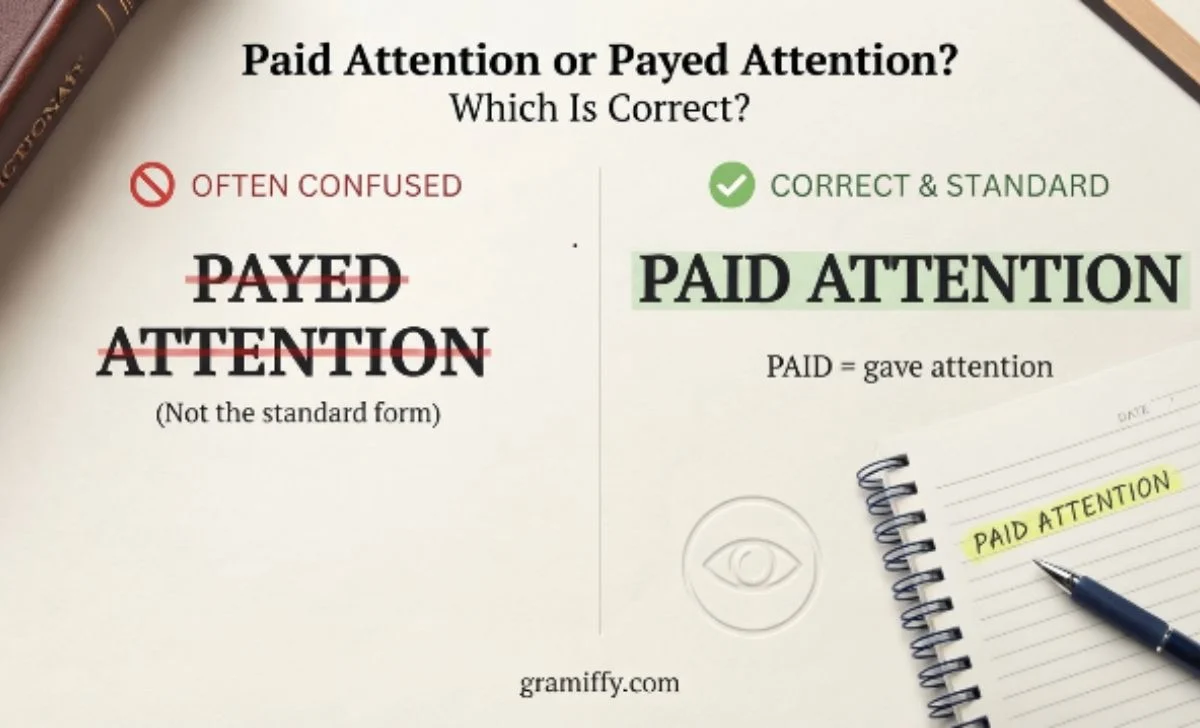
It’s “paid attention.” Paid is the past tense of “pay” in every sense except two narrow nautical ones. Attention isn’t nautical, so “payed attention” is a mistake.
The rest of this post is about why, because the reason will help you avoid the same slip with other words.
The quick rule
| You mean… | Write |
|---|---|
| Focused on something in the past | paid attention |
| Handed over money | paid |
| Showed respect, visited someone, gave a compliment | paid |
| Let out a rope or chain | payed out |
| Sealed a wooden hull with tar or pitch | payed |
If there’s no rope, chain or ship’s hull in your sentence, use paid. That covers nearly everything you’ll ever write.
So why does “payed” exist at all?
This is the part that trips people up, and most short answers skip it.
“Payed” is a real past form of “pay.” It just belongs to a small corner of nautical English.
Scribbr’s example is a captain ordering the bottom of a boat to be payed with tar, and Writing Explained describes payed out as letting a rope or cable out by slacking it.
- The crew payed out the anchor chain.
- The shipwright payed the seams with pitch.
Both are real sentences, and you’ll rarely meet them outside sailing or maritime history. Dictionaries do list payed, which is also why spellcheck often stays quiet. It isn’t flagging a nonword, only a word in the wrong place.
One thing worth knowing: dictionaries generally trace the tar-sealing verb to a different root than the money verb, which is why the two ended up with different past forms.
I’d double-check this against the OED or Merriam-Webster before leaning on it.
Why “paid” and not “payed”?
Most English verbs just add -ed: play → played, stay → stayed, enjoy → enjoyed. So “payed” feels like the natural answer.
But a small group of verbs ending in -y switch to -aid in the past:
| Present | Past |
|---|---|
| pay | paid |
| lay | laid |
| say | said |
The “-aid trio” is a good mental shortcut. If you’d never write “sayed” or “layed”, you shouldn’t write “payed” either. (Yes, people do write “layed”, and it’s wrong for the same reason.)
Since “paid” is both the simple past and the past participle, you use it in both places: I paid attention, I have paid attention.
Why do we “pay” attention anyway?
The verb “pay” doesn’t only mean handing over money. It also covers giving or bestowing something: pay attention, pay respect, pay a visit, pay a compliment, pay tribute.
Attention is treated like a currency, something you spend on what matters, and that’s why the same verb works. It also means the past tense follows the ordinary “pay” rule, which is paid.
Every tense of “pay attention”
This is where a lot of people slip, so here’s the full set.
| Tense | Example |
|---|---|
| Present | I pay attention. She pays attention. |
| Past | I paid attention. |
| Present perfect | I have paid attention. |
| Past perfect | I had paid attention. |
| Future | I will pay attention. |
| Present continuous | I am paying attention. |
| Past continuous | I was paying attention. |
| Negative past | I didn’t pay attention. |
| Question | Did you pay attention? |
Two traps to avoid:
- “Didn’t paid.” After did or didn’t, the verb goes back to its base form: didn’t pay, not didn’t paid.
- “Payying.” The continuous form is paying, with one “y”. Nobody writes “payying,” but “payed” sometimes sneaks in where “paying” belongs.
Common phrases with “pay,” and their past forms
| Phrase | Past form |
|---|---|
| pay close attention | paid close attention |
| pay no attention (to) | paid no attention |
| pay respects | paid respects |
| pay a visit | paid a visit |
| pay a compliment | paid a compliment |
| pay off (worth the effort or clear a debt) | paid off |
| pay out (money) | paid out |
| pay out (a rope) | payed out |
Scribbr puts the “off” idiom well: “payed off” is not correct in either sense. Hard work paid off, and so does a student loan.
The last two rows show the same phrasal verb splitting by meaning. Paid out is what an insurer does. Payed out is what a sailor does with a rope.
How to catch the mistake in your own writing
Because “payed” is a real word, spellcheck won’t always help. A few habits will:
- Search your document for “payed” before you send or publish it.
- Check each hit for rope, chain, cable or ship seams. If none, change it to paid.
- Read the sentence aloud. If it’s about focus, money, respect or a debt, it’s paid.
- Be careful with autocorrect and predictive text, which can preserve a wrong spelling you’ve typed before.
A memory trick that works
Think of the -aid trio: paid, laid, said. If “sayed” looks wrong to you, “payed” should too.
The other shortcut is to ask: is there a rope in this sentence? If not, it’s paid.
Examples you can borrow
Correct
- She paid close attention during the safety briefing.
- I wish I’d paid more attention in maths.
- He paid no attention to the warning.
- Have you paid attention to the fine print?
- Their hard work finally paid off.
Incorrect
- ❌ He payed attention during the lecture. → paid
- ❌ I didn’t paid attention. → pay
- ❌ We payed off the loan. → paid
The rare correct “payed”
- The deckhand payed out the line as the boat drifted.
- The hull had been payed with tar.
Quick quiz
Pick the right word.
- She ______ close attention to every word. (paid / payed)
- The deckhand ______ out the rope slowly. (paid / payed)
- I didn’t ______ attention in class. (pay / paid)
- Her hard work finally ______ off. (paid / payed)
- He has ______ attention all week. (paid / payed)
- The shipwright ______ the seams with pitch. (paid / payed)
Answers
- paid
- payed
- pay (base form after didn’t)
- paid
- paid
- payed
FAQs
Is “payed attention” ever correct?
No. “Payed” has only nautical senses, and paying attention isn’t one of them.
Is “payed” a real word?
Yes, but only in specific nautical uses: letting out a rope or cable, and sealing a ship’s hull with tar or pitch.
What’s the past tense of “pay attention”?
Paid attention.
What’s the past participle?
Also paid: “I have paid attention.”
Is it “didn’t paid attention” or “didn’t pay attention”?
Didn’t pay attention. The verb returns to its base form after “did” or “didn’t.”
Is it “paid off” or “payed off”?
Paid off.
Why doesn’t spellcheck catch “payed”?
Because it’s a real word, just in the wrong context.
Does the same rule apply to “lay”?
Yes, the past of lay is laid, not “layed.”
The short version
“Paid attention” is right, and “payed attention” is a slip that looks plausible because “payed” is a genuine word with a genuine, but very narrow, meaning. Unless your sentence involves rope or ship’s tar, write paid.
Read More:

Hi, I’m Safdar Ali, an English language teacher with 26 years of teaching experience. My expertise is in English linguistics, grammar, and the differences between British and American English.
Through Gramiffy, I share practical, research-based guides to help students, writers, and English learners improve their language skills. My goal is to make English simple, accurate, and easy for everyone to understand.