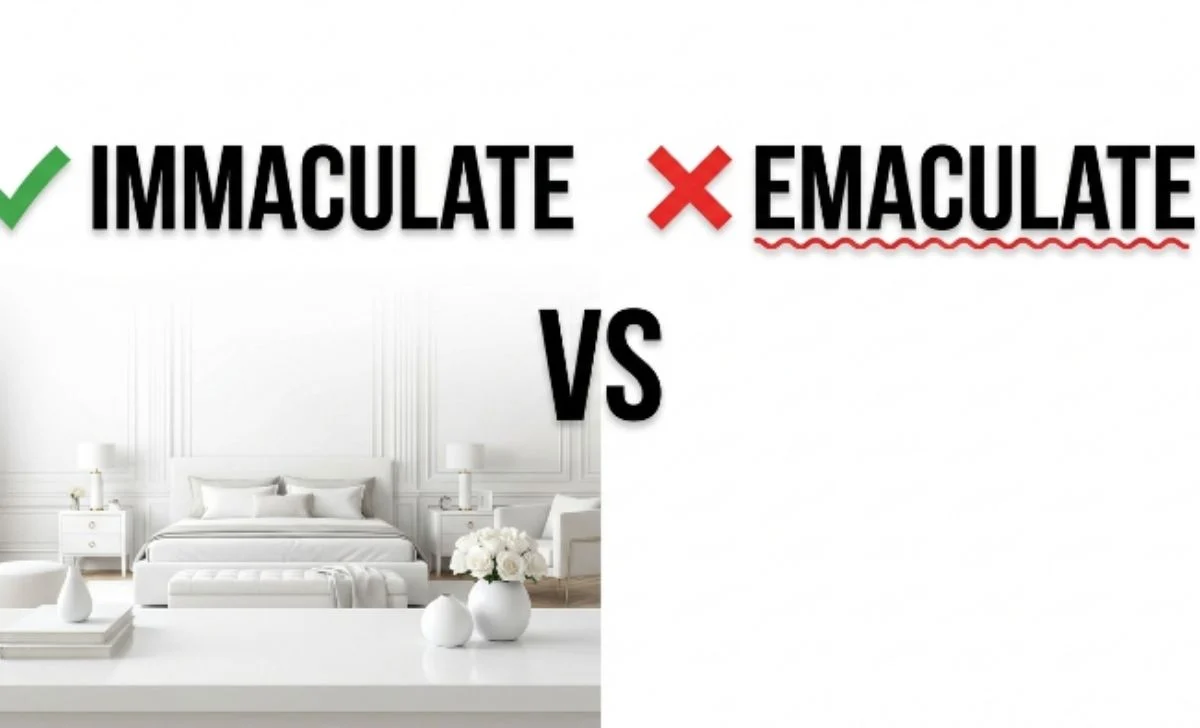
Immaculate is the correct spelling. Emaculate is a misspelling and is not a standard English word.
If you mean perfectly clean, flawless, pure, or without any imperfections, use immaculate.
Her room was immaculate.
He arrived in an immaculate suit.
The confusion often happens because immaculate is not spelled exactly as it sounds. The word begins with imm-, not em-.
Immaculate or Emaculate: Quick Answer
| Word | Correct? | Meaning |
|---|---|---|
| Immaculate | Yes | Perfectly clean, flawless, or without a fault |
| Emaculate | No | Common misspelling of immaculate |
The correct spelling
IMMACULATE ✅
EMACULATE ❌
A quick memory trick is to remember the double M:
IM + MACULATE = IMMACULATE
What Does Immaculate Mean?
Immaculate is an adjective meaning completely clean, neat, perfect, or free from flaws.
It can describe physical cleanliness, appearance, behavior, condition, or quality.
Immaculate meaning perfectly clean
The kitchen was immaculate.
This means the kitchen was extremely clean and tidy.
She keeps her house immaculate.
The house is kept in excellent, spotless condition.
Immaculate meaning flawless
The word can also mean perfect or without defects.
He delivered an immaculate performance.
The artist produced an immaculate painting.
Here, immaculate means exceptionally good or flawless rather than simply clean.
Is Emaculate a Word?
No. Emaculate is not the standard spelling of the English adjective.
If you write:
❌ The hotel room was emaculate.
you should change it to:
✅ The hotel room was immaculate.
Emaculate is usually a spelling error caused by the pronunciation or by confusion about the beginning of the word.
Immaculate vs Immaculately
The adjective is:
immaculate
The adverb is:
immaculately
Examples
Her apartment is immaculate.
Her apartment is immaculately clean.
He was dressed immaculately for the ceremony.
Remember the spelling:
immaculate → immaculately
How Do You Pronounce Immaculate?
Immaculate is commonly pronounced approximately:
ih-MAK-yuh-lət
The pronunciation can make the spelling harder to remember because the first vowel is not strongly emphasized.
That is one reason people sometimes write emaculate instead of immaculate.
The spelling, however, is always:
immaculate
Immaculate Meaning in Different Contexts
Cleanliness
The bathroom was immaculate.
Meaning: completely clean.
Appearance
He wore an immaculate white shirt.
Meaning: extremely neat and clean.
Performance
She gave an immaculate performance.
Meaning: flawless or exceptionally good.
Condition
The car was in immaculate condition.
Meaning: almost perfect and extremely well maintained.
Morality or purity
In more formal or literary contexts, immaculate can mean pure or free from moral fault.
The character was portrayed as immaculate and innocent.
The exact meaning depends on context.
Immaculate Synonyms
The best synonym depends on what you are describing.
When it means very clean
- spotless
- pristine
- spotless
- clean
- tidy
- pristine
- neat
The laboratory was immaculate.
The laboratory was spotless.
When it means flawless
- flawless
- perfect
- faultless
- impeccable
- perfect
- unblemished
She gave an immaculate performance.
She gave a flawless performance.
When it means pure
- pure
- innocent
- untainted
- undefiled
- unblemished
Not every synonym works in every context.
Immaculate vs Spotless
Immaculate and spotless are close in meaning when describing cleanliness.
Spotless strongly emphasizes the absence of dirt or marks.
The floor was spotless.
Immaculate can suggest not only cleanliness but also excellent order and overall condition.
The entire house was immaculate.
Both are natural, but immaculate can sound slightly more formal or emphatic.
Immaculate vs Pristine
Pristine usually means something is in its original, fresh, or exceptionally well-preserved condition.
The beach remained pristine.
Immaculate focuses more strongly on cleanliness, perfection, or freedom from flaws.
The hotel room was immaculate.
The meanings overlap, but they are not identical.
Immaculate vs Impeccable
These words are often interchangeable when describing excellent quality, but they have slightly different emphasis.
Immaculate can mean completely clean or flawless.
Impeccable means having no faults or mistakes.
Compare:
He arrived in an immaculate suit.
The suit looked perfectly clean and neat.
She has impeccable manners.
Her manners are exceptionally good and free from faults.
Common Mistakes With Immaculate
Mistake 1: Writing emaculate
Incorrect:
❌ The hotel was emaculate.
Correct:
✅ The hotel was immaculate.
Mistake 2: Dropping one M
Incorrect:
❌ imaculate
Correct:
✅ immaculate
There are two Ms after the initial i:
i-m-m-a-c-u-l-a-t-e
Mistake 3: Using immaculate only for physical cleanliness
The word can also describe:
- performances
- appearance
- condition
- records
- behavior
- quality
- purity
For example:
The goalkeeper had an immaculate record.
Here, it does not mean physically clean. It means free from failure or mistakes.
Real-Life Examples of Immaculate
Home
Her living room is always immaculate.
Clothing
He appeared in an immaculate suit.
Car
The classic car is in immaculate condition.
Performance
The pianist gave an immaculate performance.
Work
The designer’s attention to detail was immaculate.
Record
The team maintained an immaculate record throughout the season.
Nature
They discovered an immaculate stretch of coastline.
These examples show how flexible the word can be.
Immaculate in a Sentence
Here are some natural sentence patterns:
The room was immaculate.
She keeps her office immaculate.
His shoes were immaculate.
The car was in immaculate condition.
She gave an immaculate performance.
The document was prepared with immaculate attention to detail.
The athlete maintained an immaculate record.
Immaculate Conception: A Special Meaning
Immaculate also appears in the religious phrase Immaculate Conception.
In Catholic theology, the Immaculate Conception refers specifically to the conception of the Virgin Mary, not to the conception of Jesus.
This is a specialized religious use of the word and is different from the everyday meaning of immaculate as “spotless” or “flawless.”
Word Origin of Immaculate
Immaculate comes from Latin immaculatus, meaning unstained or spotless.
It is formed from in-, meaning “not,” and macula, meaning “spot” or “stain.”
This origin connects directly to the modern meaning.
Something immaculate is literally described as being free from stains or imperfections.
The word entered English through French and has been used for centuries.
Why Is Immaculate Spelled With Double M?
The spelling comes from the word’s Latin origin and its formation.
The prefix im- is attached to the root associated with macula, producing:
im + maculate → immaculate
This is why the spelling begins with imm-.
The correct sequence is:
I M M A C U L A T E
Not:
E M A C U L A T E
and not:
I M A C U L A T E
Immaculate or Emaculate: Which Should You Use?
Always use immaculate when you mean:
- perfectly clean
- spotless
- flawless
- faultless
- pure
- without imperfections
- in excellent condition
Use emaculate for none of these meanings because it is not the standard English spelling.
Compare
❌ The room was emaculate.
✅ The room was immaculate.
❌ She gave an emaculate performance.
✅ She gave an immaculate performance.
❌ The car is in emaculate condition.
✅ The car is in immaculate condition.
Frequently Asked Questions
Is it immaculate or emaculate?
Immaculate is correct. Emaculate is a misspelling.
Is emaculate a real word?
No. Emaculate is not a standard English word. It is usually a misspelling of immaculate.
What does immaculate mean?
Immaculate means perfectly clean, flawless, pure, or free from imperfections.
How do you spell immaculate?
The correct spelling is:
I-M-M-A-C-U-L-A-T-E
Does immaculate have two Ms?
Yes. Immaculate begins with imm-, so it contains two consecutive m letters.
What is a synonym for immaculate?
Depending on the context, synonyms include spotless, pristine, flawless, impeccable, faultless, and unblemished.
Is immaculate the same as spotless?
They can have the same meaning when describing cleanliness. However, immaculate can also mean flawless or perfect, while spotless mainly emphasizes cleanliness.
Is immaculate formal?
Immaculate is common in both everyday and formal English. It can sound particularly polished when describing appearance, condition, or quality.
What is the opposite of immaculate?
Possible opposites include dirty, stained, messy, flawed, imperfect, and blemished, depending on the context.
Immaculate or Emaculate: Final Verdict
There is no spelling choice between these two in standard English:
Immaculate ✅
Emaculate ❌
Use immaculate when you mean spotless, flawless, perfectly clean, or free from imperfections.
The easiest way to remember it is to focus on the double M:
IMMACULATE = I + MM + ACULATE
If you are writing about a spotless room, a flawless performance, a perfectly maintained car, or an excellent record, immaculate is the word you want.
Read More:

Hi, I’m Safdar Ali, an English language teacher with 26 years of teaching experience. My expertise is in English linguistics, grammar, and the differences between British and American English.
Through Gramiffy, I share practical, research-based guides to help students, writers, and English learners improve their language skills. My goal is to make English simple, accurate, and easy for everyone to understand.