Sheath and sheathe look almost identical, but they are different parts of speech with different jobs. One is usually a noun; the other is a verb.
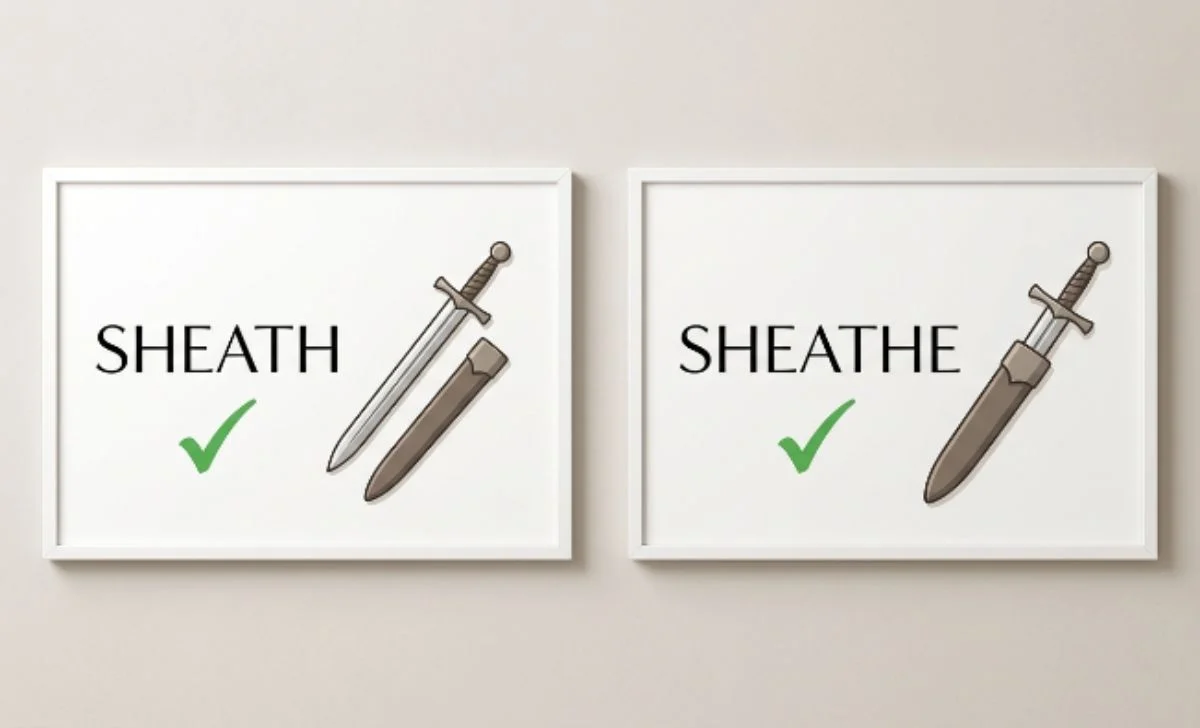
The easiest way to remember them is simple: a sheath is the covering or holder, while sheathe means to put something into that covering.
Sheath = the covering
Sheathe = put something into the covering
For example, a sword goes into a sheath, and when you put the sword away, you sheathe it.
Quick Answer
Sheath is a noun meaning a protective covering, case, or holder.
Sheathe is a verb meaning to put something into a sheath or covering.
The sword was in its sheath.
The soldier sheathed his sword.
| Word | Part of Speech | Meaning | Example |
|---|---|---|---|
| sheath | Noun | A protective covering or holder | The knife was in its sheath. |
| sheathe | Verb | To put something into a sheath | He sheathed the knife. |
What Does Sheath Mean?
A sheath is a covering designed to protect or contain something.
It is often associated with:
- swords
- knives
- blades
- cables
- wires
- plant structures
- protective coverings
Sword or knife
The sword remained inside its sheath.
Electrical cable
The cable has a protective outer sheath.
Plant structure
In botany, a sheath can be a structure that surrounds or encloses part of a plant.
So the word is not limited to weapons. Its broader idea is a covering around something.
What Does Sheathe Mean?
Sheathe is a verb.
It means to put a sword, knife, or other object into a sheath.
He sheathed his sword after the battle.
It can also be used figuratively to mean covering or enclosing something.
Common forms
| Verb form | Example |
|---|---|
| Base | sheathe |
| Present | sheathe / sheathes |
| Past | sheathed |
| -ing form | sheathing |
Examples:
Please sheathe the blade.
She sheathed her sword.
The warrior was sheathing his weapon.
Sheath vs Sheathe: The Core Difference
The distinction becomes easy when you think about thing vs action.
Sheath = thing
A sheath is the object that holds or covers something.
The dagger has a leather sheath.
Sheathe = action
To sheathe something means to put it into its sheath.
He sheathed the dagger.
Think of this pattern:
Sheath = container
Sheathe = action
Sheath vs Sheathe in a Sentence
Compare these sentences:
The sword is in the sheath.
Here, sheath is the protective covering.
The knight sheathed the sword.
Here, sheathed describes the action of putting the sword away.
Another example:
The knife’s sheath was made of leather.
She sheathed the knife after using it.
The words are related, but they cannot simply replace one another.
Pronunciation
Sheath
IPA: /ʃiːθ/
Approximate pronunciation:
SHEETH
The final sound is the unvoiced th sound, like the sound in thin.
Sheathe
IPA: /ʃiːð/
Approximate pronunciation:
SHEETH
The spelling is different, and the final th sound is voiced, similar to the sound in this.
This pronunciation difference can be difficult to notice in ordinary conversation.
Singular and Plural Forms
Sheath
Singular:
one sheath
Plural:
two sheaths
The plural is sheaths.
The museum displayed several sword sheaths.
Sheathe
Sheathe is a verb, so it does not have a singular or plural form.
Its verb forms include:
sheathe
sheathes
sheathed
sheathing
American vs British English
There is no major American-British spelling difference between sheath and sheathe.
Both varieties use:
sheath
and:
sheathe
The meanings and grammatical roles are also essentially the same.
| English Variety | Noun | Verb |
|---|---|---|
| American English | sheath | sheathe |
| British English | sheath | sheathe |
| Canadian English | sheath | sheathe |
| Australian English | sheath | sheathe |
Where Do Sheath and Sheathe Come From?
Both words have a long history in English.
Sheath comes from Old English sceath, meaning a case or covering for a sword or other object.
The verb sheathe developed from the noun and came to mean putting something into a sheath.
The relationship is therefore straightforward:
sheath → sheathe
The extra e in the verb helps distinguish the action from the noun in modern spelling.
Grammar Rules to Remember
“sheath” as a noun
The blade was inside its sheath.
Use “sheathe” as a verb
He decided to sheathe the blade.
“sheathed” for the past tense
The soldier sheathed his sword.
Use “sheathing” for the -ing form
He was sheathing the knife.
Don’t use “sheath” as the normal verb
In standard modern usage, use sheathe for the action.
❌ He sheath the sword.
✅ He sheathed the sword.
Common Mistakes
Mistake 1: Confusing the noun and verb
❌ He put the sword into its sheathe.
✅ He put the sword into its sheath.
Mistake 2: Using sheath as the verb
❌ She sheath the knife.
✅ She sheathed the knife.
Mistake 3: Using sheathe as the noun
❌ The knife has a leather sheathe.
✅ The knife has a leather sheath.
Mistake 4: Confusing sheath with sheathe
Remember:
A sheath is something you have.
To sheathe is something you do.
Real-Life Examples
Sword
The knight drew his sword from its sheath.
After the fight, he sheathed his sword.
Hunting knife
The knife came with a strong leather sheath.
He carefully sheathed the knife.
Cable
The electrical wire has an insulating sheath.
Here, sheath refers to the protective outer covering.
Figurative use
The mountain was sheathed in fog.
Here, sheathed means covered or enclosed by something.
This broader use is useful because sheathe is not limited to putting a weapon into a case.
Sheath Synonyms
Depending on context, synonyms for sheath include:
- cover
- casing
- case
- sleeve
- coating
- housing
- protective covering
For example:
The cable has a protective sheath.
could be described as having a protective covering or casing.
The exact synonym depends on what the sheath contains.
Sheathe Synonyms
Depending on context, synonyms for sheathe include:
- cover
- enclose
- encase
- put away
- holster
- store
For a sword:
He sheathed his sword.
A more general alternative could be:
He put away his sword.
But sheathe is more precise when the object is being placed into a sheath.
Antonyms
Sheath
There is no single direct antonym for sheath.
Depending on context, related opposites could include:
- exposure
- opening
- uncovered state
Sheathe
The clearest contextual opposite is:
draw
When talking about a sword or knife:
sheathe the sword = put it away
draw the sword = take it out
This is the most useful contrast to remember.
Sheathe vs Draw
These verbs are often used together when discussing swords, knives, and similar weapons.
The warrior drew his sword.
Then:
The warrior sheathed his sword.
So:
draw = take out
sheathe = put back
This makes the distinction easy to remember.
A Simple Memory Trick
Use this rule:
SHEATH = SHELL
Both refer to a protective covering.
Then:
SHEATHE = put it in the SHEATH
The extra e in sheathe can remind you that it is the verb.
A quick formula:
Sheath = object
Sheathe = action
Sheathed = past action
Practice Exercise
Choose sheath, sheathe, sheathed, or sheathing.
1.
The sword was inside its leather _____.
2.
The soldier decided to _____ his sword.
3.
He _____ the knife after using it.
4.
The warrior was _____ his blade.
5.
The knife came with a protective _____.
Answers
- sheath
- sheathe
- sheathed
- sheathing
- sheath
People Also Ask
What is the difference between sheath and sheathe?
Sheath is a noun meaning a protective covering or holder. Sheathe is a verb meaning to put something into a sheath.
Is sheathe a verb or noun?
Sheathe is a verb.
He sheathed his sword.
Is sheath a verb or noun?
Sheath is primarily a noun.
The sword was in its sheath.
What is the past tense of sheathe?
The past tense is sheathed.
He sheathed his sword.
What is the plural of sheath?
The plural is sheaths.
Several sheaths were displayed in the museum.
Is sheathe pronounced differently from sheath?
Yes. The final th sound differs: sheath normally ends with an unvoiced sound, while sheathe ends with a voiced sound.
What is the opposite of sheathe?
For a sword or knife, the most useful opposite is draw.
Draw the sword → sheathe the sword.
FAQs
Can sheath be used for things other than swords?
Yes. A sheath can be a protective covering around cables, wires, plants, knives, and other objects.
Can sheathe mean cover something?
Yes. Sheathe can be used figuratively to mean cover or enclose something.
The hills were sheathed in mist.
Is sheathe the same as sheath?
No. They are related but have different grammatical functions.
Sheath = covering.
Sheathe = put into a covering.
How do you remember sheath vs sheathe?
Remember:
Sheath = thing. Sheathe = action.
Is “sheathed” a correct word?
Yes. Sheathed is the past tense and past participle of sheathe.
The sword was sheathed.
What is the difference between sheathe and unsheathe?
Sheathe means to put a weapon into its covering.
Unsheathe means to remove it from the covering.
He sheathed the sword.
He unsheathed the sword.
Final Verdict
The difference between sheath and sheathe is simple once you focus on grammar.
Sheath is the covering or holder:
The sword is in its sheath.
Sheathe is the action of putting something into that covering:
He sheathed his sword.
Remember the shortcut:
Sheath = thing
Sheathe = action
And when you’re talking about taking a sword out, use the opposite action:
draw → take it out
sheathe → put it back
Read More:

Hi, I’m Safdar Ali, an English language teacher with 26 years of teaching experience. My expertise is in English linguistics, grammar, and the differences between British and American English.
Through Gramiffy, I share practical, research-based guides to help students, writers, and English learners improve their language skills. My goal is to make English simple, accurate, and easy for everyone to understand.