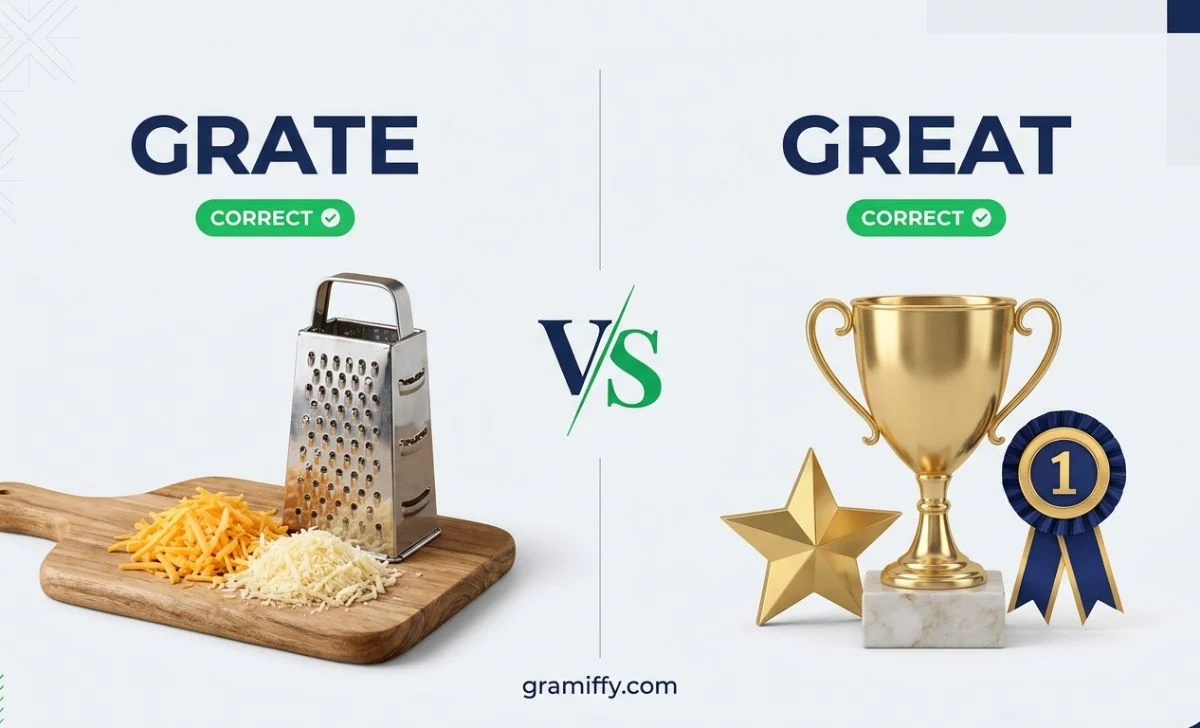
One tiny spelling mistake can turn a compliment into a cooking instruction! Imagine writing “Have a grate day” when you mean “Have a great day.”
Both words sound identical, but their meanings couldn’t be more different. Great describes something excellent or impressive, while grate means to shred food, scrape against something, or irritate someone.
So, how do you know which one belongs in your sentence? The trick is simpler than you might think.
Let’s break down grate or great with clear examples, easy explanations, and a simple memory trick so you never confuse them again.
Quick Answer: Grate or Great?
Both grate and great are correct English words, but they are used in different contexts.
- Great means excellent, impressive, large, or important.
- Grate means to shred food, scrape against something, cause irritation, or refer to a metal structure.
| Word | Meaning | Example |
|---|---|---|
| Great | Excellent or very good | We had a great time. |
| Great | Large or important | It was a great achievement. |
| Grate | Shred food into small pieces | Grate the cheese before adding it. |
| Grate | Annoy or irritate | His constant complaints grate on me. |
| Grate | A metal frame or covering | Leaves covered the drain grate. |
Easy rule: If you mean something is excellent or impressive, use great. If you mean shredding, scraping, irritating, or a metal structure, use grate.
What Does Great Mean?
Great is commonly used as an adjective to describe something excellent, impressive, large, or important.
It can also be used as a noun for an outstanding person and informally as an adverb in expressions such as “You did great.”
According to the Cambridge Dictionary, the word has several meanings depending on the context.
1. Great means excellent
Use great when something is very good or produces a positive impression.
Examples:
- You did a great job on the project.
- We had a great holiday together.
- That is a great idea for the new website.
- She gave a great performance at the concert.
In each sentence, great describes something positively.
2. Great means large or significant
The word can also describe something substantial in size, amount, degree, or importance.
Examples:
- The team made great progress this year.
- She showed great courage during a difficult time.
- A great number of people attended the event.
- Education can have a great influence on a person’s future.
Notice that great does not always mean enjoyable or wonderful. It can also emphasise the size or importance of something.
3. Great as a noun
In informal English, great can refer to a person who has achieved outstanding success in a particular field.
Examples:
- She is considered one of the sport’s all-time greats.
- The museum celebrates the work of literary greats.
This use is less common than the adjective, but it is useful to recognise.
What Does Grate Mean?
Grate can function as both a verb and a noun. Its meaning depends on how it is used in a sentence.
1. Grate means to shred food
In cooking, grate means to rub food against a grater so that it breaks into small pieces.
Examples:
- Grate the carrots before mixing them into the salad.
- I need to grate some cheese for the pasta.
- She grated fresh ginger into the sauce.
- Grate the chocolate over the dessert.
Here, grate describes an action. The related forms include grates, grated, and grating.
2. Grate means to irritate or annoy
The word can also describe something that becomes irritating, especially a sound, voice, habit, or behaviour.
Examples:
- His constant interruptions grate on my nerves.
- The loud music began to grate after an hour.
- Her sarcastic comments grate on everyone in the office.
The expression “grate on someone’s nerves” means to annoy or irritate that person.
For example:
“His habit of arriving late really grates on me.”
This does not mean that he is excellent or impressive. It means his behaviour is annoying.
3. Grate means to scrape or rub harshly
When hard objects rub together, they can grate and produce an unpleasant sound.
Examples:
- The metal gate grated against the pavement.
- The old machine made a grating noise.
- The wheels grated as the trolley moved across the rough floor.
4. Grate as a noun
A grate can also be a metal structure, such as the frame that holds fuel in a fireplace or a metal covering over a drain.
Examples:
- The fire burned brightly beneath the iron grate.
- Rainwater disappeared through the street drain grate.
- The fireplace grate needed cleaning.
These meanings show why grate is much more than a cooking verb.
Grate vs. Great: What Is the Difference?
The main difference is their meaning and grammatical use. Although the two words sound alike, they cannot be substituted for one another in ordinary sentences.
| Feature | Grate | Great |
|---|---|---|
| Main use | Verb and noun | Mainly adjective |
| Common meaning | Shred, scrape, irritate, or metal structure | Excellent, large, or important |
| Cooking example | Grate the potatoes. | The meal was great. |
| Figurative example | The noise began to grate. | She has great talent. |
| Pronunciation | /ɡreɪt/ | /ɡreɪt/ |
| British vs. American spelling | Same standard spelling | Same standard spelling |
Both words are homophones: they have the same pronunciation but different spellings and meanings.
Cambridge Dictionary gives the pronunciation of grate as /ɡreɪt/ in both British and American English; great has the same pronunciation.
You can check the pronunciations here: grate and great.
There is no standard British-versus-American spelling difference between these two words.
Grate or Great in a Sentence
The easiest way to choose the correct spelling is to look at the meaning of the whole sentence.
Consider these examples:
Correct: You have done a great job.
Great describes the quality of the work.
Incorrect: You have done a grate job.
Grate does not mean excellent.
Correct: Please grate the cheese.
Grate describes the action of shredding food.
Incorrect: Please great the cheese.
Great does not describe this cooking action.
Correct: That repetitive noise begins to grate on me.
Grate means to irritate.
Incorrect: That repetitive noise begins to great on me.
The intended expression uses grate, not great.
Correct: The drain grate was blocked with leaves.
Here, grate is a noun referring to the metal covering.
Remember that the correct choice depends on what you want to say, not on how the word sounds.
Common Mistakes With Grate and Great
Some mistakes occur because people rely on pronunciation instead of meaning. Others involve related words that have their own spellings.
1. “Have a grate day”
Incorrect: Have a grate day!
Correct: Have a great day!
The intended message is a wish for someone to have a pleasant day, so great is the right choice.
2. “Grate job”
Incorrect: You did a grate job.
Correct: You did a great job.
Use great when praising someone’s work or achievement.
3. “Great the cheese”
Incorrect: Great the cheese and add it to the sauce.
Correct: Grate the cheese and add it to the sauce.
The sentence describes a cooking action, so grate is required.
4. “Greatful” instead of “grateful”
Incorrect: I am greatful for your support.
Correct: I am grateful for your support.
Grateful means feeling or showing thanks.
Although it resembles great, its spelling is grateful, not greatful. The word has a historical connection to an older sense of grate meaning pleasing or thankful, rather than to the modern adjective great.
See the Oxford Learner’s Dictionary entry for grateful.
This is a related spelling trap worth remembering, especially in emails, cards, and formal writing.
How to Remember the Difference
You can remember these words with two simple associations.
Great = good, big, or important.
Think of phrases such as:
- Great work
- Great news
- Great achievement
- Great opportunity
Grate = shred, scrape, or irritate.
Think of phrases such as:
- Grate cheese
- Grate carrots
- A metal grate
- Grate on my nerves
Here is a practical memory trick: You grate cheese to prepare a great meal.
The sentence uses both words correctly and connects their meanings.
When you are unsure which spelling to choose, ask yourself whether you are describing something excellent or referring to an action, irritation, or metal structure.
Frequently Asked Questions
Is grate or great correct?
Both spellings are correct. Use great to describe something excellent, large, or important. Use grate when referring to shredding food, scraping, irritation, or a metal structure.
Are grate and great pronounced the same?
Yes. Both are pronounced /ɡreɪt/ in standard British and American English. They are homophones, meaning they sound alike but have different spellings and meanings.
Can grate be used as a noun?
Yes. A grate can be a metal frame in a fireplace or a metal covering over an opening, such as a drain. It can also be used as a verb.
What does “grate on my nerves” mean?
It means to annoy or irritate someone. For example, “His constant complaining grates on my nerves” means that his complaining is irritating.
Is “greatful” a correct spelling?
No. The standard spelling is grateful, meaning thankful or appreciative. Do not confuse it with great, which has a different meaning.
Is grate British spelling and great American spelling?
No. Both grate and great are standard spellings in British and American English. The correct choice depends on the intended meaning, not the country.
Conclusion
The difference between grate or great becomes simple when you focus on meaning. Use great for something excellent, impressive, large, or important.
Use grate for shredding food, scraping, irritating someone, or referring to a metal structure.
Although the words sound identical, they serve different purposes in a sentence. Remember this simple example: Grate the cheese to make a great meal.
With a little practice, you can choose the right word confidently and avoid common spelling mistakes.
Read More:

Hi, I’m Safdar Ali, an English language teacher with 26 years of teaching experience. My expertise is in English linguistics, grammar, and the differences between British and American English.
Through Gramiffy, I share practical, research-based guides to help students, writers, and English learners improve their language skills. My goal is to make English simple, accurate, and easy for everyone to understand.