Have you ever typed “wierd” and then stopped because it somehow looked wrong? You are not alone. Weird is one of those English words that breaks a spelling pattern many learners expect, making wierd a very common mistake.
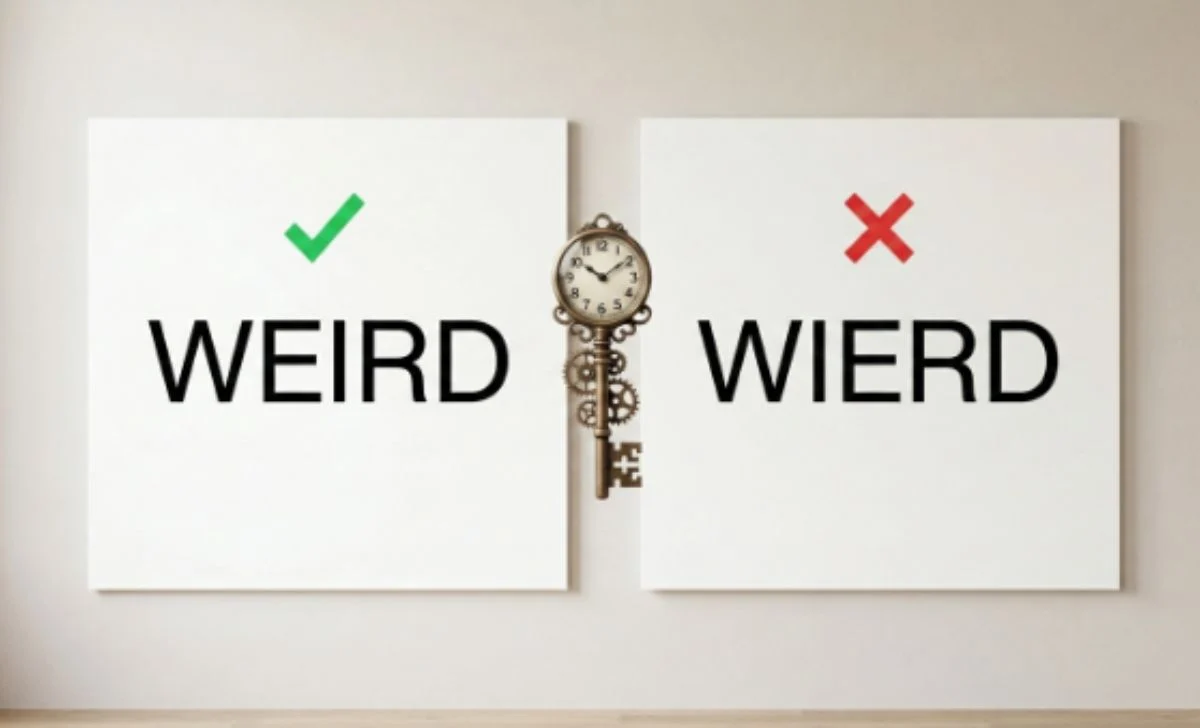
The good news is simple: weird is the correct spelling in standard English. Wierd is a misspelling.
The unusual spelling comes from the word’s history, not from a modern spelling rule. Once you understand that, remembering weird becomes much easier.
The Quick Answer
Weird is correct.
Wierd is incorrect in standard modern English.
✅ That was a weird experience.
❌ That was a wierd experience.
The tricky part is that many English words follow the familiar i before e pattern, such as believe and piece. But weird is one of the well-known exceptions.
| Spelling | Correct? | Meaning | Example |
|---|---|---|---|
| weird | Yes | Strange, unusual, or bizarre | That’s a weird story. |
| wierd | No | Common misspelling | ❌ Wierd |
What Does Weird Mean?
Weird is an adjective meaning strange, unusual, unexpected, or difficult to explain.
It can describe a person, situation, feeling, behavior, sound, experience, or event.
Examples
That was a weird dream.
He gave me a weird look.
There’s a weird noise coming from the kitchen.
She had a weird feeling that something was wrong.
The word can describe something mildly unusual or genuinely bizarre. The meaning depends on context and tone.
Why Is “Wierd” Wrong?
The spelling wierd looks logical because of the common spelling pattern:
i before e
For example:
- believe
- achieve
- piece
- field
So it is easy to assume:
w + i + e + r + d = wierd
But English spelling does not always follow that pattern.
The correct spelling is:
w + e + i + r + d = weird
The important thing to remember is that weird is an exception to the familiar “i before e” pattern.
Why Is Weird Spelled With “E-I”?
The answer goes back to the word’s history.
Weird comes from the Old English word wyrd, which was associated with fate, destiny, or what happens by fate.
Over time, the spelling and meaning changed.
The modern meaning of strange or unusual developed from older associations with fate and the supernatural.
So the spelling weird is not simply an arbitrary exception. It reflects the word’s unusual historical development.
Weird Pronunciation
Weird is pronounced:
/wɪrd/
A simple pronunciation guide is:
WEERD
It generally rhymes with words such as:
- bird
- heard
- word
- third
The spelling may look unusual, but the pronunciation is relatively straightforward.
Does “wierd” sound different?
Usually, no.
Weird and the misspelling wierd would generally be intended to represent the same pronunciation.
That is one reason the mistake is so common: you cannot hear the spelling difference.
Weird as a Noun, Adjective, or Verb
In modern everyday English, weird is most commonly an adjective.
That’s weird.
He has a weird sense of humor.
Weird as a noun
The noun weird has an older or literary use connected with fate or destiny.
For example, in older English and literary contexts, the Weird can refer to fate.
You may also encounter the plural weirds in specialized or literary writing, but this is not the normal modern use.
As a verb
Weird can also appear in the informal phrasal verb:
weird out
That horror movie really weirded me out.
Here, weird out means to make someone feel uncomfortable, disturbed, or strange.
Singular and Plural Forms
Because weird is primarily an adjective, it does not normally have singular or plural forms.
You say:
a weird idea
several weird ideas
The adjective remains weird.
When used as the rare noun referring to a fate or supernatural force, its grammatical behavior depends on the context.
For everyday English, simply remember:
weird stays weird whether the noun is singular or plural.
American vs British English
There is no spelling difference between American and British English.
Both use:
weird
and reject:
wierd
| Variety | Correct | Incorrect |
|---|---|---|
| American English | weird | wierd |
| British English | weird | wierd |
| Canadian English | weird | wierd |
| Australian English | weird | wierd |
So unlike pairs such as color/colour or organize/organise, this spelling does not change between major English varieties.
Weird vs Strange: Are They the Same?
They are close, but not always identical.
Strange is a broad and relatively neutral word for something unfamiliar or unusual.
Weird often adds a stronger sense of something being odd, unsettling, bizarre, or unexpected.
Compare:
That’s a strange building.
This could simply mean the building has an unusual design.
That’s a weird building.
This can suggest that something about it feels noticeably odd or unsettling.
In casual English, the two words often overlap.
Synonyms for Weird
Depending on context, synonyms include:
- strange
- unusual
- odd
- bizarre
- peculiar
- abnormal
- unconventional
- eccentric
- uncanny
- surreal
- quirky
- bizarre
Examples
That is a weird idea.
That is a strange idea.
That is an unusual idea.
That is a bizarre idea.
The best synonym depends on how strong the intended meaning is.
Antonyms of Weird
Possible opposites include:
- normal
- ordinary
- usual
- typical
- conventional
- familiar
- expected
- common
For example:
That’s not weird. It’s completely normal.
Her reaction was ordinary, not unusual.
There is no single perfect antonym because weird can have several shades of meaning.
Grammar Rules for Weird
Before a noun
a weird story
a weird sound
a weird experience
After linking verbs
The situation is weird.
That sounds weird.
The movie became weird.
“weirdly” as the adverb
He was weirdly calm during the argument.
Use “weirder” for comparison
This story is weirder than the first one.
Use “weirdest” for the superlative
That was the weirdest dream I’ve ever had.
These forms are all based on the correct spelling weird.
Common Mistakes With Weird
1. Writing “wierd”
This is the most common spelling mistake.
❌ wierd
✅ weird
2. Applying “i before e” automatically
The rule is often taught as:
“I before E except after C…”
But weird does not fit neatly into that rhyme.
It is better to remember its spelling individually.
3. Writing “weired”
Another common mistake is adding an extra e:
❌ weired
✅ weird
4. Confusing weird with wired
Weird means strange.
Wired can mean connected by wires, equipped with electronic connections, or extremely alert/energized.
That’s weird.
The building is wired for internet access.
Changing one letter changes the meaning completely.
Weird vs Wired
This is another spelling trap worth knowing.
| Word | Meaning | Example |
|---|---|---|
| weird | Strange or unusual | That’s a weird dream. |
| wired | Connected by wires; highly alert | The house is wired for security. |
A sentence such as:
I had a weird feeling.
means you had a strange feeling.
But:
I was wired after drinking coffee.
means you felt highly energetic or alert.
Real-Life Examples of Weird
Everyday conversation
That’s a weird question.
Social situations
He was acting weird at dinner.
Technology
My phone is making a weird noise.
Food
This tastes weird.
Dreams
I had a really weird dream last night.
Weather
The weather has been weird this week.
Internet
I found a weird website while searching for that topic.
Feeling
I have a weird feeling about this.
These examples show how flexible the word is in everyday English.
The History Behind the Strange Spelling
The modern spelling makes more sense when you look at the word’s history.
Old English had the word wyrd, which referred to fate or destiny. It was related to the idea of what would happen or what was destined to happen.
Over centuries, the word developed into weird.
The meaning also shifted. Instead of simply referring to fate, weird became associated with supernatural or mysterious forces and eventually developed its modern sense of strange or unusual.
This historical development helps explain why weird does not follow the spelling pattern many learners expect.
A Simple Memory Trick
Here is the easiest way to remember it:
Weird has “E-I”
Think:
WEIRD = E before I
Don’t try to force the normal spelling rule onto this word.
Another trick:
WEIRD starts like WE.
WE + IRD = WEIRD
Or simply memorize:
W-E-I-R-D
If you see W-I-E-R-D, stop and correct it.
Practice Exercise
Choose the correct spelling.
1.
That was a very _____ experience.
- A) wierd
- B) weird
2.
My computer is making a _____ noise.
- A) weird
- B) wierd
3.
She had the _____ feeling that someone was watching her.
- A) wierd
- B) weird
4.
That is the _____ movie I’ve ever seen.
- A) weirdest
- B) wierdest
5.
He acted _____ during the meeting.
- A) weird
- B) wierd
Answers
- weird ✓
- weird ✓
- weird ✓
- weirdest ✓
- weird ✓
People Also Ask
Is it weird or wierd?
Weird is the correct spelling. Wierd is a common misspelling.
Why is weird spelled weird?
The spelling comes from the word’s historical development from Old English wyrd, meaning fate or destiny.
Is weird an exception to “i before e”?
Yes. Weird is commonly cited as an exception to the familiar “i before e” spelling pattern.
What does weird mean?
Weird means strange, unusual, bizarre, or sometimes unsettling.
Is wierd ever correct?
No. Wierd is not the standard spelling of the modern English word. Use weird.
How do you pronounce weird?
Weird is generally pronounced /wɪrd/, approximately WEERD.
Is weird an adjective?
Yes. In modern English, weird is most commonly used as an adjective.
What is the plural of weird?
As an adjective, weird has no plural form. You say weird things, not “weirds things.”
FAQs
Is “wierd” a word?
Wierd is generally considered a misspelling of weird, not the standard spelling of the word.
Why do people spell weird as wierd?
The main reason is the familiar i before e spelling pattern. Since words such as believe and piece use ie, people naturally write wierd instead of weird.
Is weird a positive or negative word?
It depends on context. Weird can be negative, neutral, playful, or even complimentary.
For example:
That’s a weird problem.
sounds negative.
But:
I love your weird sense of humor.
can be affectionate or positive.
What is the comparative form of weird?
The comparative is:
weirder
This movie is weirder than the first one.
What is the superlative form of weird?
The superlative is:
weirdest
That was the weirdest experience of my life.
What is the noun form of weird?
In modern everyday English, weird is mainly an adjective. The noun has historical and literary uses, while the informal expression weirdness is common for the quality of being strange.
I couldn’t explain the weirdness of the situation.
Conclusion
If you are wondering whether it is weird or wierd, there is only one standard spelling:
WEIRD ✓
WIERD ✗
The word is unusual because it does not follow the spelling pattern many learners expect. Its history goes back to Old English wyrd, which helps explain why its spelling developed differently.
Whenever you feel tempted to write wierd, remember:
WEIRD has E before I.
It may look strange—but that’s exactly the word you’re trying to spell.
Read More:

Hi, I’m Safdar Ali, an English language teacher with 26 years of teaching experience. My expertise is in English linguistics, grammar, and the differences between British and American English.
Through Gramiffy, I share practical, research-based guides to help students, writers, and English learners improve their language skills. My goal is to make English simple, accurate, and easy for everyone to understand.