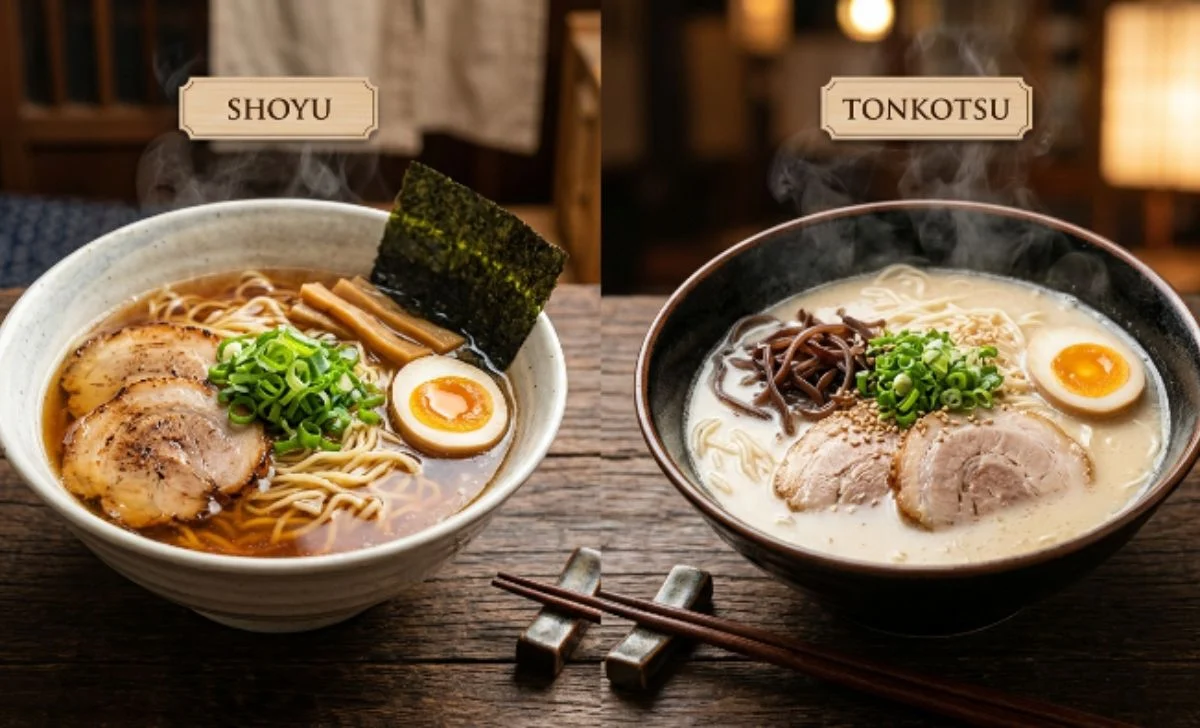
If you’re looking at a ramen menu and wondering whether to order shoyu or tonkotsu, the biggest difference is the broth base and overall flavor.
Shoyu ramen is seasoned primarily with soy sauce (shoyu). It usually has a clear, brown broth with a savory, salty, slightly tangy flavor.
Tonkotsu ramen is made by simmering pork bones for hours, producing a rich, creamy, opaque broth with a deep pork flavor.
So, if you want something lighter and more soy-forward, choose shoyu. If you prefer a rich, creamy, intensely savory bowl, tonkotsu is the better choice.
Quick Answer
| Feature | Shoyu Ramen | Tonkotsu Ramen |
|---|---|---|
| Main characteristic | Soy sauce seasoning | Pork-bone broth |
| Broth | Usually clear or lightly cloudy | Creamy and opaque |
| Flavor | Salty, savory, balanced | Rich, fatty, deeply savory |
| Texture | Lighter | Heavier and silky |
| Common origin | Tokyo and other regions | Fukuoka, especially Hakata |
| Best for | A lighter ramen bowl | Rich broth lovers |
The important point is that shoyu and tonkotsu describe different aspects of ramen. Shoyu refers mainly to the seasoning, while tonkotsu refers to the broth itself.
What Is Shoyu Ramen?
Shoyu is the Japanese word for soy sauce.
Shoyu ramen is ramen seasoned with soy sauce. Its broth is commonly made from ingredients such as:
- chicken stock
- pork stock
- dashi
- seafood
- vegetables
- soy sauce
The result is often a brown, aromatic broth with a distinctly savory flavor.
A traditional shoyu ramen can be relatively light compared with tonkotsu, but not every shoyu ramen is light. The underlying stock can make a major difference.
What Does Shoyu Taste Like?
Shoyu ramen typically has:
- salty flavor
- umami
- soy sauce aroma
- subtle sweetness
- savory depth
- a cleaner finish
Because soy sauce is central to the seasoning, its flavor is easy to notice.
What Is Tonkotsu Ramen?
Tonkotsu is a Japanese ramen style known for its pork-bone broth.
Pork bones are simmered for many hours, often at a vigorous boil. This extracts fat, collagen, marrow, and other components from the bones and creates the characteristic opaque broth.
Tonkotsu is strongly associated with Hakata ramen from Fukuoka, Japan.
What Does Tonkotsu Taste Like?
Tonkotsu is typically:
- rich
- creamy
- deeply savory
- fatty
- pork-forward
- silky in texture
It is often more intense than a traditional shoyu ramen.
The Biggest Difference: Seasoning vs Broth
This is the detail many ramen comparisons miss.
Shoyu identifies the seasoning.
Tonkotsu identifies the broth base.
That means they are not always direct opposites.
A ramen restaurant can technically serve a tonkotsu broth seasoned with shoyu.
You might therefore encounter ramen that combines characteristics of both styles.
Think of it this way:
Shoyu = soy sauce seasoning
Tonkotsu = pork-bone broth
This distinction makes ramen menus much easier to understand.
Shoyu vs Tonkotsu Flavor
Shoyu ramen usually gives you a cleaner, sharper savory taste.
The soy sauce adds saltiness and umami without necessarily making the broth extremely heavy.
Tonkotsu
Tonkotsu has a fuller mouthfeel.
The long cooking process produces a broth that feels thick, silky, and intensely savory.
If you enjoy rich pork flavor, tonkotsu is likely to appeal to you.
How the Broths Are Made
Shoyu broth
There isn’t one universal shoyu broth recipe.
A chef may prepare a stock from:
- chicken
- pork
- fish
- kombu
- dried seafood
- vegetables
Soy sauce is then used as the primary seasoning, often alongside a concentrated seasoning mixture called tare.
Tonkotsu broth
Tonkotsu traditionally relies on pork bones.
The bones may be:
- cleaned
- broken or chopped
- blanched
- simmered for many hours
The vigorous cooking helps emulsify fat and other components into the liquid.
This produces the famous cloudy appearance.
Shoyu vs Tonkotsu Texture
The difference is noticeable as soon as you take a spoonful.
Shoyu:
- lighter mouthfeel
- thinner broth
- cleaner finish
Tonkotsu:
- thicker mouthfeel
- silky texture
- richer finish
However, shoyu does not always mean thin, and tonkotsu does not necessarily mean extremely thick. Recipes vary from restaurant to restaurant.
Which One Is More Savory?
Both can be highly savory because both contain umami.
But they express that flavor differently.
Shoyu gets much of its recognizable character from soy sauce and other ingredients in the tare.
Tonkotsu gets its richness and depth largely from the pork-bone broth itself.
If you want a pronounced soy sauce flavor, choose shoyu.
If you want deep pork richness, choose tonkotsu.
Shoyu vs Tonkotsu Noodles
The noodles can also differ.
Hakata-style tonkotsu ramen is famous for thin, straight noodles. These noodles cook quickly and are often served firm.
Shoyu ramen has more variation. Depending on the regional style and restaurant, you may find:
- thin noodles
- medium noodles
- wavy noodles
- straight noodles
So noodle shape is not a reliable way to identify shoyu ramen by itself.
Common Toppings
Both styles can include classic ramen toppings.
Shoyu toppings
You might find:
- chashu
- menma
- green onions
- nori
- soft-boiled egg
- spinach
- bamboo shoots
Tonkotsu toppings
Common additions include:
- chashu
- green onions
- wood ear mushrooms
- pickled ginger
- sesame seeds
- garlic
- nori
- soft-boiled egg
Toppings vary widely by restaurant.
Shoyu vs Tonkotsu: Which Is Healthier?
Neither style can automatically be called healthy or unhealthy.
The nutritional profile depends on:
- portion size
- broth ingredients
- pork content
- added oil
- sodium
- noodles
- toppings
Tonkotsu can be higher in fat because of its rich pork-bone broth, while shoyu ramen can still contain substantial sodium because soy sauce is salty.
If you’re watching your sodium or fat intake, check the restaurant’s nutrition information rather than judging the bowl by its name alone.
Which One Should You Choose?
Choose shoyu if you prefer:
- lighter broth
- soy sauce flavor
- a cleaner finish
- balanced savory flavors
- less creamy texture
Choose tonkotsu if you prefer:
- rich broth
- pork flavor
- creamy texture
- intense umami
- a heavier mouthfeel
A Simple Choice
First ramen experience? Try shoyu for a balanced introduction.
Love rich, creamy soups? Try tonkotsu.
Of course, taste is personal. Someone who loves bold flavors may prefer tonkotsu immediately.
Can Shoyu and Tonkotsu Be Combined?
Yes.
This is where ramen terminology gets interesting.
A bowl can use tonkotsu broth and be seasoned with shoyu tare.
That gives you the richness of pork bones with the savory character of soy sauce.
So you may see descriptions such as:
Tonkotsu shoyu ramen
This isn’t contradictory.
It tells you something about both the broth and the seasoning.
Shoyu vs Tonkotsu vs Miso
Another common ramen comparison is miso.
| Style | Main defining feature | Typical character |
|---|---|---|
| Shoyu | Soy sauce seasoning | Savory, salty, aromatic |
| Tonkotsu | Pork-bone broth | Rich, creamy, porky |
| Miso | Miso seasoning | Fermented, hearty, robust |
Unlike tonkotsu, miso primarily identifies the seasoning.
This is why ramen styles can overlap.
A bowl could potentially combine a tonkotsu broth with miso seasoning, for example.
Shoyu vs Tonkotsu Origin
Shoyu ramen became strongly associated with Tokyo-style ramen, although soy-sauce-seasoned ramen exists across Japan.
Tokyo ramen traditionally developed around a chicken- and dashi-based broth seasoned with soy sauce.
Tonkotsu
Tonkotsu is strongly associated with Fukuoka Prefecture, particularly Hakata.
Hakata ramen became famous for its pork-bone broth and thin noodles.
Today, both styles are served throughout Japan and around the world.
Pronunciation
Shoyu
Shoyu is commonly pronounced approximately:
SHOH-yoo
Japanese:
しょうゆ
Romanized:
shōyu
Tonkotsu
Tonkotsu is commonly pronounced approximately:
TON-kot-soo
Japanese:
とんこつ
Romanized:
tonkotsu
The Japanese terms refer to different components of ramen culture, which is why their meanings are useful to understand when ordering.
Common Misunderstandings
“Shoyu is always a clear broth.”
Not necessarily.
Shoyu describes the soy-sauce seasoning. The underlying stock can vary.
“Tonkotsu means any pork ramen.”
Not exactly.
Tonkotsu specifically refers to a broth made by simmering pork bones.
A ramen bowl can contain pork without being tonkotsu.
“Shoyu and tonkotsu are competing types.”
Not always.
They can describe different elements of the same bowl.
“All tonkotsu ramen tastes the same.”
Definitely not.
Cooking methods, pork bones, aromatics, tare, oils, noodles, and toppings can dramatically change the final bowl.
Common Ramen Terms to Know
Understanding a few Japanese ramen terms makes menus easier to navigate.
Tare
Tare is the concentrated seasoning component added to ramen broth.
Common types include:
- shoyu tare
- miso tare
- shio tare
Dashi
Dashi is a Japanese stock commonly made using ingredients such as kombu and bonito flakes.
It provides umami and can form part of a ramen broth.
Chashu
Chashu is a popular ramen topping made from seasoned meat, commonly pork.
Menma
Menma is seasoned fermented bamboo shoots commonly served as a ramen topping.
Nori
Nori is dried edible seaweed often placed on the side of a ramen bowl.
Frequently Asked Questions
Is shoyu or tonkotsu better?
Neither is objectively better. Shoyu is better if you prefer a savory, soy-forward and relatively clean broth. Tonkotsu is better if you prefer rich, creamy pork-bone broth.
Is shoyu ramen healthier than tonkotsu?
Not automatically. Shoyu ramen may be lighter, but it can be high in sodium. Tonkotsu can contain more fat. Ingredients and portion sizes matter.
Is tonkotsu always pork?
Traditional tonkotsu broth is made from pork bones. The word itself refers to pork bones.
Does shoyu mean soy sauce?
Yes. Shoyu is the Japanese term for soy sauce.
What is the difference between shoyu and tonkotsu ramen?
Shoyu primarily describes soy sauce seasoning, while tonkotsu describes a pork-bone broth.
Can tonkotsu ramen have soy sauce?
Yes. Tonkotsu broth can be seasoned with shoyu, creating a tonkotsu-shoyu combination.
Is tonkotsu ramen spicy?
Traditional tonkotsu is not inherently spicy. Garlic, chili oil, chili paste, or other toppings can make it spicy.
Is shoyu ramen spicy?
Shoyu ramen is not inherently spicy either. Its flavor is primarily savory and soy-based.
Final Verdict
The simplest way to remember shoyu vs tonkotsu is this:
Shoyu = soy sauce
Tonkotsu = pork bones
Shoyu ramen usually offers a savory, aromatic broth with a cleaner mouthfeel. Tonkotsu delivers a rich, creamy, pork-forward experience created through prolonged cooking of pork bones.
And because these terms describe different parts of ramen, they can appear together. Tonkotsu shoyu ramen can have a pork-bone broth seasoned with soy sauce.
So if you’re choosing your next bowl, go by the flavor you want: shoyu for a cleaner savory taste, tonkotsu for deep, creamy richness.
Read More:

I am Constance Hale, an, editor, and writing expert dedicated to helping people write with clarity and confidence. Through my articles on Gramiffy.com, I simplify grammar, spelling, and language usage for readers of all levels. My goal is to make English writing more engaging, accurate, and enjoyable.