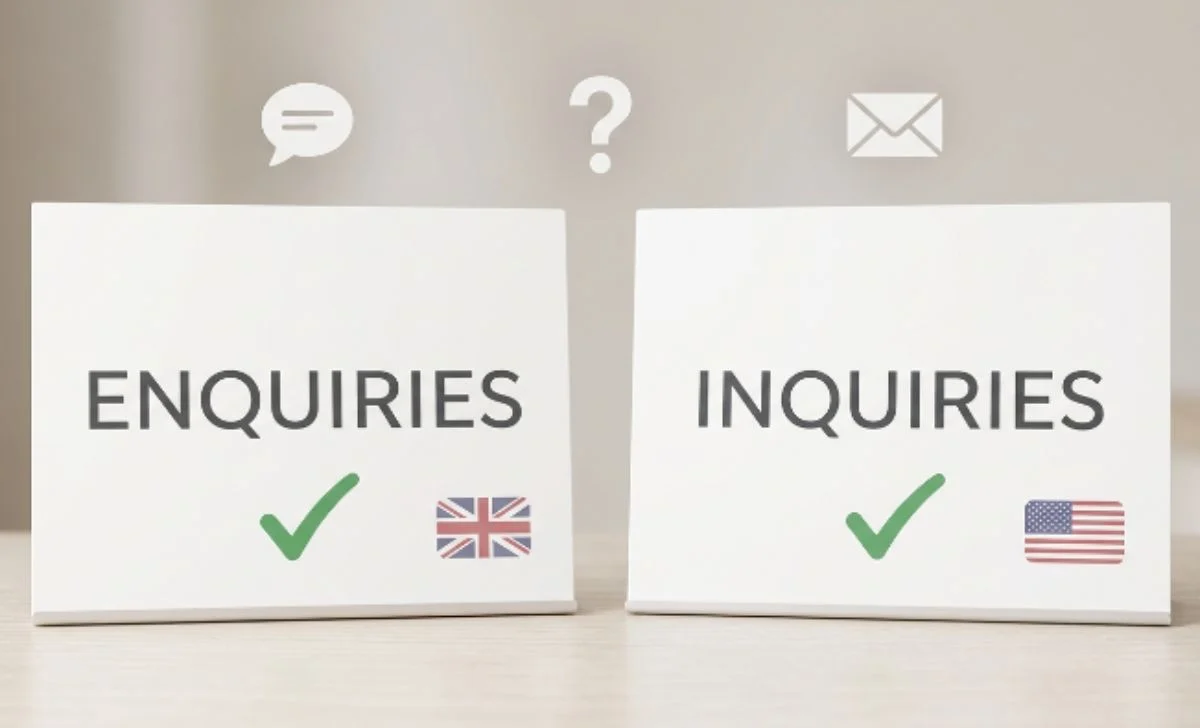
Enquiries or inquiries? Both spellings are correct, but your choice depends mainly on English variety and context.
In British English, enquiries is commonly used for general questions or requests for information, while inquiries is often used for formal investigations.
However, the distinction is not absolute: British English can use either spelling for either meaning. Oxford specifically notes that both spellings can be used in either sense. (Oxford Learner’s Dictionaries)
In American English, inquiries is the standard spelling for both general questions and formal investigations. (Cambridge Dictionary)
So, if you’re writing for a British audience, enquiries will often look more natural. For an American audience, choose inquiries.
The Simple Answer
Both enquiries and inquiries are correct.
British English: enquiries / inquiries
American English: inquiries
For everyday British usage:
Please direct all enquiries to our support team.
For American English:
Please direct all inquiries to our support team.
Cambridge lists enquiry as the UK form of inquiry, while its Business English dictionary gives inquiries as the plural and enquiries as the UK variant. (Cambridge Dictionary)
What Does “Enquiries” Mean?
Enquiries is the plural of enquiry. It means questions, requests for information, or attempts to find something out.
Examples:
We have received several enquiries about the new course.
Please send your enquiries by email.
The hotel handles booking enquiries throughout the day.
In British English, this spelling is especially familiar in customer service, business communication, travel, education, and everyday requests for information.
What Does “Inquiries” Mean?
Inquiries is the plural of inquiry.
It can mean:
- questions
- requests for information
- investigations
- official examinations
- attempts to discover facts
For example:
We received several inquiries about the product.
Or:
The government launched several inquiries into the incident.
Cambridge gives both the general “question/request for information” sense and the formal “official process to discover facts” sense. (Cambridge Dictionary)
Enquiries vs Inquiries: The Real Difference
The difference becomes clearer when you separate spelling from meaning.
| Feature | Enquiries | Inquiries |
|---|---|---|
| Singular | enquiry | inquiry |
| Main meaning | Questions or requests for information | Questions, requests, or investigations |
| British English | Common | Also used |
| American English | Uncommon | Standard |
| Formal investigation | Sometimes used | Common |
| Customer questions | Common in UK | Common in US |
The important point is that enquiries is not an incorrect spelling of inquiries. It is an established British variant. (Cambridge Dictionary)
British English vs American English
This is where most of the confusion comes from.
British English
British writers commonly use:
enquiry → enquiries
for a general request for information.
Example:
We welcome customer enquiries.
For a formal investigation, inquiry is also traditionally used:
A public inquiry was launched into the accident.
However, modern British English does not enforce this distinction rigidly. Oxford notes that either spelling can be used for either meaning. (Oxford Learner’s Dictionaries)
American English
American English generally uses:
inquiry → inquiries
for both meanings.
Examples:
Customer inquiries are answered within 24 hours.
An official inquiry was launched.
This makes inquiries the safest choice when writing specifically for a US audience. (Cambridge Dictionary)
A Useful Comparison
| Meaning | British English | American English |
|---|---|---|
| General question | enquiry | inquiry |
| Customer request | enquiry | inquiry |
| Request for information | enquiry | inquiry |
| Formal investigation | inquiry | inquiry |
| Plural, general | enquiries | inquiries |
| Plural, investigation | inquiries | inquiries |
This is a useful traditional guideline, but remember that British English can use enquiry and inquiry more flexibly. (Oxford Learner’s Dictionaries)
How Do You Pronounce Enquiries and Inquiries?
Both forms are pronounced essentially the same.
Enquiries
en-KWYE-uh-reez
IPA:
/ɪnˈkwaɪəriz/
Inquiries
en-KWYE-uh-reez
IPA:
/ɪnˈkwaɪəriz/
The difference is mainly visible in writing, not something you normally hear in speech.
Singular and Plural Forms
The spelling changes slightly when moving from singular to plural.
British form
enquiry → enquiries
Example:
I sent an enquiry yesterday.
We received several enquiries today.
American form
inquiry → inquiries
Example:
I made an inquiry.
We received several inquiries.
Notice that the y changes to i before the plural ending:
enquiry → enquiries
inquiry → inquiries
Why Is It “Enquiries” Instead of “Enquirys”?
The normal English plural spelling rule applies.
When a noun ends in a consonant + y, the y changes to i before -es.
So:
enquiry → enquiries
Similarly:
inquiry → inquiries
Other examples include:
country → countries
family → families
company → companies
This is why enquirys and inquirys are incorrect.
Word Origin
Inquiry and enquiry come from the same historical source.
They are related to the verb inquire, meaning to ask for information or investigate something.
The spelling variation developed through different English usage traditions. Enquiry became particularly associated with British English, while inquiry became the dominant form in American English.
Today, dictionaries recognize both forms. Cambridge lists enquiry as a UK form of inquiry, while Oxford notes that both spellings may be used in British English. (Cambridge Dictionary)
Grammar Rules You Should Know
Use “an enquiry” or “an inquiry”
Both are countable nouns when referring to a question or request.
I made an enquiry.
I made an inquiry.
Use “enquiries” or “inquiries” for multiple questions
We received several enquiries.
We received several inquiries.
Use “enquiry into” or “inquiry into” for an investigation
An inquiry into the accident was launched.
An enquiry into the matter was conducted.
Both can occur in British English, depending on style and context. (Oxford Learner’s Dictionaries)
Don’t use an apostrophe for the plural
Incorrect:
❌ customer enquiry’s
Correct:
✅ customer enquiries
The apostrophe would indicate possession, not a normal plural.
Everyday Examples
Customer service
British:
Please send all customer enquiries to our support team.
American:
Please send all customer inquiries to our support team.
Hotel booking
The hotel received several booking enquiries.
In American English:
The hotel received several booking inquiries.
University
The admissions office handles student enquiries.
Business
We answer all product inquiries within one business day.
Formal investigation
The government ordered an inquiry into the incident.
Common Mistakes
Mistake 1: Thinking enquiries is wrong
❌ Enquiries is an incorrect spelling.
Not true.
Enquiries is a standard British English form. (Cambridge Dictionary)
Mistake 2: Thinking inquiries is only American
Not exactly.
Inquiry/inquiries is also used in British English, particularly for formal investigations, and either spelling can occur in British usage. (Oxford Learner’s Dictionaries)
Mistake 3: Writing “inquirys”
❌ We received three inquirys.
✅ We received three inquiries.
Mistake 4: Writing “enquirys”
❌ Please send your enquirys.
✅ Please send your enquiries.
Mistake 5: Mixing regional styles
If your entire website uses British English, suddenly switching from enquiries to inquiries can make the writing look inconsistent.
Choose a regional style and use it consistently.
Enquiry or Inquiry in Business Writing?
Both can be professional.
If your company primarily serves the UK:
For further enquiries, please contact our team.
If your company primarily serves the US:
For further inquiries, please contact our team.
For an international audience, inquiries may be more universally recognizable, but consistency with the rest of your site’s English matters more than trying to force one spelling everywhere.
Enquiries vs Inquiries in Formal Investigations
This is one area where the traditional British distinction is useful.
British English may use:
enquiry = general request for information
inquiry = formal investigation
For example:
I made an enquiry about the train schedule.
The government launched an inquiry into the accident.
However, this distinction is a usage preference rather than an absolute grammar rule. Oxford explicitly says that either spelling can be used in either meaning in British English. (Oxford Learner’s Dictionaries)
American English generally uses inquiry for both:
I made an inquiry about the train schedule.
The government launched an inquiry into the accident.
Synonyms
Depending on the context, useful alternatives include:
- questions
- queries
- requests
- investigations
- examinations
- probes
- information requests
- concerns
For example:
We received many enquiries.
could become:
We received many questions.
or:
We received many requests for information.
The best synonym depends on whether you’re asking for information or referring to a formal investigation.
A Simple Memory Trick
Use this shortcut:
UK → ENQUIRY
US → INQUIRY
And remember:
enquiry → enquiries
inquiry → inquiries
For formal investigations in British English, inquiry is traditionally preferred.
This won’t cover every variation in real-world English, but it works well as a practical starting point.
Practice Exercise
Choose enquiries or inquiries.
1.
The company received hundreds of customer _____.
2.
Please direct all UK _____ to our London office.
3.
The American website handles customer _____ online.
4.
The government launched an _____ into the accident.
5.
We welcome all booking _____.
Answers
- enquiries or inquiries, depending on regional style
- enquiries
- inquiries
- inquiry / inquiries, depending on singular or plural
- enquiries in British English; inquiries in American English
People Also Ask
Is it enquiries or inquiries?
Both are correct. Enquiries is commonly associated with British English, while inquiries is the standard American spelling. British English can use both forms. (Cambridge Dictionary)
Is enquiries British or American?
Enquiries is primarily associated with British English. American English generally uses inquiries.
Is inquiries British English?
Yes. British English uses inquiries, especially for formal investigations, although enquiries is also common for general requests.
What is the plural of enquiry?
The plural is enquiries.
What is the plural of inquiry?
The plural is inquiries.
Is enquiry a formal word?
Yes. Enquiry is a standard noun meaning a question, request for information, or investigation, particularly in British English. (Cambridge Dictionary)
Is inquiry more correct than enquiry?
No. Neither is universally more correct. The preferred spelling depends on regional English and context.
FAQs
Should I use enquiries or inquiries?
Use enquiries if you’re following British English for general questions or requests. Use inquiries for American English. If writing British English about a formal investigation, inquiry is traditionally common.
Can I use inquiries in British English?
Yes. British English uses inquiry, and dictionaries recognize both spellings. (Oxford Learner’s Dictionaries)
Can I use enquiries in American English?
It is understandable, but inquiries is the normal American spelling.
Are enquiries and inquiries pronounced differently?
Generally, no. They are normally pronounced the same.
Is “customer enquiries” correct?
Yes, particularly in British English.
We welcome customer enquiries.
In American English:
We welcome customer inquiries.
Is “further enquiries” correct?
Yes. Further enquiries is a common British English expression meaning additional questions or requests for information.
Is “further inquiries” correct?
Yes. It is the standard American form and is also used in British English.
Final Verdict
So, enquiries or inquiries?
The answer is both.
Enquiries → commonly British English
Inquiries → standard American English and also used in British English
For general British communication:
Please contact us with any further enquiries.
For American communication:
Please contact us with any further inquiries.
And when referring to a formal investigation, inquiry is traditionally preferred in British English as well.
The safest strategy is simple: match your spelling to your audience and stay consistent throughout your writing. (Oxford Learner’s Dictionaries)
Read More:

Hi, I’m Safdar Ali, an English language teacher with 26 years of teaching experience. My expertise is in English linguistics, grammar, and the differences between British and American English.
Through Gramiffy, I share practical, research-based guides to help students, writers, and English learners improve their language skills. My goal is to make English simple, accurate, and easy for everyone to understand.