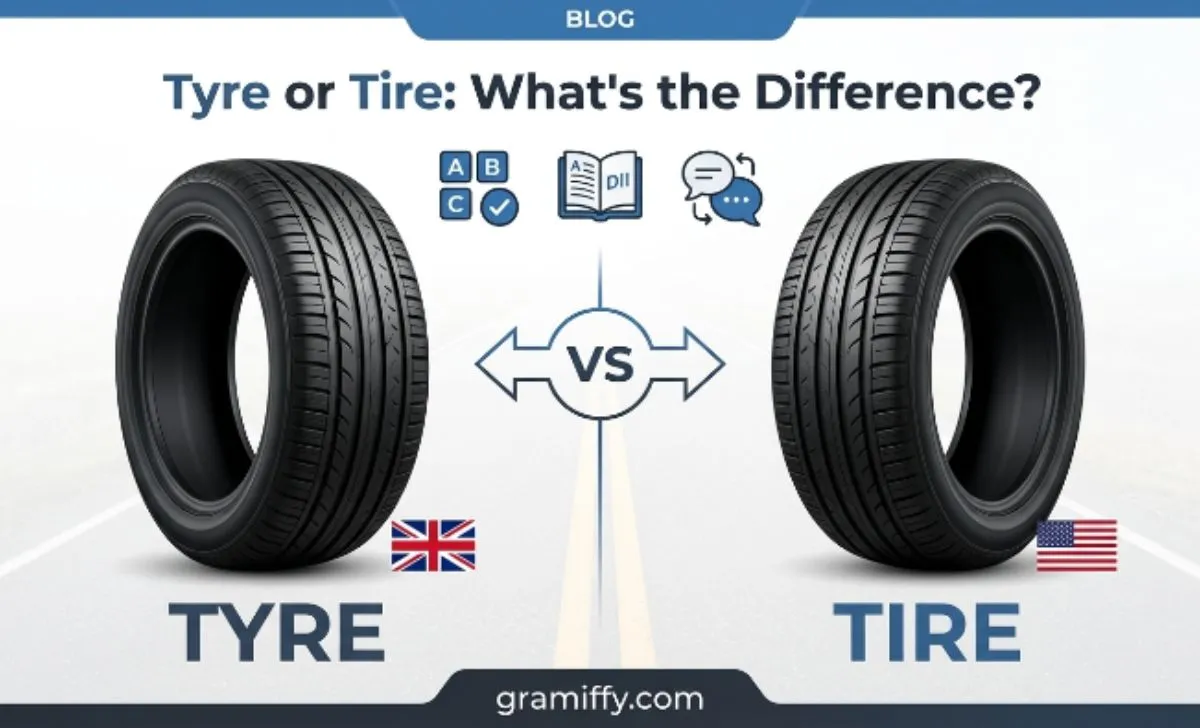
If you’re unsure whether to write tyre or tire, the short answer is simple:
- Tyre is the correct spelling in British English.
- Tire is the correct spelling in American English.
Both words refer to the rubber covering fitted around a vehicle’s wheel, and they have exactly the same meaning and pronunciation. The only difference is the regional variety of English you’re using.
However, there’s one important exception. The word tire is also a verb meaning to become exhausted or to make someone feel tired. This verb is correct in both British and American English, while tyre is never used as a verb.
Because both spellings appear in books, websites, newspapers, and online searches, many people wonder:
- Is tire or tyre the correct spelling?
- Why do British and American English use different spellings?
- Which spelling should I use in school, business writing, or blog posts?
- Is tyre accepted by dictionaries?
- Is tire wrong outside the United States?
- Which spelling should international websites use?
This complete guide answers every one of those questions. You’ll also discover the history behind the two spellings, dictionary definitions, grammar rules, pronunciation, real-world examples, comparison tables, common mistakes, FAQs, and expert writing tips.
Whether you’re a student, writer, blogger, editor, English learner, or simply curious about language differences, this guide will help you choose the correct spelling with confidence.
Quick Answer:tyres vs tires
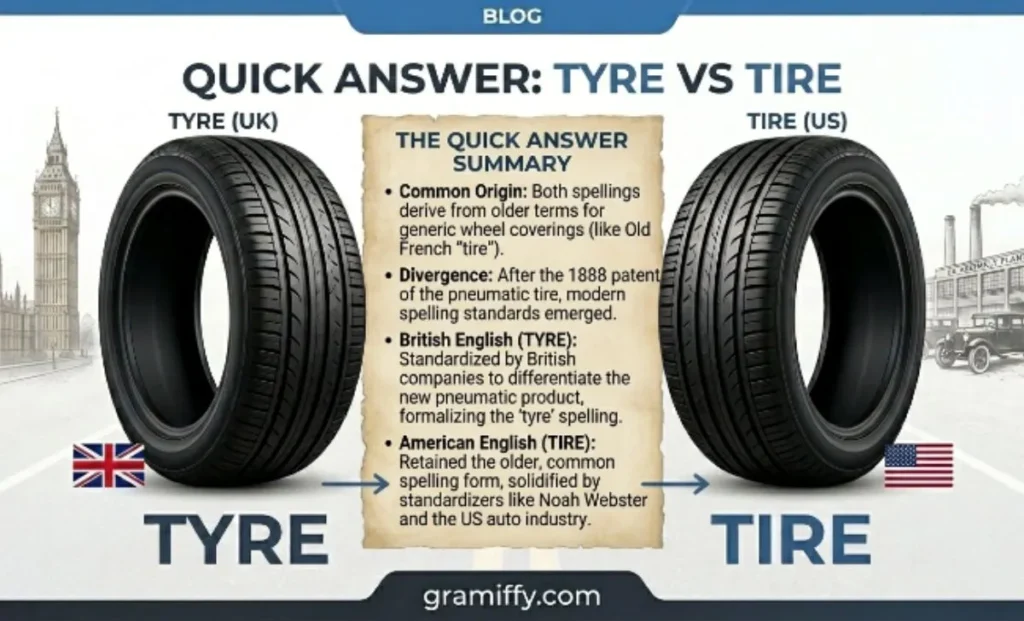
If you only need a quick answer, here it is.
| Question | Answer |
|---|---|
| Which spelling is correct? | Both are correct. |
| British English | ✅ Tyre |
| American English | ✅ Tire |
| Meaning | The rubber covering around a vehicle’s wheel |
| Pronunciation | Exactly the same |
| Dictionary recognized | ✅ Both |
| Can it mean “become exhausted”? | Only tire |
| Should you mix both spellings? | ❌ No |
Easy Rule:
Writing for a British audience? Use “tyre.”
Writing for an American audience? Use “tire.”
At a Glance tire vs tyre
Here’s a quick comparison before we explore the details.
| Feature | Tyre | Tire |
|---|---|---|
| British English | ✅ Standard | ❌ Not standard for the wheel covering |
| American English | ❌ Rarely used | ✅ Standard |
| Means the rubber wheel covering | ✅ Yes | ✅ Yes |
| Functions as a verb | ❌ No | ✅ Yes |
| Pronunciation | /taɪər/ | /taɪər/ |
| Used in formal writing | ✅ Yes | ✅ Yes |
| Accepted by dictionaries | ✅ Yes | ✅ Yes |
The table shows that the difference is regional spelling, not meaning.
Why Is There Confusion Between “Tyre” and “Tire”?
The confusion exists because English has two major written standards: British English and American English.
Many English words have different spellings depending on the variety of English being used.
For example:
| British English | American English |
|---|---|
| Colour | Color |
| Honour | Honor |
| Favourite | Favorite |
| Centre | Center |
| Jewellery | Jewelry |
| Travelling | Traveling |
| Defence | Defense |
| Tyre | Tire |
Because both spellings are correct in their own regions, learners often assume one must be a mistake.
In reality, they’re simply different regional spellings of the same noun.
Why Does British English Use “Tyre”?
British English adopted the spelling tyre to distinguish the wheel covering from the verb tire, meaning to become weary.
This distinction makes written English easier to understand.
For example:
- The tyre needs replacing.
- Long journeys tire me.
Even though the words sound identical, the different spellings immediately show which meaning is intended.
Why Does American English Use “Tire”?
American English kept the spelling tire for both meanings.
Native speakers rely on context to understand whether tire refers to:
- the rubber covering around a wheel, or
- becoming exhausted.
Examples:
- I need a new tire.
- Long meetings tire me.
Although both words are spelled the same, the surrounding sentence makes the meaning obvious.
Which Countries Use “Tyre”?
The spelling tyre is standard in countries that primarily follow British English.
These include:
| Country | Preferred Spelling |
|---|---|
| United Kingdom | Tyre |
| Pakistan | Tyre |
| India | Tyre |
| Australia | Tyre |
| New Zealand | Tyre |
| Ireland | Tyre |
| South Africa | Tyre |
| Singapore | Usually Tyre |
| Malaysia | Usually Tyre |
If you’re writing for readers in these countries, tyre is the preferred spelling.
Which Countries Use “Tire”?
The spelling tire is standard in countries that primarily follow American English.
| Country | Preferred Spelling |
|---|---|
| United States | Tire |
| American businesses worldwide | Tire |
| US automotive industry | Tire |
Because American English has a significant global influence, you’ll also encounter tire in international product manuals, automotive websites, and marketing materials.
What Does “Tyre” Meaning?
A tyre is the rubber outer covering fitted around a wheel.
Its primary functions include:
- providing grip on the road
- absorbing shocks
- improving braking performance
- supporting vehicle stability
- increasing passenger comfort
- protecting the wheel
Modern tyres are designed using advanced rubber compounds and tread patterns to improve safety, fuel efficiency, and performance in different weather conditions.
Examples
- My car needs a new tyre before our trip.
- Check your tyre pressure every month.
- One of the bicycle tyres has a puncture.
- Winter tyres improve grip on icy roads.
- The mechanic replaced all four tyres.
Each of these examples follows standard British English.
What Does “Tire” Meaning?
The meaning of tire has two different meanings.
Meaning 1: The Vehicle Wheel Covering
In American English, tire refers to the rubber covering around a wheel.
Examples:
- My truck needs new tires.
- The front tire is flat.
- Check the tire pressure before driving.
- Winter tires improve traction.
- Replace worn tires immediately.
Meaning 2: To Become Exhausted
As a verb, tire means:
- to become tired
- to make someone feel tired
This meaning is correct in both British and American English.
Examples:
- Long meetings tire me.
- She quickly tires after running.
- Don’t tire yourself before the exam.
- Hard work can tire anyone.
- The children soon tired of waiting.
This is a completely different meaning from the vehicle related noun.
Dictionary Definitions
One of the easiest ways to confirm correct spelling is to consult trusted dictionaries.
All major English dictionaries recognize both spellings but clearly identify their regional usage.
| Dictionary | British English | American English |
|---|---|---|
| Oxford | Tyre | Tire |
| Cambridge | Tyre | Tire |
| Collins | Tyre | Tire |
| Dictionary.com | Tyre | Tire |
| Merriam-Webster | Mentions British tyre | Uses tire as the standard American form |
All of these dictionaries also recognize tire as the verb meaning to become exhausted.
This consistency across leading references confirms that:
- Tyre is correct in British English.
- Tire is correct in American English.
- Tire is the only correct verb.
Is “Tyre” or “Tire” Correct?
The answer depends entirely on which variety of English you’re using.
Use “Tyre” If You’re Writing in British English
Choose tyre when writing for audiences in:
- the United Kingdom
- Pakistan
- India
- Australia
- New Zealand
- Ireland
- South Africa
- other countries that generally follow British English conventions
Examples:
- Check the tyre pressure.
- My tyres need replacing.
- The mechanic repaired the punctured tyre.
Use “Tire” If You’re Writing in American English
Choose tire when writing for readers in the United States or when following American English style.
Examples:
- Check the tire pressure.
- My tires need replacing.
- The mechanic repaired the damaged tire.
Tyre vs. Tire: What’s the Difference?
The difference between tyre and tire is spelling, not meaning.
Both words refer to the rubber outer covering fitted around a vehicle’s wheel. Whether you’re talking about a car, truck, motorcycle, bicycle, bus, or tractor, the object is exactly the same.
The only difference is the variety of English you use:
- Tyre → British English
- Tire → American English
This is one of many spelling differences between British and American English. Just as colour becomes color and honour becomes honor, tyre becomes tire.
Quick Comparison
| Feature | Tyre | Tire |
|---|---|---|
| British English | ✅ Standard | ❌ Not standard (for the wheel covering) |
| American English | ❌ Rare | ✅ Standard |
| Same pronunciation | ✅ Yes | ✅ Yes |
| Same meaning | ✅ Yes | ✅ Yes |
| Used as a verb | ❌ No | ✅ Yes |
| Accepted by dictionaries | ✅ Yes | ✅ Yes |
Bottom line: There is no difference in meaning—only a difference in regional spelling.
Featured Snippet Answer: Is It “Tyre” or “Tire”?
Both spellings are correct. Use tyre in British English and tire in American English when referring to the rubber covering around a vehicle’s wheel. The word tire is also the correct verb meaning to become exhausted in both British and American English.
Why Did the Spellings Become Different?
Many people assume that one spelling is older than the other or that one is incorrect.
Neither assumption is true.
The difference developed as British and American English gradually established separate spelling conventions.
British English adopted tyre for the wheel covering to distinguish it from the verb tire.
American English continued using tire for both meanings, relying on context to avoid confusion.
Today, both spellings are accepted worldwide, provided they’re used in the correct regional context.
The History of “Tyre” and “Tire”
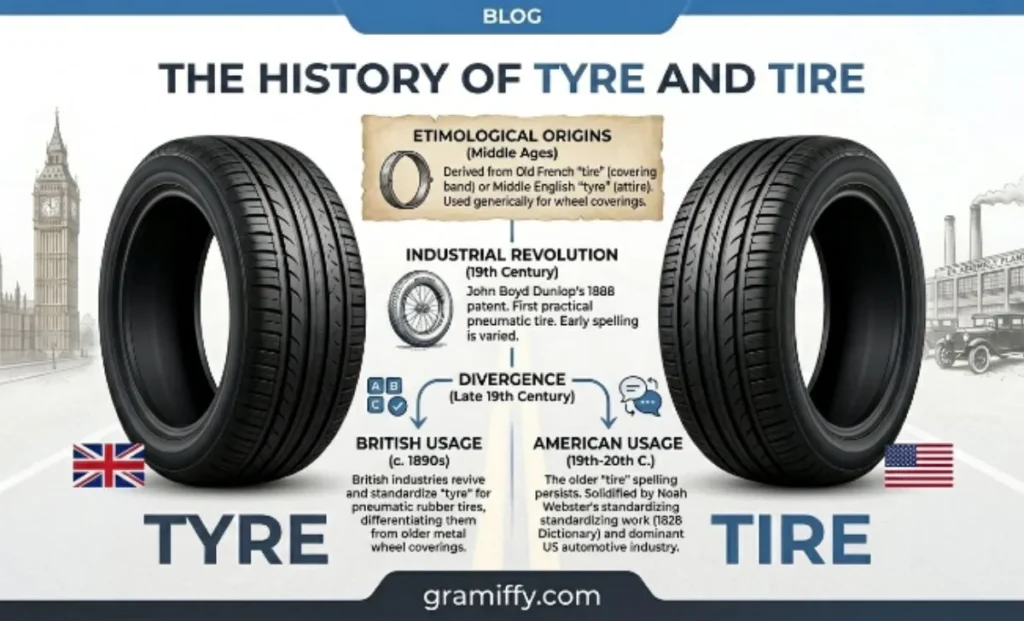
Understanding the history makes the spelling difference much easier to remember.
Before automobiles existed, wheels on wagons and carriages were protected by metal or wooden bands.
As rubber technology advanced during the nineteenth century, manufacturers began fitting wheels with rubber coverings.
The word tire was already associated with wheel coverings in English.
When British English standardized spelling, tyre became the preferred spelling for the rubber wheel covering, helping distinguish it from the verb tire.
American English retained the spelling tire for both meanings.
More than a century later, that distinction remains unchanged.
Why Does British English Use “Tyre” Instead of “Tire”?
British English values spelling distinctions that reduce ambiguity.
Consider these two sentences:
- The tyre needs replacing.
- Long journeys tire me.
Because the noun and verb have different spellings, readers immediately understand the intended meaning.
This distinction is one reason British English continues using tyre today.
Why Does American English Keep “Tire”?
American English generally favors simpler and more consistent spellings.
Instead of introducing a separate spelling for the wheel covering, American English kept tire for both meanings.
Native speakers have little difficulty because context clearly indicates whether the word refers to:
- a vehicle component, or
- becoming exhausted.
For example:
- I bought a new tire yesterday.
- Long meetings tire me.
The surrounding words remove any ambiguity.
Grammar Rules for “Tyre” and “Tire”
Understanding the grammar prevents many common mistakes.
Rule 1: “Tyre” Is Always a Noun
In British English, tyre only refers to the rubber covering around a wheel.
It cannot be used as a verb.
Correct Examples
- My bicycle tyre is flat.
- Replace worn tyres immediately.
- Check your tyre pressure regularly.
- Winter tyres improve road safety.
- The mechanic fitted a new tyre.
Rule 2: “Tire” Can Be a Noun
In American English, tire is the noun referring to the rubber wheel covering.
Correct Examples
- My tire is flat.
- Rotate your tires regularly.
- Check the tire pressure.
- The rear tire needs replacing.
- New tires improve fuel efficiency.
Rule 3: “Tire” Can Also Be a Verb
Unlike tyre, tire functions as a verb in both British and American English.
It means:
- become exhausted
- make someone feel tired
Examples
- Long flights tire me.
- She quickly tires after running.
- Don’t tire yourself.
- Hard work can tire anyone.
- The children soon tired of waiting.
Verb Forms of “Tire”
Since tire is a regular English verb, it follows standard conjugation rules.
| Verb Form | Example |
|---|---|
| Base Form | tire |
| Third Person | tires |
| Present Participle | tiring |
| Past Tense | tired |
| Past Participle | tired |
Example Sentences
- Long meetings tire me.
- She tires easily.
- The hike was tiring.
- The journey tired everyone.
- We were tired after travelling.
Notice that tyre never appears in these grammatical forms.
Pronunciation
One of the easiest parts of this topic is pronunciation.
Although the spellings differ, both words sound exactly the same.
They rhyme with:
- fire
- wire
- hire
- buyer
- choir (depending on accent)
Whether someone writes tyre or tire, native speakers pronounce them almost identically.
Common Automotive Terms
The spelling changes depending on whether you’re using British or American English.
| British English | American English |
|---|---|
| Tyre pressure | Tire pressure |
| Flat tyre | Flat tire |
| Spare tyre | Spare tire |
| Winter tyres | Winter tires |
| Summer tyres | Summer tires |
| Tyre tread | Tire tread |
| Tyre repair | Tire repair |
| Tyre replacement | Tire replacement |
| Tyre shop | Tire shop |
| Tyre inflation | Tire inflation |
| Tyre balancing | Tire balancing |
| Tyre wear | Tire wear |
| Tyre rotation (less common) | Tire rotation |
These expressions are commonly used in repair manuals, driving guides, vehicle maintenance articles, and automotive websites.
Which Spelling Should You Use?
The answer depends on your audience not on which spelling you personally prefer.
Use “Tyre” If Your Readers Are In:
- United Kingdom
- Pakistan
- India
- Australia
- New Zealand
- Ireland
- South Africa
- Most Commonwealth countries
Use “Tire” If Your Readers Are In:
- United States
- American businesses
- American universities
- US-based publications
- American automotive websites
If your audience is international, choose one style guide British or American—and use it consistently throughout your content.
Country by Country Spelling Guide
One of the most common questions online is which spelling different countries use.
Here’s a quick reference table.
| Country | Preferred Spelling |
|---|---|
| United Kingdom | Tyre |
| United States | Tire |
| Pakistan | Tyre |
| India | Tyre |
| Australia | Tyre |
| New Zealand | Tyre |
| Ireland | Tyre |
| South Africa | Tyre |
| Canada | Usually Tire (though British forms also appear) |
| Singapore | Usually Tyre |
| Malaysia | Usually Tyre |
How to Use “Tyre” and “Tire” Correctly
Knowing the difference between tyre and tire is only the first step. The next step is learning how to use each spelling naturally in real-world writing.
The simplest rule is:
- Tyre → British English noun
- Tire → American English noun
- Tire → Verb meaning to become exhausted (both British and American English)
Once you remember this rule, you’ll rarely make a spelling mistake.
Using “Tyre” in British English
If you’re writing for readers in the United Kingdom, Pakistan, India, Australia, New Zealand, or other countries that generally follow British English conventions, tyre is the correct spelling.
Examples
- My car needs a new tyre before our holiday.
- The mechanic checked the tyre pressure.
- Both front tyres need replacing.
- The rear tyre has a slow puncture.
- Always inspect your spare tyre before a long journey.
- Premium tyres usually last longer.
- Winter tyres improve grip on icy roads.
- The bicycle tyre lost air overnight.
- Check your tyres once a month.
- The damaged tyre was beyond repair.
Using “Tire” in American English
If you’re writing for an American audience, tire is the correct noun.
Examples
- My tire is flat.
- Check the tire pressure before driving.
- I bought four new tires yesterday.
- The front tire needs replacing.
- Winter tires improve traction.
- Rotate your tires every few thousand miles.
- The spare tire saved our trip.
- The mechanic balanced all four tires.
- Good tires improve fuel economy.
- Replace worn tires immediately.
Using “Tire” as a Verb
Unlike tyre, tire can also be used as a verb.
It means:
- become tired
- make someone feel tired
- lose interest because of repetition
This meaning is correct in both British and American English.
Examples
- Long meetings tire me.
- She quickly tires after running.
- Don’t tire yourself before the exam.
- Hard work can tire anyone.
- The children soon tired of waiting.
- He never seems to tire of learning.
- The hike tired everyone.
- We were completely tired after travelling.
- The repetitive task began to tire the workers.
- I don’t tire easily.
Real Life Examples
Understanding how native speakers use these words makes the difference much easier to remember.
At a Garage
British English
- My tyre has a puncture.
- I need two new tyres.
- Please check the tyre pressure.
- This tyre can’t be repaired.
- The mechanic balanced all four tyres.
American English
- My tire is leaking air.
- I need two new tires.
- Check the tire pressure.
- This tire needs replacing.
- The mechanic rotated the tires.
While Driving
British English
- The warning light shows low tyre pressure.
- One tyre is wearing unevenly.
- The spare tyre is in the boot.
- My rear tyre needs air.
- Winter tyres improve braking performance.
American English
- The tire pressure warning light came on.
- One tire is losing air.
- The spare tire is in the trunk.
- My rear tire needs replacing.
- Winter tires improve traction.
At a Bicycle Shop
British English
- I need a new mountain bike tyre.
- My bicycle tyre keeps going flat.
- These tyres have excellent grip.
- The front tyre is badly worn.
- Tubeless tyres reduce punctures.
American English
- I need a new bike tire.
- My bicycle tire keeps losing air.
- These tires last much longer.
- The front tire is worn out.
- Tubeless tires are very popular.
Common Expressions
Several everyday English expressions use tire as a verb.
These expressions are common in both British and American English.
Tire Yourself Out
Meaning: Become completely exhausted.
Examples:
- Don’t tire yourself out before the race.
- The children tired themselves out at the playground.
- He always tires himself out at work.
- We tired ourselves out hiking.
- Try not to tire yourself out on your first day.
Never Tire Of
Meaning: Continue enjoying something without becoming bored.
Examples:
- I never tire of reading.
- She never tires of travelling.
- They never tire of helping others.
- We never tire of learning.
- He never tires of telling that story.
Tire Someone Out
Meaning: Make another person feel exhausted.
Examples:
- Looking after toddlers can tire you out.
- Gardening always tires me out.
- The long meeting tired everyone out.
- The hike tired us out.
- Studying all night tired him out.
Tyre vs Wheel
One of the biggest misconceptions is that tyre and wheel mean the same thing.
They don’t.
A wheel is the complete assembly, including the rim.
A tyre is only the rubber covering fitted around that wheel.
Comparison Table
| Feature | Tyre | Wheel |
|---|---|---|
| Made primarily of rubber | ✅ Yes | ❌ No |
| Contains tread | ✅ Yes | ❌ No |
| Includes the metal rim | ❌ No | ✅ Yes |
| Touches the road | ✅ Yes | Partly |
| Can suffer a puncture | ✅ Yes | ❌ Usually |
Examples
- The wheel is fine, but the tyre needs replacing.
- I bought alloy wheels with premium tyres.
- The mechanic repaired the wheel before fitting a new tyre.
- The tyre burst, but the wheel wasn’t damaged.
- Always inspect both the wheel and the tyre after hitting a pothole.
Tire vs. Wheel
The same distinction exists in American English.
Comparison Table
| Feature | Tire | Wheel |
|---|---|---|
| Rubber covering | ✅ Yes | ❌ No |
| Metal rim | ❌ No | ✅ Yes |
| Holds air | ✅ Yes | ❌ No |
| Can wear out | ✅ Yes | ❌ Rarely |
| Part of the wheel assembly | ✅ Yes | ✅ Yes |
Examples
- The tire is flat, but the wheel is undamaged.
- Replace the tire, not the wheel.
- The alloy wheel looks brand new with fresh tires.
- The mechanic balanced the wheel after installing the new tire.
- My tire burst, but the wheel remained intact.
Tyre vs Rim
Another common source of confusion is the difference between a tyre and a rim.
The rim is the metal outer edge of the wheel.
The tyre is the rubber covering mounted around that rim.
Comparison Table
| Feature | Tyre | Rim |
|---|---|---|
| Rubber | ✅ Yes | ❌ No |
| Metal | ❌ No | ✅ Yes |
| Contains tread | ✅ Yes | ❌ No |
| Contacts the road | ✅ Yes | ❌ No |
| Supports the tyre | ❌ No | ✅ Yes |
Examples
- The rim was scratched, but the tyre was undamaged.
- The mechanic repaired the rim before fitting a new tyre.
- My tyre wasn’t sealing properly against the rim.
- The alloy rim looked new after replacing the tyre.
- A bent rim can damage a perfectly good tyre.
Tyre vs Tube
Not every tyre contains an inner tube.
Modern passenger cars typically use tubeless tyres, while many bicycles, motorcycles, and some off-road vehicles still use inner tubes.
Comparison Table
| Feature | Tyre | Tube |
|---|---|---|
| Outer rubber covering | ✅ Yes | ❌ No |
| Holds air directly (tubeless) | ✅ Yes | ❌ No |
| Fits inside the tyre | ❌ No | ✅ Yes |
| Used on many bicycles | ✅ Yes | ✅ Yes |
| Common on modern cars | ✅ Yes | ❌ Usually |
Examples
- My bicycle needs a new tube, not a new tyre.
- Modern cars usually have tubeless tyres.
- The mechanic replaced the damaged tube inside the tyre.
- A punctured tube can quickly deflate the tyre.
- Always check whether your bike uses tubed or tubeless tyres.
Common Grammar Mistakes
Even though tyre and tire are simple words, they are often used incorrectly. Most mistakes happen because writers accidentally mix British English and American English or confuse the noun with the verb.
Learning these common errors will help you write more naturally and professionally.
Mistake 1: Mixing British and American Spellings
The biggest mistake is switching between tyre and tire within the same article.
❌ Incorrect
- My tyres need replacing because one tire has a puncture.
✅ Correct (British English)
- My tyres need replacing because one tyre has a puncture.
✅ Correct (American English)
- My tires need replacing because one tire has a puncture.
Pro Tip: Choose one regional spelling and use it consistently throughout your writing.
Mistake 2: Using “Tyre” as a Verb
Many English learners assume that if tyre is the British spelling of tire, it can also be used as a verb.
It cannot.
❌ Long journeys tyre me.
✅ Long journeys tire me.
Only tire functions as a verb meaning to become exhausted.
Mistake 3: Incorrect Plurals
Another common error is forming the plural incorrectly.
❌ tyre’s
❌ tire’s (unless showing possession)
✅ tyres
✅ tires
Examples:
- The tyres were replaced yesterday. (British English)
- The tires were rotated last week. (American English)
Remember that apostrophes are not used to form regular plurals.
Mistake 4: Using the Wrong Regional Spelling
Many websites unintentionally use American spelling for British audiences or British spelling for American audiences.
For example:
A UK automotive website should write:
- tyre pressure
- winter tyres
- spare tyre
An American automotive website should write:
- tire pressure
- winter tires
- spare tire
Matching your audience’s spelling improves readability and user trust.
Mistake 5: Confusing the Noun and Verb
The spelling tire has two meanings in American English.
Noun
- My tire is flat.
Verb
- Long meetings tire me.
Although the spelling is identical, the sentence structure makes the meaning clear.
Common Spelling Mistakes
People frequently misspell tyre and tire, especially when English is not their first language.
Incorrect vs. Correct
| Incorrect | Correct |
|---|---|
| Tyer | Tyre (UK) |
| Tyer | Tire (US) |
| Tirre | Tire |
| Tyar | Tyre |
| Tyree | Tyre |
| Tierre | Tire |
| Tyers | Tyres |
| Tier | Tire (when referring to a vehicle wheel) |
Only tyre and tire are standard spellings for the rubber wheel covering.
Tyre vs Tire in Everyday Writing
Below are examples showing how these words appear in different types of writing.
Academic Writing
British English
Vehicle tyres should be inspected regularly to improve road safety.
American English
Vehicle tires should be inspected regularly to improve road safety.
Business Writing
British English
We stock premium tyres for passenger cars, SUVs, and commercial vehicles.
American English
We stock premium tires for passenger cars, SUVs, and commercial vehicles.
News Headlines
British English
- Winter Tyres Reduce Accident Rates
American English
- Winter Tires Improve Road Safety
Automotive Manuals
British English
- Check tyre pressure before every journey.
American English
- Check tire pressure before every trip.
Driving Test Instructions
British English
- Ensure each tyre meets the legal tread-depth requirement.
American English
- Inspect every tire before operating the vehicle.
Tyre vs Tire in Automotive Vocabulary
Many automotive terms change spelling depending on the variety of English.
| British English | American English |
|---|---|
| Tyre pressure | Tire pressure |
| Tyre tread | Tire tread |
| Tyre pressure monitoring system | Tire Pressure Monitoring System (TPMS) |
| Spare tyre | Spare tire |
| Flat tyre | Flat tire |
| Tubeless tyre | Tubeless tire |
| Winter tyres | Winter tires |
| Summer tyres | Summer tires |
| All-season tyres | All-season tires |
| Performance tyres | Performance tires |
| Tyre repair | Tire repair |
| Tyre replacement | Tire replacement |
| Tyre shop | Tire shop |
| Tyre wear | Tire wear |
| Tyre balancing | Tire balancing |
| Tyre alignment (informal) | Tire alignment (often “wheel alignment”) |
Tyre vs Tire in Popular Brands
International tyre manufacturers adapt their spelling according to the market they serve.
For example:
British Websites
- Michelin tyres
- Bridgestone tyres
- Goodyear tyres
- Continental tyres
- Pirelli tyres
- Dunlop tyres
American Websites
- Michelin tires
- Bridgestone tires
- Goodyear tires
- Continental tires
- Pirelli tires
- Dunlop tires
This localization helps brands communicate naturally with their target audience.
Synonyms and Related Terms
Although there isn’t a perfect synonym for tyre or tire, these related terms are often used in automotive contexts.
Related Words
- vehicle tyre
- vehicle tire
- car tyre
- car tire
- automobile tire
- automobile tyre
- radial tyre
- radial tire
- pneumatic tyre
- pneumatic tire
- tubeless tyre
- tubeless tire
- wheel covering
- road tyre
- off-road tire
Related Automotive Components
To avoid confusion, it’s useful to understand the difference between the tyre (or tire) and other vehicle parts.
| Component | Purpose |
|---|---|
| Tyre / Tire | Rubber covering that contacts the road |
| Wheel | Complete assembly including the rim |
| Rim | Metal outer edge of the wheel |
| Tube | Inflatable inner tube used in some tyres |
| Valve Stem | Allows inflation and deflation |
| Tread | Pattern that provides grip |
| Sidewall | Outer side of the tyre |
| Bead | Seals the tyre to the rim |
Professional Writing Tips tyres or tires
If you’re a blogger, editor, student, or copywriter, these best practices will improve the quality of your content.
If You’re Writing in British English
Use:
- tyre
- tyres
- tyre pressure
- spare tyre
- winter tyres
- tyre tread
- tyre repair
If You’re Writing in American English
Use:
- tire
- tires
- tire pressure
- spare tire
- winter tires
- tire tread
- tire repair
If Your Audience Is International
Choose one regional style based on your target audience and remain consistent throughout the article.
Switching between tyre and tire without explanation can confuse readers and make your writing appear less professional.
FAQs
Is it tyre or tire?
Both spellings are correct.
- Tyre is the standard spelling in British English.
- Tire is the standard spelling in American English.
They refer to the same rubber covering around a vehicle’s wheel.
Which spelling is correct in the UK?
In the United Kingdom, tyre is the correct spelling.
Examples include:
- Tyre pressure
- Winter tyres
- Spare tyre
- Tyre tread
- Tyre repair
Which spelling is correct in the United States?
In the United States, tire is the correct spelling.
Examples include:
- Tire pressure
- Winter tires
- Spare tire
- Tire rotation
- Tire repair
Is “tyre” accepted in dictionaries?
Yes.
Leading dictionaries such as Oxford, Cambridge, and Collins recognize tyre as the standard British spelling.
Is “tire” accepted in dictionaries?
Yes.
Merriam-Webster, Dictionary.com, Oxford, Cambridge, and Collins all recognize tire as the standard American spelling.
Why do British and American English use different spellings?
The difference developed as British and American English evolved independently.
British English adopted tyre for the wheel covering to distinguish it from the verb tire, while American English continued using tire for both meanings.
Is “tyre” wrong?
No.
Tyre is completely correct when writing British English.
Is “tire” wrong?
No.
Tire is completely correct when writing American English.
It is also the correct verb meaning to become exhausted in both British and American English.
Can I use both spellings in one article?
Only if you’re specifically explaining the difference between them.
Otherwise, choose one spelling and remain consistent throughout your content.
Which spelling is used in Pakistan?
Pakistan generally follows British English, so tyre is the preferred spelling in education, journalism, government publications, and most local businesses.
Which spelling is used in India?
India also primarily follows British English, making tyre the preferred spelling.
Which spelling is used in Australia?
Australia follows British English, so tyre is standard.
Which spelling is used in Canada?
Canada uses a mix of British and American English, but tire is more common in the automotive industry and everyday usage.
What is the plural of “tyre”?
The plural is tyres.
Example:
Replace worn tyres before long journeys.
What is the plural of “tire”?
The plural is tires.
Example:
Rotate your tires regularly.
Can “tyre” be used as a verb?
No.
Only tire functions as a verb.
❌ Long walks tyre me.
✅ Long walks tire me.
What does tire meaning as a verb?
It means:
- become exhausted
- make someone feel tired
- lose interest
Examples:
- Long meetings tire me.
- She quickly tires after running.
- Don’t tire yourself.
Do “tyre” and “tire” sound different?
No.
Both are pronounced the same.
IPA: /taɪər/
They rhyme with:
- fire
- wire
- hire
- buyer
Is “tyre pressure” or “tire pressure” correct?
Both are correct.
- Tyre pressure → British English
- Tire pressure → American English
Is “winter tyres” or “winter tires” correct?
Again, both are correct.
- Winter tyres → UK
- Winter tires → US
Which spelling is better for SEO?
Neither is universally better.
Use the spelling that matches your target audience.
- UK audience → Tyre
- US audience → Tire
- Global audience → Mention both naturally, then remain consistent.
Which spelling do car manufacturers use?
International manufacturers localize their websites.
For example:
- UK websites: Michelin Tyres
- US websites: Michelin Tires
The same applies to brands such as Bridgestone, Goodyear, Continental, Pirelli, and Dunlop.
Is there any difference in pronunciation?
No.
The pronunciation is identical.
Only the spelling changes.
Is there any difference in meaning?
No.
Both words describe the same vehicle component.
The only additional meaning is that tire can also be used as a verb.
Practice Quiz
Let’s check your understanding.
1. Which spelling is correct in British English?
A. Tire
B. Tyre
✅ Answer: B
2. Which spelling is correct in American English?
A. Tire
B. Tyre
✅ Answer: A
3. Which word can also be used as a verb?
A. Tyre
B. Tire
✅ Answer: B
4. Which sentence is correct?
A. Long journeys tyre me.
B. Long journeys tire me.
✅ Answer: B
5. Which country normally uses “tyre”?
A. United Kingdom
B. United States
✅ Answer: A
6. Which sentence is correct?
A. My tyres need replacing. (British English)
B. My tires need replacing. (American English)
✅ Answer: Both are correct, depending on the variety of English.
Quick Summary
| Topic | Correct Answer |
|---|---|
| British spelling | Tyre |
| American spelling | Tire |
| Meaning | Same |
| Pronunciation | Same |
| Dictionary accepted | Yes |
| Used as a verb | Only tire |
| British plural | Tyres |
| American plural | Tires |
| Mix spellings in one article? | No |
Final Verdict: Tyre or Tire?
So, which spelling should you use?
The answer is straightforward:
- Choose tyre if you’re writing in British English.
- Choose tire if you’re writing in American English.
Neither spelling is more correct than the other—they simply reflect different regional standards of English.
The only universal rule is that tire is always the correct verb when referring to becoming exhausted.
Conclusion
The debate over tyre or tire isn’t about right versus wrong it’s about understanding the audience you’re writing for.
If your readers use British English, tyre is the correct spelling. If they use American English, tire is the correct choice. Both spellings describe the same rubber covering around a vehicle’s wheel, and both are recognized by respected dictionaries and style guides.
The only additional distinction is that tire also functions as a verb meaning to become tired or exhausted, while tyre is used only as a noun.
Once you remember the simple rule “Tyre for British English, Tire for American English”, you’ll never have to second-guess your spelling again.
References
This guide follows the standard usage described by leading English dictionaries and language references, including:
- Oxford English Dictionary
- Cambridge Dictionary
- Merriam-Webster Dictionary
- Collins English Dictionary
- Dictionary.com
Read More :

I am Bryan A. Garner a lexicographer, and language expert passionate about clear and effective writing.
I contribute grammar, spelling, and usage guides on Gramiffy.com to help readers improve their English skills. Through my work, I aim to make language rules simple, practical, and easy to understand.