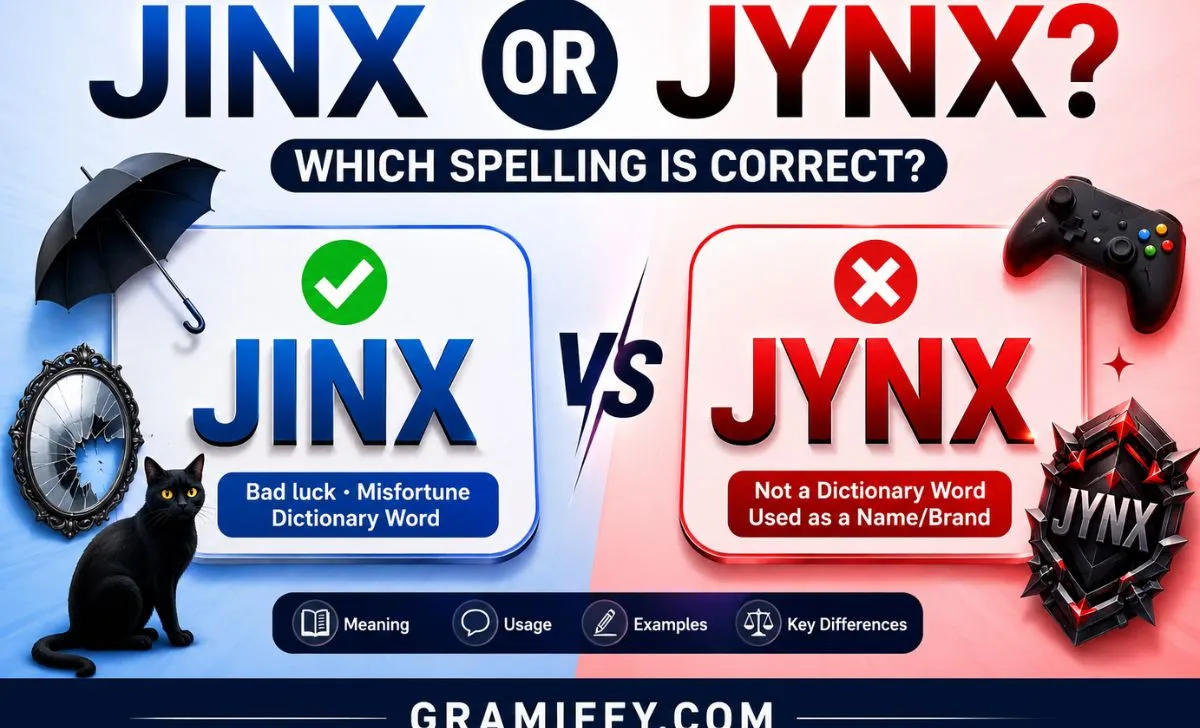
If you’ve ever searched “Jinx or Jynx?”, you’re probably wondering whether both spellings are correct or if one is simply a misspelling of the other.
Since they sound identical and both appear online, it’s easy to assume they’re interchangeable. In reality, they serve different purposes.
Jinx is the correct spelling in standard English when referring to bad luck, an unlucky person or thing, or causing bad luck by speaking too soon.
It is recognized by major dictionaries, taught in schools, and used in books, newspapers, academic writing, and professional communication.
Jynx, by contrast, is not an accepted alternative spelling of the English word jinx. Instead, it is most commonly used as a proper name, brand name, online username, or fictional character name.
While it may look stylish or unique, it should not replace Jinx in formal or everyday English writing.
Because creative spellings are common in gaming, social media, branding, and entertainment, many English learners, and even native speakers, become confused about which spelling to use.
That’s why this question continues to appear in search results and language forums.
This comprehensive guide answers every important question about Jinx and Jynx, including:
- Which spelling is correct?
- Is Jynx a real word?
- What do dictionaries say?
- How do you use jinx correctly in sentences?
- What is the difference between Jinx and Jynx?
- When is Jynx acceptable?
- What are the most common grammar and spelling mistakes?
You’ll also find pronunciation guides, comparison tables, real-life examples, FAQs, and practical writing tips to help you use the correct spelling with confidence.
By the end of this guide, you’ll know exactly when to use Jinx, when Jynx is appropriate, and how to avoid one of the most common spelling mistakes related to this word.
Quick Answer
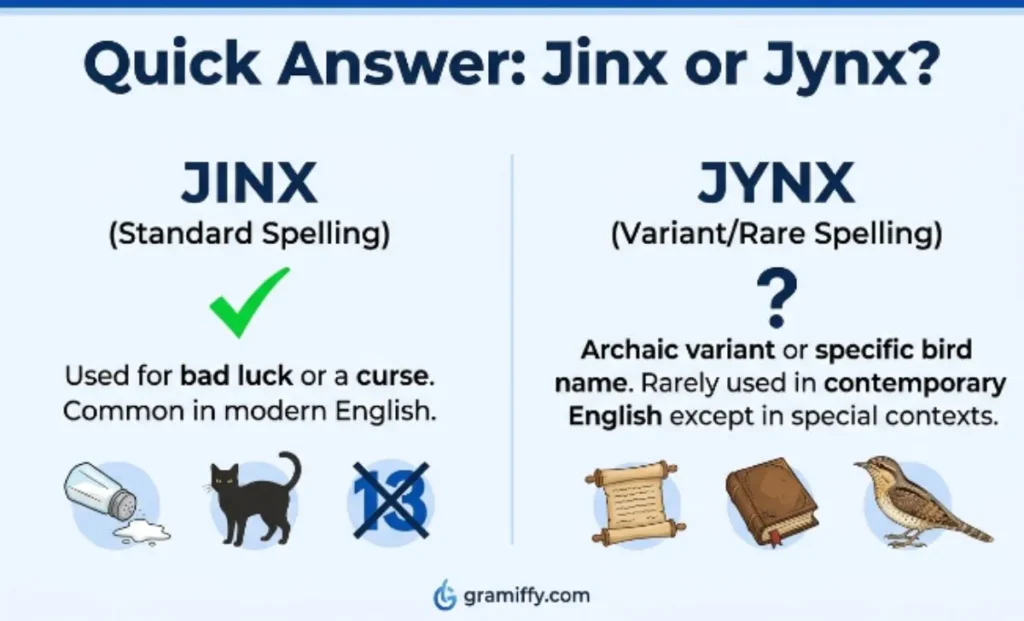
If you only need the short answer, here it is.
| Question | Answer |
|---|---|
| Correct spelling in English | Jinx ✅ |
| Alternative spelling | Jynx ❌ (not standard English) |
| Meaning | Bad luck or causing bad luck |
| Part of speech | Noun and Verb |
| Pronunciation | /dʒɪŋks/ (“jinks”) |
| Recognized by dictionaries | Jinx ✅ |
| Correct for essays and professional writing | Jinx ✅ |
| Used as a proper name or brand | Jynx ✅ |
Bottom Line: If you’re talking about bad luck or misfortune, always write Jinx. Use Jynx only when it is intentionally part of a person’s name, a brand, a username, or a fictional character.
At a Glance
Here’s a quick comparison before we explore the details.
| Feature | Jinx | Jynx |
|---|---|---|
| Standard English word | ✅ Yes | ❌ No |
| Found in major dictionaries | ✅ Yes | ❌ No |
| Means bad luck | ✅ Yes | ❌ No |
| Can be used as a verb | ✅ Yes | ❌ No |
| Accepted in academic writing | ✅ Yes | ❌ No |
| Appropriate for business writing | ✅ Yes | ❌ No |
| Common in books and newspapers | ✅ Yes | ❌ No |
| Used as a proper name | Rarely | ✅ Frequently |
| Common in gaming and usernames | Sometimes | ✅ Very Common |
| Creative spelling | ❌ No | ✅ Yes |
This table summarizes the essential difference:
Jinx is an English word. Jynx is usually a name.
Why Do People Confuse “Jinx” and “Jynx”?
The confusion doesn’t happen because English has two accepted spellings. Instead, it happens because Jynx appears so frequently in modern culture that many people assume it is a legitimate alternative.
Let’s look at the main reasons.
Creative Spellings Are Popular
Modern branding often replaces traditional spellings with more distinctive versions.
Examples include replacing:
- i with y
- s with z
- c with k
As a result, Jynx looks like a modern variation of Jinx, even though it isn’t recognized as standard English.
Gaming and Online Usernames
Gamers and content creators often choose unique usernames.
Names such as:
- ShadowJynx
- FrostJynx
- MysticJynx
- SilentJynx
- DarkJynx
appear across gaming platforms and social media.
These names are creative choices—not dictionary spellings.
Fiction and Fantasy
Fantasy novels, comics, role-playing games, and animated series frequently use unusual spellings to make characters more memorable.
A writer may intentionally create a character called Lady Jynx or Captain Jynx, but that doesn’t change the standard English spelling of the word jinx.
Brand Names
Businesses often modify ordinary words to create unique trademarks.
Changing Jinx to Jynx makes the name more distinctive and easier to register as a brand while keeping the same pronunciation.
Again, this is a marketing decision rather than a language rule.
What Does “Jinx” Mean?
The word jinx has several closely related meanings, all connected to the idea of bad luck.
In modern English, it can function as both a noun and a verb, making it more flexible than many people realize.
Jinx as a Noun
As a noun, jinx refers to:
- a person believed to bring bad luck
- an object associated with repeated misfortune
- an unlucky place
- a period of recurring failure
- anything considered responsible for unfortunate events
Examples
- Everyone believed the old stadium was a jinx.
- The broken watch became a family jinx.
- The football club finally broke its championship jinx.
- Some people thought the office was a jinx after several projects failed.
- The abandoned house gained a reputation as a jinx.
Jinx as a Verb
As a verb, jinx means:
to bring bad luck by speaking too confidently about future success before it happens.
This meaning is especially common in everyday conversations.
Examples
- Don’t jinx my interview.
- I think I jinxed our vacation.
- Please don’t jinx tomorrow’s weather.
- Stop jinxing our chances.
- She believes I jinxed the football match.
Dictionary Definitions
One of the easiest ways to determine the correct spelling is to compare trusted dictionary definitions.
Every major English dictionary recognizes Jinx as the standard spelling.
Merriam-Webster
Defines jinx as:
- A person or thing believed to bring bad luck.
- To bring bad luck to someone or something.
Cambridge Dictionary
Defines jinx as:
- Someone or something believed to cause bad luck.
- The act of causing bad luck by saying something positive before it happens.
Oxford English Dictionary
Recognizes jinx as a standard English word associated with bad luck, superstition, and recurring misfortune.
Collins English Dictionary
Defines jinx as an unlucky influence while also recognizing its use as a verb.
Dictionary.com
Lists jinx as:
- A source of bad luck.
- Someone believed to bring misfortune.
- To cause bad luck through words or actions.
Across these authoritative references, the conclusion is consistent:
Jinx is the accepted spelling in standard English.
No major English dictionary lists Jynx as an accepted alternative spelling for the word meaning “bad luck.”
Is “Jynx” a Real Word?
This is one of the most common questions people ask.
The answer depends on the context.
In Standard English
No.
Jynx is not recognized as the standard English spelling of jinx.
If you’re writing about bad luck, replacing Jinx with Jynx is considered a spelling mistake.
As a Proper Name
Yes.
Like many creative spellings, Jynx can be used as:
- a person’s nickname
- a fictional character’s name
- a business name
- a brand
- an online username
- a project title
Examples include:
- Project Jynx
- Team Jynx
- Jynx Studios
- ShadowJynx
- Lady Jynx
These are proper nouns, so their spelling is determined by the creator—not by dictionary rules.
Understanding this difference is the key to avoiding confusion.
Simply remember:
Dictionary word = Jinx
Creative name = Jynx
This one rule will help you choose the correct spelling in almost every situation.
Jinx vs. Jynx: Understanding the Difference
Although Jinx and Jynx are pronounced exactly the same, they are not interchangeable. One is a standard English word with an established meaning, while the other is primarily a creative spelling used for names, brands, and fictional characters.
If your goal is to write correct English, understanding this distinction is essential.
Side-by-Side Comparison
| Feature | Jinx | Jynx |
|---|---|---|
| Standard English spelling | ✅ Yes | ❌ No |
| Recognized by dictionaries | ✅ Yes | ❌ No |
| Means bad luck | ✅ Yes | ❌ No |
| Can be used as a noun | ✅ Yes | ❌ No |
| Can be used as a verb | ✅ Yes | ❌ No |
| Suitable for essays | ✅ Yes | ❌ No |
| Suitable for professional writing | ✅ Yes | ❌ No |
| Used in newspapers and books | ✅ Yes | ❌ No |
| Used as a brand or username | Sometimes | ✅ Frequently |
| Used as a fictional name | Occasionally | ✅ Very Common |
The Simplest Way to Remember
If you’re writing about luck, superstition, or misfortune, use Jinx.
If you’re referring to a specific name intentionally spelled Jynx, keep that spelling exactly as it is.
Think of it this way:
- Jinx = English vocabulary
- Jynx = Proper name
This simple rule answers nearly every “Jinx or Jynx?” question.
Which Spelling Should You Use?
The correct spelling depends entirely on the context.
Use “Jinx” in Everyday English
Whenever you’re referring to bad luck, an unlucky object, or causing bad luck, Jinx is the correct choice.
Use Jinx in:
- Essays
- Business emails
- Reports
- Blog posts
- Academic writing
- News articles
- Books
- Everyday conversations
- Social media posts
Correct Examples
- Don’t jinx our vacation.
- I think I jinxed the interview.
- The team finally broke its championship jinx.
- Please don’t jinx tomorrow’s meeting.
- Everyone blamed the old trophy for the jinx.
- We joked that someone had jinxed the weather.
- The club finally escaped its playoff jinx.
- Don’t jinx the internet before the presentation.
- I hope I haven’t jinxed my exam.
- She refused to predict victory because she didn’t want to jinx the team.
Every example above follows standard English usage.
Use “Jynx” Only as a Proper Name
Use Jynx only when it is intentionally part of a name.
Examples include:
- Project Jynx
- Operation Jynx
- Lady Jynx
- Captain Jynx
- Team Jynx
- ShadowJynx
- FrostJynx
- Jynx Studios
Notice that in every case, Jynx functions as a proper noun rather than a dictionary word.
Why Is “Jinx” the Standard Spelling?
English spelling isn’t determined by popularity on social media—it is established through long-term usage, dictionaries, education, and publishing standards.
The spelling Jinx has been used consistently for well over a century.
It appears in:
- dictionaries
- grammar books
- newspapers
- novels
- magazines
- academic publications
- educational materials
- professional writing
Because of this long history, Jinx became the accepted standard.
Creative spellings like Jynx may become popular online, but popularity alone does not make them standard English.
The History and Origin of “Jinx”
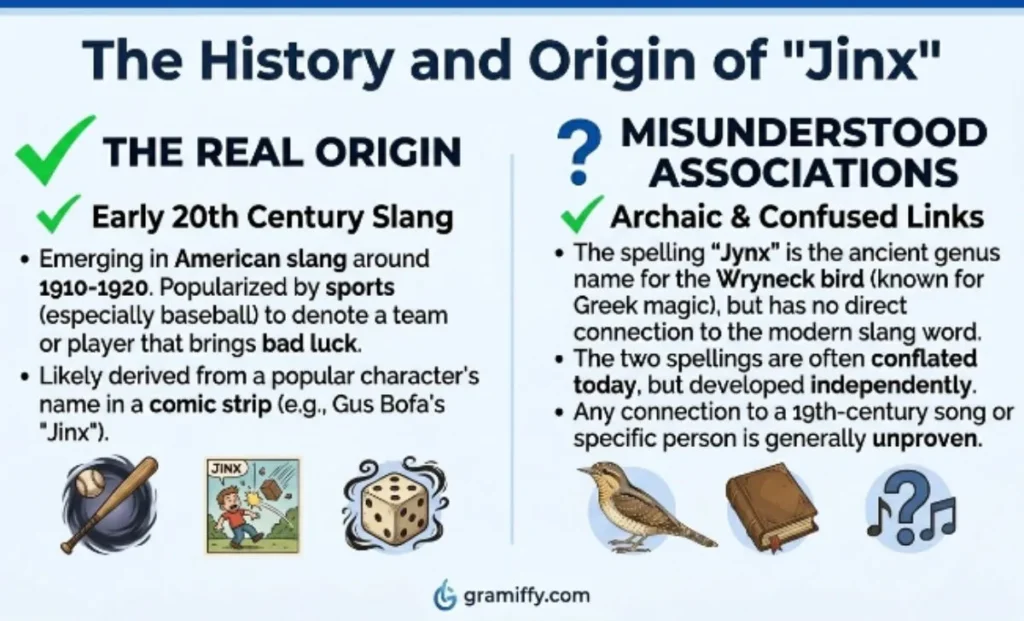
Learning where a word comes from often makes it easier to remember how it should be spelled.
Etymology
The word jinx entered American English in the late nineteenth century.
Many language historians believe it became widely known through sports journalism, where reporters described athletes, teams, or events that seemed to bring repeated bad luck.
Over time, the word spread into everyday conversation and eventually became common throughout the English-speaking world.
Today, jinx appears in both British English and American English with the same spelling and meaning.
How the Meaning Evolved
Originally, jinx referred mainly to an unlucky influence.
As the language evolved, speakers began using it as a verb.
For example:
- Don’t jinx it.
- I jinxed myself.
- She jinxed the game.
- Stop jinxing us.
Today, the verbal form is often more common than the noun in casual conversation.
Is “Jinx” Based on Superstition?
Yes—but mostly in a playful sense.
Historically, the idea of a jinx came from superstitions about luck and misfortune.
People believed that certain objects, places, or even spoken words could influence future events.
Modern speakers usually don’t mean this literally.
When someone says,
“Don’t jinx it!”
they’re rarely claiming that words have magical powers.
Instead, they’re expressing a playful fear that celebrating too early might tempt fate or lead to disappointment.
This humorous usage is one reason the expression remains popular today.
How to Pronounce “Jinx”
Many people wonder whether Jinx and Jynx are pronounced differently.
The answer is simple:
No.
Both spellings are pronounced exactly the same.
Pronunciation
Jinx
It rhymes with:
- links
- drinks
- thinks
- sinks
- winks
- blinks
Because both spellings sound identical, pronunciation cannot tell you which spelling is correct.
Only the context determines whether you should write Jinx or Jynx.
Grammar Guide: How to Use “Jinx”
One reason English learners become confused is that jinx serves more than one grammatical function.
Fortunately, both uses follow standard grammar rules.
Jinx as a Noun
As a noun, jinx refers to a person, object, place, or situation believed to bring bad luck.
Examples
- The old stadium became a jinx for visiting teams.
- Everyone blamed the broken mirror for the family’s jinx.
- The office seemed like a jinx after several projects failed.
- Fans believed the trophy carried a jinx.
- The club finally ended its championship jinx.
Jinx as a Verb
As a verb, jinx means to bring bad luck by speaking confidently about something before it happens.
Examples
- Don’t jinx tomorrow’s interview.
- I accidentally jinxed our holiday.
- Please stop jinxing the project.
- He believes I jinxed the football match.
- We laughed after someone claimed they had jinxed the weather.
Verb Forms of “Jinx”
Like most regular English verbs, jinx changes form depending on the tense.
| Verb Form | Example |
|---|---|
| Base Form – jinx | Don’t jinx it. |
| Third-Person Singular – jinxes | She always jinxes our plans. |
| Present Participle – jinxing | Stop jinxing the meeting. |
| Past Tense – jinxed | I jinxed the game. |
| Past Participle – jinxed | We’ve jinxed ourselves before. |
Once you learn these forms, you’ll be able to use jinx correctly in every tense.
Is “Jynx” Accepted by Major Dictionaries?
This question has a very clear answer.
No.
Major dictionaries—including Merriam-Webster, Cambridge, Oxford, Collins, and Dictionary.com—recognize Jinx as the standard spelling.
They explain its pronunciation, meaning, grammar, history, and usage.
By contrast, Jynx is not listed as an accepted alternative spelling for the English word meaning “bad luck.”
When you encounter Jynx, it is almost always one of the following:
- a fictional character’s name
- a business or product name
- an online username
- a gaming profile
- a creative brand
- a project title
This is why teachers, editors, publishers, and professional writers consistently recommend using Jinx in formal and everyday English writing.
How to Use “Jinx” Correctly in Sentences
Knowing that Jinx is the correct spelling is only the first step. To write naturally and confidently, you also need to understand how the word works in real sentences.
One reason jinx is such a versatile English word is that it functions as both a noun and a verb. Its meaning changes slightly depending on how it is used, but it always relates to the idea of bad luck or misfortune.
The examples below show how native English speakers use the word in everyday situations.
Using “Jinx” as a Noun
As a noun, jinx refers to a person, object, place, event, or situation believed to bring bad luck.
Although the idea originates from superstition, modern speakers often use it humorously rather than literally.
Examples
- Everyone believed the old stadium was a jinx because the home team rarely won there.
- The broken clock became a jinx after several strange accidents happened nearby.
- The football club finally ended its championship jinx.
- Many people thought the abandoned house was a jinx.
- The old trophy developed a reputation as a jinx.
- Nobody wanted to sit in the so-called jinx seat.
- The company finally overcame its hiring jinx.
- Fans joked that the referee had become a jinx.
- After years of defeats, the team finally escaped its playoff jinx.
- The restaurant owner laughed when customers called table number thirteen a jinx.
Using “Jinx” as a Verb
As a verb, jinx means to accidentally bring bad luck by talking about success before it happens.
This is by far the most common use in modern English.
Examples
- Don’t jinx my interview.
- Please don’t jinx tomorrow’s presentation.
- I think I jinxed our vacation.
- She believes I jinxed the football match.
- Stop jinxing our chances of winning.
- We laughed because someone thought they had jinxed the weather.
- Don’t jinx the internet before the meeting starts.
- I hope I haven’t jinxed today’s exam.
- He refuses to predict victory because he doesn’t want to jinx the team.
- We almost jinxed the surprise by talking about it too early.
Using “Jinx” in Everyday Situations
One of the best ways to learn vocabulary is to see how native speakers use it in real life.
Here are examples from different situations.
At School
Students often use jinx before exams, presentations, or competitions.
Examples
- Don’t jinx my math test.
- I think I jinxed today’s quiz.
- She joked that the classroom was a jinx.
- Our school finally broke its debate competition jinx.
- Please don’t jinx the exam results.
At Work
Although jinx is informal, it is very common in office conversations.
Examples
- Don’t jinx the project before it’s finished.
- I may have jinxed tomorrow’s meeting.
- The company finally broke its sales jinx.
- Everyone blamed the old printer for being a jinx.
- Don’t jinx our presentation.
During Sports Events
Sports fans use jinx more than almost anyone else.
Winning streaks, losing streaks, lucky jerseys, and team superstitions all make the word extremely common.
Examples
- The team finally broke its playoff jinx.
- Don’t jinx the penalty kick.
- Many supporters believed the stadium was a jinx.
- She refused to celebrate because she didn’t want to jinx the result.
- Fans joked that the commentator had jinxed the match.
At Home
Families frequently use jinx in lighthearted conversations.
Examples
- Don’t jinx dinner by saying nothing will burn.
- I think I jinxed the washing machine.
- Dad joked that the old car was a jinx.
- We finally broke our vacation jinx.
- Please don’t jinx our weekend plans.
While Traveling
Travelers often use jinx when discussing delays or unexpected problems.
Examples
- Don’t jinx our flight.
- We almost jinxed the trip by saying everything was going perfectly.
- Another delayed train felt like a travel jinx.
- We laughed after someone claimed they had jinxed the weather.
- Don’t jinx the hotel reservation.
On Social Media
The word jinx appears regularly on social media because it’s short, expressive, and humorous.
Examples
- I said it wouldn’t rain… and I totally jinxed it.
- Don’t jinx tonight’s concert.
- Someone always jinxes the livestream.
- We finally broke our Monday jinx.
- I definitely jinxed my internet connection.
Popular Expressions with “Jinx”
Several common English expressions include the word jinx. Learning them will help your English sound much more natural.
“Don’t Jinx It”
This is the most common expression.
Meaning: Don’t talk about success too early because something might go wrong.
Examples
- We’re almost finished. Don’t jinx it.
- Don’t jinx tomorrow’s weather.
- Please don’t jinx our holiday.
- Everything is working perfectly—don’t jinx it now.
- Don’t jinx the final score.
“Break the Jinx”
Meaning: End a long period of bad luck or repeated failure.
Examples
- The club finally broke the jinx after twenty years.
- She hopes this victory will break the jinx.
- Winning the championship helped break the jinx.
- The actor finally broke the jinx of unsuccessful films.
- Everyone celebrated after the team broke the jinx.
“Put a Jinx on”
Meaning: Cause someone or something to experience bad luck.
Examples
- Don’t put a jinx on our vacation.
- Some fans thought the reporter had put a jinx on the team.
- Nobody wanted to put a jinx on the celebration.
- They joked that the interview had put a jinx on the project.
- Please don’t put a jinx on tomorrow’s launch.
“Jinx!”
Many English-speaking children play a game where two people accidentally say the same word at exactly the same time.
The first person to shout “Jinx!” wins the round.
Depending on local traditions, the other person may not speak again until someone says their name.
Although the game is connected to the word jinx, it is simply a playful tradition and has nothing to do with actual bad luck.
“Double Jinx”
A double jinx occurs when both people say “jinx” simultaneously after speaking the same word together.
Different schools, families, and regions often have their own rules for the game.
Jinx vs. Curse
Many people use jinx and curse interchangeably, but they have different meanings.
A curse usually refers to a supernatural force believed to cause long-term suffering or misfortune.
A jinx, however, is generally an informal expression connected with bad luck and superstition rather than actual magic.
Comparison Table
| Feature | Jinx | Curse |
|---|---|---|
| Means bad luck | ✅ Yes | ✅ Yes |
| Usually supernatural | ❌ Not necessarily | ✅ Often |
| Common in everyday conversation | ✅ Yes | ✅ Yes |
| Often humorous | ✅ Yes | ❌ Rarely |
| Can describe temporary bad luck | ✅ Yes | Sometimes |
| Common in myths and legends | Rarely | ✅ Frequently |
Examples
Jinx
- Don’t jinx tomorrow’s interview.
Curse
- According to legend, the castle was under a curse.
The easiest way to remember the difference is this:
A curse usually involves supernatural power, while a jinx is more often a casual or humorous belief about bad luck.
Jinx vs. Hex
Another word commonly associated with jinx is hex.
Although both relate to misfortune, a hex almost always refers to a magical spell intended to cause harm.
A jinx, on the other hand, usually describes bad luck without implying real magic.
Comparison Table
| Feature | Jinx | Hex |
|---|---|---|
| Everyday English | ✅ Yes | Sometimes |
| Magical spell | ❌ Usually no | ✅ Yes |
| Casual expression | ✅ Yes | ❌ Rarely |
| Connected with folklore | Sometimes | ✅ Frequently |
| Common in fantasy fiction | Sometimes | ✅ Very Common |
Examples
- I think I jinxed the football match by predicting an easy win.
- According to the story, the witch placed a hex on the village.
Although both words involve misfortune, hex belongs more to the world of folklore and fantasy, while jinx is firmly established in everyday English.
Jinx vs. Bad Luck
People often use the words jinx and bad luck as though they mean exactly the same thing. While they are closely connected, they describe different ideas.
A jinx is generally believed to be the cause of bad luck, while bad luck refers to the unfortunate event or result itself.
For example, if someone says, “Don’t jinx it,” they believe talking about success too early might cause something to go wrong. If your flight is delayed because of bad weather, that’s simply bad luck—whether or not anyone believes a jinx was involved.
Comparison Table
| Feature | Jinx | Bad Luck |
|---|---|---|
| Refers to an unlucky influence | ✅ Yes | ❌ No |
| Refers to an unfortunate event | Sometimes | ✅ Yes |
| Can be used as a verb | ✅ Yes | ❌ No |
| Connected with superstition | ✅ Often | ❌ Not necessarily |
| Common in everyday English | ✅ Yes | ✅ Yes |
Examples
Jinx
- Everyone believed the old trophy was a jinx.
Bad Luck
- Missing the last train was simply bad luck.
Easy Tip: A jinx may be believed to cause bad luck, but bad luck is the unlucky event itself.
Jinx vs. Omen
Another word sometimes confused with jinx is omen.
An omen is a sign that suggests something good or bad may happen in the future. A jinx, however, is believed to bring bad luck rather than simply predict it.
Comparison Table
| Feature | Jinx | Omen |
|---|---|---|
| Means bad luck | ✅ Yes | ❌ No |
| Predicts future events | ❌ No | ✅ Yes |
| Believed to cause misfortune | ✅ Yes | ❌ Usually no |
| Can represent good fortune | ❌ No | ✅ Yes |
| Frequently appears in folklore | Sometimes | ✅ Yes |
Examples
Jinx
- They thought the old building was a jinx.
Omen
- Many people believed the shooting star was a good omen.
Although both words relate to luck and superstition, they serve different purposes in English.
Jinx vs. Superstition
The terms jinx and superstition are closely related, but they are not synonyms.
A superstition is a belief that certain actions, objects, or events can influence luck.
A jinx is one specific thing that people may believe causes bad luck.
Comparison Table
| Feature | Jinx | Superstition |
|---|---|---|
| Refers to a specific person or thing | ✅ Yes | ❌ No |
| Refers to a belief or tradition | ❌ No | ✅ Yes |
| Associated with luck | ✅ Yes | ✅ Yes |
| Common in everyday conversation | ✅ Yes | ✅ Yes |
Examples
- Some athletes believe talking about victory creates a jinx.
- Avoiding ladders is a well-known superstition in some cultures.
Common Grammar Mistakes
Even experienced English speakers occasionally misuse jinx.
Here are the most common mistakes and the correct forms.
Mistake 1: Writing “Jynx” Instead of “Jinx”
❌ I think I jynxed the game.
✅ I think I jinxed the game.
Mistake 2: Using the Wrong Verb Form
❌ I have jinx our chances.
✅ I have jinxed our chances.
Mistake 3: Incorrect Present Participle
❌ Stop jinx everything.
✅ Stop jinxing everything.
Mistake 4: Using “Jinx” as an Adjective
❌ It was a jinx day.
✅ It was an unlucky day.
✅ It was a day filled with bad luck.
Mistake 5: Using “Jynx” in Formal Writing
❌ The report described the project as a jynx.
✅ The report described the project as a jinx.
Common Spelling Mistakes
Because the pronunciation is simple, people often create incorrect spellings.
The table below highlights the most common mistakes.
| Incorrect | Correct |
|---|---|
| Jynx | ✅ Jinx |
| Jinxx | ✅ Jinx |
| Jinks | ✅ Jinx |
| Jincks | ✅ Jinx |
| Ginx | ✅ Jinx |
| Jinxe | ✅ Jinx |
| Jynks | ✅ Jinxes |
Whenever you’re referring to bad luck, Jinx is the only correct spelling.
Synonyms of “Jinx”
Although no synonym matches jinx perfectly, several words have related meanings depending on the context.
Common Synonyms
- bad luck
- misfortune
- curse
- hex
- unlucky influence
- unlucky streak
- ill fortune
- adversity
- setback
- evil spell
Examples
- The team finally escaped years of bad luck.
- Many believed the castle was under a curse.
- According to the legend, a hex had been placed on the village.
- Losing the contract was another unfortunate setback.
- The company eventually overcame its long period of misfortune.
Remember that curse and hex usually imply supernatural forces, while jinx is more commonly used in a lighthearted or conversational way.
Antonyms of “Jinx”
The opposite of a jinx involves ideas related to success, fortune, and positive outcomes.
Common Antonyms
- good luck
- good fortune
- blessing
- prosperity
- success
- advantage
- lucky charm
- fortunate event
- opportunity
- favorable outcome
Examples
- Carrying the coin became his symbol of good luck.
- Winning the scholarship was a real blessing.
- She wished everyone good fortune before the competition.
- The new strategy brought unexpected success.
- His lucky charm became a symbol of prosperity.
Is “Jynx” Correct in Professional Writing?
No.
If you’re writing:
- academic essays
- business emails
- research papers
- reports
- books
- newspapers
- resumes
- website content
- professional blog posts
you should always use Jinx when referring to bad luck.
Professional editors, teachers, publishers, and proofreading tools recognize Jinx as the standard spelling.
Using Jynx in these situations may be treated as a spelling mistake unless it is intentionally used as a proper name.
Is “Jynx” Acceptable in Creative Writing?
Yes.
Creative writing gives authors much more freedom than formal English.
Writers often invent distinctive spellings for characters, magical places, organizations, or fantasy worlds.
Examples include:
- Lady Jynx
- Captain Jynx
- Project Jynx
- Jynx Academy
- Operation Jynx
- The Kingdom of Jynx
These names are perfectly acceptable because they are proper nouns.
However, notice the difference in this example:
- Lady Jynx believed someone had jinxed the castle.
The character’s name is Jynx, but the verb remains jinxed because it follows standard English spelling.
“Jynx” in Modern Pop Culture
The growing popularity of Jynx is one of the main reasons people confuse it with Jinx.
Gaming
Gamers often choose Jynx because it sounds unique and is more likely to be available as a username.
Examples include:
- ShadowJynx
- FrostJynx
- MysticJynx
- SilentJynx
- EliteJynx
Fiction
Fantasy authors and game developers frequently use unusual spellings to make characters more memorable.
The spelling Jynx has a mysterious, magical appearance, making it popular in fantasy settings.
Branding
Companies also create distinctive spellings to stand out in competitive markets.
Changing Jinx to Jynx can make a brand name easier to trademark while still being easy to pronounce.
Although these creative uses are completely valid, they do not change the standard English spelling.
Whether you’re writing an email, an essay, or a professional article, Jinx remains the correct choice whenever you mean bad luck or misfortune.
FAQs
Is it Jinx or Jynx?
Jinx is the correct spelling in standard English when referring to bad luck or the act of causing bad luck by speaking too confidently about future success.
Jynx is not a standard English spelling. It is mainly used as a proper name, fictional character, brand, or username.
Is “Jynx” a real English word?
Not as a standard dictionary word.
Major English dictionaries recognize Jinx, not Jynx, as the correct spelling for the word meaning “bad luck.” However, Jynx is perfectly acceptable when it is intentionally used as a proper noun.
Is “Jynx” in the dictionary?
No.
Trusted dictionaries such as Oxford, Cambridge, Merriam-Webster, Collins, and Dictionary.com list Jinx as the standard spelling. Jynx is not accepted as an alternative spelling for the English word.
What does “Jinx” mean?
The word jinx has several related meanings.
It can refer to:
- a person believed to bring bad luck
- an object or place associated with repeated misfortune
- an unlucky influence
- the act of causing bad luck by speaking too soon
Can “Jinx” be both a noun and a verb?
Yes.
As a noun, it refers to an unlucky person, object, place, or situation.
Example:
- The old stadium became a jinx for visiting teams.
As a verb, it means to bring bad luck by speaking confidently before something happens.
Example:
- Don’t jinx tomorrow’s interview.
Why do people say “Don’t jinx it”?
This expression comes from the superstition that talking about success before it happens may cause things to go wrong.
Today, most people use the phrase playfully rather than literally.
Can you jinx yourself?
Many people jokingly believe you can.
For example:
“I think I jinxed myself by saying I’d never miss another flight.”
There is no scientific evidence that words create bad luck, but the expression remains popular in everyday conversation.
What does “jinxed” mean?
Jinxed is the past tense and past participle of jinx.
It means someone believes they caused bad luck by speaking too confidently.
Example
- I jinxed the game by saying we couldn’t lose.
What is a “double jinx”?
A double jinx usually happens during the children’s game where two people say the same word at the same time and both immediately shout, “Jinx!”
The exact rules vary by country, school, or family tradition.
What does “break the jinx” mean?
To break the jinx means to end a long period of bad luck or repeated failure.
Example
- The team finally broke its championship jinx after twenty years.
Is “Jinx” used in British and American English?
Yes.
The spelling Jinx is standard in both British English and American English, and its meaning is the same in both varieties of English.
How do you pronounce “Jinx”?
It rhymes with:
- links
- drinks
- thinks
- sinks
- blinks
Both Jinx and Jynx are pronounced exactly the same way.
Is “Jynx” ever correct?
Yes—but only when it is intentionally used as:
- a person’s name
- a fictional character
- a company or brand
- a game title
- a project name
- an online username
It should not replace Jinx in normal English writing.
Is “Jinx” considered formal or informal?
The word jinx is generally informal, but it is widely accepted in newspapers, books, blogs, and everyday communication.
In academic or professional writing, it is appropriate whenever you’re discussing superstition, language, sports, literature, or culture.
What is the plural of “Jinx”?
The plural form is jinxes.
Examples
- The team has overcome several jinxes throughout its history.
- Local legends describe many different jinxes associated with the castle.
What is the difference between “jinx” and “jinxed”?
- Jinx is the base form.
- Jinxed is the past tense and past participle.
Examples:
- Don’t jinx the presentation.
- I jinxed the presentation by celebrating too early.
Practice Quiz
Test your understanding with these quick questions.
1. Which spelling is correct in standard English?
A. Jynx
B. Jinx
✅ Answer: B. Jinx
2. Which sentence is correct?
A. Don’t jynx my presentation.
B. Don’t jinx my presentation.
✅ Answer: B
3. Which spelling belongs in a business report?
A. Jinx
B. Jynx
✅ Answer: A
4. Which word functions as both a noun and a verb?
A. Jinx
B. Jynx
✅ Answer: A
5. Which spelling is acceptable for a fictional character’s name?
A. Jynx
B. Jinx
✅ Answer: Both can be used as names, but Jynx is especially popular as a creative spelling.
6. Which sentence contains the correct verb form?
A. I have jinx our chances.
B. I have jinxed our chances.
✅ Answer: B
7. Which sentence uses “jinx” correctly as a noun?
A. The old stadium is a jinx.
B. The old stadium is jinxing.
✅ Answer: A
Quick Recap
If you only remember a few points from this guide, make them these:
| Topic | Correct Answer |
|---|---|
| Standard English spelling | Jinx ✅ |
| Alternative spelling | Jynx ❌ |
| Recognized by dictionaries | Jinx ✅ |
| Means bad luck | Jinx ✅ |
| Can be used as a noun | ✅ Yes |
| Can be used as a verb | ✅ Yes |
| Accepted in formal writing | Jinx ✅ |
| Used as a creative name | Jynx ✅ |
| Pronunciation | Both sound the same |
Key Takeaways
Before you leave, here are the most important lessons from this guide.
- Jinx is the only correct spelling in standard English when referring to bad luck or misfortune.
- Jinx appears in all major English dictionaries and style guides.
- It functions as both a noun and a verb.
- Jynx is not a dictionary spelling of the English word jinx.
- Jynx is commonly used for fictional characters, businesses, brands, online usernames, and creative projects.
- Both spellings have the same pronunciation.
- For school assignments, business writing, academic work, and professional communication, always choose Jinx.
- Use Jynx only when it is intentionally part of a proper name.
Easy Rule to Remember:
Talking about bad luck? → Write “Jinx.”
Talking about a specific name or brand? → “Jynx” may be correct.
References
The explanations in this guide are based on usage recognized by leading English language references and style authorities, including:
- Oxford English Dictionary
- Cambridge Dictionary
- Merriam-Webster Dictionary
- Collins English Dictionary
- Dictionary.com
Consulting trusted dictionaries is always the best way to verify spelling, meaning, pronunciation, and grammatical usage.
Final Verdict: Jinx or Jynx?
After comparing the spelling, meaning, pronunciation, grammar, dictionary recognition, usage, and real-world examples, the answer is clear:
Jinx is the correct spelling in standard English.
It is the form recognized by dictionaries, taught in schools, used by editors, and accepted in books, newspapers, blogs, academic papers, and professional writing.
Whether you’re referring to bad luck, an unlucky object, a losing streak, or the act of causing misfortune by speaking too soon, Jinx is the spelling you should use.
Jynx, while increasingly common online, is not an accepted English spelling for the word meaning “bad luck.” Instead, it is most often used as a proper noun, for a fictional character, business, brand, gaming profile, project, or username.
When deciding which spelling to use, ask yourself one simple question:
Am I referring to bad luck or misfortune?
If the answer is yes, choose Jinx.
If you’re referring to a person, character, company, or creative project intentionally named Jynx, then keep that spelling.
Following this rule will help you write accurately, avoid common spelling mistakes, and communicate with confidence in both formal and informal English.
Conclusion
Although Jinx and Jynx look similar and sound identical, they serve different purposes.
Jinx is the established English word for bad luck, an unlucky influence, or the act of bringing bad luck by speaking too soon.
It has been part of the English language for generations and remains the only standard spelling recognized by major dictionaries.
Jynx, on the other hand, belongs primarily to the world of creativity. It appears in brand names, fictional characters, usernames, games, and other imaginative contexts, but it is not a substitute for the dictionary spelling.
By understanding the distinction between these two forms, you’ll know exactly which spelling to use in every situation, whether you’re writing a blog post, completing an assignment, sending a business email, or simply improving your English vocabulary.
Whenever accuracy matters, remember this simple rule:
Bad luck is always spelled “Jinx.” Creative names may be spelled “Jynx.”
Mastering this small but important difference will make your writing clearer, more professional, and grammatically correct.
Read More :

I am Constance Hale, an, editor, and writing expert dedicated to helping people write with clarity and confidence. Through my articles on Gramiffy.com, I simplify grammar, spelling, and language usage for readers of all levels. My goal is to make English writing more engaging, accurate, and enjoyable.