If you’ve ever paused while writing and wondered whether to use honor or honour, you’re not alone.
This spelling difference confuses students, writers, professionals, and English learners around the world.
Both versions appear in books, newspapers, websites, academic papers, and official documents, making it difficult to determine which one is correct.
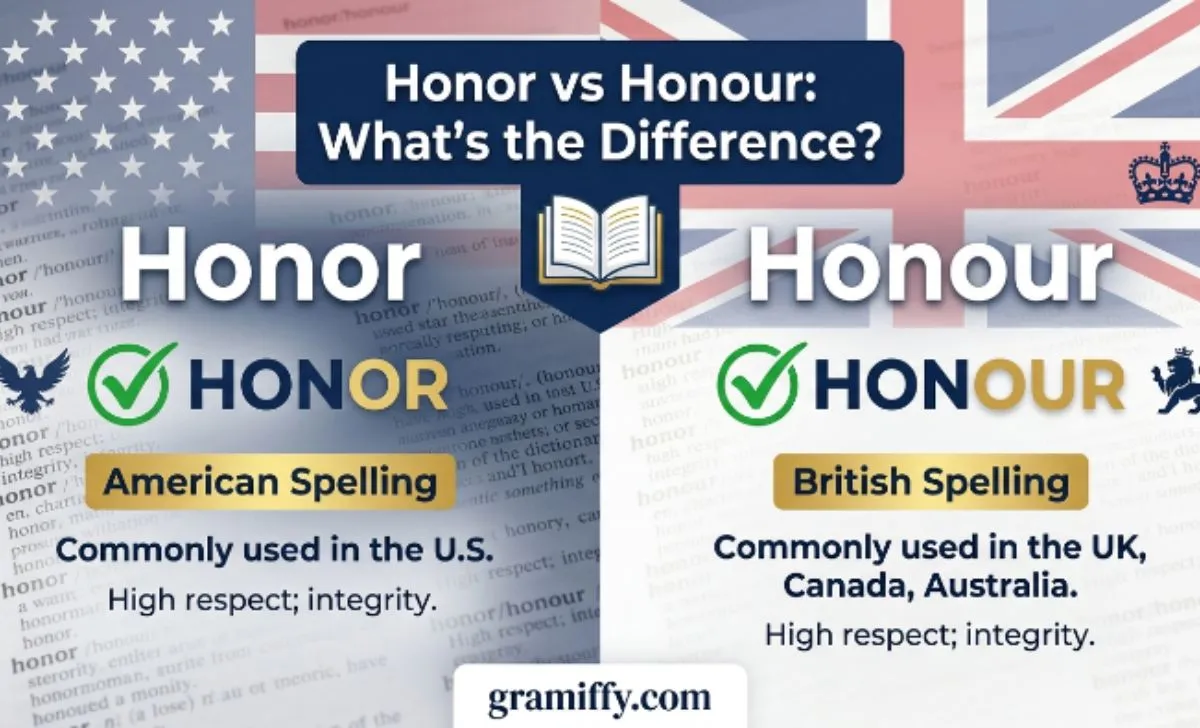
The truth is that both spellings are correct. However, the preferred choice depends on the type of English you’re using. American English favors honor, while British English and most Commonwealth countries prefer honour.
This distinction is part of a larger pattern found throughout the English language. Similar examples include color vs colour, favor vs favour, labor vs labour, and neighbor vs neighbour.
Although the spellings differ, the meanings remain exactly the same.
In this complete guide, you’ll learn everything you need to know about honor and honour, including their definitions, history, differences, pronunciation, origins, usage rules, and real world examples. By the end, you’ll know exactly which spelling to use and when to use it.
Quick Answer
Is It Honor or Honour?
Both honor and honour are correct spellings.
The difference is regional rather than grammatical.
| Spelling | Preferred Region |
|---|---|
| Honor | United States |
| Honour | United Kingdom, Canada, Australia, New Zealand |
The meaning, pronunciation, and usage are identical.
Which Spelling Should You Use?
Use honor if you’re writing for an American audience.
Use honour if you’re writing for a British, Canadian, Australian, or international audience that follows British spelling conventions.
What Does Honor Mean?
Definition of Honor
The word honor refers to respect, dignity, integrity, recognition, or a special privilege given to someone because of their achievements, character, or contributions.
Honor can describe both personal values and public recognition.
Common Meanings of Honor
Honor may refer to:
- High respect
- Moral integrity
- Personal reputation
- Recognition for achievements
- A position of distinction
- A privilege or special opportunity
Examples of Honor in Sentences
- It was an honor to receive the award.
- She served her community with honor.
- The university granted him an academic honor.
- We honor those who have sacrificed for others.
- His actions brought honor to his family.
What Does Honour Mean?
Definition of Honour
The word honour has exactly the same meaning as honor. It is simply the preferred spelling in British English and other varieties that follow British spelling conventions.
Common Meanings of Honour
Honour can refer to:
- Respect
- Esteem
- Integrity
- Recognition
- Prestige
- A privilege or distinction
Examples of Honour in Sentences
- It was an honour to meet the King.
- She graduated with honours.
- The nation honours its heroes.
- He acted with honour and courage.
- They gathered in honour of the victims.
Honor vs Honour: What’s the Difference?
The Short Answer
There is no difference in meaning between honor and honour.
The only difference is spelling.
Side-by-Side Comparison
| Feature | Honor | Honour |
|---|---|---|
| Meaning | Respect and recognition | Respect and recognition |
| Pronunciation | Same | Same |
| Grammar | Same | Same |
| Usage | American English | British English |
| Correct? | Yes | Yes |
Why People Get Confused
Many English learners assume that different spellings indicate different meanings. In this case, that’s not true.
Whether you write honor or honour, you’re expressing the same idea. The spelling simply changes depending on the audience and regional writing standards.
Why Are There Two Different Spellings?
The Evolution of English
English has developed differently in various parts of the world. As the language spread, certain spellings became standard in different countries.
British English preserved many traditional spellings that originated from French and Latin influences. American English later simplified some of these spellings.
This is why many British words contain an extra “u” that is missing in American English.
Similar Examples
| American English | British English |
|---|---|
| Color | Colour |
| Favor | Favour |
| Labor | Labour |
| Neighbor | Neighbour |
| Honor | Honour |
The honor/honour difference follows the same pattern.
The History of Honor and Honour
Latin Origins
The word originates from the Latin word honor, which referred to respect, reputation, dignity, and public recognition.
In ancient Rome, honor was considered one of the highest virtues a person could possess.
The concept was closely linked to personal character, social status, and public service.
Old French Influence
After the Norman Conquest of England in 1066, thousands of French words entered the English language.
During this period, various spellings of the word appeared, including:
- honor
- honour
- honur
- honoure
Spelling standards were not yet established, so multiple versions existed simultaneously.
Middle English Development
Over time, British English gradually standardized the spelling as honour.
For centuries, this became the accepted form throughout England and later throughout much of the British Empire.
How America Adopted the Spelling “Honor”
The Influence of Noah Webster
One of the most important figures in American spelling history was Noah Webster.
Webster believed English spelling should be simpler, more logical, and easier to learn.
As a result, he advocated removing unnecessary letters from many words.
Webster’s Spelling Reforms
His reforms included:
| British Spelling | American Spelling |
|---|---|
| Colour | Color |
| Favour | Favor |
| Labour | Labor |
| Honour | Honor |
| Neighbour | Neighbor |
These spellings became widely accepted throughout the United States and remain standard today.
Why Webster Removed the “U”
Webster believed the letter “u” was unnecessary because it was silent.
He wanted American spelling to be more efficient and more closely aligned with pronunciation.
Although Britain retained traditional spellings, the United States embraced Webster’s simplified forms.
Which Countries Use Honor?
Countries That Prefer Honor
The spelling honor is standard in:
- United States
- American government documents
- American universities
- U.S. newspapers
- American businesses
- Most U.S.-based websites
Examples
- Honor Roll
- Medal of Honor
- Honor Society
- Honor Code
These forms are considered standard throughout the United States.
Which Countries Use Honour?
Countries That Prefer Honour
The spelling honour is generally preferred in:
- United Kingdom
- Canada
- Australia
- New Zealand
- Ireland
Examples
- Honours Degree
- Roll of Honour
- Guest of Honour
- Honour Bound
These spellings follow traditional British conventions.
Is Honor More Correct Than Honour?
The Common Misconception
Many people believe that one spelling must be correct and the other must be wrong.
In reality, both are accepted standard spellings.
The Correct Perspective
Neither spelling is superior.
The best choice depends entirely on:
- Your audience
- Your location
- Your style guide
- Your publication requirements
For American readers, honor looks natural.
For British readers, honour looks natural.
Both communicate the same meaning.
How to Remember the Difference
The Easy Rule
Remember this simple pattern:
British English often keeps the extra “u.”
| British | American |
|---|---|
| Colour | Color |
| Favourite | Favorite |
| Neighbour | Neighbor |
| Honour | Honor |
If you remember color vs colour, you’ll easily remember honor vs honour.
Quick Memory Trick
Think:
United States = Honor
United Kingdom = Honour
The extra “u” usually signals British spelling.
Pronunciation of Honor and Honour
Do They Sound Different?
No.
Honor and honour are pronounced the same way.
American Pronunciation
Honor is typically pronounced:
“AH-nər”
British Pronunciation
Honour is typically pronounced:
“ON-ə”
The accent may vary slightly, but the spelling difference does not create a different word.
Why This Matters
Many learners assume different spellings indicate different pronunciations.
In this case, they don’t.
The distinction exists only in writing.
Key Takeaways
What You Should Remember
- Honor and honour have the same meaning.
- Both spellings are correct.
- Honor is the American spelling.
- Honour is the British spelling.
- Pronunciation remains the same.
- The difference originated through historical spelling developments.
- Noah Webster helped popularize honor in American English.
- Your audience should determine which spelling you use.
- Consistency is more important than choosing one spelling over the other.
Honor vs Honour in Modern English
Do Both Spellings Exist Today?
Yes. Both spellings are actively used today and appear in dictionaries, books, newspapers, websites, academic journals, and official documents.
The difference is not outdated or obsolete. Instead, it reflects the writing standards followed by different English-speaking countries.
For example, an American university will almost always use honor, while a British university will typically use honour.
Why Regional Spelling Matters
Choosing the correct spelling helps your writing appear professional and consistent.
If you’re writing for a U.S. audience, using honour may look unusual. Likewise, using honor in a British publication may seem inconsistent with local conventions.
Professional writers often choose one spelling system and use it consistently throughout a document.
Honor as a Noun
What Does Honor Mean as a Noun?
As a noun, honor refers to respect, prestige, recognition, or a special distinction.
It is often associated with achievement, character, or reputation.
Examples of Honor as a Noun
- Winning the championship was a great honor.
- It is an honor to represent my country.
- The award is considered a high honor.
- She accepted the honor with gratitude.
- The university granted him an academic honor.
Common Noun Phrases
Some common phrases include:
- Honor student
- Honor society
- Honor code
- Honor roll
- Medal of Honor
- Guest of honor
These expressions are widely used in American English.
Honour as a Noun
What Does Honour Mean as a Noun?
In British English, honour functions exactly the same way.
The meaning remains identical.
Examples of Honour as a Noun
- It was a great honour to receive the award.
- She accepted the honour on behalf of her team.
- Serving the community is an honour.
- The event was held in his honour.
- They considered it a tremendous honour.
Common British Expressions
Examples include:
- Guest of honour
- Roll of honour
- Honours degree
- Point of honour
- Matter of honour
Honor as a Verb
What Does It Mean to Honor Someone?
When used as a verb, honor means:
- To respect someone
- To recognize achievements
- To celebrate contributions
- To fulfill an agreement or obligation
Examples of Honor as a Verb
- We honor our veterans every year.
- The company honored its promise.
- The school honored the top students.
- They honored her achievements during the ceremony.
- The nation honors those who served.
Common Verb Usage
Honor is frequently used in:
- Award ceremonies
- Memorial events
- Business agreements
- Academic recognition
- Government proclamations
Honour as a Verb
What Does It Mean to Honour Someone?
The British spelling functions identically.
Examples of Honour as a Verb
- We honour those who sacrificed for our freedom.
- The school honoured its founder.
- The company honoured its commitment.
- The nation honours its traditions.
- They honoured her remarkable achievements.
The only difference remains the spelling.
Honor vs Honour in Academic Writing
Which Spelling Should Students Use?
Students should follow the spelling style required by their institution.
American Universities
American institutions generally use:
- Honor Roll
- Honor Society
- Honor Student
- Honor Code
These forms are standard throughout the United States.
British Universities
British institutions usually use:
- Honours Degree
- First-Class Honours
- Roll of Honour
These spellings align with British English standards.
Academic Writing Tip
Never mix honor and honour within the same essay, thesis, dissertation, or research paper.
Consistency is essential in academic writing.
Honor vs Honour in Business Writing
Which Spelling Is Appropriate?
Business writing should reflect the audience and market.
For American Companies
Use:
- honor
- honored
- honorable
- honor commitment
For British Companies
Use:
- honour
- honoured
- honourable
- honour commitment
Examples
American style:
We are honored to serve our customers.
British style:
We are honoured to serve our customers.
Both are correct when used in the appropriate context.
Honor vs Honour in Professional Emails
Email Writing Rules
When writing professional emails, use the spelling expected by your recipient.
Example for an American Recipient
It would be an honor to work with your organization.
Example for a British Recipient
It would be an honour to work with your organisation.
Small details like these can make communication feel more natural and professional.
Honor vs Honour in Legal Writing
Why Consistency Matters
Legal documents require precise and consistent language.
Most law firms follow the spelling conventions of their jurisdiction.
United States
Legal documents generally use:
- honor
- honorable
- dishonor
United Kingdom
Legal documents generally use:
- honour
- honourable
- dishonour
Changing spelling styles within a legal document can create unnecessary inconsistency.
Honor vs Honour in Books and Publishing
Which Spelling Do Publishers Prefer?
Publishers typically follow the style guide associated with their target audience.
American Publishing
Most American publishers prefer:
- honor
- honored
- honorable
British Publishing
Most British publishers prefer:
- honour
- honoured
- honourable
International Publishing
Some international publishers allow either spelling, provided the usage remains consistent throughout the publication.
Honor Roll vs Honour Roll
What Is an Honor Roll?
An honor roll is a list of students who have achieved high academic performance.
This term is primarily used in American schools.
Example
- Sarah made the honor roll this semester.
What Is a Honour Roll?
In British English, the equivalent phrase may appear as honour roll or roll of honour depending on context.
Comparison
| American English | British English |
|---|---|
| Honor Roll | Honour Roll |
| Honor Student | Honours Student (less common) |
| Honor Society | Academic Honours Programs |
Honor Code vs Honour Code
Meaning
An honor code is a set of ethical principles that students or members agree to follow.
Examples
- Students must follow the honor code.
- Academic honesty is part of the honour code.
The spelling changes according to the variety of English being used.
Honorable vs Honourable
Are Both Correct?
Yes.
Both words mean:
- Respectable
- Worthy of honor
- Ethical
- Distinguished
American English
Use:
Honorable
Examples:
- The judge is an honorable person.
- He lived an honorable life.
British English
Use:
Honourable
Examples:
- She is an honourable member of Parliament.
- He acted in an honourable manner.
Comparison Table
| American | British |
|---|---|
| Honorable | Honourable |
| Honorable Mention | Honourable Mention |
| Honorable Conduct | Honourable Conduct |
Honored vs Honoured
Meaning
Both words mean:
- Respected
- Recognized
- Privileged
American English
Examples:
- I am honored to be here.
- We were honored by the invitation.
British English
Examples:
- I am honoured to be here.
- We were honoured by the invitation.
Quick Comparison
| American | British |
|---|---|
| Honored | Honoured |
| Honoring | Honouring |
| Honors | Honours |
Dishonor vs Dishonour
Opposite Meaning
Both words represent the opposite of honor.
They refer to:
- Shame
- Disgrace
- Loss of reputation
- Lack of integrity
American English
Use:
Dishonor
Examples:
- He brought dishonor to the team.
- The action resulted in dishonor.
British English
Use:
Dishonour
Examples:
- His actions caused dishonour.
- They viewed it as a matter of dishonour.
Comparison Table
| American | British |
|---|---|
| Dishonor | Dishonour |
| Dishonorable | Dishonourable |
| Dishonored | Dishonoured |
Common Mistakes People Make
Mixing Spellings
Incorrect:
It was an honour to receive the honor.
This sentence mixes British and American spellings.
Correct American Version
It was an honor to receive the honor.
Correct British Version
It was an honour to receive the honour.
Switching Styles Mid-Article
Many writers accidentally switch between spelling systems.
Choose one style and use it consistently throughout the document.
Key Takeaways
What You Should Remember
- Honor and honour are equally correct.
- The difference is regional, not grammatical.
- Honor is preferred in American English.
- Honour is preferred in British English.
- Honor roll and honour roll follow the same rule.
- Honorable and honourable are both correct.
- Honored and honoured are both correct.
- Dishonor and dishonour are both correct.
- Professional writing should remain consistent.
- Always consider your audience before choosing a spelling.
Common Mistakes to Avoid When Using Honor and Honour
Even though the difference between honor and honour is mainly regional, writers still make several common mistakes. Avoiding these errors helps your writing look professional and consistent.
Mixing American and British Spellings in the Same Document
One of the most frequent mistakes is switching between American and British English.
Incorrect Example:
- The organization awarded him an honour for his bravery.
- The next paragraph refers to the same award as an honor.
This inconsistency can confuse readers and make content appear poorly edited.
Better Approach:
Choose one style and use it throughout the entire document.
- American English: honor, favorite, color, labor
- British English: honour, favourite, colour, labour
Assuming One Version Is More Correct
Many learners believe that honour is the “original” spelling and therefore more correct, while others think honor is the modern standard.
In reality, both spellings are correct.
The choice depends entirely on the audience and style guide.
Forgetting Audience Location
A website targeting readers in the United States should generally use honor.
A website targeting readers in the United Kingdom should generally use honour.
Using the preferred regional spelling can improve user experience and make content feel more natural to local readers.
Changing Spelling in Quoted Material
When quoting a source, preserve the original spelling.
For example:
If a British publication writes:
“The soldier received an honour for outstanding service.”
Do not change it to honor when quoting.
Likewise, keep American spellings unchanged when citing U.S. sources.
Misspelling Related Words
Many writers correctly use honor or honour but make mistakes with related forms.
Examples:
| American English | British English |
|---|---|
| honored | honoured |
| honoring | honouring |
| honorary | honorary |
| honorably | honourably |
Pay attention to the spelling pattern you have chosen.
Honor and Honour in Academic Writing
Academic institutions frequently encounter both spellings.
United States Universities
American institutions typically use honor.
Examples include:
- Honor Roll
- Honor Society
- Honor Code
- Honor Student
Many U.S. schools and colleges follow this spelling consistently.
British Universities
British institutions generally use honour.
Examples include:
- First-Class Honours Degree
- Honours Program
- Honours Student
- Honours Classification
Students studying in the UK often encounter the spelling honours rather than honors.
International Students
International students sometimes become confused when moving between countries.
A student who learned British English may write honour, while an American professor expects honor.
The best solution is to follow the style guide required by the institution.
Honor vs Honour in Business Communication
Businesses operating internationally should pay attention to regional spelling preferences.
For American Customers
Use:
- honor
- honored
- honoring
Example:
We are honored to serve our customers.
For British Customers
Use:
- honour
- honoured
- honouring
Example:
We are honoured to serve our customers.
Global Brands
Many multinational companies localize spelling based on region.
Their U.S. websites may use honor, while their UK websites use honour.
This localization improves readability and creates a more familiar experience for users.
Quick Quiz: Test Your Understanding
Choose the correct answer.
Question 1
Which spelling is preferred in American English?
A. Honour
B. Honor
Answer: B. Honor
Question 2
Which spelling is preferred in British English?
A. Honour
B. Honor
Answer: A. Honour
Question 3
Which sentence is correct?
A. She received an honor for her service.
B. She received an honour for her service.
Answer: Both are correct depending on the English variety being used.
Question 4
Should you mix honor and honour in the same document?
A. Yes
B. No
Answer: B. No
Consistency is important.
Honor vs Honour: The Bottom Line
The debate over honor vs honour is not about right versus wrong. Both spellings refer to the same concept: respect, integrity, recognition, and high moral character.
The only real difference is regional usage:
- Honor is the standard spelling in American English.
- Honour is the standard spelling in British English and most Commonwealth countries.
Whether you are writing an academic paper, business document, blog post, or social media update, the key is consistency. Choose the spelling that matches your audience and use it throughout your content.
Once you understand this simple distinction, you’ll never have to wonder whether to write honor or honour again.
Frequently Asked Questions About Honor vs Honour
Is Honor or Honour Correct?
Both honor and honour are correct spellings. The choice depends on the type of English you are using.
- Honor = American English
- Honour = British English, Canadian English, Australian English, and other Commonwealth varieties
Neither spelling is more correct than the other.
Why Do Americans Spell It Honor Instead of Honour?
American English underwent several spelling reforms in the late 18th and early 19th centuries. Lexicographer Noah Webster promoted simplified spellings that removed certain silent letters.
As a result:
- honour became honor
- colour became color
- favour became favor
- labour became labor
These simplified forms eventually became the standard in the United States.
Why Does British English Use Honour?
British English generally preserves older spellings that developed from French and Latin influences. The -our ending remained standard in Britain and later spread to many Commonwealth countries.
That is why British writers continue to use:
- honour
- colour
- flavour
- neighbour
Which Spelling Should I Use in School Assignments?
Use the spelling required by your teacher, institution, or style guide.
For example:
- American schools usually expect honor.
- British schools usually expect honour.
If no style guide is specified, remain consistent throughout the assignment.
Is Honour More Formal Than Honor?
No.
The two words carry exactly the same meaning and level of formality.
For example:
- It is an honor to meet you.
- It is an honour to meet you.
Both sentences are equally formal and correct.
Do Honor and Honour Have Different Meanings?
No.
They both can mean:
- Respect
- Integrity
- High moral character
- Recognition or distinction
- A privilege
The difference is only spelling, not meaning.
What Is the Difference Between Honors and Honours?
The same regional rule applies.
American English:
- Honors Program
- Honors Student
- Honors Society
British English:
- Honours Degree
- Honours Program
- Honours Classification
Both refer to academic achievement or distinction.
Is Honor Used More Frequently Online?
Generally, yes.
Because the United States has a large internet population, honor often appears more frequently in global search results and online content.
However, honour remains widely used across the UK, Canada, Australia, New Zealand, and many other English-speaking regions.
Can I Use Both Spellings in the Same Article?
It is usually best not to.
Choose one spelling style and use it consistently.
The only exception is when you are specifically discussing the difference between honor and honour, as in this article.
What Is the Plural Form of Honor and Honour?
The plural forms are:
| Singular | Plural |
|---|---|
| honor | honors |
| honour | honours |
Examples:
- She received several honors for her research.
- He graduated with honours.
Are There Other Words Similar to Honor and Honour?
Yes. Many words follow the same American-versus-British spelling pattern.
| American English | British English |
|---|---|
| honor | honour |
| color | colour |
| favor | favour |
| labor | labour |
| neighbor | neighbour |
| behavior | behaviour |
| humor | humour |
| vigor | vigour |
Learning these patterns can help you recognize whether a text follows American or British English conventions.
Final Thoughts
Understanding honor vs honour is surprisingly simple once you know the rule. Both words mean exactly the same thing and are accepted by dictionaries, educators, publishers, and professional writers around the world.
The key distinction is regional preference:
- Use honor for American English.
- Use honour for British English and most Commonwealth English varieties.
Whether you’re writing a blog post, academic paper, business document, social media update, or professional email, choosing the correct regional spelling demonstrates attention to detail and respect for your audience.
Remember this easy formula:
Honor = American English
Honour = British English
Keep your spelling consistent, follow your style guide, and you’ll always make the right choice.
Conclusion
The comparison of honor vs honour comes down to geography rather than grammar. Both spellings are correct, both share the same meaning, and both have centuries of usage behind them.
If your audience is primarily in the United States, use honor. If your audience is in the United Kingdom, Canada, Australia, New Zealand, or another Commonwealth nation, use honour.
By understanding this distinction, you can write with greater confidence, maintain consistency, and communicate more effectively with readers around the world. Whether you choose honor or honour, you’re using a perfectly valid English word—the important thing is using the version that best fits your audience.
Read More :

I am Bryan A. Garner a lexicographer, and language expert passionate about clear and effective writing.
I contribute grammar, spelling, and usage guides on Gramiffy.com to help readers improve their English skills. Through my work, I aim to make language rules simple, practical, and easy to understand.