Have you ever typed analysing in an essay, report, or blog post, only to have your spell checker suggest analyzing instead?
That small correction can make even experienced writers stop and wonder which spelling is actually correct.
If you’ve searched for analysing or analyzing, you’re not alone. Students, researchers, bloggers, business professionals, and English learners often see both versions and become confused.
The good news is that both spellings are correct. The difference comes down to regional English conventions.
This guide explains the meaning, usage, grammar rules, examples, and spelling differences so you can confidently choose the right form for any audience.
Quick Answer
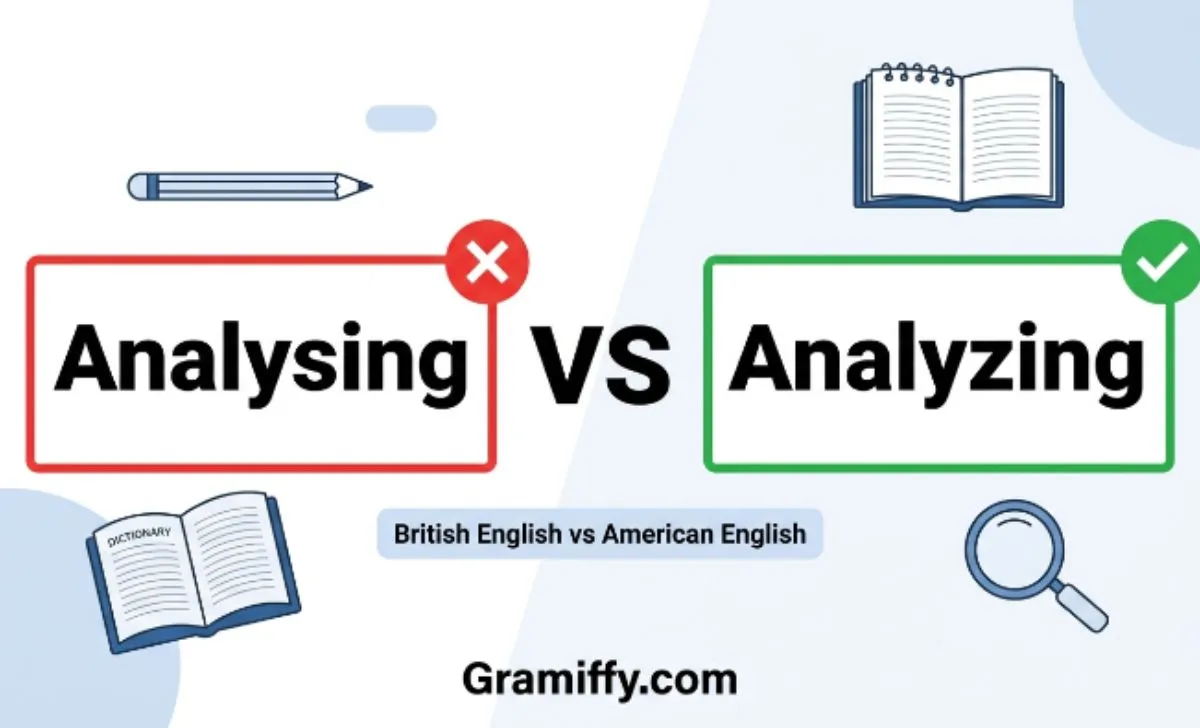
Both analysing and analyzing are correct spellings.
- Analyzing is the preferred spelling in American English.
- Analysing is the preferred spelling in British English.
The meaning remains exactly the same. Both words describe the process of examining information carefully to understand it better.
Correct Example
American English
- The team is analyzing customer feedback.
- Researchers are analyzing survey data.
British English
- The team is analysing customer feedback.
- Researchers are analysing survey data.
Incorrect Example
- The team is analizing customer feedback.
- She is analysizing the results.
Which is correct: analysing or analyzing?
Both spellings are correct. Analyzing is used in American English, while analysing is used in British English. The meaning, pronunciation, and usage are identical.
What Does Analysing or Analyzing Mean?
Both words are the present participle form of the verbs analyse and analyze.
Common Meanings
Analysing or analyzing means:
- Examining information carefully
- Studying data and evidence
- Evaluating results
- Identifying patterns
- Solving problems
- Drawing conclusions
Whether you’re analyzing customer behavior, analysing scientific findings, or reviewing business reports, the core meaning remains the same.
Simple Usage Examples
- Scientists are analyzing laboratory results.
- Students are analysing historical documents.
- The company is analyzing customer behavior.
- Researchers are analysing survey responses.
- Financial experts are analyzing market trends.
Why the Word Is Important
In today’s data-driven world, analysis helps people make informed decisions.
Businesses, researchers, teachers, marketers, and analysts all rely on analyzing information to understand trends and improve outcomes.
The Origin of Analysing and Analyzing
Understanding the history of the word helps explain why two spellings exist.
Word History
The noun analysis comes from Ancient Greek and means “breaking apart” or “examining closely.” The word entered English through Latin and eventually became a common term in academic and professional writing.
Over time, spelling conventions developed differently:
- British English adopted analyse and analysing.
- American English adopted analyze and analyzing.
Today, both forms are accepted by major dictionaries and style guides.
Why the Confusion Happens
Many people encounter both spellings online, in textbooks, and in professional documents.
For example:
- American publications usually use analyzing.
- British publications usually use analysing.
Because both versions appear frequently, writers often assume one must be wrong. In reality, both are correct when used for the appropriate audience.
British English vs American English
The difference between analysing and analyzing is based on regional spelling preferences rather than grammar.
Comparison Table
| English Variety | Preferred Verb | Preferred -ing Form |
|---|---|---|
| American English | Analyze | Analyzing |
| British English | Analyse | Analysing |
| Canadian English | Analyze / Analyse | Analyzing / Analysing |
| Australian English | Analyse | Analysing |
| New Zealand English | Analyse | Analysing |
| Indian English | Usually Analyse | Usually Analysing |
Dictionary and Style Guide Support
Major language authorities recognize both spellings.
Writers often consult:
- Merriam-Webster for American English
- Oxford dictionaries for British English
- Cambridge dictionaries for international English
- Academic style guides
- Professional writing manuals
These sources confirm that both forms are correct within their respective language systems.
Analysing or Analyzing vs Other Variations
Several related spellings can create confusion for writers.
Spelling Comparison Table
| Spelling | Correct? | Region |
|---|---|---|
| Analyzing | Yes | American English |
| Analysing | Yes | British English |
| Analyze | Yes | American English |
| Analyse | Yes | British English |
| Analysis | Yes | Worldwide |
| Analizing | No | None |
| Analysizing | No | None |
Understanding Related Forms
| American English | British English |
|---|---|
| Analyze | Analyse |
| Analyzing | Analysing |
| Analyzed | Analysed |
| Analyzes | Analyses |
Remember that the noun analysis remains the same in both British and American English.
Which Spelling Should You Use?
US Audience
If your audience is in the United States, use:
- Analyze
- Analyzing
These forms are standard in American schools, universities, businesses, and publications.
UK Audience
If your audience is in the United Kingdom, use:
- Analyse
- Analysing
These spellings follow British writing conventions.
International Writing
For global audiences, either spelling works. However, consistency is essential. Choose one style and use it throughout the document.
Academic Writing
Most universities and academic journals accept either spelling if it remains consistent.
Before submitting research papers, essays, or dissertations, check the required style guide.
Business Writing
Professional communication should reflect the language preferences of the company, client, or target market.
Social Media Usage
Both spellings are commonly used online. Regional preference usually determines which version appears more frequently.
Analysing and Analyzing in Academic Research
These words frequently appear in education and research.
Research Analysis
Researchers regularly analyze or analyse:
- Survey data
- Scientific findings
- Statistical reports
- Market research
- Case studies
Analysis helps researchers identify patterns and draw evidence-based conclusions.
Scientific Writing
Common phrases include:
- analyzing data
- analysing results
- statistical analysis
- research methodology
- data analysis techniques
The spelling depends on the journal, publisher, or institution.
Analysing and Analyzing in Business Writing
Businesses use analysis to improve decision-making and performance.
Marketing
Marketing teams analyze:
- Customer behavior
- Search trends
- Campaign results
- Website performance
Finance
Financial professionals analyze:
- Revenue reports
- Investments
- Market performance
- Economic indicators
Professional Communication
Business reports often include phrases such as:
- analyzing performance
- analysing efficiency
- customer analysis
- market analysis
Common Mistakes with Analysing or Analyzing
Frequent Errors
Common mistakes include:
- Writing analizing
- Writing analysizing
- Mixing British and American spellings
- Using analyze and analyse in the same document
Corrected Examples
| Incorrect | Correct |
|---|---|
| We are analizing the data. | We are analyzing the data. |
| She is analysizing results. | She is analysing results. |
| Analyze and analysing together in one article. | Use one style consistently. |
How to Avoid Mistakes
- Identify your target audience.
- Choose a spelling style before writing.
- Follow a trusted style guide.
- Use proofreading tools.
- Stay consistent throughout the document.
Google Trends & Usage Data
The keyword analysing or analyzing remains popular because many English learners and writers encounter both spellings.
Popular Countries
Search interest is strongest in:
- United States
- United Kingdom
- Canada
- Australia
- India
Why People Search This Keyword
Most users want to know:
- Which spelling is correct
- Whether one spelling is wrong
- The difference between British and American English
- Which spelling to use in academic writing
- How to write professionally
Related Grammar Rules
Learning related spelling variations can improve your overall writing skills.
Similar Spelling Mistakes
- Organize or Organise
- Realize or Realise
- Color or Colour
- Center or Centre
- Favorite or Favourite
- Traveling or Travelling
- Catalog or Catalogue
- Gray or Grey
Helpful Grammar Tips
- Know your audience.
- Stay consistent with one spelling system.
- Use reliable dictionaries.
- Proofread carefully before publishing.
- Follow institutional or company style guides.
FAQs
Which is correct, analysing or analyzing?
Both are correct. The choice depends on whether you use British or American English.
Is analyzing American English?
Yes. American English uses analyze and analyzing.
Is analysing British English?
Yes. British English uses analyse and analysing.
Do both words mean the same thing?
Yes. The meaning and usage are identical.
Which spelling should I use in academic writing?
Use the spelling required by your university, publisher, or style guide.
Is one spelling more professional than the other?
No. Both are professional when used correctly and consistently.
Why does British English use analysing?
British English follows the spelling pattern of analyse, which naturally becomes analysing.
Is analysing wrong in the United States?
It is not technically wrong, but American readers generally expect analyzing.
Conclusion
The answer to analysing or analyzing is straightforward: both spellings are correct. The only difference is regional preference.
American English uses analyzing, while British English uses analysing. Whether you’re writing a research paper, business report, blog post, or professional email, consistency is the key to clear communication.
Choose the spelling that matches your audience and use it throughout your writing. Whenever you’re unsure about analysing or analyzing, remember that both are correct, the best choice depends on who will be reading your work.

I am Bryan A. Garner a lexicographer, and language expert passionate about clear and effective writing.
I contribute grammar, spelling, and usage guides on Gramiffy.com to help readers improve their English skills. Through my work, I aim to make language rules simple, practical, and easy to understand.