A single hyphen can make a surprisingly big difference when you’re writing a business email, HR policy, company announcement, or professional report.
If you’ve ever typed companywide and wondered whether it should be company-wide, you’re dealing with a genuine English usage question—not simply a spelling mistake.
The good news is that companywide and company-wide have the same basic meaning: something that affects, includes, or extends throughout an entire company.
Cambridge Dictionary lists company-wide as the headword and also gives companywide and company wide as alternative forms.
So why do writers see different versions?
The answer involves compound-word formation, dictionary usage, sentence structure, and style preferences. Contrary to a rule repeated on many grammar websites, the choice isn’t as simple as saying “hyphen before a noun, no hyphen after a verb.”
Quick Answer: Companywide or Company-Wide?
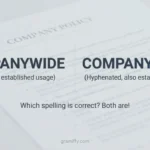
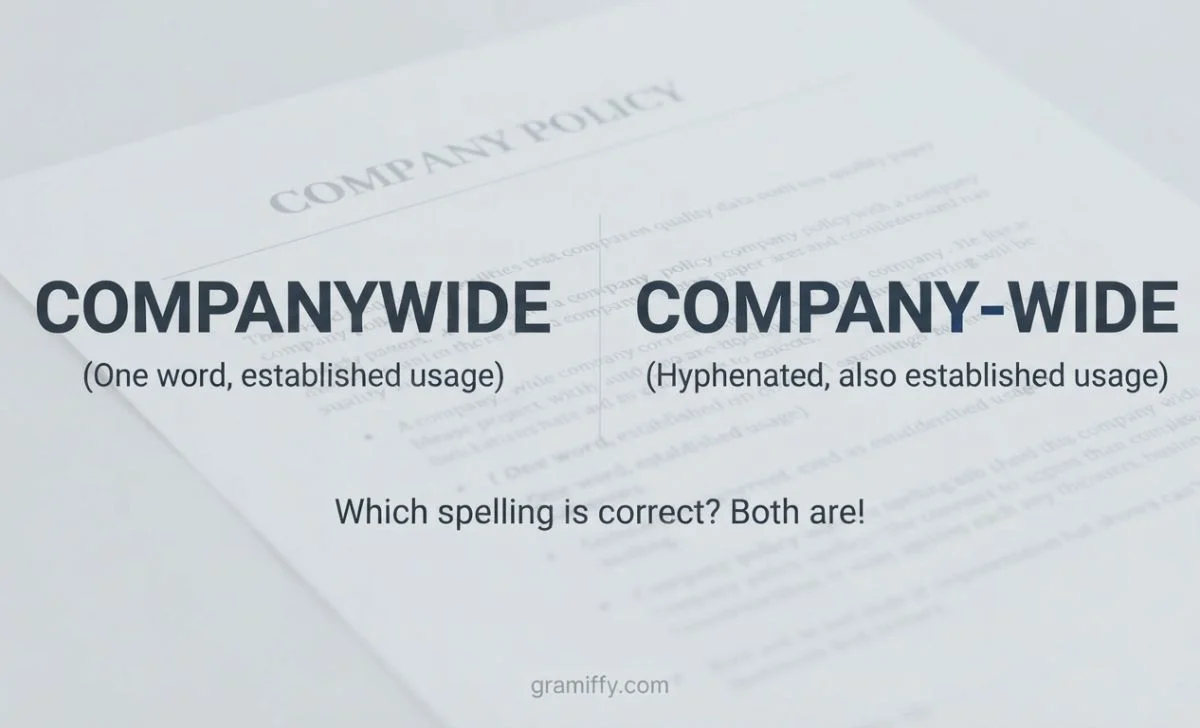
Both “companywide” and “company-wide” are established forms with the same basic meaning.
- company-wide — hyphenated form
- companywide — closed, one-word form
- company wide — also documented as a variant by Cambridge
Cambridge defines the term as relating to or affecting the whole of a company and specifically lists companywide and company wide alongside company-wide.
Examples
The company-wide recruitment freeze begins Monday.
The CEO announced a companywide restructuring.
Both sentences describe something affecting the entire company.
If you’re following a particular publication, employer, or style guide, use the spelling it specifies. If no house style applies, company-wide and companywide are both defensible choices.
What Does “Companywide” Mean?
Companywide means affecting, involving, or extending throughout an entire company.
It can describe something that applies to:
- all employees
- all departments
- the entire organization
- every branch or division
- the company as a whole
For example:
The companywide policy applies to all employees.
This means the policy applies throughout the organization.
Similarly:
The company-wide training program starts next month.
The training is intended for the company as a whole rather than a single department.
Cambridge gives the same basic meaning for company-wide and illustrates its use with workplace examples.
Companywide vs Company-Wide: What’s the Difference?
In meaning, there is essentially no difference.
Both forms describe something that extends throughout a company.
| Form | Meaning | Example |
|---|---|---|
| company-wide | throughout the whole company | a company-wide policy |
| companywide | throughout the whole company | a companywide policy |
| company wide | throughout the whole company | a company wide policy |
The main difference is spelling and style, not meaning.
This is an important distinction because some grammar websites present the issue as though one spelling is always correct and the other is always wrong.
Current dictionary evidence does not support such an absolute rule. Cambridge explicitly records all three forms.
Is “Companywide” One Word?
Yes.
Companywide is an established closed compound.
For example:
The companywide announcement was sent to every employee.
Here, companywide functions as a single word modifying announcement.
You may also see:
The changes will be implemented companywide.
Here, companywide indicates that the implementation will take place throughout the company.
Cambridge specifically recognizes companywide as an alternative form of company-wide.
So the claim that companywide is simply a misspelling of company-wide is incorrect.
Is “Company-Wide” Hyphenated?
Yes.
Company-wide is the established hyphenated form.
The hyphen connects company and wide into a compound modifier.
For example:
The company-wide meeting begins at 9 a.m.
We announced a company-wide hiring freeze.
Employees received a company-wide email.
The hyphen makes the compound structure immediately visible to the reader.
It is particularly useful when you want the traditional or explicitly hyphenated form.
What About “Company Wide” With a Space?
This is where the answer becomes more nuanced.
Company wide is also listed by Cambridge as a form of the term.
However, writers should not assume that the three forms are equally common in every publication or style system.
If you’re writing a formal business document and your organization has a preferred style, follow it.
If you’re choosing independently, company-wide or companywide will usually make the compound nature of the expression clearer than simply writing company wide.
For example, compare:
The company-wide survey begins tomorrow.
The companywide survey begins tomorrow.
Both clearly present companywide/company-wide as one concept.
By contrast:
The company wide survey begins tomorrow.
can look less conventional because the reader may initially parse company and wide as separate words.
The safest approach is therefore dictionary awareness plus consistency, rather than claiming that the spaced form can never occur.
Does “Before a Noun” Always Mean You Need a Hyphen?
Not necessarily.
This is one of the biggest weaknesses in competing explanations of companywide vs company-wide.
You will often see a rule such as:
Before a noun: company-wide
After a verb: companywide
That can be a useful practical convention, but it is too rigid when presented as an absolute grammar rule.
Consider:
The company-wide policy affects everyone.
The hyphenated form is perfectly natural.
But this is also possible:
The companywide policy affects everyone.
The closed compound is established too.
Cambridge itself gives an example of companywide before a noun:
a companywide announcement
That directly demonstrates why “companywide can only be used after a verb” is too simplistic.
The better rule
Think of the choice as a matter of established spelling and style, not a mandatory grammatical transformation based solely on the word that follows.
When Should You Use “Company-Wide”?
Choose company-wide when:
- your style guide prefers hyphenated compounds
- you want the compound structure to be visually obvious
- you’re following an established editorial convention
- consistency with other hyphenated -wide compounds matters in your document
Examples
The company-wide policy takes effect next month.
We held a company-wide meeting.
A company-wide survey was sent to all employees.
The CEO announced a company-wide restructuring.
Employees received a company-wide communication.
The hyphen makes company + wide visually function as a unit.
When Should You Use “Companywide”?
Choose companywide when:
- your dictionary or house style uses the closed form
- you prefer established closed compounds
- you’re writing business or digital content where the one-word form is already familiar
- you want consistency with other closed -wide compounds
Examples
The companywide policy takes effect next month.
We held a companywide meeting.
A companywide survey was sent to all employees.
The CEO announced a companywide restructuring.
Employees received a companywide communication.
Notice that the meaning has not changed.
Only the spelling has.
Companywide Before a Noun: Is It Wrong?
No.
This is an important point because many online grammar guides teach the hyphenated form as though it is mandatory whenever the word comes before a noun.
For example:
a companywide policy
is a valid construction because companywide is an established closed compound.
Cambridge’s own example uses companywide before a noun:
a companywide announcement
So it would be misleading to say:
“Companywide before a noun is grammatically incorrect.”
A more accurate explanation is:
Company-wide is a traditional hyphenated form, while companywide is an established closed form. Both can function as modifiers before a noun.
Companywide After a Verb
The closed form is also natural when it expresses scope.
For example:
The new system was implemented companywide.
The policy applies companywide.
Training was rolled out companywide.
The change will be introduced companywide.
In these examples, companywide tells us that the action or condition extends throughout the company.
You may also encounter:
The new system was implemented company-wide.
That spelling is also established.
So sentence position can influence stylistic preference, but it does not create an absolute correct/incorrect distinction between the two forms.
Company-Wide vs Companywide Examples
Here are some practical examples from business writing.
Company-wide
The company-wide meeting will take place Friday.
Management approved a company-wide policy change.
We launched a company-wide employee survey.
The company-wide initiative focuses on customer service.
A company-wide email was sent yesterday.
Companywide
The companywide meeting will take place Friday.
Management approved a companywide policy change.
We launched a companywide employee survey.
The companywide initiative focuses on customer service.
A companywide email was sent yesterday.
The meaning remains the same.
Common Business Phrases With “Companywide”
You’ll commonly see the term used with words such as:
- companywide policy
- companywide announcement
- companywide meeting
- companywide training
- companywide survey
- companywide changes
- companywide initiative
- companywide benefits
- companywide communication
- companywide restructuring
- companywide rollout
- companywide program
The hyphenated equivalents are also possible:
- company-wide policy
- company-wide announcement
- company-wide meeting
- company-wide training
- company-wide survey
- company-wide changes
- company-wide initiative
- company-wide benefits
- company-wide communication
- company-wide restructuring
Companywide vs Company-Wide in Business Writing
Business writing is where this question comes up most often.
You might see:
Company-wide policy update
in an HR document.
You might see:
Companywide policy update
in another organization’s documentation.
Neither spelling changes the intended meaning.
The important thing is to establish a consistent style.
For example, don’t write:
The company-wide policy applies to all staff. The companywide announcement will follow tomorrow.
unless there is a specific reason for switching forms.
For a polished document, choose one form and use it consistently.
Companywide vs Company-Wide in Headlines and Emails
Short digital formats can make companywide particularly convenient because it is compact.
For example:
Companywide Benefits Update
is concise and visually simple.
You could equally write:
Company-Wide Benefits Update
if that matches your organization’s style.
Email subject lines, internal announcements, newsletters, and website headings should generally follow the same spelling convention used throughout the organization.
Companywide vs Other “-Wide” Words
The spelling becomes easier to understand when you compare companywide with other words ending in -wide.
Worldwide
The company operates worldwide.
Nationwide
The service is available nationwide.
Statewide
The program is offered statewide.
Citywide
The citywide festival begins Friday.
Companywide
The policy applies companywide.
English has many established closed compounds ending in -wide.
But that does not mean every new -wide combination must automatically be written as one word. English compound spelling develops through usage, dictionaries, and editorial conventions.
That’s why it’s better to check an established dictionary than apply a single mechanical rule to every possible -wide expression.
Why Does English Have Both “Company-Wide” and “Companywide”?
Compound words often develop gradually.
A combination may initially appear as separate words, then become hyphenated, and eventually become a closed compound as readers become familiar with it.
This is not unusual in English.
Compare words such as:
- website
- worldwide
- nationwide
- online
- database
Spelling conventions can change as compounds become established.
Companywide is now sufficiently established that major dictionary evidence recognizes it alongside company-wide.
Cambridge’s current entry lists company-wide as the main entry and gives companywide and company wide as alternatives.
Common Mistakes With Companywide
Mistake 1: Saying “companywide” is always wrong
Companywide is incorrect. ❌
This is too absolute.
Companywide is an established form.
Mistake 2: Saying “company-wide” is the only correct form
You must always write company-wide. ❌
That ignores the established closed form companywide.
Mistake 3: Treating sentence position as an absolute rule
Before a noun = company-wide
After a verb = companywide
This can be a useful style convention, but it is not a complete description of modern dictionary usage.
Cambridge’s example companywide announcement shows that the closed form can occur before a noun.
Mistake 4: Switching forms randomly
Using both spellings in the same document without a reason can make your writing look inconsistent.
Choose the form that matches your preferred or required style and stay consistent.
Mistake 5: Assuming “company wide” can never occur
The spaced form is documented by Cambridge, so an absolute statement that it is “never correct” goes beyond the evidence.
A Simple Rule to Remember
If you need a quick practical answer, remember this:
Company-wide and companywide have the same basic meaning.
Then choose according to your dictionary, style guide, or house style.
If no specific style guide applies, either established form can work:
company-wide
or
companywide
The most important thing is to use your chosen spelling consistently.
Which Form Should You Use in Formal Writing?
There isn’t a universal rule requiring every writer to choose one form.
Instead, check the style system governing your document.
For example, a company may have an internal editorial guide that consistently uses companywide. Another organization may prefer company-wide.
If you’re writing for publication, follow the publisher’s requirements.
If you’re writing independently and want the hyphen to make the compound immediately obvious, company-wide is a straightforward choice.
If your preferred dictionary or editorial style uses the closed compound, companywide is also well established.
The key is consistency rather than pretending that one form has completely replaced the other.
FAQs
Is companywide one word?
Yes. Companywide is an established one-word form meaning affecting or extending throughout an entire company. Cambridge lists it as an alternative form of company-wide.
Is company-wide correct?
Yes. Company-wide is an established hyphenated form meaning affecting the whole company.
Is companywide or company-wide more correct?
Both are established forms. The preferred choice depends largely on dictionary usage, editorial style, and house style rather than a difference in meaning.
Should I use company-wide before a noun?
You can. For example:
a company-wide policy
But companywide can also occur before a noun. Cambridge itself gives companywide announcement as an example.
Is companywide grammatically correct?
Yes. Companywide is a recognized compound adjective/adverb meaning throughout an entire company.
Is company wide correct?
Company wide is also listed by Cambridge as a form of the expression. However, writers should follow the spelling convention required by their dictionary, publication, or organization.
Is company-wide more formal than companywide?
Not necessarily. The difference is primarily spelling and style. A writer may choose the hyphenated form for a particular editorial convention, while another organization may consistently use companywide.
Can I write “the companywide policy”?
Yes. Companywide policy is an established construction. The closed compound does not become incorrect merely because it appears before a noun.
Can I write “the policy applies companywide”?
Yes. Here companywide expresses the scope of where the policy applies.
What does companywide mean?
Companywide means throughout an entire company or affecting the company as a whole.
What is the plural of companywide?
Companywide is an adjective or adverb, so it does not normally have a plural form. The noun it modifies carries the number:
companywide policy
companywide policies
Conclusion:
Companywide and company-wide are both established forms with the same basic meaning: affecting or extending throughout an entire company.
The important point is that the choice is not as simple as “one is correct and the other is wrong.” Cambridge lists company-wide as the main form and recognizes companywide and company wide as alternatives.
For example:
The company-wide policy affects every department.
and:
The companywide policy affects every department.
both communicate the same idea.
If your employer, publisher, or style guide specifies a preferred spelling, follow it. Otherwise, choose an established form and use it consistently throughout your writing.
In short:
company-wide = correct
companywide = correct
company wide = also documented, but check your preferred style
The hyphen may be small, but understanding why it appears—or disappears—helps you make a more informed choice in professional writing.
Read More:

Hi, I’m Safdar Ali, an English language teacher with 26 years of teaching experience. My expertise is in English linguistics, grammar, and the differences between British and American English.
Through Gramiffy, I share practical, research-based guides to help students, writers, and English learners improve their language skills. My goal is to make English simple, accurate, and easy for everyone to understand.