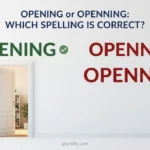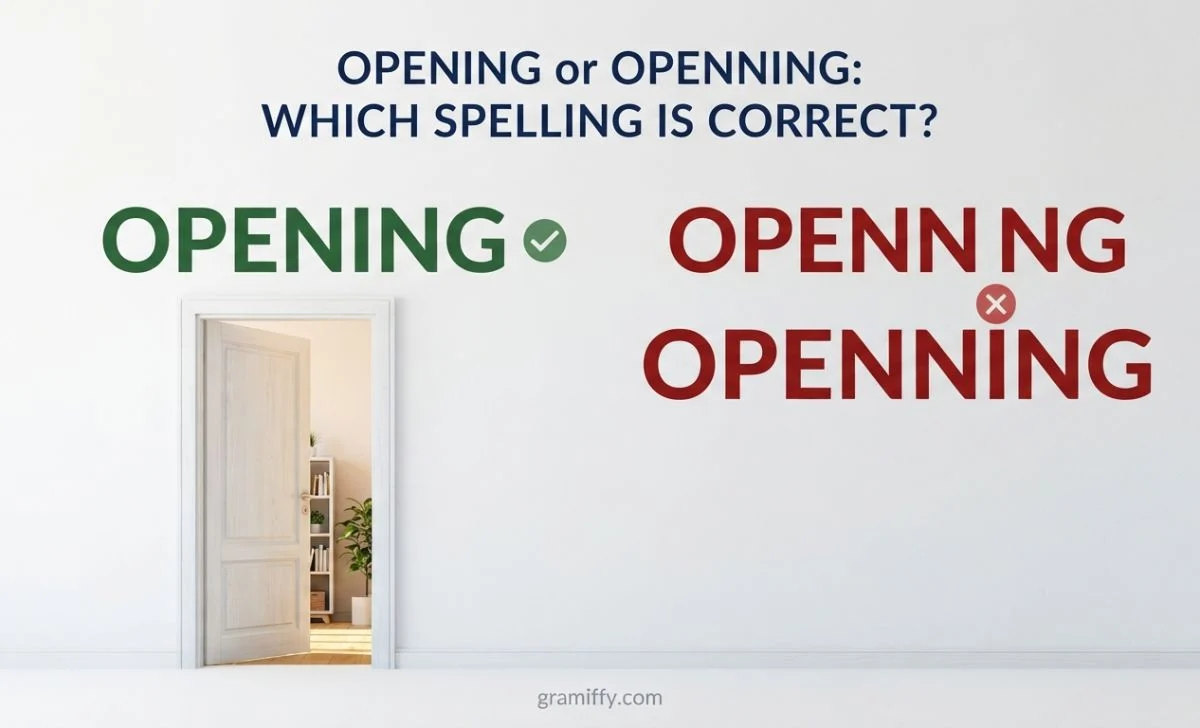
Opening is the correct spelling. Openning is a misspelling and should not be used in standard English.
If you’ve ever hesitated over whether open becomes opening or openning, the confusion is understandable.
English does double final consonants in some words before adding -ing—for example, run → running and begin → beginning. So why doesn’t open become openning?
The answer comes down to the structure and stress of the original word. Once you understand the pattern, opening becomes much easier to remember—and you’ll also have a better idea of when English actually does double a final consonant.
Quick Answer: Opening or Openning?
Opening is correct.
Openning is incorrect.
The verb open becomes opening when -ing is added. The final n stays single:
- open → opening
- open → opened
- open → opens
- open → opener
There is no standard English word openning with two ns.
| Spelling | Correct? | Example |
|---|---|---|
| opening | ✅ Yes | The store is opening tomorrow. |
| openning | ❌ No | The store is openning tomorrow. |
Why Is It “Opening” and Not “Openning”?
The easiest way to understand the spelling is to look at the word open before adding -ing.
open + ing = opening
The final n does not double.
English does sometimes double a final consonant before a suffix beginning with a vowel, but it doesn’t happen with every word ending in a consonant.
For many verbs, doubling is associated with a stressed final syllable and a suitable short-vowel/consonant pattern. Because open has its main stress on the first syllable—O-pen—the final n is not doubled.
Compare:
- O-pen → opening
- be-GIN → beginning
- re-FER → referring
- ad-MIT → admitting
So although open ends in n, it doesn’t meet the pattern that would require doubling.
The Spelling Rule for Adding -ing
When a verb takes -ing, the final consonant may sometimes be doubled. But there is more to the rule than simply asking where the stress falls.
With many common verbs, a final consonant is doubled when:
- The word ends in a single consonant.
- The consonant is preceded by a short vowel.
- The relevant syllable is stressed.
- The consonant is one that can normally be doubled under the spelling rule.
For example:
- run → running
- sit → sitting
- plan → planning
- stop → stopping
- begin → beginning
- admit → admitting
But compare these:
- open → opening
- visit → visiting
- listen → listening
- happen → happening
- offer → offering
- develop → developing
The important point is that not every final consonant gets doubled before -ing.
Why “open” stays single
The word open is pronounced with the main stress on the first syllable:
O-pen
The final syllable is unstressed, so the spelling remains:
open + ing = opening
Not:
open + ning = openning
Opening vs. Openning: At a Glance
| Feature | Opening | Openning |
|---|---|---|
| Standard English spelling | ✅ | ❌ |
| Correct -ing form of open | ✅ | ❌ |
| Used in British English | ✅ | ❌ |
| Used in American English | ✅ | ❌ |
| Example | The shop is opening. | The shop is openning. |
There is no American-versus-British spelling difference here. Opening is the standard spelling in both varieties.
Examples of “Opening” in Sentences
Opening can function in several ways, depending on the sentence.
-ing form of “open”
She is opening the window.
The company is opening a new office.
They are opening the doors at 9 a.m.
As a noun
The store’s grand opening is Saturday.
There is an opening in the fence.
We have a job opening in the marketing department.
As an adjective
I attended the opening ceremony.
The opening scene was memorable.
Check the store’s opening hours before you visit.
In a fixed expression
The company announced several new job openings.
The restaurant held its grand opening last weekend.
She gave the opening statement.
In every case, the spelling remains opening with only one n.
Common Words That Are Mistakenly Doubled
If openning looks natural to you, you’re not alone. English contains many words where a final consonant really is doubled, which can make incorrect spellings look familiar.
Here are some common comparisons:
| Base word | Correct -ing form | Incorrect form |
|---|---|---|
| open | opening | openning |
| happen | happening | happenning |
| listen | listening | listenning |
| visit | visiting | visitting |
| offer | offering | offerring |
| garden | gardening | gardenning |
| develop | developing | developping |
| limit | limiting | limitting |
| begin | beginning | beggining |
| admit | admitting | admiting |
Notice that the correct spelling isn’t determined simply by whether the word ends in a consonant.
Opening vs. Beginning: Why One Doubles
This is one of the easiest comparisons to remember.
Open → Opening
O-pen
The main stress is on the first syllable, so the final n stays single.
Begin → Beginning
be-GIN
The final syllable carries the main stress, and the spelling pattern calls for doubling the final n:
begin → beginning
This is why beginning has two ns while opening has only one.
You can use the pronunciation as a helpful clue, but remember that English spelling rules have exceptions and additional conditions. Stress alone isn’t a universal doubling rule.
Is “Openning” Ever Correct?
No. Openning is not the standard spelling of the English word opening.
If you’re writing:
- opening hours
- opening ceremony
- opening statement
- opening night
- job opening
- grand opening
- opening scene
use opening, with one n.
For example:
❌ The shop’s grand openning is tomorrow.
✅ The shop’s grand opening is tomorrow.
Is “Opening” Correct in British and American English?
Yes.
Unlike some spelling differences between British and American English—such as travelling/traveling or cancelled/canceled—there is no regional variation between opening and openning.
Both British and American English use:
opening
The spelling openning is not the standard form in either variety.
Why Does “Openning” Look So Familiar?
The mistake probably feels natural because English has many legitimate words containing -nn-:
- running
- planning
- beginning
- winning
- scanning
- beginning
There are also words such as beginning, which are visually similar to opening and are extremely common.
That can create a false pattern:
begin → beginning
open → openning
But the two verbs follow different spelling patterns.
A useful way to remember the difference is:
open → opening
Think of the word as simply open + ing.
Opening, Opened, Opens, and Opener
The word open changes in several common forms, but none requires a double n.
| Form | Correct spelling | Example |
|---|---|---|
| Base form | open | Please open the door. |
| Third-person singular | opens | The shop opens at 8. |
| Past tense | opened | She opened the box. |
| -ing form | opening | He is opening the door. |
| Noun | opener | Use a bottle opener. |
| Plural noun | openings | There are several openings. |
This gives you a simple spelling family:
open → opens → opened → opening → opener → openings
There is no openning in this family.
A Simple Memory Trick
Remember:
Open + ing = opening
Don’t add another n.
You can also connect the spelling to the pronunciation:
O-pen → O-pen-ing
The word begins with the stressed syllable O, not the final syllable. That makes opening different from words such as beginning and admitting, where the relevant final syllable is stressed.
If you’re ever unsure, write the base word first:
open
Then add:
-ing
Result:
opening
Common Mistakes to Avoid
❌ Openning hours
Correct:
✅ Opening hours
❌ Grand openning
Correct:
✅ Grand opening
❌ The store is openning today.
Correct:
✅ The store is opening today.
❌ We have a new job openning.
Correct:
✅ We have a new job opening.
These errors are especially noticeable on signs, advertisements, websites, job listings, and business pages.
Quick Quiz: Opening or Openning?
Choose the correct spelling in each sentence.
- The store’s grand __ is next week.
(opening / openning) - She is __ the package.
(opening / openning) - The company announced a new job __.
(opening / openning) - What are the restaurant’s __ hours?
(opening / openning) - They are __ a new branch downtown.
(opening / openning)
Answers
- opening
- opening
- opening
- opening
- opening
If you chose opening every time, you’ve got the spelling right.
FAQs
Is “openning” a word?
No. Openning is not the standard spelling of the -ing form of open. The correct spelling is opening.
Is it opening or openning?
Opening is correct. Openning is a misspelling.
Why doesn’t “open” become “openning”?
Because the spelling rules for doubling a final consonant do not apply to open. Its main stress is on the first syllable, giving O-pen → opening.
Why does “begin” become “beginning”?
Begin is stressed on its final syllable: be-GIN. Its spelling pattern calls for doubling the final n before -ing.
Is “opening” the same in British and American English?
Yes. Both British and American English spell the word opening.
What is the plural of “opening”?
The plural is openings.
The company has three job openings.
What is the past tense of “open”?
The past tense is opened.
She opened the door.
Is “opener” spelled with one n?
Yes. The correct spelling is opener, as in bottle opener or can opener.
Conclusion: Opening or Openning?
Opening is the only standard spelling.
Use opening when you mean the act of opening something, a gap or opportunity, the beginning of an event, or the -ing form of the verb open.
Openning is incorrect.
The easiest rule to remember is:
open + ing = opening
And when you compare it with begin → beginning, remember that consonant doubling depends on the word’s spelling and syllable pattern—not simply on whether a word ends in n.
Correct: opening
Incorrect: openning
Read More:

Hi, I’m Safdar Ali, an English language teacher with 26 years of teaching experience. My expertise is in English linguistics, grammar, and the differences between British and American English.
Through Gramiffy, I share practical, research-based guides to help students, writers, and English learners improve their language skills. My goal is to make English simple, accurate, and easy for everyone to understand.