A tiny apostrophe can completely change whether a word is written correctly. That is exactly what happens with thats and that’s.
They look almost identical, but in standard modern English, only one is the normal spelling of the contraction.
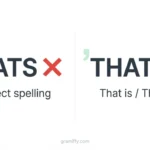
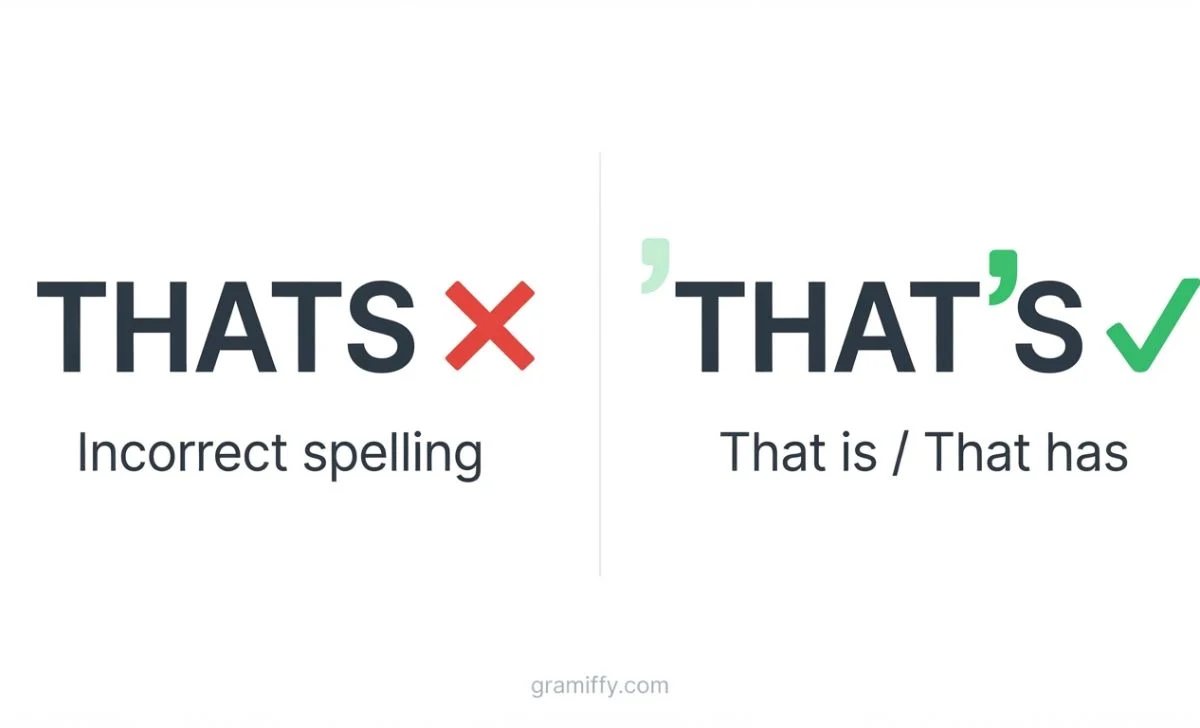
The correct form is that’s when you mean “that is” or “that has.” The form thats, without an apostrophe, is not the standard spelling of this contraction.
The apostrophe tells the reader that letters have been omitted: that is becomes that’s, while that has also becomes that’s.
The confusion becomes more interesting because that’s does not always mean the same thing.
In one sentence it can mean that is, while in another it can mean that has. Fortunately, there is a simple test that makes the difference easy to recognize.
Quick Answer: Thats or That’s?
That’s is the correct form when you mean “that is” or “that has.”
Thats without an apostrophe is not the standard spelling of this contraction.
| Form | Correct? | Meaning |
|---|---|---|
| that’s | Yes | that is / that has |
| thats | No, in standard English | Usually intended as “that’s” |
Examples
- That’s my car. → That is my car.
- That’s been a difficult decision. → That has been a difficult decision.
- I know that’s true. → I know that is true.
- That’s happened before. → That has happened before.
The easiest rule is:
If you can replace “that’s” with “that is” or “that has,” keep the apostrophe.
What Does “That’s” Mean?
That’s is a contraction. It combines that with either is or has.
There are therefore two main possibilities:
that + is → that’s
that + has → that’s
The apostrophe marks the missing letters created by the contraction.
That’s = That Is
When that’s means “that is,” it can be expanded without changing the basic meaning of the sentence.
That’s a beautiful house.
becomes:
That is a beautiful house.
Another example:
I think that’s the right answer.
becomes:
I think that is the right answer.
Here, that’s is simply a contraction of that is.
That’s = That Has
That’s can also mean “that has,” particularly when has is being used as an auxiliary verb.
That’s been a problem for years.
means:
That has been a problem for years.
Another example:
That’s happened to me before.
means:
That has happened to me before.
This second use is easy to overlook because many quick grammar guides focus only on that’s = that is.
Why Does “That’s” Have an Apostrophe?
The apostrophe shows that part of the original words has been removed.
For example:
that is → that’s
The letters i and part of the original word arrangement are represented through the contraction, with the apostrophe marking the shortened form.
The same principle applies to:
- it is → it’s
- she is → she’s
- he is → he’s
- who is → who’s
- we are → we’re
The apostrophe is therefore not decorative. It signals that that’s is a shortened form.
Without the apostrophe, thats does not represent the standard contraction that’s.
Is “Thats” a Word?
In ordinary modern English writing, thats is not the standard spelling you should use when you mean “that is” or “that has.”
For example:
Thats a good idea. ❌
The standard form is:
That’s a good idea. ✅
Likewise:
Thats been happening all week. ❌
should be:
That’s been happening all week. ✅
So if you are writing an email, essay, article, school assignment, professional message, or other standard English text, use that’s when the intended meaning is “that is” or “that has.”
That vs That’s: What’s the Difference?
One reason people confuse that and that’s is that they are closely related but grammatically different.
“That” is a complete word
That can perform several grammatical functions.
For example:
That book belongs to Sarah.
Here, that identifies a particular book.
I know that he is busy.
Here, that introduces a clause.
“That’s” is a contraction
In:
That’s my book.
that’s means:
That is my book.
So the apostrophe is important because it changes the construction.
Compare:
That book is expensive.
with:
That’s an expensive book.
The first sentence uses that as a word modifying book. The second uses that’s as a contraction of that is.
How to Tell Whether “That’s” Means “That Is” or “That Has”
You don’t need to memorize two separate rules.
Use the expansion test.
Step 1: Replace “that’s” with “that is”
That’s a good question.
→ That is a good question.
The sentence works, so that’s = that is.
Step 2: If that doesn’t work, try “that has”
That’s been a good experience.
→ That is been a good experience. ❌
That doesn’t work.
Try:
That has been a good experience. ✅
Therefore, that’s = that has.
This simple test works in a wide range of sentences.
Examples of “That’s” Meaning “That Is”
Here are some common examples:
- That’s my brother.
→ That is my brother. - That’s a great idea.
→ That is a great idea. - I think that’s correct.
→ I think that is correct. - That’s the problem.
→ That is the problem. - That’s exactly what I meant.
→ That is exactly what I meant. - That’s not what happened.
→ That is not what happened. - That’s an interesting question.
→ That is an interesting question. - That’s why I called you.
→ That is why I called you.
In each case, expanding that’s to that is preserves the sentence.
Examples of “That’s” Meaning “That Has”
The “that has” use is especially common before a past participle.
- That’s been a difficult year.
→ That has been a difficult year. - That’s happened before.
→ That has happened before. - That’s changed everything.
→ That has changed everything. - That’s caused several problems.
→ That has caused several problems. - That’s never happened to me.
→ That has never happened to me. - That’s become a major issue.
→ That has become a major issue. - That’s already happened.
→ That has already happened. - That’s made things easier.
→ That has made things easier.
A useful clue is the word that follows that’s. Forms such as been, happened, changed, become, caused, and made often indicate that that’s means “that has.”
“That’s” vs “Thats” in a Sentence
Seeing the two forms side by side makes the difference clearer.
| Incorrect in standard English | Correct |
|---|---|
| Thats my phone. | That’s my phone. |
| Thats a problem. | That’s a problem. |
| Thats what I said. | That’s what I said. |
| Thats been difficult. | That’s been difficult. |
| Thats happened before. | That’s happened before. |
| Thats the reason. | That’s the reason. |
The correction is not about pronunciation. Both forms may be intended to represent the same spoken contraction. The issue is standard written spelling.
Common Mistakes With “That’s”
1. Leaving out the apostrophe
Thats my house. ❌
Use:
That’s my house. ✅
2. Using “that’s” when you mean “that”
Don’t add an apostrophe simply because that refers to something.
That’s book is expensive. ❌
If you mean a particular book, write:
That book is expensive. ✅
Here, that modifies book. There is no contraction.
3. Confusing “that’s” with “thats”
The apostrophe is part of the standard contraction:
I think that’s right. ✅
Not:
I think thats right. ❌
4. Assuming “that’s” always means “that is”
It can also mean “that has.”
That’s changed since last year.
Here, the intended expansion is:
That has changed since last year.
Recognizing this prevents a common grammatical misunderstanding.
That’s vs Its: Why Apostrophes Cause Confusion
That’s and its illustrate two different apostrophe rules.
That’s is a contraction:
that’s = that is / that has
But its is the possessive form of it, and it normally does not take an apostrophe.
Compare:
That’s a dog.
= That is a dog.
and:
The dog wagged its tail.
This is why you shouldn’t assume that every apostrophe in English indicates possession. In contractions, an apostrophe can indicate omitted letters.
Is “That’s” Formal or Informal?
That’s is a standard English contraction and is perfectly normal in everyday writing.
However, the choice between a contraction and its expanded form can depend on the style and context.
For example:
That’s an important distinction.
is natural in general prose.
A more formal style may instead use:
That is an important distinction.
The contraction itself is not an incorrect or nonstandard form. It is simply a shortened version of the underlying expression.
In formal academic or legal writing, following the publication or institution’s style guide is the safest approach.
Is “That’s” Used in British and American English?
Yes.
That’s is used in both British and American English.
The spelling does not change between the two varieties:
- British English: that’s
- American English: that’s
You therefore do not need to choose between that’s and thats based on whether you are writing for a British or American audience.
The apostrophe remains part of the standard contraction in both varieties.
When Should You Use “That’s”?
Use that’s when you can expand it to either:
that is
or
that has
For example:
That’s the restaurant I mentioned.
→ That is the restaurant I mentioned.
And:
That’s happened several times.
→ That has happened several times.
If neither expansion makes sense, you probably need that, not that’s.
A Simple Memory Trick
Think of the apostrophe as a sign saying:
“Something is missing.”
When you see:
that’s
ask:
What is missing?
Usually, the answer will be:
that is
or:
that has
So remember:
THAT’S = THAT IS / THAT HAS
THATS = not the standard contraction
Practice: Choose “That” or “That’s”
Test yourself before looking at the answers.
- ___ my favorite restaurant.
- ___ book belongs to me.
- I think ___ the correct answer.
- ___ been a long day.
- ___ the reason I left.
- ___ house on the corner is for sale.
- ___ happened more than once.
- ___ exactly what I wanted.
Answers
- That’s my favorite restaurant.
- That book belongs to me.
- I think that’s the correct answer.
- That’s been a long day.
- That’s the reason I left.
- That house on the corner is for sale.
- That’s happened more than once.
- That’s exactly what I wanted.
The key is not simply looking for the word that. Ask whether you need the contraction that is/that has or the standalone word that.
Frequently Asked Questions
Is “thats” grammatically correct?
Not when it is intended as the standard contraction of “that is” or “that has.” In standard English writing, use that’s.
Is “that’s” short for “that is”?
Yes. That’s can be a contraction of “that is.”
For example:
That’s interesting.
means:
That is interesting.
Can “that’s” mean “that has”?
Yes. That’s can also be a contraction of “that has.”
For example:
That’s happened before.
means:
That has happened before.
Why does “that’s” have an apostrophe?
The apostrophe indicates that the expression has been contracted. That’s is formed from that is or that has.
Is “thats” ever correct?
For ordinary standard English writing, thats is not the standard spelling of the contraction that’s. If you mean “that is” or “that has,” write that’s.
What is the difference between “that” and “that’s”?
That is a standalone word with several grammatical uses. That’s is a contraction meaning “that is” or “that has.”
Compare:
That car is expensive.
with:
That’s an expensive car.
Is “that’s” used in American English?
Yes. That’s is standard in American English.
Is “that’s” used in British English?
Yes. That’s is also standard in British English.
How can I quickly check whether “that’s” is correct?
Try expanding it to “that is” or “that has.” If one of those versions makes sense, that’s is appropriate.
Final Answer: Thats or That’s?
That’s is the correct standard form when you mean “that is” or “that has.”
Thats without the apostrophe is not the standard spelling of this contraction.
The easiest way to remember the difference is:
that’s = that is / that has
So write:
That’s a great idea.
and:
That’s happened before.
But don’t write:
Thats a great idea.
The apostrophe may be tiny, but it carries an important grammatical signal: something has been shortened.
Read More:

Hi, I’m Safdar Ali, an English language teacher with 26 years of teaching experience. My expertise is in English linguistics, grammar, and the differences between British and American English.
Through Gramiffy, I share practical, research-based guides to help students, writers, and English learners improve their language skills. My goal is to make English simple, accurate, and easy for everyone to understand.