Imagine you are walking through a quiet forest trail early in the morning. The sun is rising, birds are calling, and suddenly you see a wild animal moving between the trees.
It has pointed ears, a long nose, and a furry tail. For a moment, you wonder: Was that a fox or a coyote?
This is a common wildlife mystery that attracts thousands of searches every year. Foxes and coyotes may look similar from a distance, but they have many differences in size, behavior, habitat, diet, and appearance.
Whether you are a nature lover, hiker, pet owner, or simply curious about wildlife, knowing these differences helps you identify what you saw. This guide explains everything you need to know about fox or coyote comparison.
Quick Answer
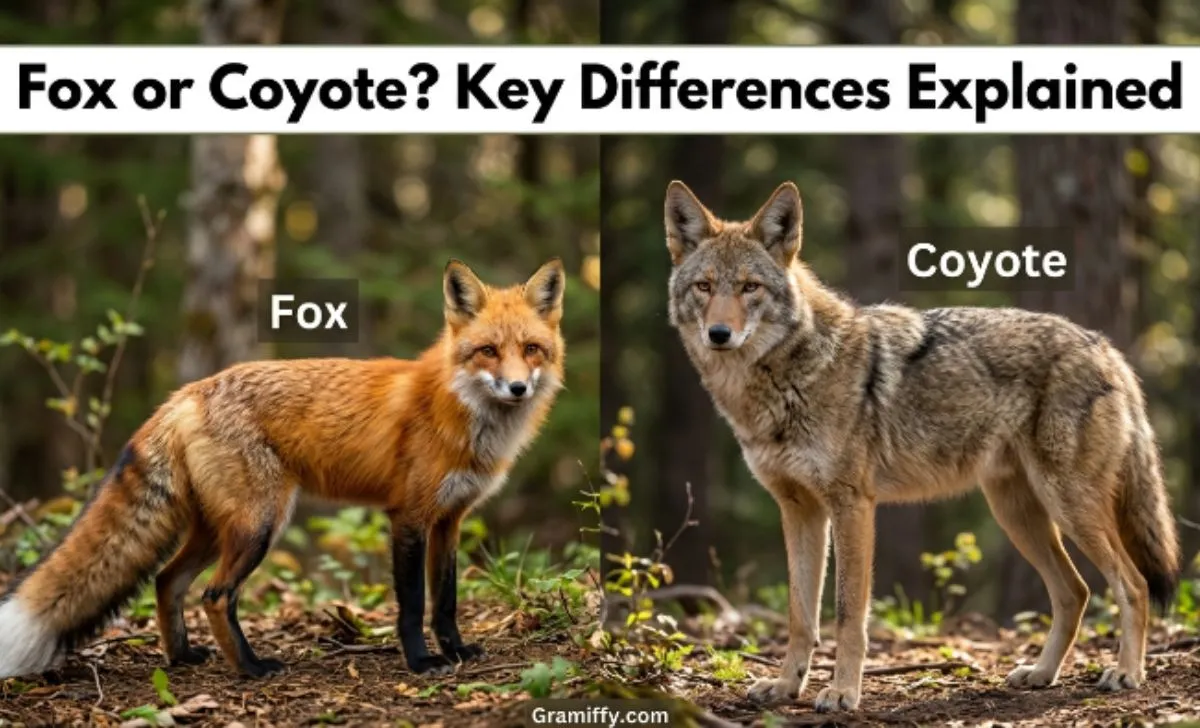
A coyote is larger, stronger, and more wolf-like than a fox. A fox is smaller, lighter, and usually has a much bushier tail.
Quick Comparison
| Feature | Fox | Coyote |
|---|---|---|
| Size | Small | Medium |
| Weight | 4–30 lbs | 20–50 lbs |
| Tail | Very bushy | Less bushy |
| Face | Small and pointed | Long and narrow |
| Behavior | Mostly solitary | More social |
| Appearance | Cat-sized dog | Lean wolf-like dog |
Simple rule:
Small animal with a fluffy tail = likely a fox.
Larger animal with a dog-like body = likely a coyote.
What Are Foxes and Coyotes?
Both animals belong to the Canidae family, which also includes wolves and domestic dogs.
Fox
The most common fox species is the Red Fox.
Foxes are known for:
- Small bodies
- Sharp intelligence
- Excellent hearing
- Bushy tails
- Quiet hunting style
Foxes live in forests, grasslands, deserts, and even urban areas.
Coyote
The Coyote is a wild canine native to North America.
Coyotes are known for:
- Greater size
- Strong survival skills
- Adaptability
- Howling sounds
- Ability to live near humans
Coyotes have expanded their range because they can survive in many environments.
Coyote vs Fox Size Difference
Size is one of the easiest ways to identify these animals.
Fox Size
Most foxes weigh:
- 4 to 30 pounds
They have:
- Shorter legs
- Smaller bodies
- Lightweight appearance
Coyote Size
Coyotes usually weigh:
- 20 to 50 pounds
They have:
- Longer legs
- Bigger bodies
- Stronger build
A coyote often looks like a small wolf, while a fox looks more like a small wild dog.
Appearance Differences Between Fox and Coyote
Face and Ears
A fox usually has:
- Narrow face
- Small pointed nose
- Large ears compared to body size
A coyote usually has:
- Longer muzzle
- Wider head
- More dog-like appearance
Tail Difference
The tail is another major clue.
Fox Tail
- Thick
- Fluffy
- Often carried upward
Coyote Tail
- Longer
- Less fluffy
- Usually hangs downward
The famous bushy tail is one of the strongest fox identification signs.
Fox vs Coyote Habitat
Both animals are adaptable, but their preferred environments differ.
Fox Habitat
Foxes commonly live in:
- Forests
- Farms
- Grasslands
- Mountains
- Suburban areas
Different species live in different climates.
Examples:
- Arctic Fox lives in cold regions.
- Fennec Fox lives in deserts.
Coyote Habitat
Coyotes can survive in:
- Deserts
- Forests
- Grasslands
- Mountains
- Cities
Their ability to adapt makes them one of the most successful wild mammals.
Fox or Coyote Behavior Differences
Behavior can help you identify them.
Fox Behavior
Foxes are usually:
- Quiet
- Shy
- Solitary
- More active during dawn and night
They normally avoid humans.
Coyote Behavior
Coyotes are:
- More confident
- Highly adaptable
- Sometimes social
- Active day and night
They can live surprisingly close to human neighborhoods.
Fox vs Coyote Diet
Both animals are hunters, but their diets are slightly different.
What Foxes Eat
Foxes usually eat:
- Mice
- Rabbits
- Birds
- Insects
- Fruits
- Small animals
They depend on speed and stealth.
What Coyotes Eat
Coyotes eat:
- Rodents
- Rabbits
- Birds
- Reptiles
- Fruits
- Larger animals
Because coyotes are bigger, they can hunt larger prey.
Fox or Coyote Sounds: How to Identify Them
Sound is another useful clue.
Fox Sounds
Foxes can make:
- Screams
- Barks
- Whines
- Yelps
Their screams often surprise people because they sound unusual.
Coyote Sounds
Coyotes are famous for:
- Howling
- Yipping
- Barking
- Group calls
A loud nighttime howl is usually associated with coyotes.
Are Foxes or Coyotes Dangerous?
This is one of the most searched questions about these animals.
Fox Safety
Foxes are generally not dangerous to humans.
However:
- Avoid approaching wild foxes
- Do not feed them
- Keep pets protected
Coyote Safety
Coyotes are larger and stronger.
They usually avoid people, but problems can happen when:
- They become used to humans
- Food sources are available
- Pets are left outside
Small pets may be at risk.
Fox vs Coyote vs Wolf Comparison
Many people confuse these animals.
| Animal | Average Weight | Appearance |
|---|---|---|
| Fox | 4–30 lbs | Small and fluffy |
| Coyote | 20–50 lbs | Lean and dog-like |
| Wolf | 70–150+ lbs | Large and powerful |
A wolf is much bigger than both a fox and coyote.
Fox or Coyote Tracks Identification
Tracks can reveal which animal passed through an area.
Fox Tracks
- Smaller prints
- Narrow shape
- Light walking pattern
Coyote Tracks
- Larger prints
- Similar to dog tracks
- Longer stride
Wildlife trackers often use footprints to identify animals.
Google Search Trends and Common Queries
People search this keyword because they want answers like:
- fox or coyote difference
- fox vs coyote size
- fox vs coyote tracks
- coyote or fox identification
- can a fox beat a coyote
- fox and coyote comparison
- fox vs coyote sounds
- are coyotes dangerous
The topic is popular among:
- Wildlife lovers
- Hikers
- Students
- Pet owners
- Nature photographers
Fox vs Coyote Comparison Table
| Category | Fox | Coyote |
|---|---|---|
| Family | Canidae | Canidae |
| Size | Smaller | Larger |
| Weight | 4–30 lbs | 20–50 lbs |
| Tail | Very bushy | Less bushy |
| Hunting | Mostly alone | Alone or groups |
| Sounds | Screams and barks | Howls and yips |
| Adaptability | High | Extremely high |
| Human Areas | Sometimes | Very common |
FAQs
Is a fox bigger than a coyote?
No. Coyotes are much larger than foxes.
How can you tell a fox from a coyote?
Check the size, tail, and body shape. Foxes are smaller with bushier tails.
Can foxes and coyotes live together?
Yes, but they may compete for food.
Which is smarter, fox or coyote?
Both are intelligent, but coyotes are especially known for adaptability.
Do coyotes attack foxes?
Coyotes may compete with or sometimes attack foxes because they are larger.
Are foxes friendly?
Wild foxes should not be treated like pets. They usually avoid humans.
Which animal is faster, fox or coyote?
Coyotes are generally faster because of their larger body and longer legs.
Conclusion
The difference between fox or coyote becomes clear when you look at their size, appearance, and behavior.
Foxes are smaller, quieter, and known for their beautiful bushy tails. Coyotes are larger, stronger, and more adaptable animals that can survive in many environments, including cities.
If you see a small wild animal with a fluffy tail, it is probably a fox. If you see a larger animal that looks like a thin dog or small wolf, it is likely a coyote.
Both animals play an important role in nature by controlling populations of smaller animals and maintaining ecosystem balance.
Whether you encounter a fox on a quiet trail or hear a coyote calling at night, understanding their differences makes wildlife observation more interesting and meaningful.
Read More Blogs :

I am Constance Hale, an, editor, and writing expert dedicated to helping people write with clarity and confidence. Through my articles on Gramiffy.com, I simplify grammar, spelling, and language usage for readers of all levels. My goal is to make English writing more engaging, accurate, and enjoyable.