Imagine you are writing a medical report or sending an email, and you type a word that looks correct but suddenly you stop and think: Is it inpatient or impatient?
These two words create confusion because they look almost identical and sound very similar. However, their meanings are completely different.
One word belongs to the world of hospitals and healthcare, while the other describes feelings, behavior, and emotions.
Many people search for inpatient or impatient because they want to know which spelling is correct, how to use each word, and how to avoid mistakes in professional or everyday writing.
Whether you are a student, healthcare worker, English learner, or content writer, understanding this difference helps you communicate clearly.
In this complete guide, you will learn the meaning, pronunciation, grammar, examples, medical usage, common mistakes, and simple tricks to remember the difference between inpatient and impatient.
Quick Answer
Inpatient and impatient are both correct words, but they have completely different meanings.
Featured Snippet Answer
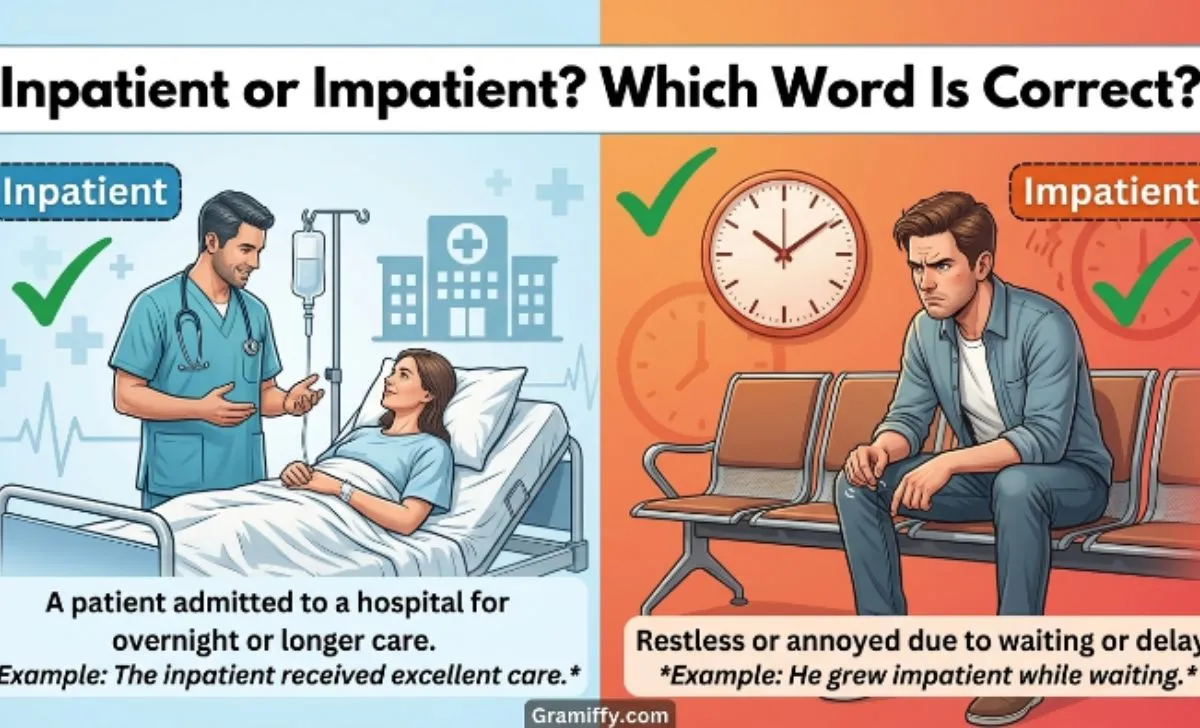
Inpatient means a person who stays in a hospital or healthcare facility for treatment.
Impatient means someone who cannot wait calmly or becomes annoyed because something is taking too long.
Quick Example
Medical:
✅ The doctor admitted the patient as an inpatient.
Waiting:
✅ She became impatient because the meeting was delayed.
Inpatient Meaning in Healthcare
The word inpatient is mainly used in the medical field.
An inpatient is a person who stays inside a hospital or healthcare facility and receives continuous medical care.
Inpatient Care Examples
- Surgery recovery
- Emergency treatment
- Long-term medical monitoring
- Serious illness management
- Hospital-based treatment
Healthcare professionals use this term when discussing hospital admission and patient care.
Inpatient vs Outpatient
| Inpatient | Outpatient |
|---|---|
| Stays in hospital | Goes home after treatment |
| Needs continuous care | Needs short medical visits |
| Usually serious cases | Often routine care |
Example:
“The hospital provides inpatient services for critical patients.”
Impatient Meaning in English
Impatient describes a person’s emotions or behavior.
Someone who is impatient:
- Does not like waiting
- Gets frustrated quickly
- Wants immediate results
- Becomes annoyed by delays
Examples
- He became impatient while waiting for the bus.
- The customer was impatient because the delivery was late.
- She is impatient to start her new project.
The opposite of impatient is patient.
Inpatient vs Impatient Pronunciation
Although these words look similar, pronunciation can help you identify them.
Inpatient Pronunciation
IN-pay-shent
Meaning:
A person receiving hospital care.
Impatient Pronunciation
im-PAY-shent
Meaning:
Unable to wait calmly.
The stress changes slightly, but the spelling difference changes the meaning completely.
Origin of Inpatient and Impatient
Both words come from the base word patient.
The word “patient” has two meanings:
- A person receiving medical treatment.
- Someone who can wait calmly.
Because of this double meaning, confusion happens.
Inpatient Formation
In + patient = Inpatient
“In” suggests being inside a place.
Meaning:
A patient inside a hospital.
Impatient Formation
Im + patient = Impatient
“Im-” means not or opposite.
Meaning:
Not patient or unable to wait.
Inpatient or Impatient: Main Difference
The easiest way to remember:
Inpatient = Hospital
Impatient = Waiting
Comparison Table
| Feature | Inpatient | Impatient |
|---|---|---|
| Meaning | Hospital patient | Cannot wait calmly |
| Field | Healthcare | Everyday emotions |
| Opposite | Outpatient | Patient |
| Example | Inpatient treatment | Impatient customer |
British English vs American English Usage
Unlike some English words, these words are spelled the same in all major English varieties.
| English Type | Medical Word | Behavior Word |
|---|---|---|
| American English | Inpatient | Impatient |
| British English | Inpatient | Impatient |
| Canadian English | Inpatient | Impatient |
| Australian English | Inpatient | Impatient |
There is no spelling difference between countries.
Common Mistakes with Inpatient and Impatient
Mistake 1: Using Impatient for Medical Meaning
❌ The hospital admitted him as an impatient.
✅ The hospital admitted him as an inpatient.
Mistake 2: Using Inpatient for Feelings
❌ I am inpatient because the train is late.
✅ I am impatient because the train is late.
Mistake 3: Confusing Patient and Patience
Patient:
“She is patient while waiting.”
Impatient:
“She is not patient while waiting.”
Patience:
“The ability to wait calmly.”
Inpatient and Impatient in Everyday Examples
Medical Writing
“The study examined inpatient treatment results.”
Hospital Communication
“The inpatient department handles admitted patients.”
Business Emails
“I am impatient to receive your response.”
Social Media
“People are becoming impatient with slow internet.”
Academic Writing
“The research focuses on inpatient healthcare quality.”
Related Words and Terms
Inpatient Related Terms
- Hospital admission
- Patient care
- Medical treatment
- Healthcare facility
- Clinical care
- Hospital stay
Impatient Related Terms
- Restless
- Frustrated
- Anxious
- Eager
- Unable to wait
Google Search Intent and Common Queries
People searching inpatient or impatient usually want answers like:
- Is it inpatient or impatient?
- Inpatient meaning
- Impatient meaning
- Inpatient vs outpatient difference
- Patient vs impatient difference
- How to use inpatient in a sentence
- How to use impatient in a sentence
- Why are inpatient and impatient different?
- Inpatient definition medical
- Impatient person meaning
Main Search Intent:
Informational intent
Users want a clear definition, comparison, and examples.
Inpatient vs Impatient Comparison Chart
| Category | Inpatient | Impatient |
|---|---|---|
| Correct Word | Yes | Yes |
| Used In | Healthcare | Daily life |
| Meaning | Hospital stay | Lack of patience |
| Example | Inpatient care | Impatient person |
| Opposite | Outpatient | Patient |
FAQs
Is inpatient or impatient correct?
Both are correct words, but they have different meanings.
What does inpatient mean?
An inpatient is a person who stays in a hospital for treatment.
What does impatient mean?
Impatient means unable to wait calmly or easily frustrated.
Is an inpatient a patient?
Yes. An inpatient is a patient who receives care inside a healthcare facility.
What is the opposite of inpatient?
The opposite is outpatient.
What is the opposite of impatient?
The opposite is patient.
Is impatient always negative?
Usually yes, because it describes frustration, but sometimes it can show eagerness.
How do I remember inpatient vs impatient?
Remember:
Inpatient = Inside hospital
Impatient = Impossible to wait
Are inpatient and impatient pronounced the same?
They sound similar, but their stress and meaning are different.
Can impatient be used in formal writing?
Yes, it is a normal English adjective used in both formal and casual writing.
Conclusion
The confusion between inpatient or impatient happens because both words look and sound similar, but their meanings are completely different. Inpatient is a healthcare term used for someone staying in a hospital or medical facility for treatment. Impatient describes a person who cannot wait calmly or becomes frustrated because something is taking too long.
A simple memory trick makes the difference easy: inpatient means inside a hospital, while impatient means not patient while waiting.
Using the correct word improves your writing in emails, academic work, medical documents, and everyday communication. Both words are correct, but they should never be used interchangeably.
Whenever you are confused, remember the context: if you are talking about healthcare, use inpatient. If you are talking about emotions or waiting, use impatient.
Read More Blogs :