If you’ve ever wondered whether it’s gopher or gofer, you’re not alone.
Since both words are pronounced exactly the same, many English learners, writers, and even native speakers confuse them in writing. The answer, however, depends entirely on what you’re referring to.
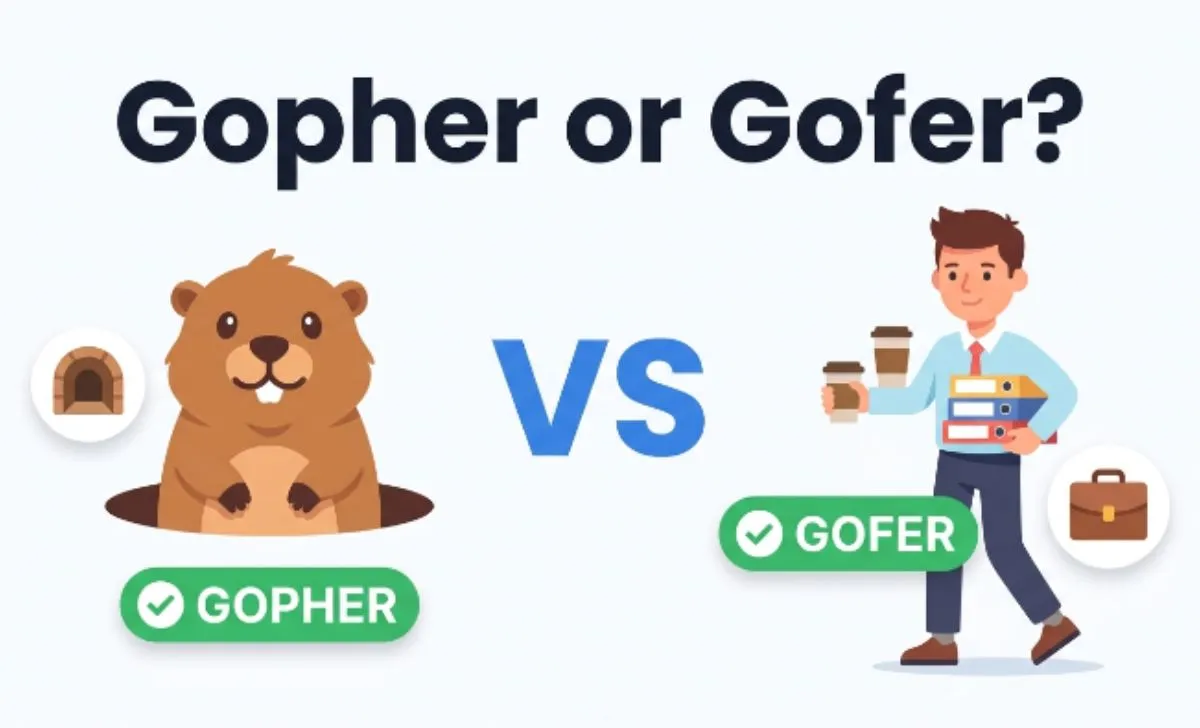
If you’re talking about the burrowing rodent, the correct spelling is always gopher. If you’re describing someone who runs errands at work, the standard spelling is gofer.
Here’s the surprising part that many grammar websites overlook: Merriam-Webster also recognizes “gopher” as a less common variant spelling of the errand-runner meaning.
That means the two spellings aren’t always completely separate, although gofer remains the preferred choice in modern writing.
In this guide, you’ll learn the exact difference between gopher vs. gofer, their meanings, pronunciation, origins, grammar rules, and the situations where each spelling should be used. By the end, you’ll never confuse these two words again.
Quick Answer
If you’re referring to the small burrowing animal, the correct spelling is gopher.
If you’re referring to someone whose job is to run errands, the standard spelling is gofer.
Although some dictionaries list gopher as an accepted variant for the errand-runner meaning, gofer is still the spelling most editors, writers, and style guides recommend because it avoids confusion.
Gopher vs. Gofer: At a Glance
| Feature | Gopher | Gofer |
|---|---|---|
| Primary meaning | Burrowing rodent | Person who runs errands |
| Part of speech | Noun | Noun |
| Pronunciation | GOH-fer | GOH-fer |
| IPA | /ˈɡoʊfər/ | /ˈɡoʊfər/ |
| Formality | Standard | Informal workplace term |
| Origin | Animal name dating back to the 1700s | From the phrase “go for” |
| Plural | Gophers | Gofers |
| Used worldwide | Yes | Mostly North American English |
| Dictionary status | Standard | Standard |
| Accepted variant | Sometimes used for the errand-runner meaning | Never refers to the animal |
Gopher Definition
A gopher is a small burrowing rodent found mainly in North and Central America. These animals are famous for digging long underground tunnel systems and storing food in external cheek pouches, which is why many species are called pocket gophers.
Gardeners and farmers often consider gophers pests because their tunnels can damage lawns, crops, irrigation systems, and plant roots.
Beyond its zoological meaning, gopher also appears in several well-known names and technologies, including:
- The Gopher Internet Protocol
- The famous Go Gopher mascot for the Go programming language
- Minnesota’s nickname, The Gopher State
- The University of Minnesota’s Golden Gophers
- Gopher from Winnie the Pooh
- Informal regional slang for certain mobility scooters
In every one of these cases, the correct spelling is gopher, never gofer.
Gofer Definition
A gofer is an informal noun describing a person whose main responsibility is running errands, delivering documents, picking up supplies, or completing small tasks for others.
The word is common in workplaces such as:
- Film production
- Television studios
- Construction sites
- Corporate offices
- Event management
- Retail businesses
A gofer usually performs support duties rather than specialized professional work.
Examples
- The intern worked as a gofer during the summer.
- Every film crew needs a reliable gofer.
- She started her career as a gofer before becoming a producer.
Although the term is informal, it remains widely understood in American English.
Pronunciation
One reason people ask, “Is it gopher or gofer?” is that both words sound exactly alike.
| Word | IPA | Pronunciation |
|---|---|---|
| Gopher | /ˈɡoʊfər/ | GOH-fer |
| Gofer | /ˈɡoʊfər/ | GOH-fer |
There is no pronunciation difference between the two words. The distinction exists only in writing.
This makes gopher vs. gofer a classic example of two words that are pronounced identically but carry different meanings.
Word Origins (Etymology)
Understanding where these words came from makes them much easier to remember.
Origin of Gopher
The history of gopher is surprisingly uncertain.
The word first appeared in English during the late eighteenth century. Linguists believe it may have developed from French dialects spoken in North America or from Native American languages, although no single origin has been universally accepted.
Over time, gopher became the standard English name for several species of burrowing rodents belonging to the family Geomyidae.
Because these animals are so well known for digging tunnels, the word eventually spread into popular culture, sports, computing, and software development.
Today, gopher remains the only accepted spelling for the animal and everything named after it.
Origin of Gofer
Unlike gopher, the history of gofer is well documented.
The word appeared in American English around 1938 as a phonetic spelling of the phrase “go for.”
Imagine a junior employee constantly hearing instructions like:
- “Go for coffee.”
- “Go for the mail.”
- “Go for the blueprints.”
Eventually, people began calling that employee the go-fer, which later became the standard spelling gofer.
Although gofer looks similar to gopher, the two words developed independently. Their resemblance is largely accidental, even though the similar pronunciation has caused confusion ever since.
Some dictionaries also recognize the hyphenated spelling go-fer, but gofer is by far the most common form used today.
Gopher: The Animal (and Why the Word Is So Well Known)
When most people hear the word gopher, they think of the small burrowing rodent—and that’s exactly what the word originally refers to. Gophers belong to the family Geomyidae and are native to North and Central America. They spend most of their lives underground, using powerful front claws and large teeth to dig complex tunnel systems.
These tunnels serve several purposes. Gophers use them to store food, raise their young, and protect themselves from predators. Because they feed on roots, bulbs, and other underground plant parts, they can become a nuisance for gardeners, farmers, and landscapers.
Characteristics of a Gopher
| Feature | Description |
|---|---|
| Animal type | Rodent |
| Habitat | Underground tunnel systems |
| Native region | North and Central America |
| Diet | Roots, bulbs, stems, grasses |
| Common nickname | Pocket gopher |
| Active time | Mostly daytime, depending on the species |
Although gophers are often viewed as pests, they also play an important role in nature by loosening soil, improving aeration, and recycling nutrients.
Other Meanings of “Gopher”
One reason the word gopher appears so frequently in search results is that it has been adopted in many different fields beyond zoology.
1. The Gopher Internet Protocol
Before the World Wide Web became dominant, the Gopher protocol was used to organize and retrieve documents across the internet. Developed in the early 1990s, it introduced a menu-based system for accessing information and influenced the way early online resources were structured.
2. The Go Programming Mascot
Software developers often refer to the mascot of the Go programming language as the Go Gopher. Designed by illustrator Renee French, the blue cartoon gopher has become one of the most recognizable mascots in programming communities worldwide.
3. Minnesota’s Nickname
Minnesota is widely known as The Gopher State, and the athletic teams of the University of Minnesota compete as the Golden Gophers.
4. Popular Culture
The word also appears in entertainment, including:
- Gopher from Winnie the Pooh
- Gopher from the television series The Love Boat
These names all use the animal spelling gopher.
Gofer: The Errand Runner
A gofer is someone whose primary responsibility is handling small tasks and running errands for other people. The job usually involves supporting a team by completing routine assignments rather than making major decisions.
Although the role is informal, it exists in many industries where fast-moving operations require someone to handle miscellaneous duties.
Common Responsibilities of a Gofer
A gofer may be asked to:
- Deliver documents
- Pick up office supplies
- Collect food or coffee
- Transport equipment
- Make bank or post office runs
- Assist with event preparation
- Deliver messages between departments
- Handle last-minute requests
Many successful professionals began their careers in entry-level support roles similar to that of a gofer, gaining valuable experience before moving into more senior positions.
Example Sentences Using “Gofer”
- He worked as a gofer on a television production before becoming a director.
- During the conference, several volunteers acted as gofers, delivering materials to speakers.
- Every office needs someone willing to be the unofficial gofer during busy periods.
- As the newest employee, she often served as the team’s gofer.
- The production company hired two gofers to help with equipment and supplies.
The Surprising Exception Most Grammar Articles Miss
Here’s the fact that makes gopher or gofer more interesting than many people realize.
Most grammar websites simply say:
- gopher = animal
- gofer = errand-runner
While this advice works in most situations, it isn’t the complete story.
Several major dictionaries, including Merriam-Webster, recognize gopher as a less common variant spelling of gofer when referring to an errand-runner.
This means that a sentence like:
“He started as a gopher in the film industry.”
is not technically incorrect according to those dictionaries.
However, because gopher is overwhelmingly associated with the animal, most editors recommend avoiding this spelling when referring to a person.
Should You Ever Use “Gopher” for an Errand Runner?
Technically, yes.
Practically, almost never.
Although dictionaries acknowledge the variant spelling, using gopher for a workplace assistant can confuse readers, who may briefly wonder whether you’re referring to the animal.
For that reason, professional writers usually prefer:
✔ gofer → person who runs errands
instead of
△ gopher → accepted but uncommon variant
Clear writing always takes priority over unusual spellings.
Why People Confuse Gopher and Gofer
The confusion comes from three main reasons.
1. They Sound Exactly the Same
Both words are pronounced:
GOH-fer
Because there’s no difference in pronunciation, listeners cannot tell which spelling is intended.
2. They Look Very Similar
The only difference is the letter “ph” versus “f.”
Many English words have spelling variations like this, so writers naturally assume gopher and gofer are interchangeable.
3. Spellcheck Doesn’t Always Help
Some writing tools automatically recognize gopher because it’s the much more common word.
As a result, people may accidentally write:
“I worked as a gopher during college.”
without realizing that gofer is the preferred spelling for the job title.
Which Spelling Should You Use?
For nearly every piece of modern writing, the answer is straightforward.
| Situation | Correct Choice |
|---|---|
| Talking about the animal | Gopher |
| Talking about the Go mascot | Gopher |
| Talking about the internet protocol | Gopher |
| Referring to Minnesota’s nickname | Gopher |
| Describing an errand-runner | Gofer |
| Professional or academic writing | Gofer |
| Casual writing using the rare dictionary variant | Gopher (acceptable but uncommon) |
Is It Gopher or Gofer?
If you’re still unsure, ask yourself one simple question:
Am I talking about an animal or a person?
- If it’s a burrowing rodent, write gopher.
- If it’s someone who runs errands, write gofer.
- If you’ve seen gopher used for an errand-runner, remember that it’s a recognized but uncommon dictionary variant. For clarity, gofer remains the safest and most widely accepted choice.
This simple rule will help you avoid confusion in emails, articles, reports, and everyday writing.
British vs. American English
Unlike many English words, gopher and gofer do not have different British and American spellings.
Both varieties of English use:
- Gopher for the burrowing rodent.
- Gofer for a person who runs errands.
The only noticeable difference is frequency of use. Since the term gofer originated in the United States, it appears far more often in American English than in British English. British speakers usually prefer terms like runner, office assistant, messenger, or errand runner instead.
Comparison
| Usage | American English | British English |
|---|---|---|
| Animal | Gopher | Gopher |
| Errand-runner | Gofer | Gofer (less common) |
| Preferred alternatives | Gofer | Runner, office assistant, messenger |
Key takeaway: There is no spelling difference between British and American English for either word.
Grammar Note
Both gopher and gofer are countable nouns. This means they can be singular or plural and can be used with articles such as a, an, and the.
Examples
- A gopher dug holes across the lawn.
- Several gophers were found in the field.
- She worked as a gofer during college.
- The production hired two gofers for the event.
Neither word functions as a verb in standard English.
Singular and Plural Forms
| Singular | Plural |
|---|---|
| Gopher | Gophers |
| Gofer | Gofers |
Example Sentences
- One gopher destroyed the flower bed.
- Three gophers were trapped safely.
- The studio hired one gofer for the shoot.
- The event organizers relied on several gofers throughout the conference.
Common Collocations
Certain words naturally appear with gopher and gofer.
Common Collocations with Gopher
- Pocket gopher
- Gopher tunnels
- Gopher holes
- Gopher damage
- Gopher control
- Gopher trap
- Gopher population
- Go Gopher
- Golden Gophers
- Gopher protocol
Common Collocations with Gofer
- Office gofer
- Production gofer
- Studio gofer
- Film gofer
- Personal gofer
- Gofer duties
- Gofer job
- Gofer position
- Gofer role
- Gofer tasks
Using these natural combinations makes your writing sound more fluent.
Common Mistakes
Even experienced writers sometimes confuse gopher and gofer because the words sound identical. Here are some of the most common mistakes to avoid.
Mistake 1: Using Gopher for an Errand-Runner
❌ The company hired a new gopher to deliver documents.
✅ The company hired a new gofer to deliver documents.
Why?
Although gopher is listed as a rare variant by some dictionaries, gofer is the standard and clearer spelling for a person who runs errands.
Mistake 2: Using Gofer for the Animal
❌ A gofer dug tunnels under my vegetable garden.
✅ A gopher dug tunnels under my vegetable garden.
Why?
The rodent is always spelled gopher.
Mistake 3: Misspelling Proper Names
❌ The Go programming Gofer is famous.
✅ The Go programming Gopher is famous.
Proper names, mascots, sports teams, and technologies always use gopher.
Mistake 4: Assuming They’re Interchangeable
❌ You can always replace gopher with gofer.
✅ The correct spelling depends on the meaning.
The two words overlap only in one rare dictionary-recognized sense. In everyday writing, they should not be treated as interchangeable.
Easy Memory Trick
If you struggle to remember which spelling to use, these simple tricks can help.
Trick 1: Gopher = Ground
Both words start with G.
Gopher → Ground
If the creature spends its life underground, write gopher.
Trick 2: Gofer = Go For
Think of the phrase:
“Go for the coffee.”
“Go for the mail.”
“Go for the supplies.”
Someone who is constantly told to go for things becomes the gofer.
This memory trick also explains the word’s origin.
Usage Frequency
Although gofer receives a lot of attention in spelling discussions, gopher is by far the more common word in published English.
That’s because gopher appears in several different contexts:
- The burrowing rodent
- Wildlife and gardening articles
- Computing history (Gopher protocol)
- Go programming language
- University of Minnesota athletics
- Books, films, and television
By contrast, gofer is used almost exclusively to describe someone who performs errands or support tasks.
General Usage Comparison
| Word | Frequency | Typical Contexts |
|---|---|---|
| Gopher | Very common | Animals, technology, sports, software, popular culture |
| Gofer | Less common | Offices, film sets, businesses, events |
This difference in usage explains why many spellcheckers recognize gopher more readily than gofer.
Formal vs. Informal Usage
Understanding the level of formality can help you choose the right word.
| Word | Formality | Best Used In |
|---|---|---|
| Gopher | Neutral | Academic, scientific, everyday writing |
| Gofer | Informal | Workplace conversations, journalism, entertainment |
If you’re writing a formal report, a resume, or a business document, consider replacing gofer with more professional alternatives such as:
- Office assistant
- Administrative assistant
- Operations assistant
- Runner
- Support assistant
- Production assistant (where appropriate)
These alternatives sound more professional while describing similar responsibilities.
Related and Commonly Confused Words
The following words are often associated with gopher or gofer, but they are not always interchangeable.
| Word | Meaning |
|---|---|
| Gopher | Burrowing rodent; also used in technology and proper names |
| Gofer | Person who runs errands |
| Go-fer | Less common hyphenated spelling of gofer |
| Runner | Person who delivers items or messages |
| Messenger | Person who carries messages or packages |
| Production assistant | Entry-level assistant in film or television production |
Among these, gofer remains the preferred spelling for the workplace role, while go-fer is an accepted but less frequently used variant.
Pro Tip
When you’re unsure whether to write gopher or gofer, don’t focus on the spelling—focus on the meaning.
- Animal, technology, mascot, sports team, or proper name? → Gopher
- Person running errands? → Gofer
Choosing the word based on its meaning rather than its pronunciation will help you avoid almost every mistake.
Real-Life Examples of Gopher
The following sentences show the correct use of gopher when referring to the animal or other established meanings.
Gopher (Animal)
- A gopher dug several tunnels beneath our vegetable garden.
- The farmer installed traps to protect his crops from gophers.
- Scientists studied how the gopher builds its underground tunnel system.
- The dog spent all afternoon trying to catch a gopher.
- We found fresh gopher holes near the fence this morning.
- Pocket gophers store food inside their cheek pouches.
- The wildlife documentary explained how gophers help aerate the soil.
- The gardener repaired the lawn after gophers damaged the roots.
Gopher (Other Meanings)
- The Go Gopher has become an iconic mascot in the programming community.
- The Gopher protocol played an important role in the early development of the internet.
- The Golden Gophers celebrated another championship victory.
- Minnesota is proudly known as the Gopher State.
Real-Life Examples of Gofer
These examples demonstrate the standard use of gofer for someone who performs errands or support tasks.
- She started her career as a gofer on a television production.
- Every film crew relies on a dependable gofer.
- The office gofer delivered contracts between departments.
- During the conference, several volunteers worked as gofers.
- He spent the morning acting as the team’s unofficial gofer.
- The producer asked the gofer to collect lunch for the cast.
- Working as a gofer taught her how the business operated.
- The company hired two gofers to assist during the event.
- Before becoming a manager, he worked as a gofer for nearly a year.
- The newest employee jokingly called himself the office gofer.
Gopher vs. Gofer: Side-by-Side Examples
Seeing both words together makes the distinction much easier.
| Correct Sentence | Why It Is Correct |
|---|---|
| The gopher destroyed the tomato plants. | Refers to the animal. |
| The gofer picked up the supplies. | Refers to an errand-runner. |
| The Go Gopher is popular among developers. | Proper name of the mascot. |
| The production company hired a gofer. | Workplace role. |
| The gopher disappeared into its tunnel. | Animal. |
| Our office gofer delivered the packages. | Person performing errands. |
Synonyms of Gofer
Because gofer describes a workplace role rather than a specific profession, several words have similar meanings.
Common Synonyms
- Errand runner
- Runner
- Office assistant
- Office helper
- Administrative assistant
- Messenger
- Production assistant (in some industries)
- Support assistant
- Junior assistant
- Office aide
Near Synonyms
- Assistant
- Volunteer
- Clerk
- Helper
- Attendant
- Coordinator (depending on duties)
Note: These words are similar but not always interchangeable. A gofer specifically performs miscellaneous errands and support tasks.
Synonyms of Gopher
Unlike gofer, gopher refers to a specific species of animal, so it has very few true synonyms.
Related Terms
- Pocket gopher
- Burrowing rodent
- Mammal
- Rodent
- Geomyid (scientific family reference)
Most dictionaries treat gopher as the standard name rather than a word with interchangeable synonyms.
Related Words
If you’re researching gopher or gofer, you may also come across these related terms.
Animal-Related
- Pocket gopher
- Mole
- Ground squirrel
- Prairie dog
- Burrow
- Tunnel
- Rodent
Workplace-Related
- Runner
- Messenger
- Office assistant
- Administrative assistant
- Intern
- Production assistant
- Volunteer
Why Do People Search “Gopher or Gofer”?
Search data suggests that people look up gopher or gofer for several reasons.
1. They Heard the Word but Never Saw It Written
Since both words are pronounced GOH-fer, many people don’t know which spelling is correct.
2. Spellcheck Suggested a Different Word
Someone writing about an office gofer may see gopher suggested instead, leading them to wonder whether they’ve made a mistake.
3. They Encountered Both Spellings Online
Some dictionaries recognize gopher as a variant of gofer in the errand-runner sense, while most style guides recommend gofer. This mixed guidance naturally creates confusion.
4. They Want the Correct Word for Professional Writing
Students, journalists, bloggers, copywriters, and business professionals often search this question because they want to avoid spelling mistakes in formal writing.
Which Word Fits? (Practice)
Choose the correct word before checking the answers.
1.
A ______ dug tunnels beneath our lawn.
A. Gopher
B. Gofer
✅ Answer: Gopher
2.
The director asked the ______ to collect everyone’s lunch.
A. Gopher
B. Gofer
✅ Answer: Gofer
3.
The ______ protocol was popular before the World Wide Web.
A. Gopher
B. Gofer
✅ Answer: Gopher
4.
She worked as a ______ while learning the film industry.
A. Gopher
B. Gofer
✅ Answer: Gofer
5.
The ______ disappeared into its underground tunnel.
A. Gopher
B. Gofer
✅ Answer: Gopher
Quick Quiz
Test your understanding.
Question 1
Which word refers to the burrowing rodent?
- A. Gofer
- B. Gopher
✅ Answer: B. Gopher
Question 2
Which spelling is normally used for someone who runs errands?
- A. Gopher
- B. Gofer
✅ Answer: B. Gofer
Question 3
True or False?
Some dictionaries recognize gopher as a less common variant of gofer when referring to an errand-runner.
✅ Answer: True
Question 4
Which spelling is recommended in professional writing for an errand-runner?
- A. Gopher
- B. Gofer
✅ Answer: B. Gofer
Question 5
Are gopher and gofer pronounced differently?
- A. Yes
- B. No
✅ Answer: B. No
Frequently Asked Questions
Is it gopher or gofer?
It depends on the meaning. Use gopher when referring to the burrowing rodent, the Go programming mascot, the Gopher internet protocol, or other established names. Use gofer when referring to someone who runs errands or performs support tasks in a workplace.
Is gofer a real word?
Yes. Gofer is a genuine English word that has been in use since the late 1930s. It originated as a phonetic spelling of the phrase “go for” and refers to someone who regularly runs errands for others.
Can gopher mean an errand-runner?
Yes, but only in limited circumstances. Merriam-Webster recognizes gopher as a less common variant spelling of gofer for the errand-runner meaning. However, because gopher is overwhelmingly associated with the animal, most editors and style guides recommend using gofer to avoid confusion.
Is gofer ever correct for the animal?
No. The burrowing rodent is always spelled gopher. Using gofer for the animal is considered a spelling mistake.
Are gopher and gofer pronounced differently?
No. Both words are pronounced GOH-fer and share the same IPA pronunciation: /ˈɡoʊfər/. The only difference is their spelling and meaning.
What is the origin of the word gofer?
Gofer comes from the phrase “go for.” It became popular in American English around 1938 to describe a person constantly sent to “go for” coffee, documents, supplies, or other items.
Why do people confuse gopher and gofer?
The confusion happens because:
- They sound exactly the same.
- Their spellings are very similar.
- Some dictionaries list gopher as a variant of gofer in one specific meaning.
- Spellcheck tools sometimes suggest gopher, even when gofer is intended.
Is go-fer also correct?
Yes. Go-fer is an accepted hyphenated variant of gofer, but it appears much less frequently in modern English. Today, gofer is the preferred spelling in most publications.
Is gofer an offensive word?
Generally, no. However, it can sound informal or slightly dismissive if used to minimize someone’s responsibilities. In professional writing, alternatives such as office assistant, administrative assistant, or production assistant may be more appropriate depending on the role.
Which spelling should I use in professional writing?
For clear and professional communication:
- Use gopher only for the animal and established proper names.
- Use gofer for someone who runs errands.
- Avoid using gopher for the workplace meaning unless you’re intentionally following a source that uses the rare dictionary variant.
This approach matches modern editorial standards and prevents misunderstanding.
Final Verdict: Gopher or Gofer?
Choosing between gopher and gofer is easy once you understand the meanings behind the two words.
If you’re referring to the burrowing rodent—or to well-known names like the Go Gopher mascot, the Gopher internet protocol, or the Golden Gophers—the correct spelling is always gopher.
If you’re talking about someone whose job involves running errands or handling miscellaneous tasks, the standard and recommended spelling is gofer. Although dictionaries such as Merriam-Webster acknowledge gopher as a less common variant for this workplace meaning, gofer remains the clearer and more widely accepted choice in modern English.
Whenever you’re unsure, remember this simple rule:
Ground = Gopher
Go for errands = Gofer
Using the correct spelling not only improves your writing but also helps your readers understand your meaning instantly.
Read More:

Hi, I’m Safdar Ali, an English language teacher with 26 years of teaching experience. My expertise is in English linguistics, grammar, and the differences between British and American English.
Through Gramiffy, I share practical, research-based guides to help students, writers, and English learners improve their language skills. My goal is to make English simple, accurate, and easy for everyone to understand.