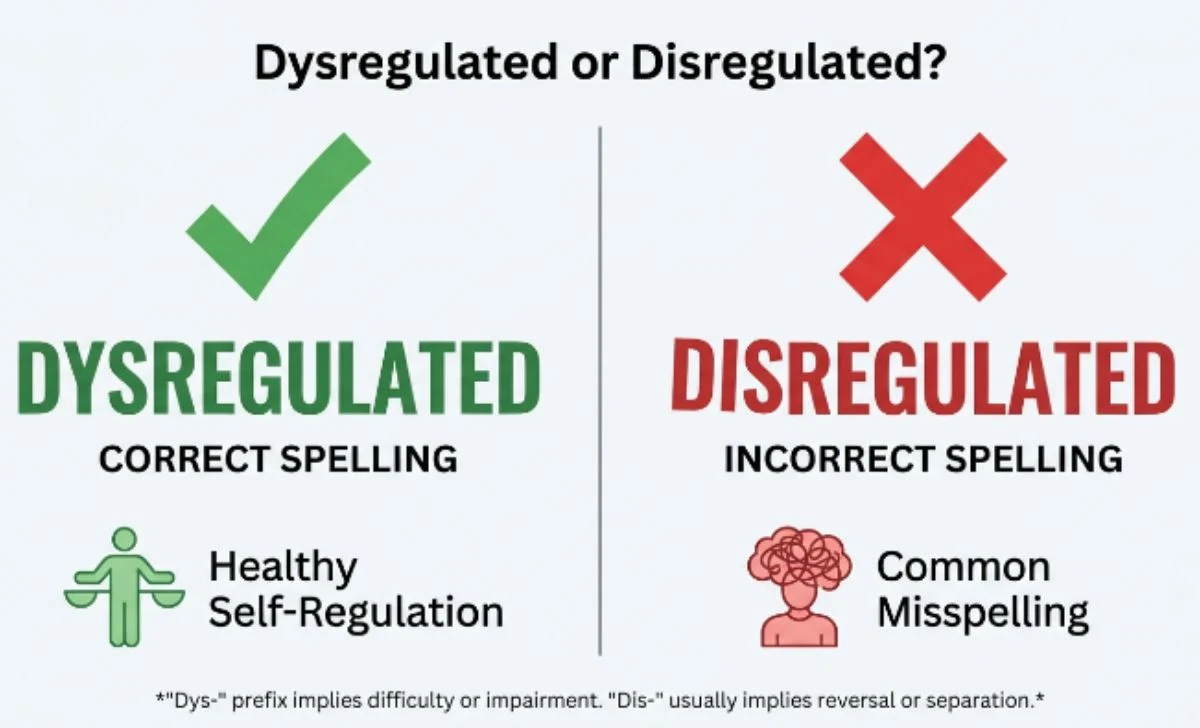
Typed “disregulated” and had a nagging feeling it looked off? You’re right to pause — dysregulated is the correct word, and disregulated isn’t standard English at all.
The mix-up happens because “dis-” is everywhere in English (disconnect, disorganized, disoriented), so it feels like the natural choice, even though it’s the wrong prefix here.
One letter changes the entire meaning. In this guide, you’ll learn exactly why “dys-” is correct, how the word is used in psychology and medicine, and what emotional dysregulation actually looks like — so you never second-guess this word again.
Quick Answer
Dysregulated is the correct word. Disregulated is not a standard English word — it’s a common misspelling that swaps in the wrong prefix.
If you’re describing an emotion, system, or process that isn’t functioning the way it should, the word you want is dysregulated.
You’ll see this word often in psychology, medicine, and increasingly in everyday conversations about mental health. Here’s exactly why dysregulated is right, and disregulated isn’t.
Why “Dys-” Is Correct and “Dis-” Isn’t
The confusion comes down to a single letter — but that letter carries real meaning.
What the Prefix “Dys-” Means
“Dys-” comes from Greek and means bad, difficult, or abnormal. It shows up in words where something is functioning, but poorly:
- Dysfunction — not functioning properly
- Dyslexia — difficulty processing language
- Dysphoria — a state of unease or dissatisfaction
Attach “dys-” to “regulated” and you get a word that means regulation is happening, but it’s impaired or abnormal.
What the Prefix “Dis-” Means
“Dis-” typically signals removal, absence, or the opposite of something:
- Disconnect — to remove a connection
- Disengage — to stop being engaged
- Disorganized — lacking organization
“Disregulated” would technically suggest regulation has been removed entirely — which isn’t what the word is trying to describe. That’s why it doesn’t hold up linguistically, and why you won’t find it in major dictionaries.
Quick Comparison Table
| Correct | Incorrect |
|---|---|
| Dysfunction | Disfunction |
| Dyslexia | Dislexia |
| Dysphoria | Disphoria |
| Dysregulated | Disregulated |
What Does “Dysregulated” Actually Mean?
Simple Definition
Dysregulated (adjective): functioning in an abnormal, impaired, or poorly controlled way. It describes a system that is still active but has lost its ability to self-correct or maintain balance.
Dysregulated in Emotional and Psychological Contexts
This is where the word shows up most in everyday conversation. Emotional dysregulation refers to difficulty managing the intensity or duration of an emotional response — reacting more strongly than a situation calls for, or struggling to return to a calm state afterward.
Examples:
- She felt emotionally dysregulated after the stressful meeting.
- The child became dysregulated following a sudden change in routine.
Dysregulated in Biological Contexts
The word isn’t limited to emotions. It’s also used across medicine and biology to describe systems in the body that aren’t self-regulating properly:
- Dysregulated blood sugar levels (common in diabetes)
- Dysregulated immune responses (seen in autoimmune conditions)
- Dysregulated hormone levels (affecting sleep, mood, or metabolism)
Dysregulated vs. Deregulated vs. Unregulated
These three words sound related but mean very different things, and mixing them up is a separate — equally common — mistake.
Comparison Table
| Word | Meaning | Common Context |
|---|---|---|
| Dysregulated | A system that used to function normally but is now impaired | Psychology, medicine, biology |
| Deregulated | Rules or restrictions have been removed | Economics, government, industry |
| Unregulated | Never had rules or oversight to begin with | Law, markets, new products |
One Example Each
- Dysregulated: His nervous system stayed dysregulated for weeks after the accident.
- Deregulated: The airline industry became deregulated in the late 20th century.
- Unregulated: The new supplement is currently unregulated, since no laws yet govern it.
Why So Many People Search “Disregulated”
If “disregulated” isn’t a real word, why does it show up in searches so often? A few reasons:
Prefix Confusion
English has far more common words starting with “dis-” (disconnect, disorganized, disoriented) than “dys-” words. People naturally reach for the more familiar pattern.
Autocorrect and Spelling Patterns
Spellcheck tools don’t always flag less common clinical vocabulary correctly, and the two prefixes sound nearly identical when spoken quickly.
Rise of the Term in Everyday Conversation
“Dysregulated” has become a much more common word in mainstream conversations about mental health over the past few years, largely through therapy-informed content on social media. As more people encounter the term casually rather than in a clinical setting, spelling mistakes naturally follow.
Is “Disregulated” Ever Acceptable?
Not in professional, academic, or clinical writing. It doesn’t appear in major dictionaries like Merriam-Webster, and healthcare professionals, researchers, and therapists consistently use dysregulated instead.
That said, you may occasionally see “disregulated” in casual, informal writing — texts, social media posts, or quick notes.
It’s not “grammatically illegal” in that context, but it’s inaccurate, and using it in anything formal will read as a mistake to anyone familiar with the terminology.
Emotional Dysregulation: A Brief, Careful Note
Since this word comes up so often in conversations about mental health, it’s worth pausing on the concept itself, not just the spelling.
What It Looks Like
Emotional dysregulation can look like reacting intensely to a small stressor, struggling to calm down after being upset, or noticing your mood shift quickly and unpredictably. It’s often connected to stress, trauma, ADHD, anxiety, or simply being exhausted and overwhelmed.
It’s Common — Not a Character Flaw
Feeling dysregulated sometimes doesn’t mean something is wrong with you, and it isn’t a diagnosis on its own. It’s a normal way the body and mind respond to stress, and most people experience it at some point.
When to Consider Talking to a Professional
If dysregulated emotions are frequent, intense, or making daily life difficult, a therapist or counselor can help you understand what’s driving it and build tools to manage it. That’s a reasonable, healthy step — not a sign of failure.
How to Use “Dysregulated” Correctly in a Sentence
Correct Examples
- The patient presented with a dysregulated stress response.
- Chronic sleep deprivation left her feeling mentally dysregulated.
- Sensory overload can make a dysregulated environment feel overwhelming for autistic children.
- After weeks of burnout, his emotional responses became noticeably dysregulated.
Common Mistake to Avoid
❌ She became disregulated during the therapy session. ✅ She became dysregulated during the therapy session.
Sources and Further Reading
FAQs
Is “dysregulated” in the dictionary?
Yes. It appears in major dictionaries, including Merriam-Webster, and is recognized as standard English.
Is “disregulated” grammatically wrong, or just informal?
It’s not a standard word at all — it doesn’t appear in major dictionaries and isn’t used in professional or academic writing. It occasionally appears in casual, informal contexts, but it’s considered incorrect.
What’s the difference between dysregulated and deregulated?
Dysregulated describes an internal system (like emotions or hormones) that isn’t functioning properly. Deregulated describes external rules or restrictions being removed, usually in an economic or legal context.
Is emotional dysregulation a mental health diagnosis?
No. It’s a descriptive term for difficulty managing emotional responses, and it can occur with or without a formal diagnosis.
How do you use “dysregulated” in a sentence correctly?
Use it to describe a system, emotion, or process that isn’t self-regulating properly — for example, “Her nervous system felt dysregulated after months of stress.”
Why do people confuse dysregulated with disregulated?
Mostly because “dis-” is a far more common English prefix than “dys-,” so it feels more familiar — even though it’s the wrong one here.
What is the difference between deregulation and dysregulation?
Deregulation refers to the removal or reduction of government rules and regulations, usually in industries such as banking, transportation, or telecommunications.
Dysregulation refers to the abnormal or impaired regulation of a biological or psychological process, such as immune system dysregulation, emotional dysregulation, or hormonal dysregulation.
Conclusion
Dysregulated is the correct word; disregulated is not standard English. The difference comes down to one prefix: “dys-” means impaired or abnormal function, while “dis-” implies removal or absence — and it’s impaired function, not removal, that the word is actually describing.
Whether you’re writing a psychology paper, a workplace email, or just trying to describe how you feel after a hard day, dysregulated is the word that gets it right.
Read More:

Hi, I’m Safdar Ali, an English language teacher with 26 years of teaching experience. My expertise is in English linguistics, grammar, and the differences between British and American English.
Through Gramiffy, I share practical, research-based guides to help students, writers, and English learners improve their language skills. My goal is to make English simple, accurate, and easy for everyone to understand.