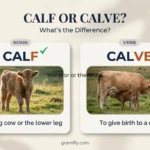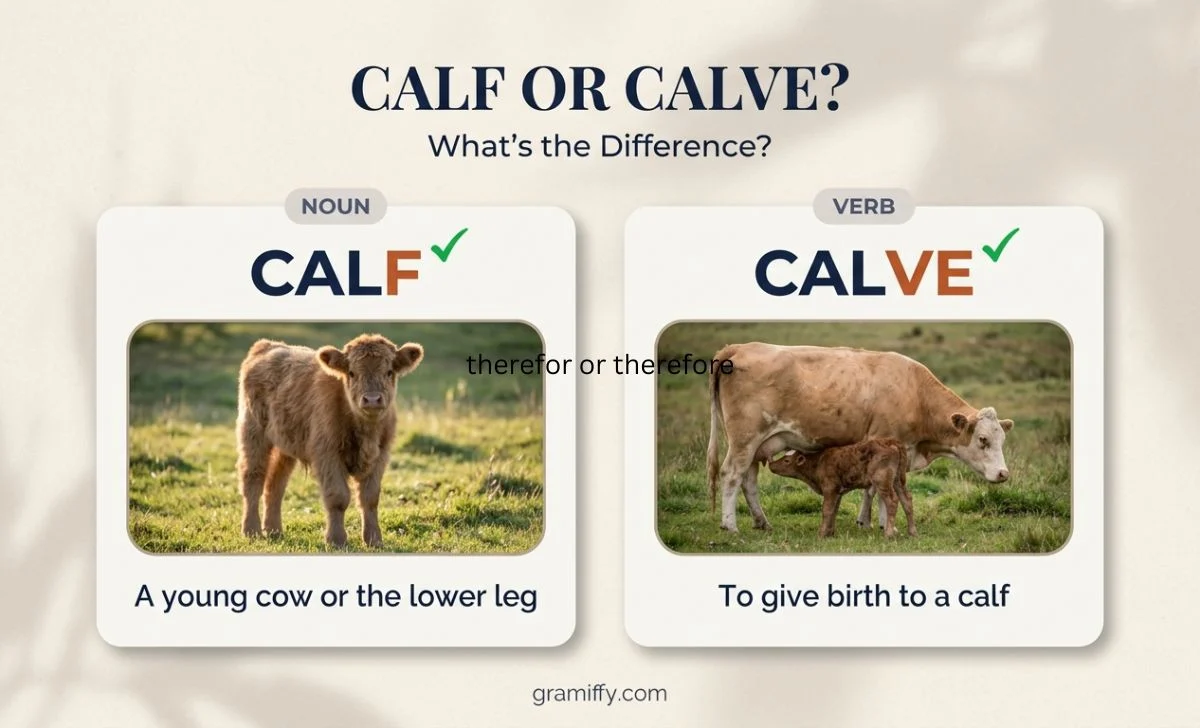
A cow can have a calf, but when it gives birth, it may calve. The words look almost identical, yet using the wrong one can make an otherwise correct sentence sound awkward.
The same confusion appears when people write calve muscle instead of calf muscle, or wonder whether the plural is calves or calfs.
The rule is straightforward once you understand the role each word plays. Calf is a noun, usually referring to a young animal or the back of your lower leg.
Calve is a verb meaning to give birth to a calf. It can also describe a glacier or ice shelf breaking off a piece of ice.
There is one more detail worth remembering: calves can be both the plural of calf and the present-tense form of calve used with he, she, or it.
Calf or Calve: The Quick Answer
Use calf when you are naming something. Use calve when you are describing the action of giving birth or an ice mass breaking away.
| Word | Part of speech | Meaning | Example |
|---|---|---|---|
| Calf | Noun | A young animal or the back of the lower leg | The calf followed its mother. |
| Calves | Plural noun | More than one calf | The calves rested in the field. |
| Calve | Verb | To give birth to a calf; for ice to break away | The cow is expected to calve soon. |
| Calves | Verb | Gives birth; breaks away, depending on context | The cow calves every spring. |
| Calved | Verb | Gave birth or broke away | The cow calved overnight. |
| Calving | Verb form or noun | Giving birth or the breaking away of ice | The calving season has begun. |
Easy memory trick: A baby animal is a calf. The action of giving birth is to calve. When there is more than one calf, write calves.
What Does Calf Mean?
Calf is a noun with several meanings. The context tells you which one is intended.
1. A young animal
A calf is a young cow or bull. The word is also used for the young of several other large mammals, including elephants and whales.
Examples:
- The newborn calf stood beside its mother.
- The farmer checked whether the calf was feeding properly.
- A whale calf stayed close to its mother.
2. The back of your lower leg
In human anatomy, the calf is the fleshy area at the back of the lower leg, below the knee. The muscles in this area help you walk, run, jump, and stand on your toes.
Examples:
- I strained my left calf while running.
- Stretching can help loosen tight calf muscles.
- Both of his calves were sore after the hike.
The correct expression is calf muscle, not calve muscle.
3. Calfskin
Calf can also refer to the skin of a young cow, especially when it is used to make leather.
Example:
- The bag was made from soft calfskin leather.
4. Calf in glacier terminology
The noun calf can also appear in specialized descriptions of ice, but everyday readers are much more likely to encounter the verb calve in glacier and iceberg reports.
For example, a report might say that a glacier calved a large iceberg. Here, calved describes the action of ice breaking away.
What Does Calve Mean?
Calve is a verb. It has two main uses: describing an animal giving birth to a calf and describing ice breaking away from a larger mass.
1. To give birth to a calf
Farmers and veterinarians use calve when talking about a cow giving birth. The term is also used for other animals that have calves, including some large mammals such as whales.
Examples:
- The cow is expected to calve tonight.
- Several cows calved during the spring.
- The farmer prepared a clean area for the cow to calve.
The birth process is called calving.
2. For a glacier or ice shelf to break away
In glaciology, calve describes a glacier or ice shelf shedding a piece of ice. That piece may become an iceberg.
Examples:
- The glacier began to calve into the sea.
- Scientists recorded a large iceberg calving from the ice shelf.
- The ice shelf calved a massive block of ice.
In this context, calve has nothing to do with an animal giving birth. The meaning is different, but the verb is the same.
Calves or Calfs: Which Is Correct?
Calves is the standard plural of calf. Use it when referring to several young animals or both lower legs.
Examples:
- Three calves were born on the farm.
- The calves followed the herd.
- My calves hurt after a long run.
- The trainer recommended exercises to strengthen the calves.
Why does calf change to calves instead of simply adding -s? Some English nouns ending in -f or -fe change that ending to -ves in the plural. However, this is a spelling pattern, not a rule that applies to every such noun.
A small dictionary detail can cause confusion: some dictionary entries recognize calfs as a variant plural in limited contexts.
Nevertheless, calves is the safest and most widely accepted choice for general writing, including schoolwork, articles, and everyday communication.
| Singular | Standard plural | Example |
|---|---|---|
| Calf | Calves | The calves are feeding. |
| Calf muscle | Calf muscles | She exercises her calf muscles. |
| Half | Halves | Cut the apple into halves. |
| Shelf | Shelves | The books are on the shelves. |
Practical advice: If you are unsure whether to write calves or calfs, choose calves.
Calf Muscle or Calve Muscle?
The correct expression is calf muscle.
Calf names the part of the leg, so it functions as a noun modifying another noun, muscle. Calve is a verb and does not fit this expression.
Correct examples:
- I pulled my calf muscle during football practice.
- The physiotherapist examined her injured calf.
- Calf muscles help you push off the ground when walking or running.
Incorrect:
- I pulled my calve muscle.
- My calve hurts after exercise.
When talking about both legs, you can say my calves hurt or my calf muscles hurt.
Remember that calf muscles is also correct when referring to the muscles in one or both lower legs. Avoid calves muscles.
Calve, Calves, Calved, and Calving: Verb Forms
The verb calve follows a regular pattern once you know how to spell it.
| Verb form | When to use it | Example |
|---|---|---|
| Calve | Base form | The cow may calve tonight. |
| Calves | Present tense with he, she, or it | The cow calves every spring. |
| Calved | Past tense and past participle | The cow calved yesterday. |
| Calving | -ing form | The cow is calving now. |
Notice that calves has two grammatical roles:
- Noun: The calves are sleeping.
- Verb: The cow calves in spring.
The surrounding sentence makes the meaning clear.
Calf vs. Calve: Examples in Sentences
Compare these sentences to see how the words work.
| Sentence | Correct word | Why? |
|---|---|---|
| The farmer fed the newborn ___. | Calf | It names an animal. |
| The cow will ___ tomorrow. | Calve | It describes an action. |
| He injured his ___ muscle. | Calf | It names part of the leg. |
| The glacier began to ___. | Calve | It describes ice breaking away. |
| The two ___ followed their mother. | Calves | It is the plural noun. |
| The cow ___ every spring. | Calves | It is the verb with the cow. |
| The cow ___ last night. | Calved | It is the past tense. |
| The ___ season starts soon. | Calving | It names the season of giving birth. |
The fastest way to choose is to ask whether the sentence names a thing or describes an action.
Why Do Calf and Calve Have Different Spellings?
The words are closely related, but they perform different grammatical jobs.
- Calf is the noun: the animal or the part of the leg.
- Calve is the verb: to give birth to a calf or, of ice, to break away.
- Calves is the usual plural of the noun and also the third-person singular form of the verb.
English contains other related words with different endings, such as half and halve, and shelf and shelve.
These pairs can help you remember the spelling, but they do not establish a universal rule that every noun ending in -f has a matching verb ending in -ve.
The best approach is to learn the words in context rather than rely on the ending alone.
How to Pronounce Calf, Calves, and Calve
The l is silent in all three words. However, the vowel sound differs between British and American English.
| Word | British pronunciation | American pronunciation |
|---|---|---|
| Calf | /kɑːf/ | /kæf/ |
| Calves | /kɑːvz/ | /kævz/ |
| Calve | /kɑːv/ | /kæv/ |
As a rough guide, American calf sounds like “kaf,” while American calve sounds like “kav.” In British English, the vowel is generally longer, closer to the vowel in father.
Do not pronounce the l. The same silent letter appears in half and halve.
Common Mistakes With Calf and Calve
Here are the errors to watch for when writing about animals, anatomy, or glaciers.
1. Using calve as a noun
Incorrect: The calve was born last night.
Correct: The calf was born last night.
2. Writing calve muscle
Incorrect: My calve muscle hurts.
Correct: My calf muscle hurts.
3. Using calfs as the usual plural
Less suitable for standard general writing: Three calfs were in the barn.
Preferred: Three calves were in the barn.
4. Using calf instead of calve for the action
Incorrect in standard modern usage: The cow will calf soon.
Preferred: The cow will calve soon.
5. Spelling the past tense as calfed
Incorrect: The cow calfed yesterday.
Correct: The cow calved yesterday.
6. Pronouncing the l
Incorrect pronunciation: Saying the l in calf or calve.
Correct pronunciation: Leave the l silent.
Quick Quiz: Calf, Calve, or Calves?
Test what you have learned. Choose the word that completes each sentence.
- The newborn ___ stood beside its mother.
- The cow is expected to ___ tomorrow.
- Both of my ___ hurt after the hike.
- The glacier began to ___ into the sea.
- The cow ___ every spring.
- The farmer checked the young ___ in the barn.
- Yesterday, the cow ___ overnight.
- I strained my ___ muscle during the race.
Answers
- Calf
- Calve
- Calves
- Calve
- Calves
- Calves
- Calved
- Calf
If you got them all right, you understand the main distinction: calf names something, while calve describes an action.
Frequently Asked Questions
Is it calf or calve?
Both are correct words, but they have different uses. Calf is a noun for a young animal or the back of the lower leg. Calve is a verb meaning to give birth to a calf or, in glacier terminology, to break away a piece of ice.
What is the plural of calf?
The standard plural is calves. For example, “The calves followed their mother.”
Is calfs ever correct?
Some dictionary entries list calfs as a variant plural in limited contexts. For ordinary writing, use calves, the standard and widely accepted form.
Is calve a noun?
In standard modern usage, calve is used as a verb. The noun is calf.
Is it calf muscle or calve muscle?
The correct expression is calf muscle. Use calf because it names the part of the leg. For both legs, you can write calves or calf muscles.
What does calve mean?
Calve means to give birth to a calf. It is also used when a glacier or ice shelf breaks off a piece of ice.
What is the past tense of calve?
The past tense is calved. Example: “The cow calved during the night.”
Can calves be a verb?
Yes. Calves is the present-tense form of calve used with a singular subject such as the cow, she, or it. Example: “The cow calves in spring.”
How do you pronounce calf and calve?
The l is silent in both words. Pronunciation varies by accent: American English typically uses /kæf/ and /kæv/, while British English typically uses /kɑːf/ and /kɑːv/.
What is calving?
Calving can mean the process of giving birth to a calf. In glaciology, it means the breaking away of a piece of ice from a glacier or ice shelf.
Conclusion
Calf is a noun: a young animal or the back of your lower leg. Calve is a verb: to give birth to a calf or, when talking about glaciers, to break away a piece of ice.
Calves is the standard plural of calf and also the present-tense form of calve used with he, she, or it.
When in doubt, ask yourself one question: Am I naming something or describing an action? If it is a thing, use calf. If it is the action of giving birth or ice breaking away, use calve.
Read More:

Hi, I’m Safdar Ali, an English language teacher with 26 years of teaching experience. My expertise is in English linguistics, grammar, and the differences between British and American English.
Through Gramiffy, I share practical, research-based guides to help students, writers, and English learners improve their language skills. My goal is to make English simple, accurate, and easy for everyone to understand.