If you’ve ever typed “halfs” and wondered whether it was correct, you’re not alone. This is one of the most common English spelling questions because the plural form of half doesn’t follow the regular rule of simply adding -s.
Many students, writers, professionals, and English learners search for “halves or halfs,” “is it halfs or halves,” or “what is the plural of half” to avoid making grammar mistakes in essays, emails, blog posts, and everyday writing.
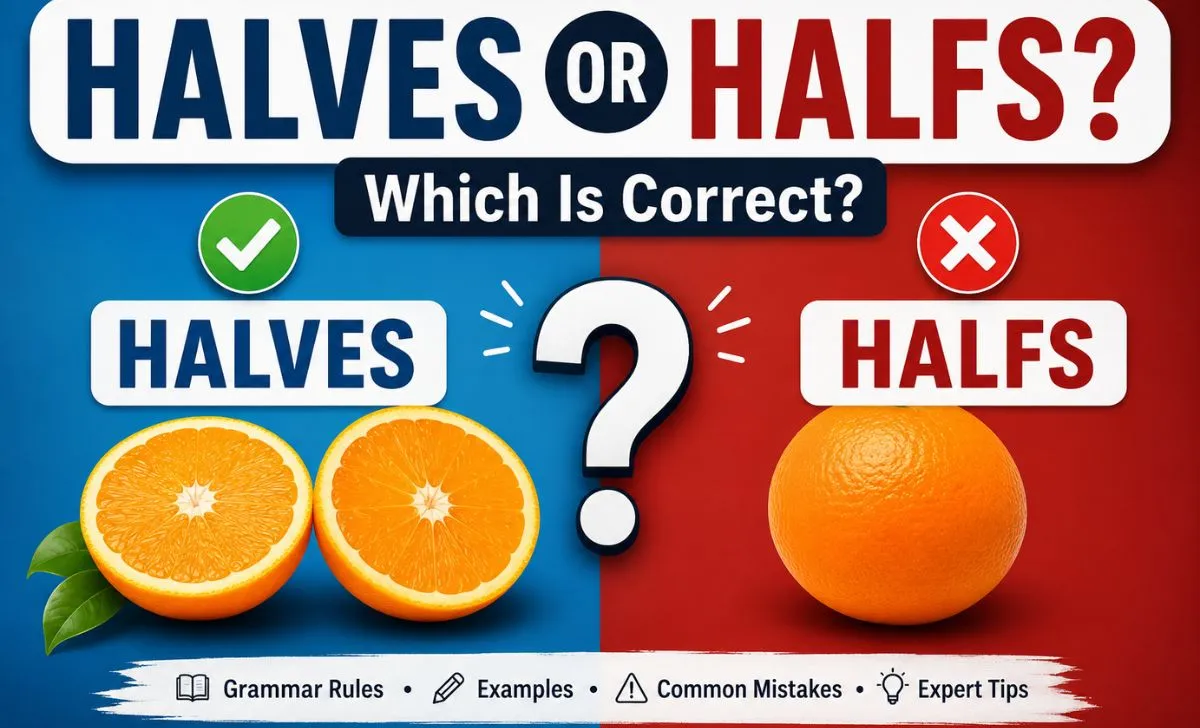
The answer is simple: “halves” is the correct plural form, while “halfs” is considered incorrect in standard English.
In this complete guide, you’ll learn:
- The correct spelling
- The grammar rule behind half → halves
- Why halfs is incorrect
- Real-life examples
- Comparison tables
- Common mistakes to avoid
- Similar irregular plural nouns
- Pronunciation and usage
- Frequently asked questions
By the end of this guide, you’ll know exactly when to use half and halves with confidence.
Quick Answer
If you’re wondering whether halves or halfs is correct, here’s the short answer:
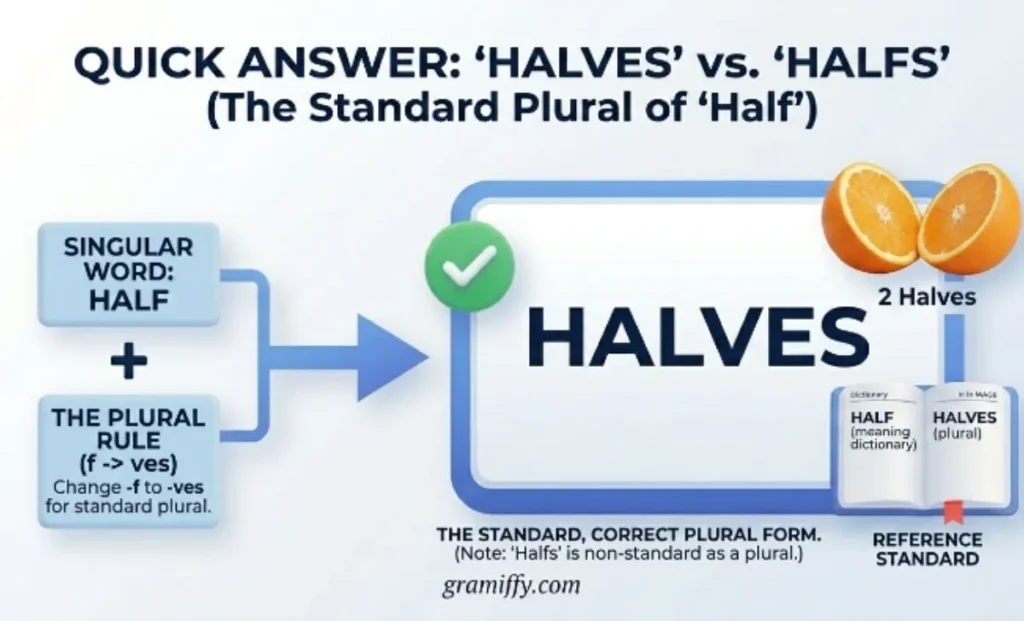
“Halves” is the correct plural of “half.” “Halfs” is a misspelling and should not be used in standard English.
Correct Examples
- ✅ She cut the sandwich into halves.
- ✅ The football match consists of two halves.
- ✅ We compared both halves of the report.
- ❌ She cut the sandwich into halfs.
- ❌ The game has two halfs.
The word half is an irregular noun, which means it doesn’t become plural by simply adding -s. Instead, the final f changes to ves, creating the plural halves.
Halves vs Halfs: At a Glance
Understanding the difference is easy when you compare the two spellings side by side.
Comparison Table
| Feature | Halves | Halfs |
|---|---|---|
| Correct spelling | ✅ Yes | ❌ No |
| Standard English | ✅ Yes | ❌ No |
| Plural of half | ✅ Yes | ❌ No |
| Accepted by dictionaries | ✅ Yes | ❌ No |
| Formal writing | ✅ Yes | ❌ Never |
| Academic writing | ✅ Yes | ❌ Incorrect |
| Business writing | ✅ Yes | ❌ Incorrect |
| Everyday English | ✅ Always | ❌ Avoid |
Which One Should You Use?
Always choose halves whenever you’re referring to more than one half.
Examples:
- Two halves of an orange
- The first and second halves of the match
- Equal halves of the cake
- Both halves of the brain
The spelling halfs should be avoided because it is not recognized as the correct plural form in modern English.
Why Do People Confuse “Halves” and “Halfs”?
Many English spelling mistakes happen because learners naturally apply regular grammar rules to irregular words.
Most English Nouns Add -S
The majority of nouns become plural by simply adding -s.
| Singular | Plural |
|---|---|
| Book | Books |
| Car | Cars |
| Teacher | Teachers |
| Computer | Computers |
| Student | Students |
Because this pattern is so common, many people assume:
Half → Halfs
It seems logical—but English has many exceptions.
Half Is an Irregular Plural Noun
Instead of adding -s, the word half changes its ending from -f to -ves.
This makes it part of a group of irregular plural nouns.
| Singular | Correct Plural |
|---|---|
| Half | Halves |
| Knife | Knives |
| Wife | Wives |
| Life | Lives |
| Wolf | Wolves |
| Shelf | Shelves |
| Leaf | Leaves |
| Calf | Calves |
| Loaf | Loaves |
| Thief | Thieves |
Once you recognize this spelling pattern, remembering half → halves becomes much easier.
What Does “Half” Mean?
The word half refers to one of two equal parts of a whole. It can describe an amount, a fraction, a period of time, or one side of something divided into two equal pieces.
Examples of “Half”
- I ate half of the pizza.
- She spent half the day reading.
- The bottle is half full.
- Add half a teaspoon of salt.
- We walked half a mile before stopping.
The word appears in everyday conversation, mathematics, science, sports, cooking, education, business, and many other contexts.
What Does “Halves” Mean?
Halves is the plural form of half.
It refers to two or more equal parts of one or more objects.
Examples of “Halves”
- Cut the apple into two halves.
- The football game has two halves.
- Both halves of the report were reviewed.
- The twins shared equal halves of the inheritance.
- Scientists studied the two halves of the brain.
Whenever you’re talking about multiple equal parts, halves is the correct spelling.
Is “Halfs” Ever Correct?
This is one of the most searched grammar questions online.
The answer is simple:
No—Not in Standard English
Modern English dictionaries, grammar books, and style guides all recognize halves as the correct plural of half.
The spelling halfs is considered a spelling mistake in standard English.
You should never use halfs in:
- School assignments
- College essays
- Professional emails
- Business reports
- Website content
- Blog posts
- Academic papers
- Books
- Newspapers
- Formal writing
If your spell checker changes halfs to halves, it’s because halves is the accepted spelling used by native English speakers and major dictionaries worldwide.
What Is the Plural of “Half”?
The plural of half is halves.
Although many English nouns become plural by adding -s, half follows an irregular pluralization rule. Instead of adding -s, the final f changes to ves.
The Correct Plural Form
| Singular | Correct Plural |
|---|---|
| Half | Halves |
Examples:
- I ate half of the cake.
- She divided the orange into two halves.
- The football match has two halves.
- We compared both halves of the document.
Whenever you need the plural form, always write halves, never halfs.
Incorrect vs Correct Usage
| Incorrect | Correct |
|---|---|
| Two halfs | Two halves |
| Four halfs of the pizza | Four halves of the pizza |
| The game has two halfs | The game has two halves |
| Both halfs were equal | Both halves were equal |
| Divide it into halfs | Divide it into halves |
Using halves makes your writing grammatically correct and more professional.
Why Does “Half” Become “Halves”?
One of the biggest questions people ask is:
“Why isn’t the plural of half simply ‘halfs’?”
The answer lies in the history of the English language.
The F to VES Rule
Many English nouns ending in -f or -fe change the final f to ves when they become plural.
This pattern developed over hundreds of years as English pronunciation evolved.
Examples include:
| Singular | Plural |
|---|---|
| Half | Halves |
| Knife | Knives |
| Wife | Wives |
| Life | Lives |
| Wolf | Wolves |
| Shelf | Shelves |
| Leaf | Leaves |
| Loaf | Loaves |
| Calf | Calves |
| Thief | Thieves |
Instead of saying:
❌ Halfs
English speakers naturally pronounce:
✅ Halves
The spelling changed over time to match that pronunciation.
Why This Rule Exists
English isn’t a perfectly regular language.
It developed from several languages, including Old English, Norse, French, and Latin. Because of this long history, some words kept older plural patterns while newer words adopted simpler -s endings.
That’s why we write:
- Knife → Knives
- Wolf → Wolves
- Half → Halves
Rather than:
- Knifes
- Wolfs
- Halfs
Do All Words Ending in F Become VES?
No.
This is one of the reasons English spelling can be challenging.
Some nouns ending in -f become -ves, while others simply add -s.
Words That Change to VES
| Singular | Plural |
|---|---|
| Half | Halves |
| Knife | Knives |
| Wife | Wives |
| Life | Lives |
| Wolf | Wolves |
| Shelf | Shelves |
| Leaf | Leaves |
| Loaf | Loaves |
| Calf | Calves |
| Thief | Thieves |
Words That Simply Add S
| Singular | Plural |
|---|---|
| Roof | Roofs |
| Chief | Chiefs |
| Belief | Beliefs |
| Cliff | Cliffs |
| Proof | Proofs |
| Safe | Safes |
| Gulf | Gulfs |
| Handkerchief | Handkerchiefs |
Because there isn’t one universal rule, it’s best to learn common irregular plurals individually.
Fortunately, half always becomes halves.
Is “Half” an Irregular Plural Noun?
Yes.
A noun is called irregular when it doesn’t form its plural by simply adding -s or -es.
Instead, its spelling changes.
Common Irregular Plural Nouns
| Singular | Plural |
|---|---|
| Child | Children |
| Man | Men |
| Woman | Women |
| Tooth | Teeth |
| Foot | Feet |
| Mouse | Mice |
| Goose | Geese |
| Half | Halves |
Learning irregular plurals is an important part of mastering English grammar because these words appear frequently in both spoken and written English.
Halves vs Halfs: Side-by-Side Comparison
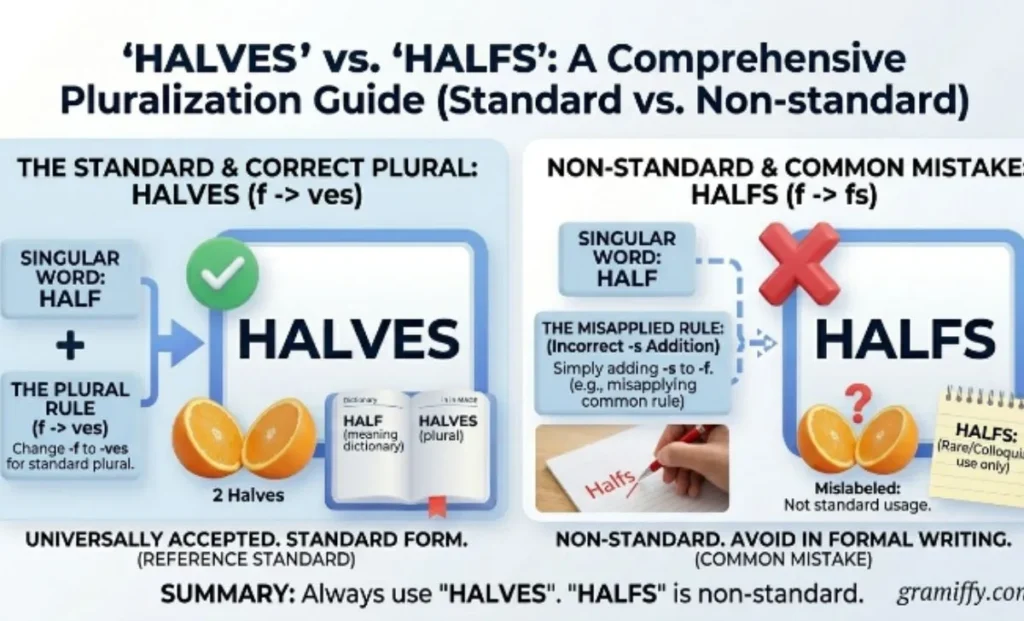
Although the answer is straightforward, comparing the two spellings helps reinforce the rule.
Detailed Comparison
| Feature | Halves | Halfs |
|---|---|---|
| Correct spelling | ✅ Yes | ❌ No |
| Dictionary approved | ✅ Yes | ❌ No |
| Used in formal writing | ✅ Yes | ❌ Never |
| Used in academic writing | ✅ Yes | ❌ Incorrect |
| Used by native speakers | ✅ Yes | ❌ Rare (as a mistake) |
| Plural of “half” | ✅ Yes | ❌ No |
| British English | ✅ Yes | ❌ No |
| American English | ✅ Yes | ❌ No |
If you’re ever unsure, remember:
One half. Two halves. Never two halfs.
Pronunciation of “Half” and “Halves”
Besides the spelling, the pronunciation also changes slightly.
IPA Pronunciation
| Word | IPA | Pronunciation |
|---|---|---|
| Half | /hæf/ (US), /hɑːf/ (UK) | HAF / HAHF |
| Halves | /hævz/ (US), /hɑːvz/ (UK) | HAVZ |
Notice that the f sound changes to a v sound in halves.
This pronunciation supports the spelling change from -f to -ves.
Examples of “Halves” in Everyday English
Seeing the word used naturally makes it easier to remember.
Food
- Cut the avocado into two halves.
- She served the potatoes in neat halves.
- Divide the sandwich into equal halves.
Sports
- The match consists of two halves.
- Our team played much better in the second half.
- Both halves were exciting to watch.
Mathematics
- Two halves make one whole.
- Shade both halves of the circle.
- Divide the rectangle into equal halves.
Science
- The human brain has two halves.
- Researchers examined both halves of the specimen.
- The fruit naturally separated into two halves.
Everyday Conversation
- We each took half of the bill.
- Both halves of the family attended the reunion.
- The company merged the two halves of the project.
These examples show that half and halves are used in many different contexts, making it important to understand the difference.
Common Mistakes to Avoid
Many writers make the same mistakes because they assume every noun follows the regular plural rule.
Frequent Errors
| Incorrect Sentence | Correct Sentence |
|---|---|
| She cut it into two halfs. | She cut it into two halves. |
| The game has two halfs. | The game has two halves. |
| Both halfs are equal. | Both halves are equal. |
| We divided the cake into four halfs. | We divided the cake into four halves. |
| These halfs look identical. | These halves look identical. |
Avoiding these mistakes will make your writing more accurate and help you communicate like a fluent English speaker.
When Should You Use “Half”?
Use half when you’re talking about one of two equal parts of something. It is the singular form and can function as a noun, adjective, adverb, or determiner depending on the sentence.
Use “Half” as a Noun
As a noun, half means one of two equal parts.
Examples:
- I ate half of the pizza.
- She drank half of the bottle.
- Only half of the class attended.
- We completed half the project.
- Half of the cake is still in the fridge.
Use “Half” as an Adjective
Sometimes half describes another noun.
Examples:
- We took a half-day trip.
- He scored a half-century.
- She bought a half-pound of cheese.
- The recipe needs a half cup of milk.
Use “Half” in Measurements
You’ll often see half used with measurements.
Examples include:
- Half an hour
- Half a mile
- Half a kilogram
- Half a teaspoon
- Half a liter
- Half an inch
These are all singular expressions, so half remains unchanged.
When Should You Use “Halves”?
Use halves whenever you’re referring to two or more equal parts.
It is the plural form of half.
Examples of Correct Usage
- Cut the apple into two halves.
- The football game has two halves.
- We compared both halves of the report.
- The watermelon was divided into equal halves.
- Scientists examined the two halves of the brain.
Whenever the quantity is more than one, halves is the correct choice.
Half vs Halves
Many people understand the spelling but still wonder when each word should be used.
Comparison Table
| Feature | Half | Halves |
|---|---|---|
| Number | Singular | Plural |
| Meaning | One equal part | Two or more equal parts |
| Correct spelling | ✅ Yes | ✅ Yes |
| Example | Half the cake | Two halves of the cake |
| Used with one object | ✅ Yes | ❌ No |
| Used with multiple parts | ❌ No | ✅ Yes |
A simple rule is:
- One = Half
- More than one = Halves
Real Life Examples of “Half” and “Halves”
Understanding how native speakers use these words helps reinforce the grammar rule.
Cooking
Examples:
- Slice the avocado into two halves.
- Add half a teaspoon of salt.
- We shared half the pizza.
- Cut the lemon into equal halves.
Sports
Examples:
- The first half was very competitive.
- The second half decided the match.
- Both halves were exciting.
- The team scored in each half.
Mathematics
Examples:
- Two halves make one whole.
- Shade half the rectangle.
- Divide the circle into equal halves.
- One half equals fifty percent.
Science
Examples:
- The brain consists of two halves.
- Researchers studied half the samples.
- The cell divided into two halves.
- Compare both halves carefully.
Business
Examples:
- We completed half the work today.
- The report has two halves.
- The budget was reduced by half.
- Both halves of the presentation were equally important.
Common Expressions Using “Half”
The word half appears in many everyday English expressions.
Time Expressions
- Half an hour
- Half a day
- Half a minute
- Half a year
- Half a century
Examples:
- I’ll be there in half an hour.
- We waited for half a day.
Quantity Expressions
- Half the money
- Half the class
- Half the population
- Half the price
- Half the distance
Examples:
- Half the students passed the exam.
- We paid half the cost.
Everyday Expressions
- Half asleep
- Half awake
- Half empty
- Half full
- Half joking
- Half serious
- Half finished
- Half expected
Examples:
- I’m half asleep.
- The glass is half full.
These phrases always use the singular word half.
Common Expressions Using “Halves”
The plural form also appears in many familiar expressions.
Popular Phrases
- Better halves
- Two halves of a whole
- Equal halves
- Both halves
- First and second halves
- Divide into halves
- Cut into halves
Example Sentences
- The orange was cut into halves.
- The two halves fit together perfectly.
- The coach praised both halves of the team’s performance.
- Scientists compared the two halves of the brain.
Similar Words That Follow the Same Grammar Rule
One of the easiest ways to remember half → halves is to learn similar irregular nouns.
Words That Change F to VES
| Singular | Plural |
|---|---|
| Half | Halves |
| Knife | Knives |
| Wife | Wives |
| Life | Lives |
| Wolf | Wolves |
| Shelf | Shelves |
| Leaf | Leaves |
| Loaf | Loaves |
| Calf | Calves |
| Thief | Thieves |
When you remember one of these words, the others become much easier to spell correctly.
Words That Do Not Follow the Same Rule
Not every noun ending in -f changes to -ves.
Regular Plural Nouns Ending in F
| Singular | Plural |
|---|---|
| Roof | Roofs |
| Chief | Chiefs |
| Cliff | Cliffs |
| Belief | Beliefs |
| Proof | Proofs |
| Safe | Safes |
| Gulf | Gulfs |
| Handkerchief | Handkerchiefs |
This is why memorization is often more reliable than trying to apply a single grammar rule to every word.
Why “Halfs” Looks Correct
Many learners instinctively write halfs because English usually forms plurals by adding -s.
For example:
- Car → Cars
- Phone → Phones
- Student → Students
- Apple → Apples
Following that pattern, it’s natural to think:
Half → Halfs
However, half belongs to a smaller group of irregular nouns that follow the f → ves rule.
This historical spelling pattern has remained unchanged in modern English.
Memory Tricks to Remember “Halves”
A few simple tricks can help you avoid this mistake forever.
Trick 1: Remember Knife → Knives
If you already know:
- Knife → Knives
Then you’ll also remember:
- Half → Halves
Both words follow the same grammar pattern.
Trick 2: Think About Sports
Every football or soccer match has:
- First half
- Second half
Together, they become:
- Two halves
You’ll never hear professional commentators say “two halfs.”
Trick 3: Read It Aloud
Compare these pronunciations:
- Halfs
- Halves
Halves sounds natural because English speakers pronounce it with a v sound.
The pronunciation matches the spelling.
Practice Quiz
Test your understanding with these quick questions.
Question 1
We shared two ______ of the sandwich.
- Halfs
- Halves
✅ Answer: Halves
Question 2
I finished ______ the assignment.
- Half
- Halves
✅ Answer: Half
Question 3
The football match has two ______.
- Halfs
- Halves
✅ Answer: Halves
Question 4
Add ______ a cup of sugar.
- Half
- Halves
✅ Answer: Half
Question 5
The orange was divided into equal ______.
- Halfs
- Halves
✅ Answer: Halves
If you answered all five correctly, you’ve mastered the difference between half and halves.
What Do Major Dictionaries Say About “Halves” and “Halfs”?
One of the best ways to verify the correct spelling of a word is to consult trusted dictionaries. Fortunately, every major English dictionary agrees on the plural form of half.
Dictionary Comparison
| Dictionary | Correct Plural of Half |
|---|---|
| Oxford English Dictionary | ✅ Halves |
| Merriam-Webster | ✅ Halves |
| Cambridge Dictionary | ✅ Halves |
| Collins Dictionary | ✅ Halves |
| Dictionary.com | ✅ Halves |
| Macmillan Dictionary | ✅ Halves |
None of these dictionaries recognize halfs as the standard plural form.
This consistency across authoritative sources confirms that halves is the only correct spelling in modern English.
What Do Grammar Experts Recommend?
Professional editors, English teachers, publishers, and grammar experts all recommend using halves.
You’ll find this spelling in:
- Academic textbooks
- University writing guides
- Newspapers
- Professional magazines
- Research papers
- Business reports
- Government publications
- Educational websites
- Professional blogs
Whether you’re writing an email, essay, article, or report, halves is always the correct choice.
Why Correct Grammar Matters
Using the correct plural form helps you:
- Write more professionally.
- Improve your grammar.
- Build credibility with readers.
- Avoid spelling mistakes.
- Communicate more clearly.
- Perform better in academic writing.
- Increase confidence in your English skills.
Even small grammar improvements can make your writing look much more polished.
Is “Halfs” Ever Correct?
This is another question people frequently search online.
The Short Answer
No.
In standard English, halfs is considered a misspelling.
You should avoid using it in:
- School assignments
- College essays
- Business emails
- Website content
- Blog posts
- Reports
- Books
- Newspapers
- Professional documents
Why You Might See “Halfs”
Although halfs isn’t correct in standard English, you may occasionally encounter it in:
- Historical texts
- Informal online discussions
- Typographical errors
- Fictional dialogue where a writer intentionally represents incorrect speech
These rare examples do not make halfs an accepted spelling.
British English vs American English
Some spelling differences depend on the variety of English.
For example:
| American English | British English |
|---|---|
| Color | Colour |
| Honor | Honour |
| Center | Centre |
| Theater | Theatre |
However, this is not one of those cases.
The Correct Spelling Around the World
| English Variety | Correct Plural |
|---|---|
| American English | Halves |
| British English | Halves |
| Canadian English | Halves |
| Australian English | Halves |
| New Zealand English | Halves |
No matter where you’re writing, halves remains the correct plural form.
Common Grammar Mistakes Related to “Half”
People who write halfs often make similar mistakes with other irregular nouns.
Learning these words together can help you avoid future errors.
Incorrect vs Correct Plurals
| Incorrect | Correct |
|---|---|
| Halfs | Halves |
| Knifes | Knives |
| Wolfs | Wolves |
| Lifes | Lives |
| Wifes | Wives |
| Leafs (tree leaves) | Leaves |
| Shelfs | Shelves |
| Loafs | Loaves |
| Thiefs | Thieves |
| Calfs (animal) | Calves |
These are among the most commonly misspelled irregular plural nouns in English.
Exceptions to the F → VES Rule
While many nouns ending in -f change to -ves, others simply add -s.
This is one reason English spelling can be difficult.
Words That Change to VES
| Singular | Plural |
|---|---|
| Half | Halves |
| Knife | Knives |
| Wife | Wives |
| Wolf | Wolves |
| Shelf | Shelves |
| Leaf | Leaves |
| Calf | Calves |
| Loaf | Loaves |
Words That Add S
| Singular | Plural |
|---|---|
| Roof | Roofs |
| Chief | Chiefs |
| Belief | Beliefs |
| Cliff | Cliffs |
| Proof | Proofs |
| Safe | Safes |
| Gulf | Gulfs |
| Handkerchief | Handkerchiefs |
Rather than relying on a universal rule, it’s best to learn the most common irregular nouns individually.
Collocations with “Half”
A collocation is a group of words that naturally appear together in English.
Learning common collocations helps you sound more fluent.
Time Collocations
- Half an hour
- Half a day
- Half a minute
- Half a year
- Half a century
Quantity Collocations
- Half the money
- Half the class
- Half the population
- Half the price
- Half the distance
Measurement Collocations
- Half a cup
- Half a teaspoon
- Half a kilogram
- Half a liter
- Half an inch
Everyday Expressions
- Half asleep
- Half awake
- Half full
- Half empty
- Half serious
- Half joking
- Half finished
- Half expected
All of these expressions use the singular word half.
Common Expressions with “Halves”
The plural form also appears in many familiar phrases.
Popular Expressions
- Two halves of a whole
- Equal halves
- Better halves
- Both halves
- Cut into halves
- Divide into halves
- First and second halves
Example Sentences
- The orange was cut into two halves.
- Both halves of the project were successful.
- The two halves fit together perfectly.
- The coach praised both halves of the team’s performance.
These expressions appear frequently in sports, cooking, science, mathematics, and everyday English.
Proofreading Tips to Avoid This Mistake
Even experienced writers occasionally type halfs by accident.
A quick proofreading habit can help you catch the error.
Editing Checklist
Before publishing your writing, ask yourself:
- Am I talking about more than one half?
- Did I accidentally write halfs?
- Should the word follow the f → ves rule?
- Would a dictionary recognize this spelling?
If the answer is yes, replace halfs with halves.
Most grammar checkers will also flag the incorrect spelling automatically.
Practice Exercise
Choose the correct answer.
Question 1
The apple was cut into two ______.
- Halfs
- Halves
✅ Answer: Halves
Question 2
I only finished ______ the assignment.
- Half
- Halves
✅ Answer: Half
Question 3
The football match has two ______.
- Halfs
- Halves
✅ Answer: Halves
Question 4
Use ______ a cup of milk.
- Half
- Halves
✅ Answer: Half
Question 5
The report is divided into two equal ______.
- Halfs
- Halves
✅ Answer: Halves
Frequently Asked Questions About Halves or Halfs
Is it “halves” or “halfs”?
The correct spelling is halves.
Halves is the standard plural form of half, while halfs is considered a misspelling in modern English.
Correct Examples:
- She cut the sandwich into two halves.
- The football match has two halves.
Incorrect Examples:
- She cut the sandwich into two halfs.
- The game has two halfs.
Always use halves in formal, academic, and everyday writing.
What Is the Plural of Half?
The plural of half is halves.
Unlike regular nouns that simply add -s, half changes its ending from -f to -ves.
Singular and Plural Forms
| Singular | Plural |
|---|---|
| Half | Halves |
Examples:
- One half of the cake.
- Two halves of the cake.
Why Does Half Become Halves?
The word half follows an irregular pluralization pattern found in English grammar.
Many nouns ending in -f or -fe change to -ves in the plural.
Similar Examples
| Singular | Plural |
|---|---|
| Half | Halves |
| Knife | Knives |
| Life | Lives |
| Wife | Wives |
| Wolf | Wolves |
| Shelf | Shelves |
| Leaf | Leaves |
| Loaf | Loaves |
| Calf | Calves |
| Thief | Thieves |
Learning this pattern will help you spell many common English words correctly.
Is “Halfs” a Real Word?
In standard modern English, no.
Although you may occasionally find halfs in:
- old publications,
- typing mistakes,
- social media posts,
- or fictional dialogue,
it is not the accepted plural of half.
Professional writers, editors, teachers, and dictionaries all recommend using halves.
Is Halves Used in British and American English?
Yes.
Both British English and American English use halves.
Unlike words such as:
- Color / Colour
- Honor / Honour
- Center / Centre
there is no spelling difference for the plural of half.
English Variations
| Variety | Correct Form |
|---|---|
| American English | Halves |
| British English | Halves |
| Canadian English | Halves |
| Australian English | Halves |
| New Zealand English | Halves |
No matter where your audience is located, halves is always correct.
How Do You Pronounce Halves?
The pronunciation changes slightly from half.
IPA Pronunciation
| Word | IPA |
|---|---|
| Half | /hæf/ (US), /hɑːf/ (UK) |
| Halves | /hævz/ (US), /hɑːvz/ (UK) |
Notice that the f sound changes into a v sound.
This pronunciation matches the spelling change from -f to -ves.
Can You Ever Use Halfs?
For practical purposes, no.
Whether you’re writing:
- an email,
- a research paper,
- a blog post,
- a business report,
- a school assignment,
- website content,
- or social media captions,
you should always use halves.
Using halfs can make your writing appear incorrect and less professional.
How Can You Remember the Correct Spelling?
There are several easy memory tricks.
Memory Trick #1
If you remember:
- Knife → Knives
Then you’ll also remember:
- Half → Halves
Both follow the same grammar rule.
Memory Trick #2
Think about a football match.
Every match has:
- First half
- Second half
Together they become:
- Two halves
You’ll never hear professional commentators say “two halfs.”
Memory Trick #3
Remember this sentence:
One half. Two halves. Never two halfs.
It’s simple, memorable, and always correct.
Final Verdict: Halves or Halfs?
After examining the grammar rules, pronunciation, examples, dictionary guidance, and common usage, the answer is clear.
The Correct Spelling
✅ Halves is the correct plural of half.
❌ Halfs is incorrect in modern standard English.
Whether you’re writing for school, work, business, blogging, publishing, or everyday communication, halves is the only spelling you should use.
Key Takeaways
Let’s quickly review the most important points from this guide.
Grammar Summary
- Half is the singular form.
- Halves is the plural form.
- Halfs is a misspelling.
- Half follows the irregular -f → -ves plural rule.
- Major dictionaries recognize only halves.
- Both British and American English use halves.
- The pronunciation changes from /f/ to /v/ in the plural.
- Learning similar irregular nouns like knife → knives and wolf → wolves makes the rule easier to remember.
- Using halves improves the accuracy and professionalism of your writing.
One-Sentence Answer
If you only remember one thing from this article, remember this:
The correct plural of “half” is “halves.” “Halfs” is incorrect and should not be used in standard English.
Conclusion
The confusion between halves and halfs is understandable because most English nouns form their plurals by simply adding -s. However, half is an important exception.
It follows an irregular plural rule in which the final -f changes to -ves, making halves the only correct plural form.
Whether you’re talking about two halves of an orange, the two halves of a football match, equal halves of a mathematical shape, or both halves of a report, the spelling never changes.
By understanding this simple grammar rule and recognizing other words that follow the same pattern, you’ll avoid one of the most common English spelling mistakes.
The next time you hesitate between halves and halfs, remember this simple rule:
One half. Two halves. Never two halfs.
Using the correct spelling will make your writing clearer, more accurate, and more professional whether you’re writing an essay, an email, a blog post, or everyday messages.
Read More :

I am Constance Hale, an, editor, and writing expert dedicated to helping people write with clarity and confidence. Through my articles on Gramiffy.com, I simplify grammar, spelling, and language usage for readers of all levels. My goal is to make English writing more engaging, accurate, and enjoyable.