Choosing between planning and planing may seem like a small spelling issue, but using the wrong word can completely change the meaning of your sentence.
Although these words differ by just one letter, they have different pronunciations, different definitions, different origins, and are used in entirely different contexts.
Many students, professionals, writers, bloggers, and English learners accidentally write planing when they actually mean planning.
Since both are real English words, spell checkers often fail to identify the mistake, making it one of the most common spelling errors in everyday writing.
If you’ve searched for any of the following, this guide has the answer:
- planning or planing
- planning vs planing
- planing or planning
- is it planning or planing?
- planning meaning
- planing meaning
- planning definition
- planing definition
- why is planning spelled with two n’s?
- is planing a real word?
- planning grammar rule
- difference between planning and planing
- planning examples
- planing examples
- planning in a sentence
- planing in a sentence
- planning spelling
- planing spelling
- when to use planning
- when to use planing
Whether you’re writing an email, an academic paper, a business proposal, a blog post, or simply trying to improve your English, this guide will help you choose the correct spelling every time.
Quick Answer
If you only need the short answer, here it is:
| If You Mean… | Correct Word |
|---|---|
| Making plans | Planning ✅ |
| Organizing work | Planning ✅ |
| Preparing for the future | Planning ✅ |
| Scheduling an event | Planning ✅ |
| Business strategy | Planning ✅ |
| Smoothing wood with a plane | Planing ✅ |
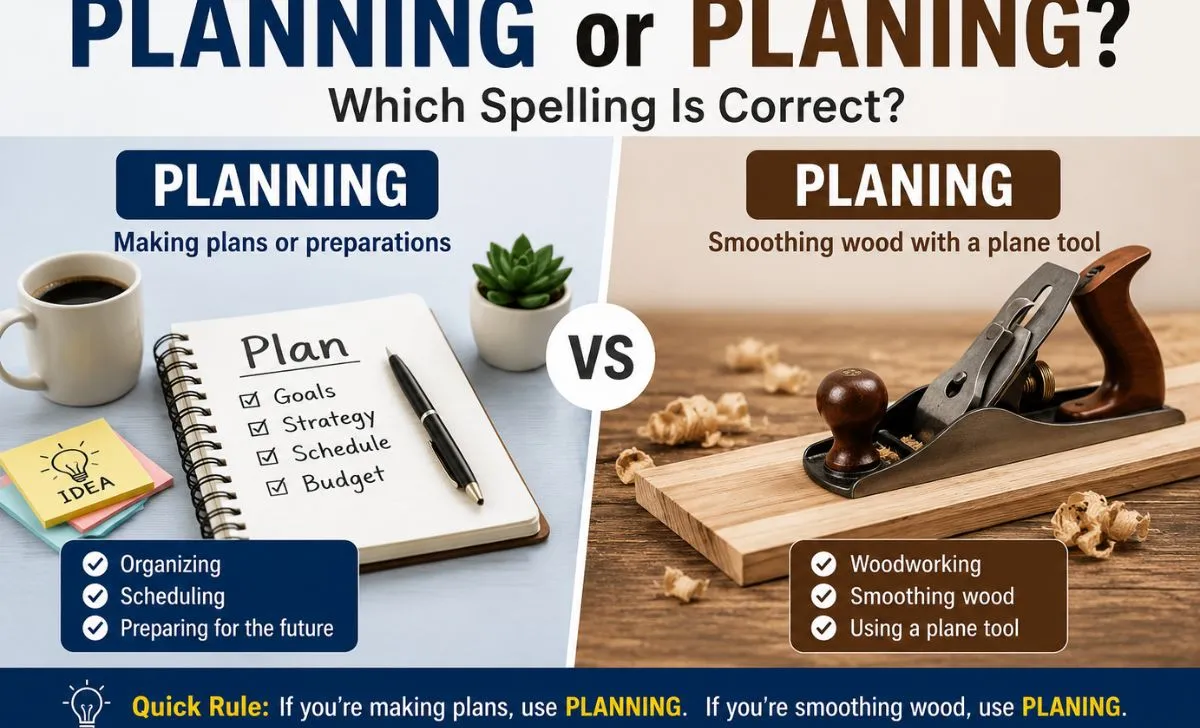
Planning means preparing, organizing, or making plans.
Planing means smoothing or shaping wood (or another material) with a plane, a woodworking tool.
For nearly all everyday writing, planning is the correct spelling.
What Is the Difference Between Planning and Planing?
The difference is based entirely on meaning.
Although the words look similar, they come from different base verbs and are used in different fields.
| Feature | Planning | Planing |
|---|---|---|
| Base word | Plan | Plane |
| Meaning | Organizing or preparing | Smoothing a surface |
| Common use | Everyday English | Woodworking |
| Grammar | Present participle / Gerund | Present participle |
| Frequency | Very common | Relatively uncommon |
| Used in business | ✔ | ✘ |
| Used in education | ✔ | ✘ |
| Used in travel | ✔ | ✘ |
| Used in carpentry | ✘ | ✔ |
The easiest way to remember the difference is this:
- Planning is about ideas, goals, schedules, and preparation.
- Planing is about wood, tools, and smoothing surfaces.
Is It Planning or Planing?
The correct spelling depends on what you’re trying to express.
Use Planning When You’re Talking About:
- making plans
- organizing tasks
- preparing for the future
- scheduling activities
- setting goals
- developing strategies
- arranging projects
- managing events
Examples:
- We’re planning our vacation.
- She’s planning her wedding.
- The company is planning a new product launch.
- Good planning reduces mistakes.
- Financial planning helps people achieve long-term goals.
Use Planing When You’re Talking About:
- woodworking
- carpentry
- smoothing wood
- flattening lumber
- using a hand plane
- using a power planer
- shaping wooden surfaces
Examples:
- The carpenter is planing the tabletop.
- He’s planing the edge of the door.
- The machine is planing rough lumber.
- Proper planing creates a smooth finish.
Unless you’re discussing woodworking or manufacturing, planning is almost certainly the word you need.
Why Do So Many People Confuse Planning and Planing?
There are several reasons these words are frequently mixed up.
They Look Almost Identical
The only visual difference is one extra n.
- planning
- planing
When typing quickly, it’s easy to omit the extra letter.
Both Are Correctly Spelled English Words
Unlike many spelling mistakes, this isn’t simply a typo.
Both words appear in major English dictionaries.
Because of that, grammar checkers often don’t recognize when you’ve chosen the wrong one.
For example:
❌ We are planing our marketing campaign.
The spelling is technically correct, but the meaning is wrong.
Many People Don’t Know Planing Is a Real Word
Most English speakers rarely encounter planing unless they work in woodworking, carpentry, construction, or manufacturing.
As a result, people often assume it’s just a misspelling of planning.
It isn’t.
The Double-Consonant Rule Causes Confusion
Another reason is that English spelling rules aren’t always obvious.
Many learners wonder:
Why isn’t it planing if the base word is plan?
The answer lies in the English double consonant rule, which we’ll explain in detail later in this guide.
What Does Planning Mean?
Planning is the present participle and gerund form of the verb plan.
It refers to thinking ahead, organizing actions, setting objectives, and deciding how something should be accomplished.
Dictionary Style Definition
Planning (noun/verb):
The process of deciding in advance what actions should be taken to achieve a goal.
Planning is an essential skill in nearly every aspect of life.
People use planning when they:
- organize projects
- prepare for exams
- schedule appointments
- manage finances
- create business strategies
- arrange travel
- coordinate events
- build long-term goals
Common Types of Planning
Planning appears in many fields and industries.
Some of the most common examples include:
Business Planning
Businesses create plans to achieve growth, improve operations, and reduce risk.
Examples include:
- strategic planning
- operational planning
- financial planning
- workforce planning
- marketing planning
- production planning
Project Planning
Project managers use planning to:
- define objectives
- allocate resources
- estimate timelines
- manage budgets
- identify risks
- track progress
Without effective planning, projects are far more likely to fail.
Financial Planning
Financial planning helps individuals and families:
- create budgets
- save money
- invest wisely
- prepare for retirement
- reduce debt
- build long-term wealth
Academic Planning
Students and educators rely on planning for:
- lesson planning
- curriculum planning
- study schedules
- assignment preparation
- semester organization
- research planning
Personal Planning
Planning also plays a major role in daily life.
Examples include:
- meal planning
- travel planning
- wedding planning
- career planning
- retirement planning
- fitness planning
- family planning
- daily planning
These examples show why planning is one of the most frequently used words in English.
What Does Planing Mean?
Unlike planning, the word planing belongs primarily to the world of woodworking and manufacturing.
It comes from the verb plane, not plan.
Dictionary Style Definition
Planing (verb):
The process of smoothing, flattening, or shaping a surface by using a plane.
A plane is a tool that removes thin layers of material to produce a flat, even surface.
Planing may be done using:
- a hand plane
- a bench plane
- a block plane
- a power planer
- an industrial planer machine
Although wood is the material most commonly associated with planing, the term can also apply to certain manufacturing and engineering processes involving other materials.
Examples of Planing
- The carpenter spent two hours planing oak boards.
- She’s planing the edges before assembling the cabinet.
- Machine planing produces a perfectly smooth surface.
- The craftsman inspected the wood after planing it.
Because this meaning is highly specialized, most people will rarely need to use planing outside technical or trade related discussions.
Planning vs Planing: At a Glance
| Question | Correct Answer |
|---|---|
| Making plans? | Planning |
| Organizing a meeting? | Planning |
| Preparing a budget? | Planning |
| Scheduling an event? | Planning |
| Writing a business strategy? | Planning |
| Studying for an exam? | Planning |
| Smoothing a wooden board? | Planing |
| Using a hand plane? | Planing |
| Working in carpentry? | Planing |
| Flattening lumber? | Planing |
Why This Difference Matters
Using the wrong spelling may seem minor, but it can make your writing appear less accurate and less professional.
For example:
- In a business report, writing “strategic planing” instead of “strategic planning” may distract readers and reduce your credibility.
- In a woodworking manual, replacing “planing” with “planning” changes the meaning entirely and could confuse readers.
Understanding the distinction helps you communicate more clearly in academic writing, professional documents, emails, blog posts, and everyday conversations.
Common Uses of Planning in Everyday English
Because planning refers to preparing for future actions, it appears in almost every area of life. From businesses and schools to healthcare and personal finances, planning helps people organize tasks, reduce uncertainty, and achieve their goals.
Below are some of the most common contexts where planning is the correct word.
Business Planning
Business leaders rarely make important decisions without careful planning.
Examples:
- The company is planning to expand into international markets.
- Strategic planning helps businesses stay competitive.
- Good planning reduces operational risks.
- The executive team spent months planning the new product launch.
- Successful organizations invest heavily in long-term planning.
Common business phrases include:
- strategic planning
- business planning
- operational planning
- workforce planning
- production planning
- capacity planning
- succession planning
- contingency planning
- growth planning
- marketing planning
Project Planning
Every successful project begins with a well-defined plan.
Project planning typically includes:
- defining objectives
- creating timelines
- assigning responsibilities
- estimating budgets
- managing risks
- monitoring progress
Examples:
- Effective project planning prevents delays.
- The team is planning the software rollout.
- Resource planning improves productivity.
- Proper planning minimizes unexpected costs.
Financial Planning
Financial planning helps individuals and businesses make informed money decisions.
Examples:
- Retirement planning should start early.
- Financial planning helps families build long-term security.
- She’s planning her investment strategy.
- Tax planning can reduce unnecessary expenses.
- Estate planning ensures assets are distributed according to your wishes.
Related terms:
- budget planning
- investment planning
- retirement planning
- estate planning
- tax planning
Travel Planning
Planning ahead can make travel less stressful and more enjoyable.
Examples:
- We’re planning a two-week trip to Italy.
- Travel planning helped us save money on flights.
- She’s planning every detail of the itinerary.
- Vacation planning usually begins months in advance.
- Proper planning prevents last-minute problems.
Academic Planning
Students, teachers, and educational institutions rely on planning every day.
Examples:
- The teacher is planning next week’s lessons.
- Academic planning improves graduation success.
- She’s planning her course schedule.
- Study planning helps students manage their workload.
- Research planning is essential before collecting data.
Personal Planning
Planning is also part of everyday life.
People regularly engage in:
- meal planning
- wedding planning
- family planning
- career planning
- fitness planning
- daily planning
- weekly planning
- event planning
Examples:
- I’m planning my weekly meals.
- They’re planning their wedding.
- She’s planning a career change.
- Good daily planning reduces stress.
- Family planning helps couples prepare for the future.
Common Uses of Planing
Unlike planning, planing is much more specialized.
It mainly appears in woodworking, carpentry, construction, furniture making, and manufacturing.
Hand Planing
A hand plane is a traditional woodworking tool used to shave thin layers from a piece of wood.
Examples:
- The craftsman is planing the edge of the board.
- Hand planing produces an exceptionally smooth finish.
- He’s planing the tabletop before applying varnish.
- The carpenter finished planing the cabinet door.
Machine Planing
Modern workshops often use power planers or industrial planers.
Examples:
- The machine is planing rough lumber.
- Automated planing improves production speed.
- Industrial planing creates boards with consistent thickness.
- The operator inspected the wood after planing.
Construction and Carpentry
Planing is commonly used to adjust wooden components so they fit correctly.
Examples:
- The contractor is planing the door because it sticks.
- The carpenter spent an hour planing the beam.
- Careful planing removed the uneven edges.
- The wooden frame required additional planing before installation.
Unless you’re discussing physical materials, tools, or woodworking techniques, planning is almost always the correct choice.
Why Is Planning Spelled with Two “N”s?
One of the most common grammar questions is:
Why is it “planning” instead of “planing”?
The answer lies in a standard English spelling rule.
The Double Consonant Rule
When a one-syllable verb ends in a consonant vowel consonant (CVC) pattern, the final consonant is usually doubled before adding ing.
The word plan follows this pattern:
- P = consonant
- L = consonant
- A = vowel
- N = consonant
Therefore:
- plan → planning ✅
Not:
- plan →
planing❌ (when referring to making plans)
Other Words That Follow the Same Rule
| Base Verb | Correct -ing Form |
|---|---|
| run | running |
| stop | stopping |
| swim | swimming |
| sit | sitting |
| begin | beginning |
| admit | admitting |
| refer | referring |
| occur | occurring |
| plan | planning |
Learning this pattern helps you spell many English words correctly not just planning.
Why Doesn’t “Plane” Become “Planning”?
This is another common point of confusion.
The verb plane already ends with the silent letter e.
According to English spelling rules, when a verb ends in e, you typically drop the final e before adding ing.
Examples:
| Base Verb | Correct Form |
|---|---|
| make | making |
| write | writing |
| drive | driving |
| bake | baking |
| smile | smiling |
| plane | planing |
So:
- plane → planing ✅
This is why both planning and planing are correct spellings they simply come from different base words.
Word Origins (Etymology)
Understanding where these words come from makes the difference easier to remember.
Origin of Planning
The verb plan entered English from French and ultimately traces back to the Latin word planum, meaning a drawing or outline. Over time, its meaning evolved to refer to creating a scheme, arranging future actions, or designing a course of action.
Today, planning refers to organizing ideas before taking action.
Origin of Planing
The word plane comes from the Latin planus, meaning flat or level.
A woodworking plane is a tool designed to make wood flat by shaving off thin layers.
As a result, planing literally means making a surface flatter or smoother.
Although the two words share distant historical roots related to flatness or outlines, their meanings diverged centuries ago and are now completely distinct in modern English.
Planning vs Planing: Side-by-Side Examples
Sometimes the easiest way to understand the difference is to compare both words in similar sentence structures.
| Correct Sentence | Why It’s Correct |
|---|---|
| We are planning a family vacation. | Preparing for a future event |
| She’s planning her university schedule. | Organizing coursework |
| The company is planning a merger. | Business strategy |
| The city is planning a new bridge. | Future development |
| He’s planning his retirement. | Personal preparation |
| The carpenter is planing the tabletop. | Smoothing wood |
| They’re planing rough lumber. | Woodworking process |
| The machine finished planing the boards. | Manufacturing operation |
| The cabinet maker is planing the edges. | Carpentry task |
| Proper planing creates a smooth finish. | Woodworking technique |
Notice how planning is associated with ideas and preparation, while planing is associated with tools and materials.
Common Mistakes to Avoid
Even experienced writers occasionally confuse these words because both are legitimate English spellings.
Mistake 1: Using Planing for Everyday Writing
❌ We are planing our marketing campaign.
✅ We are planning our marketing campaign.
Mistake 2: Using Planning in Woodworking
❌ The carpenter is planning the wooden board.
✅ The carpenter is planing the wooden board.
Mistake 3: Assuming Spell Check Will Catch the Error
Because both words exist in English dictionaries, many grammar checkers won’t recognize contextual mistakes.
Always proofread your writing instead of relying solely on automated tools.
Mistake 4: Forgetting the Base Word
Remember:
- planning ← plan
- planing ← plane
Thinking about the original verb often makes the correct spelling obvious.
Pronunciation: How to Say Planning and Planing
Another reason people confuse these words is that they look very similar in writing. However, their pronunciation is different because they come from different base words.
| Word | IPA Pronunciation | Sounds Like |
|---|---|---|
| Planning | /ˈplæn.ɪŋ/ | PLAN-ing |
| Planing | /ˈpleɪ.nɪŋ/ | PLAYN-ing |
Planning Pronunciation
The word planning uses the same short a sound found in words like:
- plan
- man
- hand
- cat
- map
Examples:
- We are planning a vacation.
- She’s planning her future.
Planing Pronunciation
The word planing comes from plane, so it has a long a sound.
Examples:
- The carpenter is planing the board.
- Machine planing produces a smooth surface.
Why the Pronunciation Matters
Although native speakers often understand both words from context, using the wrong pronunciation or more commonly, the wrong spelling can cause confusion in formal writing.
When in doubt, remember:
- Planning rhymes with manning.
- Planing begins with the sound of plane.
Planning vs Planing in British and American English
A common misconception is that planning is British English while planing is American English.
This is not true.
Both British English and American English use exactly the same spellings and meanings.
| Meaning | British English | American English |
|---|---|---|
| Making plans | Planning | Planning |
| Smoothing wood | Planing | Planing |
British English Examples
- We’re planning our holiday.
- The joiner is planing the wooden door.
American English Examples
- We’re planning our vacation.
- The carpenter is planing the wooden door.
The vocabulary around the sentence may differ (such as holiday vs. vacation), but planning and planing do not change between the two varieties of English.
Planning vs Planing in Different Contexts
The easiest way to choose the correct word is to consider the topic you’re writing about.
Business
Use planning.
Examples:
- Strategic planning drives long-term growth.
- The company is planning a global expansion.
- Effective business planning improves decision-making.
Education
Use planning.
Examples:
- Lesson planning helps teachers stay organized.
- Students are planning their exam schedules.
- Academic planning supports graduation goals.
Marketing
Use planning.
Examples:
- The marketing team is planning a new campaign.
- Content planning ensures consistent publishing.
- Campaign planning starts months before launch.
Healthcare
Use planning.
Examples:
- Treatment planning improves patient outcomes.
- Doctors are planning the next phase of care.
- Hospital planning requires careful coordination.
Event Management
Use planning.
Examples:
- Wedding planning takes time and attention to detail.
- They’re planning the annual conference.
- Event planning includes budgeting and scheduling.
Construction
Usually, the correct word depends on the meaning.
If you’re organizing a construction project:
- construction planning ✅
If you’re smoothing wooden materials:
- wood planing ✅
Carpentry
Use planing.
Examples:
- The carpenter is planing the cabinet door.
- Proper planing creates a smooth finish.
- Hand planing requires patience and skill.
Planning vs Planing: Real Life Sentence Examples
The following examples show how these words are used in everyday English.
Examples with Planning
- We’re planning a surprise birthday party.
- She’s planning to study abroad next year.
- Careful planning prevents unnecessary mistakes.
- Financial planning helps families reach their goals.
- The company is planning to hire more employees.
- They’re planning a charity event.
- Good travel planning saves both time and money.
- Urban planning improves the quality of city life.
- Strategic planning gives businesses a competitive advantage.
- He’s planning his retirement.
Examples with Planing
- The carpenter is planing the edge of the table.
- They’re planing rough lumber before assembly.
- Hand planing produces an exceptionally smooth finish.
- The machine finished planing the wooden boards.
- She spent the afternoon planing oak planks.
- Proper planing removes small imperfections.
- The furniture maker inspected each board after planing it.
- Industrial planing ensures uniform thickness.
- The workshop specializes in planing hardwood.
- He continued planing until the surface was perfectly flat.
Common Collocations
Collocations are words that naturally appear together. Learning them improves both writing and speaking.
Common Collocations with Planning
These phrases are widely used in business, education, and everyday English.
- strategic planning
- business planning
- project planning
- financial planning
- retirement planning
- lesson planning
- travel planning
- event planning
- wedding planning
- family planning
- production planning
- workforce planning
- urban planning
- operational planning
- disaster planning
- estate planning
- tax planning
- content planning
- career planning
- long term planning
These are all correct, natural, and commonly searched phrases.
Common Collocations with Planing
Because planing is a technical term, it appears alongside woodworking vocabulary.
Examples include:
- planing wood
- planing boards
- planing lumber
- planing timber
- surface planing
- edge planing
- thickness planing
- finish planing
- hand planing
- machine planing
Outside woodworking and manufacturing, these collocations are rarely used.
Synonyms of Planning
Although synonyms don’t always match every context, these words often express similar ideas.
Depending on the sentence, planning may be replaced with:
- preparing
- organizing
- arranging
- scheduling
- coordinating
- designing
- developing
- outlining
- managing
- strategizing
- forecasting
- programming
- mapping out
Example:
Original:
We’re planning a marketing campaign.
Alternative:
We’re organizing a marketing campaign.
While not every synonym works in every sentence, understanding related vocabulary helps improve your writing.
Synonyms of Planing
Since planing has a specialized meaning, there are fewer true synonyms.
Depending on the context, related terms include:
- smoothing
- flattening
- shaving
- trimming
- leveling
- shaping
- dressing (wood)
- finishing
- surfacing
These words describe similar woodworking actions but are not always interchangeable.
Commonly Confused Words Similar to Planning vs Planing
English contains many word pairs that look alike but have different meanings.
Examples include:
| Word Pair | Difference |
|---|---|
| affect vs effect | Verb vs noun (usually) |
| advice vs advise | Noun vs verb |
| accept vs except | Receive vs excluding |
| lose vs loose | Misplace vs not tight |
| than vs then | Comparison vs time |
| your vs you’re | Possessive vs “you are” |
| its vs it’s | Possessive vs contraction |
| principal vs principle | Person vs rule |
| stationary vs stationery | Not moving vs writing supplies |
| compliment vs complement | Praise vs complete |
Like these pairs, planning and planing require attention to both spelling and meaning.
Memory Tricks to Never Confuse Them Again
Here are a few simple ways to remember the correct spelling.
Memory Trick #1: Think About the Extra N
Planning has an extra N because it helps you think about the Next step.
Planning = Next steps = Extra N
Memory Trick #2: Connect Planing with Plane
If you can picture a plane shaving wood, you’ll remember that planing comes from plane.
Plane → Planing
Memory Trick #3: Ask Yourself One Question
Before writing the word, ask:
Am I organizing something or smoothing wood?
If you’re organizing:
✅ Planning
If you’re smoothing wood:
✅ Planing
This quick mental check prevents almost every mistake.
Common Mistakes and How to Avoid Them
Even experienced writers occasionally confuse planning and planing because both are legitimate English words. The key is to focus on the meaning rather than the spelling alone.
Mistake #1: Using Planing Instead of Planning
This is by far the most common error.
❌ Incorrect:
- We are planing our business strategy.
- She’s planing her wedding.
- I’m planing my weekly schedule.
- They’re planing a road trip.
✅ Correct:
- We are planning our business strategy.
- She’s planning her wedding.
- I’m planning my weekly schedule.
- They’re planning a road trip.
In all of these examples, the subject is organizing or preparing, so planning is the correct choice.
Mistake #2: Using Planning in Woodworking
The opposite mistake also occurs, though less frequently.
❌ Incorrect:
- The carpenter is planning the table.
- He’s planning the wooden door.
- Machine planning produces smooth boards.
✅ Correct:
- The carpenter is planing the table.
- He’s planing the wooden door.
- Machine planing produces smooth boards.
Whenever you’re talking about smoothing wood or using a plane, use planing.
Mistake #3: Trusting Spell Check Completely
Many people assume spelling tools will catch every mistake.
Unfortunately, they often won’t.
For example:
We are planing our annual conference.
Most spell checkers won’t flag planing because it’s a correctly spelled English word.
Always read the sentence for meaning not just spelling.
Mistake #4: Forgetting the Root Word
The simplest way to avoid confusion is to remember the original verb.
- Planning ← plan
- Planing ← plane
If you know the root word, choosing the correct spelling becomes much easier.
Quick Quiz: Test Your Understanding
Choose the correct answer before checking the explanation.
Question 1
We are ________ a new marketing strategy.
A. planning
B. planing
✅ Answer: A. planning
You’re organizing a future activity.
Question 2
The carpenter spent all morning ________ the wooden boards.
A. planning
B. planing
✅ Answer: B. planing
The sentence describes smoothing wood.
Question 3
Proper financial ________ helps people prepare for retirement.
A. planning
B. planing
✅ Answer: A. planning
Financial preparation requires planning.
Question 4
The machine is ________ rough lumber.
A. planning
B. planing
✅ Answer: B. planing
The machine is smoothing wood.
Question 5
She’s ________ her university timetable.
A. planning
B. planing
✅ Answer: A. planning
A timetable is organized, not smoothed.
Question 6
The cabinet maker finished ________ the tabletop.
A. planning
B. planing
✅ Answer: B. planing
The sentence refers to woodworking.
Question 7
Successful companies invest in strategic ________.
A. planning
B. planing
✅ Answer: A. planning
Strategic planning is a standard business term.
Question 8
We’re ________ a surprise party for our parents.
A. planning
B. planing
✅ Answer: A. planning
A party is organized, so planning is correct.
Planning vs Planing: Scenario Based Examples
Sometimes context is the easiest teacher. Here are common situations and the correct word to use.
| Situation | Correct Word | Example |
|---|---|---|
| Organizing a business | Planning | Business planning improves efficiency. |
| Preparing for an exam | Planning | Good planning leads to better results. |
| Scheduling a vacation | Planning | We’re planning a trip to Spain. |
| Managing a construction project | Planning | Construction planning reduces delays. |
| Creating a marketing campaign | Planning | Marketing planning starts early. |
| Smoothing a wooden board | Planing | The carpenter is planing the board. |
| Using a hand plane | Planing | Hand planing requires patience. |
| Preparing furniture for painting | Planing | Proper planing creates a smooth surface. |
Notice how the surrounding words make the correct choice obvious.
Professional Writing Tips
Whether you’re writing an email, report, article, or academic paper, these tips will help you avoid this mistake.
Read the Whole Sentence
Don’t focus only on the word itself.
Ask:
What is happening in this sentence?
If someone is preparing or organizing, choose planning.
If someone is shaping wood, choose planing.
Think About Your Audience
Most readers expect planning because it’s far more common.
If you accidentally write planing in a business report or school assignment, readers may assume it’s a typo.
Use Context Clue
Words that suggest planning:
- project
- strategy
- meeting
- budget
- event
- travel
- lesson
- future
- goals
- schedule
- campaign
- retirement
Words that suggest planing:
- wood
- board
- lumber
- timber
- carpenter
- joiner
- plane
- workshop
- cabinet
- furniture
- sawdust
- workshop tools
Proofread Carefully
Before publishing or submitting your work, search your document for:
- planing
If you’re not discussing woodworking, there’s a good chance you meant planning instead.
FAQs
Is planning the correct spelling?
Yes. If you’re talking about making plans, organizing tasks, preparing for the future, or creating a strategy, planning is the correct spelling.
Is planing a real English word?
Yes.
Planing is the present participle of plane and refers to smoothing or shaping wood or another surface with a plane.
Why is planning spelled with two “n”s?
Because plan follows the English double-consonant rule.
The final n is doubled before adding ing, resulting in planning.
Is planing always incorrect?
No.
It’s incorrect only when you mean making plans.
It’s completely correct when discussing woodworking, carpentry, or manufacturing.
Which word is more common?
Planning is much more common.
It’s used in everyday conversations, business, education, healthcare, travel, finance, project management, and many other fields.
Planing is primarily used in technical and trade-related contexts.
Can I use planning as a noun?
Yes.
Examples:
- Good planning saves time.
- Careful planning improves results.
In these sentences, planning functions as a gerund (a verb form acting as a noun).
Can planning also be a verb?
Yes.
Example:
- We’re planning our summer vacation.
Here, planning is the present participle of the verb plan.
Does British English spell it differently?
No.
Both British and American English use:
- planning
- planing
The meanings remain exactly the same.
How do I remember the difference?
Use this simple rule:
Planning = Making plans.
Planing = Using a plane.
If no woodworking tool is involved, you almost certainly need planning.
Final Verdict: Planning or Planing?
If you’re deciding between planning and planing, the correct choice depends entirely on the meaning of your sentence.
- Use planning when you’re talking about making plans, organizing tasks, preparing for the future, setting goals, or developing strategies.
- Use planing only when you’re referring to smoothing or shaping wood (or another surface) with a plane.
Although the two words differ by just one letter, they come from different base verbs and describe completely different actions.
For the vast majority of people, planning is the correct spelling because it applies to everyday communication, business, education, travel, finance, healthcare, project management, and countless other situations.
By contrast, planing is a technical term used mainly by carpenters, woodworkers, furniture makers, manufacturers, and construction professionals.
If you’re ever unsure, remember this simple rule:
If you’re preparing for the future, use planning. If you’re smoothing wood with a plane, use planing.
That one sentence will help you choose the correct spelling almost every time.
Key Takeaways
Before you leave, here’s a quick summary of the most important points.
- Planning is the correct spelling when you mean making plans or preparing for the future.
- Planing is the correct spelling when you mean smoothing wood or another surface with a plane.
- Planning comes from the verb plan.
- Planing comes from the verb plane.
- The word planning has two n’s because it follows the English double-consonant spelling rule.
- The word planing drops the silent e from plane before adding -ing.
- Both spellings are correct—but they are not interchangeable.
- There is no spelling difference between British English and American English.
- Most spelling mistakes occur because both words are valid English words, so spell checkers may not detect incorrect usage.
- Reading the entire sentence and considering the context is the best way to choose the correct word.
Quick Reference Table
| If You Mean… | Use This Word |
|---|---|
| Making plans | ✅ Planning |
| Organizing work | ✅ Planning |
| Preparing for an exam | ✅ Planning |
| Business strategy | ✅ Planning |
| Financial preparation | ✅ Planning |
| Event management | ✅ Planning |
| Travel arrangements | ✅ Planning |
| Project management | ✅ Planning |
| Smoothing wood | ✅ Planing |
| Using a hand plane | ✅ Planing |
| Flattening timber | ✅ Planing |
| Woodworking | ✅ Planing |
One-Minute Summary
Here’s everything you need to remember in under a minute.
- Planning means organizing, preparing, scheduling, or making plans.
- Planing means smoothing or flattening wood with a plane.
- Planning is used in everyday English.
- Planing is mainly used in woodworking and manufacturing.
- If you’re writing about work, school, travel, business, finances, projects, goals, or events, you almost certainly need planning.
- If you’re writing about carpentry, lumber, boards, furniture, or workshop tools, planing is the correct word.
A helpful memory trick is:
Planning has an extra “N” for the “Next” step in your plan.
Planing comes from “plane,” the tool used to smooth wood.
Trusted References
This guide is based on standard English grammar rules and definitions found in widely recognized language authorities, including:
- Merriam-Webster Dictionary
- Cambridge Dictionary
- Oxford English Dictionary (OED)
- Collins English Dictionary
- The Chicago Manual of Style
- APA Publication Manual
- MLA Handbook
These references consistently distinguish planning (making plans) from planing (smoothing a surface with a plane).
Conclusion
The confusion between planning and planing is understandable because the words look similar, but their meanings are entirely different.
In modern English, planning is the word you’ll use most often. It applies whenever you’re organizing, preparing, scheduling, or thinking ahead whether you’re creating a business strategy, planning a vacation, preparing for an exam, managing a project, or organizing an event.
Planing, on the other hand, belongs to the specialized language of woodworking, carpentry, furniture making, and manufacturing. It refers to the process of smoothing or flattening a surface with a plane and is rarely used outside those fields.
By understanding the root words, spelling rules, and contexts in which each term is used, you can avoid one of the most common English spelling mistakes and write with greater precision.
The next time you hesitate between planning and planing, simply ask yourself one question:
Am I making a plan, or am I using a plane?
If you’re making a plan, the answer is planning.
If you’re using a plane to smooth wood, the answer is planing.
With that simple distinction in mind, you’ll choose the correct spelling confidently every time.
Read More :

I am Bryan A. Garner a lexicographer, and language expert passionate about clear and effective writing.
I contribute grammar, spelling, and usage guides on Gramiffy.com to help readers improve their English skills. Through my work, I aim to make language rules simple, practical, and easy to understand.