If you’ve ever stopped in the middle of writing a sentence because you couldn’t decide between “laying in bed” and “lying in bed,” you’re far from alone.
This is one of the most confusing grammar questions in English.
Students, bloggers, journalists, authors, professionals, and even native speakers regularly mix up the verbs lay and lie because they look similar, sound similar, and share overlapping verb forms.
You might hear someone say:
“I’m laying in bed watching TV.”
A teacher might immediately correct it to:
“I’m lying in bed watching TV.”
So, who’s right?
The answer is simple, but understanding why it’s correct is what helps you remember it forever.
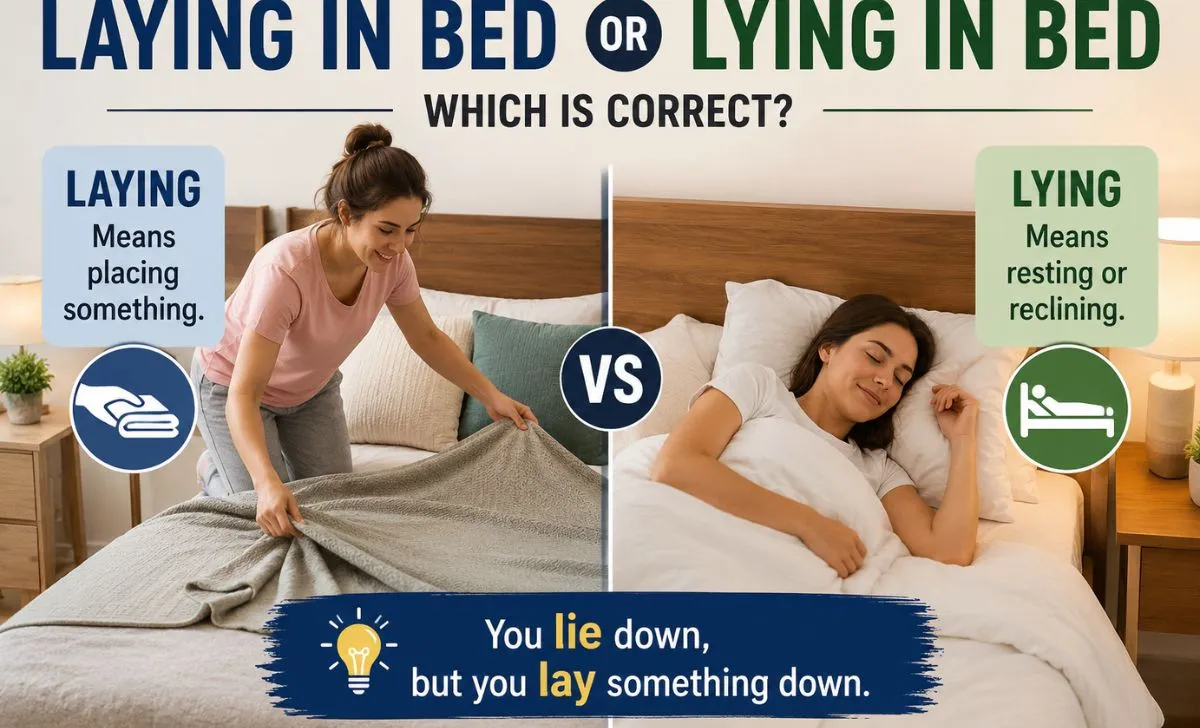
In standard English, “lying in bed” is the correct phrase when you’re talking about resting, sleeping, relaxing, or reclining.
The phrase “laying in bed” is only correct in specific situations where lay means to place something down, such as laying a blanket, a pillow, or a book on the bed.
The confusion exists because the verb lie has an irregular past tense (lay), while lay is also a completely different verb with its own meaning. That overlap has puzzled English learners—and even native speakers for generations.
In this complete guide, you’ll learn:
- Which phrase is grammatically correct
- Why millions of people make this mistake
- The difference between lay and lie
- How dictionaries and grammar experts explain the rule
- Hundreds of real world examples
- Memory tricks that actually work
- American vs. British English usage
- Common mistakes to avoid
- Professional writing tips
- FAQs that answer every related search query
By the end of this guide, you’ll know exactly when to use lying in bed, when laying is appropriate, and how to avoid one of the most common grammar mistakes in English.
Quick Answer
If you’re talking about resting or reclining, the correct phrase is:
✅ Lying in bed
Example:
I’m lying in bed reading a novel.
Use laying only when something is being placed.
Example:
She’s laying fresh sheets on the bed.
The One Rule to Remember
- Lie = Recline yourself.
- Lay = Put something down.
If there’s no direct object, choose lie.
If there is a direct object, choose lay.
At a Glance
| Question | Answer |
|---|---|
| Which phrase is grammatically correct? | Lying in bed |
| Is “laying in bed” always wrong? | No. It’s correct only when something is being placed. |
| Which verb means to rest? | Lie |
| Which verb means to place something? | Lay |
| Which phrase should I use in formal writing? | Lying in bed |
| Is “I’m laying in bed” standard English? | No, unless you’re placing something. |
Why This Grammar Question Confuses Millions of People
Every month, thousands of people search Google for:
- Is it laying in bed or lying in bed?
- Which is correct: laying or lying?
- Why do people say laying in bed?
- Is I’m laying in bed grammatically correct?
- What is the difference between lay and lie?
If so many people ask the same question, there must be a reason.
In fact, there are five major reasons why this grammar rule causes so much confusion.
1. The Verbs Sound Similar
The words lay and lie differ by just one letter, making them easy to confuse in both speech and writing.
2. They Describe Similar Actions
Both verbs relate to horizontal positions.
One refers to reclining, while the other refers to placing something.
Because the actions are closely related, many people assume the verbs are interchangeable.
They aren’t.
3. The Past Tense Makes Everything Worse
Here’s where English becomes tricky.
| Verb | Present | Past | Past Participle |
|---|---|---|---|
| Lie | lie | lay | lain |
| Lay | lay | laid | laid |
Notice something unusual.
The word lay appears twice.
It is:
- the present tense of one verb, and
- the past tense of another.
Very few English verbs behave this way.
4. Everyday Speech Doesn’t Always Follow Grammar Rules
Native speakers often say things like:
- I’m laying in bed.
- He’s laying on the couch.
- She’s laying on the floor.
These expressions are common in informal conversation, but common usage doesn’t always match standard grammar.
For formal writing, editors and style guides continue to recommend lying in bed when the meaning is “reclining.”
5. English Is Full of Irregular Verbs
English contains many irregular verbs, but lay and lie are among the most confusing because they overlap.
Instead of trying to memorize every verb form immediately, it’s easier to understand the core difference first.
The Difference Between “Lay” and “Lie” in 60 Seconds
Here’s the simplest explanation you’ll find.
Lie means to rest or recline.
No object is needed.
Examples:
- I lie in bed every night.
- She’s lying on the sofa.
- They were lying on the beach.
Lay means to put or place something somewhere.
A direct object is required.
Examples:
- Lay the book on the table.
- She’s laying the blanket on the bed.
- He laid his phone beside the pillow.
That’s the entire rule.
Everything else builds on this foundation.
The Direct Object Test
Professional editors often rely on one quick question:
What is receiving the action?
If the answer is nothing, use lie.
If the answer is something, use lay.
Example 1
I’m lying in bed.
Question:
What am I lying?
Nothing.
✅ Correct.
Example 2
I’m laying in bed.
Question:
What am I laying?
Nothing.
❌ Incorrect.
Example 3
I’m laying fresh blankets on the bed.
Question:
What am I laying?
Fresh blankets.
✅ Correct.
This test works in the vast majority of situations.
Comparison Table: Lying in Bed vs. Laying in Bed
| Situation | Correct Phrase | Why? |
|---|---|---|
| Sleeping | ✅ Lying in bed | You are reclining. |
| Taking a nap | ✅ Lying in bed | No object is involved. |
| Reading in bed | ✅ Lying in bed | You are resting. |
| Recovering from illness | ✅ Lying in bed | The subject reclines. |
| Making the bed | ✅ Laying sheets on the bed | Sheets are being placed. |
| Putting a baby into bed | ✅ Laying the baby in bed | The baby is the direct object. |
| Arranging pillows | ✅ Laying pillows on the bed | Pillows receive the action. |
Understanding the Difference Between Lay and Lie
If you remember only one thing from this guide, remember this:
You lie down. You lay something down.
That single sentence explains the difference better than most grammar textbooks.
The confusion begins because both verbs involve horizontal positions, but they describe different actions.
Think about who or what is performing the action.
- If you move into a resting position, you lie.
- If you move another person or object, you lay it somewhere.
Although this sounds simple, English complicates things with irregular verb forms, which is why millions of writers search for this topic every year.
The Core Grammar Rule
The easiest way to choose the correct verb is to ask one question:
Is there a direct object?
A direct object is the person or thing receiving the action.
If the answer is yes, use lay.
If the answer is no, use lie.
Example 1
I am lying in bed.
Question:
What am I lying?
Nothing.
The subject is simply resting.
✅ Correct.
Example 2
I am laying the blanket on the bed.
Question:
What am I laying?
The blanket.
The blanket receives the action.
✅ Correct.
Example 3
I am laying in bed.
Question:
What am I laying?
Nothing.
❌ Incorrect in standard English.
What Is a Direct Object?
Many grammar articles mention direct objects without explaining them.
Here’s a simple explanation.
A direct object answers the question:
- What?
- Whom?
Look at this sentence:
She laid the baby in bed.
Ask:
She laid what?
The baby.
“The baby” is the direct object.
Now compare:
She is lying in bed.
Ask:
She is lying what?
Nothing.
There is no direct object.
That tells us lie is the correct verb.
The Complete Verb Forms of Lie
One of the biggest reasons people struggle with this topic is that lie is an irregular verb.
Here’s the complete conjugation.
| Tense | Verb Form | Example |
|---|---|---|
| Base Form | lie | I lie in bed every night. |
| Third Person | lies | She lies on the couch. |
| Present Participle | lying | He is lying in bed. |
| Past Tense | lay | Yesterday I lay in bed until noon. |
| Past Participle | lain | I have lain awake all night. |
Notice something unusual.
The past tense is lay, not lied.
Many learners mistakenly write:
❌ Yesterday I lied in bed.
That is incorrect when talking about reclining.
Remember:
lied belongs to the verb lie, meaning to tell an untruth.
Example:
He lied about his age.
Different verb.
Different meaning.
The Complete Verb Forms of Lay
Now let’s look at the second verb.
| Tense | Verb Form | Example |
|---|---|---|
| Base Form | lay | Lay the book on the desk. |
| Third Person | lays | She lays the towels on the bed. |
| Present Participle | laying | He is laying carpet. |
| Past Tense | laid | She laid the keys on the table. |
| Past Participle | laid | They have laid new flooring. |
Unlike lie, this verb always involves placing something.
Two Verbs. One Confusing Word.
Here’s why these verbs confuse nearly everyone.
The word lay appears in both verb families.
As the Present Tense
I lay the blanket on the bed.
Meaning:
I place the blanket there.
As the Past Tense
Yesterday I lay in bed until noon.
Meaning:
Yesterday I rested in bed.
Same spelling.
Different verb.
Different meaning.
This is why memorizing isolated words doesn’t work. Understanding the action does.
Timeline: The Verb Families
Instead of memorizing random forms, think of each verb as its own family.
Family 1: Lie (to recline)
lie
↓
lying
↓
lay
↓
lain
Meaning:
To rest, recline, or remain in a horizontal position.
Family 2: Lay (to place)
lay
↓
laying
↓
laid
↓
laid
Meaning:
To put or place something somewhere.
Keeping these families separate makes the rule much easier to remember.
Visual Comparison Table
| Meaning | Present | Present Continuous | Past | Past Participle |
|---|---|---|---|---|
| Recline | lie | lying | lay | lain |
| Place | lay | laying | laid | laid |
Real Life Examples of Lying in Bed
Now let’s see how the rule works in everyday situations.
Morning Routine
- I’m lying in bed checking my emails.
- She is lying in bed reading the news.
- The children are still lying in bed.
- Dad enjoys lying in bed on Sundays.
- We spent the morning lying in bed talking.
Health and Recovery
- The patient is lying in bed comfortably.
- He remained lying in bed after surgery.
- She was lying in bed with a fever.
- The doctor advised him to keep lying in bed.
- My grandmother spent the afternoon lying in bed.
Leisure
- I’m lying in bed watching Netflix.
- She’s lying in bed listening to music.
- They’re lying in bed planning their vacation.
- He likes lying in bed during thunderstorms.
- We were lying in bed when the phone rang.
Literature Style
- She lay awake until dawn.
- He remained lying in bed, thinking about the future.
- The child fell asleep while lying in bed beside his teddy bear.
- They lay together beneath a warm blanket.
- She had lain awake for hours before sunrise.
Notice how the verb changes with the tense while the meaning stays the same.
Real Life Examples of Lay
Now compare sentences where lay is the correct choice.
- Lay the book on the table.
- Lay your phone beside the pillow.
- Lay the blanket over the child.
- She is laying fresh sheets on the bed.
- He laid the baby in bed.
- They laid flowers at the memorial.
- The workers are laying bricks.
- She laid the report on my desk.
- Dad is laying carpet upstairs.
- We have laid new flooring throughout the house.
Every sentence contains something that receives the action.
Common Mistakes Native Speakers Make
One surprising fact is that this mistake isn’t limited to English learners.
Native speakers often say:
- I’m laying in bed.
- He’s laying on the couch.
- She’s laying on the floor.
- We were laying on the beach.
These forms are common in informal speech, but editors generally revise them to:
- I’m lying in bed.
- He’s lying on the couch.
- She’s lying on the floor.
- We were lying on the beach.
Language in conversation is often more flexible than language in published writing.
Memory Tricks That Actually Work
Most people don’t remember grammar rules.
They remember pictures and patterns.
Here are four practical memory tricks.
Trick #1: The Bed Test
Imagine walking into your bedroom.
If you climb into bed, you lie in bed.
If you put clean sheets on the bed, you lay the sheets on the bed.
One action is about you.
The other is about something else.
Trick #2: Ask “What?”
Complete the sentence.
I’m laying…
What?
No answer.
Wrong verb.
Now try:
She’s laying the blanket…
What?
The blanket.
Correct.
Trick #3: Yourself vs. Something Else
Move yourself?
Use lie.
Move another object?
Use lay.
This simple distinction works in almost every situation.
Trick #4: Remember This Sentence Forever
You lie down, but you lay something down.
If you can remember this one sentence, you’ll avoid the vast majority of mistakes involving these verbs.
Quick Practice
Choose the correct answer.
- I’m _____ in bed reading a novel.
- laying
- lying ✅
- She is _____ the blanket on the bed.
- lying
- laying ✅
- Yesterday I _____ in bed until noon.
- lay ✅
- laid
- The workers are _____ bricks.
- lying
- laying ✅
- The patient has _____ in bed since yesterday.
- laid
- lain ✅
American English vs. British English: Is There Any Difference?
One of the biggest misconceptions about this topic is that American English and British English use different grammar rules for lay and lie.
The short answer is:
No.
Both varieties of English follow the same fundamental grammatical distinction.
- Lie means to recline or rest.
- Lay means to place something down.
Therefore, in both American and British English, the standard expression is:
✅ I’m lying in bed.
Not:
❌ I’m laying in bed.
Why Do You Hear “I’m Laying in Bed” So Often?
Many native speakers—especially in casual conversation—use laying where formal grammar expects lying.
This is an example of colloquial speech, not a different grammatical rule.
If you’re writing:
- a blog post
- an essay
- a research paper
- a business email
- website content
- marketing copy
you should use lying in bed when referring to someone resting.
Formal vs. Informal Usage
Grammar expectations change depending on the context.
The table below shows which expression is appropriate in different situations.
| Context | Recommended Form |
|---|---|
| Academic writing | ✅ Lying in bed |
| Business writing | ✅ Lying in bed |
| Journalism | ✅ Lying in bed |
| Books and novels | ✅ Lying in bed |
| Government documents | ✅ Lying in bed |
| Professional emails | ✅ Lying in bed |
| Casual conversation | “Laying in bed” may be heard, but “lying in bed” is grammatically preferred |
| Social media | Both appear, but lying is the standard form |
If your goal is clear, polished English, lying in bed is the safer and more professional choice.
How Editors Handle “Laying in Bed”
Professional editors don’t simply ask whether a phrase is common, they ask whether it’s grammatically accurate and appropriate for the publication.
Consider this sentence:
I’m laying in bed thinking about tomorrow.
An editor would likely revise it to:
I’m lying in bed thinking about tomorrow.
However, compare it with:
I’m laying fresh sheets on the bed.
This sentence would remain unchanged because laying correctly describes placing the sheets.
The key question is always:
Is something receiving the action?
If yes, lay is correct.
If no, lie is usually correct.
Grammar Decision Tree
When you’re unsure, follow this decision tree.
Are you talking about resting or reclining?

        │
       Yes
        │
Use LIE / LYING
        │
Example:
She is lying in bed.
Are you placing a person or object somewhere?

        │
       Yes
        │
Use LAY / LAYING
        │
Example:
She is laying the blanket on the bed.
If you can’t identify a direct object, choose lie.
“Can I Say…?” Real Questions with Clear Answers
These are some of the most common questions learners ask.
Can I say “I’m laying in bed”?
Standard English: No.
Use:
I’m lying in bed.
Can I say “I was laying in bed”?
The standard form is:
I was lying in bed.
Can I say “I’ve been laying in bed all day”?
The preferred form is:
I’ve been lying in bed all day.
Can I say “She’s laying on the couch”?
Use:
She’s lying on the couch.
Can I say “The dog is laying on the floor”?
The grammatically preferred version is:
The dog is lying on the floor.
Can I say “He’s laying the baby in bed”?
Yes.
The baby is the direct object.
Can I say “They’re laying pillows on the bed”?
Yes.
The pillows receive the action.
Can I say “Lay down”?
Yes.
Examples:
- Lay your phone down.
- Lay the book on the desk.
Can I say “Lie down”?
Yes.
Examples:
- Lie down and rest.
- I need to lie down for a while.
Notice that the meanings are different even though the expressions look similar.
Common Myths About Lay and Lie
Let’s clear up a few misconceptions.
| Myth | Reality |
|---|---|
| “Laying in bed” is always correct. | ❌ It isn’t. Use lying when reclining. |
| American English prefers “laying.” | ❌ Standard grammar is the same in both varieties. |
| Native speakers never make this mistake. | ❌ Many do, especially in informal speech. |
| “Lay” and “lie” mean the same thing. | ❌ They describe different actions. |
| You can ignore the difference in professional writing. | ❌ Editors usually distinguish between them. |
Everyday Situations and the Correct Choice
The easiest way to master this topic is to see it in real-life contexts.
| Situation | Correct Expression |
|---|---|
| Sleeping | lying in bed |
| Taking a nap | lying in bed |
| Reading a book | lying in bed |
| Watching TV | lying in bed |
| Recovering from illness | lying in bed |
| Relaxing | lying in bed |
| Making the bed | laying the sheets on the bed |
| Arranging pillows | laying the pillows on the bed |
| Putting a baby to sleep | laying the baby in bed |
| Decorating the bedroom | laying a blanket across the bed |
Common Expressions You Should Memorize
These phrases appear naturally in everyday English.
Correct with Lie
- lie in bed
- lie awake
- lie asleep
- lie still
- lie flat
- lie quietly
- lie on the sofa
- lie on the couch
- lie on the beach
- lie on the floor
- lie under the stars
- lie in the sunshine
Correct with Lay
- lay the table
- lay the foundation
- lay eggs
- lay flowers
- lay bricks
- lay carpet
- lay the baby down
- lay your cards on the table
- lay plans
- lay the blame
Learning these natural combinations (called collocations) helps your English sound more fluent.
Teacher’s Notes
If you’re learning English, don’t try to memorize every verb form on day one.
Instead, build the habit of asking:
Am I resting, or am I placing something?
Once that answer becomes automatic, choosing the correct verb becomes much easier.
Teachers often introduce the rule using simple present-tense examples first, then add past and perfect forms later. This gradual approach reduces confusion and helps learners develop confidence before tackling irregular verb patterns.
Writer’s Notes
If you’re a blogger, copywriter, student, or editor, accuracy matters.
When someone is reclining, write:
lying in bed
If the sentence describes placing an object, write:
laying the blanket on the bed
Being consistent with this distinction improves clarity and shows attention to detail—qualities readers and editors appreciate.
Mini Quiz
Choose the correct answer.
1.
She is _____ in bed with a cold.
- laying
- lying ✅
2.
The workers are _____ new carpet.
- lying
- laying ✅
3.
Yesterday we _____ in bed until ten.
- lay ✅
- laid
4.
They have _____ fresh flowers on the table.
- laid ✅
- lain
5.
The children are _____ on the grass.
- lying ✅
- laying
History and Etymology of Lay and Lie

Understanding where these verbs come from makes it easier to understand why they’re so confusing today.
The verb lie has been part of English for centuries and comes from Old English licgan, meaning to recline, rest, or remain in a horizontal position. Over time, its forms evolved into lie, lay, and lain.
The verb lay comes from the Old English word lecgan, meaning to put or place something down. Although the two verbs developed separately, their spellings and verb forms gradually became similar, creating the confusion English learners still experience today.
This historical overlap explains why:
- lay is the present tense of one verb.
- lay is also the past tense of another verb.
Few English verbs have this kind of relationship, which is why grammar books often use lay and lie as classic examples of irregular verbs.
What Grammar Authorities Recommend
Respected dictionaries and grammar references consistently distinguish between these two verbs.
Their guidance can be summarized like this:
| Source Type | General Recommendation |
|---|---|
| Major dictionaries | Use lie for reclining and lay for placing something. |
| Style guides | Maintain the distinction in edited writing. |
| Academic writing | Prefer the standard grammatical forms. |
| Professional editors | Revise laying in bed to lying in bed unless lay truly means “place.” |
Although casual speech sometimes blurs the distinction, formal English continues to follow this traditional rule.
Advanced Examples by Tense
Seeing the verbs across different tenses helps reinforce the pattern.
Present Simple
- I lie in bed every night before sleeping.
- She lays the towels on the bed every morning.
Present Continuous
- I’m lying in bed reading.
- She’s laying fresh sheets on the mattress.
Past Simple
- Yesterday I lay in bed until 9 a.m.
- He laid the blanket over the child.
Present Perfect
- I have lain awake for hours.
- They have laid new carpet upstairs.
Future Simple
- I will lie in bed after work.
- She will lay the clothes on the chair.
Real World Examples
Here are additional examples that mirror natural English usage.
Correct Uses of Lying in Bed
- I’m lying in bed listening to the rain.
- She was lying in bed when the phone rang.
- They enjoy lying in bed on lazy weekends.
- The patient remained lying in bed overnight.
- The children were lying in bed before sunrise.
- He spent the afternoon lying in bed with a headache.
- We stayed lying in bed until breakfast.
- The cat was lying in bed near the window.
- She prefers lying in bed with a good novel.
- They were lying in bed talking about their future.
Correct Uses of Laying
- She is laying clean towels on the bed.
- He laid the suitcase beside the door.
- They are laying new tiles in the kitchen.
- Lay the notebook on the desk.
- Please lay your coat on the chair.
- The gardener is laying stones along the path.
- She laid the baby gently in bed.
- They have laid fresh flowers on the table.
- He is laying a blanket over the sleeping child.
- Lay the menu beside each plate.
Grammar Cheat Sheet
| If You Mean… | Use… | Example |
|---|---|---|
| Resting | lie | I lie in bed. |
| Sleeping | lie | She is lying in bed. |
| Relaxing | lie | They were lying on the beach. |
| Putting something down | lay | Lay the phone here. |
| Arranging objects | lay | She’s laying the blankets on the bed. |
| Past of lie | lay | Yesterday I lay in bed. |
| Past of lay | laid | She laid the book on the desk. |
| Past participle of lie | lain | I have lain awake all night. |
| Past participle of lay | laid | They have laid the carpet. |
Memory Tip:
You lie down. You lay something down.
FAQs
Is it grammatically correct to say lying in bed?
Yes. If you’re resting, sleeping, or reclining, lying in bed is the standard grammatical form.
Is laying in bed ever correct?
Yes, but only when laying means placing something.
Example:
She is laying fresh sheets on the bed.
Why do so many people say laying in bed?
Because the verbs lay and lie are irregular, and casual spoken English often simplifies grammar. However, in formal writing, lying in bed is generally preferred.
Is I’m laying in bed wrong?
In standard written English, yes. The preferred sentence is:
I’m lying in bed.
What is the easiest way to remember the rule?
Remember this sentence:
You lie down, but you lay something down.
Which form should students use in essays?
Students should write lying in bed when referring to resting or reclining.
Which form should bloggers use?
If you’re writing professionally, lying in bed is the better choice. You can mention laying in bed only when explaining the common mistake or discussing the search query.
Does this rule apply in both American and British English?
Yes. Both varieties distinguish between lie (recline) and lay (place something).
What is the past tense of lie?
The past tense of lie (meaning to recline) is lay.
Example:
Yesterday I lay in bed until noon.
What is the past tense of lay?
The past tense of lay is laid.
Example:
She laid the blanket on the bed.
Final Verdict
If you’re talking about someone resting, sleeping, relaxing, or reclining, the correct expression is:
✅ Lying in bed
Use laying only when something is being placed.
Examples:
- ✅ I’m lying in bed reading.
- ✅ She’s lying in bed with a cold.
- ✅ They’re lying in bed watching a movie.
But:
- ✅ She’s laying fresh sheets on the bed.
- ✅ He’s laying the baby in bed.
- ✅ They’re laying blankets on the mattress.
When you’re unsure, ask yourself one simple question:
Is something receiving the action?
If the answer is yes, choose lay.
If the answer is no, choose lie.
Conclusion
The confusion between laying in bed and lying in bed has existed for generations, largely because the verbs lay and lie have similar meanings and overlapping forms.
While everyday conversation sometimes blurs the distinction, standard English remains consistent: use lie when someone is reclining and lay when someone is placing an object.
Rather than memorizing every verb form immediately, focus on the underlying meaning. Once you understand that lie describes your own position and lay describes moving something else, the correct choice becomes much easier.
Whether you’re writing an essay, editing a blog post, sending a business email, or simply trying to improve your English, using lying in bed correctly demonstrates clear, accurate communication.
And if you ever forget the rule, remember the simplest sentence in this guide:
You lie down. You lay something down.
That one sentence will help you avoid one of the most common grammar mistakes in English.
Read More :

I am Constance Hale, an, editor, and writing expert dedicated to helping people write with clarity and confidence. Through my articles on Gramiffy.com, I simplify grammar, spelling, and language usage for readers of all levels. My goal is to make English writing more engaging, accurate, and enjoyable.