Have you ever paused while writing and wondered whether the correct plural form of yes is yeses or yesses?
You’re not alone.
Thousands of students, writers, bloggers, teachers, business professionals, and English learners search for this exact question every month.
At first glance, both spellings seem possible. Since the word yes already ends in s, many people assume that adding another s before -es makes sense. Others believe the correct form should simply be yeses.
The confusion is understandable because English contains many unusual plural forms and spelling rules.
However, when it comes to yeses vs yesses, there is a clear answer supported by dictionaries, grammar experts, editors, publishers, and style guides.
In this comprehensive guide, you’ll learn:
- The correct plural of yes
- Why yeses is correct and yesses is not
- Dictionary definitions and grammar rules
- Real-world examples from voting, business, and academic writing
- Common mistakes to avoid
- Related grammar questions
- Expert tips for remembering the correct spelling
By the end of this article, you’ll know exactly when and how to use yeses with confidence.
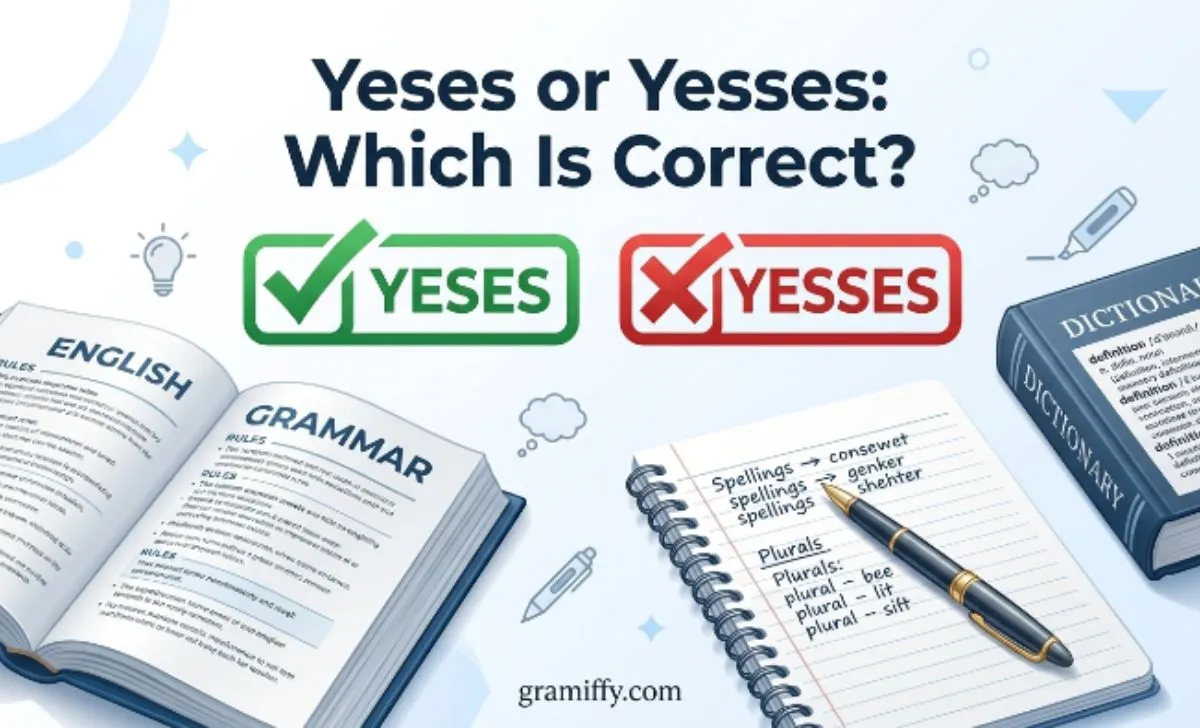
Quick Answer: Is It Yeses or Yesses?
If you’re looking for the short answer, here it is:
| Word | Correct? |
|---|---|
| Yeses | ✅ Correct |
| Yesses | ❌ Incorrect |
The correct plural form of yes is yeses.
Correct Examples
- The proposal received several yeses.
- The committee counted all the yeses and noes.
- The survey generated hundreds of yeses.
Incorrect Examples
- The proposal received several yesses.
- The committee counted all the yesses.
In standard English, dictionaries and grammar authorities recognize yeses as the accepted plural form.
Featured Snippet Answer
If you’re searching for a quick definition:
Yeses is the correct plural form of “yes.” Yesses is generally considered incorrect in standard English. Major dictionaries, grammar experts, editors, and style guides all recognize yeses as the accepted spelling for multiple affirmative responses, votes, agreements, or approvals.
Why This Question Confuses So Many People
The debate between yeses and yesses exists because English spelling doesn’t always follow obvious patterns.
Several factors contribute to the confusion.
The Word Already Ends in S
Many people wonder whether another s should be added before the plural ending.
The Plural Form Is Rarely Used
Most people say “yes” frequently but rarely write its plural form.
Pronunciation Can Be Misleading
When spoken aloud, yeses may sound as though it contains an additional s, leading some writers to mistakenly spell it as yesses.
English Contains Many Irregular Patterns
Because English has numerous exceptions, writers often second-guess themselves when encountering uncommon plurals.
These factors explain why searches such as:
- yeses or yesses
- what is the plural of yes
- is yesses a word
- is yeses correct
- how to spell yeses
remain so popular.
Why You Can Trust This Answer
When researching grammar questions online, it’s common to find conflicting information.
Fortunately, the answer to yeses or yesses is supported by authoritative language resources.
Leading dictionaries consistently recognize yeses as the correct plural form.
Professional editors, teachers, proofreaders, publishers, and academic institutions also use yeses when referring to multiple affirmative responses.
Because the evidence is consistent across trusted sources, writers can confidently use yeses in:
- Academic writing
- Business writing
- Professional communication
- Journalism
- Research papers
- Everyday English
What Does the Word “Yes” Mean?
Before discussing its plural form, it’s helpful to understand the word itself.
The word yes is one of the most common words in the English language.
It expresses:
- Agreement
- Approval
- Acceptance
- Confirmation
- Permission
- Positive response
Examples
- Yes, I agree.
- Yes, that’s correct.
- Yes, you may proceed.
- Yes, I understand.
In these examples, yes functions as a response.
However, English grammar also allows yes to function as a noun.
This distinction becomes important when forming the plural.
Understanding Yes as a Noun
Many people know yes only as an answer.
However, grammar allows words to perform different functions.
Yes as an Interjection
- Yes, I’ll attend the meeting.
Yes as a Noun
- We counted all the yeses.
When the word becomes a noun, it can take a plural form.
That plural form is yeses.
What Is the Plural of Yes?
The plural of yes is yeses.
Whenever you’re referring to more than one affirmative response, agreement, approval, or vote, use yeses.
Singular
- We received one yes.
Plural
- We received several yeses.
More Examples
- The survey produced many yeses.
- The proposal received enough yeses to pass.
- Researchers analyzed all the yeses and noes.
The word yeses simply means multiple instances of the word yes.
Yeses Meaning in English
The meaning of yeses is straightforward.
It refers to:
- Multiple affirmative responses
- Multiple agreements
- Positive answers
- Supporting votes
- Approvals
Examples
- The questionnaire received numerous yeses.
- The board recorded several yeses.
- Most participants responded with yeses.
In each example, the word describes more than one affirmative response.
Is Yesses a Word?
This is one of the most frequently searched questions related to the topic.
Short Answer
No.
Yesses is not the accepted plural form in standard English.
Although you may occasionally encounter it online, it is generally considered a spelling mistake rather than a dictionary-approved word.
Correct Form
✅ yeses
Incorrect Form
❌ yesses
If your goal is grammatically correct writing, always choose yeses.
Dictionary Definitions of Yeses
One of the best ways to resolve grammar debates is to consult trusted dictionaries.
Major dictionaries consistently recognize yeses as the standard plural form of yes.
Merriam-Webster
Recognizes yeses as affirmative votes, responses, or agreements.
Oxford Dictionary
Lists yeses as the accepted plural form.
Cambridge Dictionary
Includes yeses as the standard spelling.
Collins Dictionary
Also recognizes yeses as the correct plural.
The agreement among major dictionaries makes the answer clear.
Yeses vs Yesses: Side-by-Side Comparison
| Feature | Yeses | Yesses |
|---|---|---|
| Correct Spelling | ✅ | ❌ |
| Dictionary Approved | ✅ | ❌ |
| Standard English | ✅ | ❌ |
| Academic Writing | ✅ | ❌ |
| Business Writing | ✅ | ❌ |
| Journalism | ✅ | ❌ |
| Professional Communication | ✅ | ❌ |
| Recommended by Editors | ✅ | ❌ |
| Recommended by Teachers | ✅ | ❌ |
| Accepted Worldwide | ✅ | ❌ |
The comparison clearly shows why writers should use yeses instead of yesses.
The Grammar Rule Behind Yeses
Understanding the grammar rule makes the spelling easier to remember.
Nouns Ending in S Often Add ES
Examples include:
| Singular | Plural |
|---|---|
| bus | buses |
| class | classes |
| lens | lenses |
| yes | yeses |
The word yes follows the same pattern.
Because it ends in s, the standard plural form becomes yeses.
This rule explains why dictionaries and grammar experts support yeses rather than yesses.
Why Is “Yeses” Grammatically Correct?
Many writers accept that yeses is correct but still wonder why English uses this spelling.
The answer lies in English pluralization rules.
When a noun ends in the letter s, the language often forms the plural by adding -es.
Examples
| Singular | Plural |
|---|---|
| bus | buses |
| class | classes |
| kiss | kisses |
| lens | lenses |
| yes | yeses |
The word yes follows the same pattern.
Because of this grammatical rule, yeses became the accepted plural form and eventually appeared in dictionaries and style guides.
Why Do People Write “Yesses”?
If yeses is correct, why do so many people search for yesses?
The answer comes down to spelling assumptions.
Writers Hear an Extra Sound
When spoken aloud, yeses sounds similar to:
“yess-iz”
This pronunciation sometimes tricks writers into believing an additional s should appear in the spelling.
The Word Looks Unusual
Most people don’t write the plural of yes very often.
Because the word is uncommon, even experienced writers occasionally hesitate.
English Has Many Exceptions
English contains numerous irregular spellings.
As a result, writers often assume yeses might be another exception and attempt to create forms such as yesses.
However, standard English does not recognize yesses as the preferred spelling.
How Native Speakers Use Yeses
One interesting fact is that many native English speakers rarely need to write the plural form of yes.
In everyday conversation, people usually say:
- Everyone agreed.
- Most people said yes.
- The proposal was approved.
Because the plural form isn’t used daily, even native speakers sometimes double-check the spelling.
Whenever multiple affirmative responses need to be discussed, professional writers use yeses.
Examples
- The meeting generated several yeses.
- The survey produced more yeses than expected.
- The committee received enough yeses to approve the recommendation.
Common Situations Where Yeses Is Used
The word appears in many professional and academic settings.
Voting
Voting is one of the most common contexts.
Examples:
- The bill passed with sixty yeses.
- Parliament recorded more yeses than noes.
- The proposal succeeded because of overwhelming yeses.
Surveys
Researchers frequently categorize responses as yeses and noes.
Examples:
- The questionnaire produced hundreds of yeses.
- Customer surveys generated many yeses.
- Researchers analyzed all yeses before publishing the results.
Meetings
Organizations often vote on decisions.
Examples:
- The board recorded enough yeses to approve the project.
- Several yeses were received during the meeting.
- Final yeses exceeded expectations.
Education
Teachers and researchers sometimes conduct classroom polls.
Examples:
- The teacher counted all the yeses.
- Student responses included many yeses.
- The class poll generated overwhelming yeses.
How to Use Yeses in a Sentence
Many people understand the definition but still want usage examples.
Below are common sentence structures.
Basic Examples
- We received several yeses.
- The survey generated many yeses.
- There were more yeses than noes.
Voting Examples
- The legislation passed after receiving enough yeses.
- The chairman announced the final yeses.
- Parliament recorded 120 yeses.
Business Examples
- The proposal earned unanimous yeses.
- Stakeholders provided enough yeses for approval.
- The project moved forward because of strong yeses.
Academic Examples
- Researchers categorized responses as yeses and noes.
- The study produced hundreds of yeses.
- Statistical analysis revealed a majority of yeses.
Yeses Meaning in Voting
One of the most common uses of the word appears in voting procedures.
When a group votes on an issue, members may respond:
- Yes
- No
When counting multiple responses, the plural forms become necessary.
Example
- 75 yeses
- 25 noes
The word yeses therefore refers to affirmative votes.
This usage is common in:
- Government proceedings
- Legislative sessions
- Board meetings
- Corporate voting
- Organizational elections
Yeses Meaning in Surveys and Research
Researchers frequently use the word when presenting results.
Instead of writing lengthy descriptions, they may summarize answers as:
- Yeses
- Noes
Example
A study might report:
“The survey recorded 650 yeses and 150 noes.”
This concise wording helps readers understand the findings quickly.
Yeses in Academic Writing
Academic writing values precision and consistency.
Because yeses is the standard plural form, it regularly appears in:
- Research papers
- Journal articles
- Thesis projects
- Survey reports
- Educational studies
Academic Examples
- Participants submitted 450 yeses.
- Researchers evaluated all yeses and noes.
- The findings revealed significantly more yeses than expected.
Using yesses in academic work could be marked as a spelling error.
Yeses in Business Writing
Businesses often gather feedback from:
- Customers
- Employees
- Stakeholders
- Board members
As a result, the word yeses appears in many professional documents.
Examples
- The proposal received enough yeses to proceed.
- Employee surveys generated numerous yeses.
- Management recorded unanimous yeses.
Professional communication requires accuracy, making yeses the preferred choice.
Yeses in Journalism
News organizations frequently report voting outcomes.
Examples include:
- Elections
- Referendums
- Parliamentary votes
- Corporate decisions
Examples
- The measure passed with 85 yeses and 20 noes.
- Lawmakers delivered enough yeses for approval.
- Final yeses exceeded predictions.
Because journalism follows established style standards, yeses remains the accepted spelling.
American English vs British English
Some spelling debates differ depending on location.
Examples include:
- color vs colour
- center vs centre
- organize vs organise
However, yeses vs yesses is not one of those debates.
American English
✅ yeses
British English
✅ yeses
Canadian English
✅ yeses
Australian English
✅ yeses
The spelling remains consistent throughout the English-speaking world.
Is Yeses Formal or Informal?
Many writers wonder whether the word belongs only in formal contexts.
The answer is no.
Formal Usage
- Research papers
- Government reports
- Academic writing
- Business documents
Informal Usage
- Emails
- Conversations about survey results
- Event planning
- Group discussions
The spelling remains yeses regardless of context.
Why Editors Prefer Yeses
Professional editors prioritize standard English usage.
When editors encounter:
❌ yesses
they typically replace it with:
✅ yeses
because dictionaries and style guides consistently support that spelling.
Using yeses from the beginning reduces editing corrections and improves credibility.
Decision Guide: Should You Use Yeses or Yesses?
Use this quick decision chart whenever you’re unsure.
Are You Referring to More Than One “Yes”?
If NO:
Use yes
Example:
- We received one yes.
If YES:
Use yeses
Example:
- We received several yeses.
Should You Ever Use Yesses?
No.
Standard English prefers yeses.
Quick Reference Table
| Question | Answer |
|---|---|
| Correct plural of yes | Yeses |
| Is yeses correct? | Yes |
| Is yesses correct? | No |
| Dictionary approved? | Yes |
| Academic writing? | Yes |
| Business writing? | Yes |
| British English? | Yeses |
| American English? | Yeses |
| Meaning of yeses | Multiple affirmative responses |
Key Takeaways So Far
Before moving to the advanced grammar section, remember these important points:
- Yeses is the correct plural form of yes.
- Yesses is generally considered incorrect.
- Major dictionaries support yeses.
- The word appears in voting, research, business, and journalism.
- Both American and British English use yeses.
- Editors and teachers recommend yeses.
- The spelling follows standard plural noun rules.
Advanced Grammar Rules Behind Yeses
To fully understand why yeses is correct, it helps to look beyond simple memorization and examine how English grammar treats words such as yes.
Many grammar mistakes happen because writers focus on how a word sounds rather than how English actually forms plurals.
Rule 1: Words Can Function as Nouns
Most people think of yes as a response.
Example:
- Yes, I agree.
However, English also allows yes to function as a noun.
Example:
- We counted all the yeses.
Once the word becomes a noun, it follows noun grammar rules and can take a plural form.
Rule 2: Nouns Ending in S Often Add ES
One of the most common pluralization patterns in English involves adding -es to nouns ending in s.
Examples:
| Singular | Plural |
|---|---|
| bus | buses |
| class | classes |
| lens | lenses |
| kiss | kisses |
| yes | yeses |
This pattern explains why yeses is grammatically correct.
Rule 3: Standard Usage Matters
Grammar isn’t determined only by logic.
Usage matters too.
Over time, dictionaries, publishers, educators, and editors adopted yeses as the accepted plural form.
Once a spelling becomes standardized, it becomes the form writers are expected to use.
How Grammar Experts Explain Yeses
Professional editors and grammar instructors generally agree on this issue.
Language experts recommend following established dictionary usage rather than inventing alternative spellings.
When discussing multiple affirmative responses, grammar authorities consistently use:
✅ yeses
and avoid:
❌ yesses
This consistency is why you’ll find yeses in edited books, academic publications, newspapers, and professional documents.
Historical Development of the Word Yeses

Many writers wonder whether yeses is a modern invention.
In reality, the word has existed for a long time.
As English evolved, speakers needed a way to refer to multiple affirmative responses.
Words such as:
- yes
- no
- if
- but
began functioning as nouns.
Once these words became nouns, plural forms naturally developed.
Over time, yeses became the accepted spelling and eventually entered major dictionaries.
Today it is recognized throughout the English-speaking world.
Real-World Examples of Yeses
Seeing authentic examples makes grammar rules easier to remember.
Voting Examples
- The motion passed with seventy-two yeses.
- The chairman counted the final yeses and noes.
- More yeses were recorded than expected.
- Lawmakers submitted enough yeses to approve the measure.
- The proposal succeeded because of overwhelming yeses.
Survey Examples
- Researchers collected hundreds of yeses.
- The questionnaire generated more yeses than noes.
- Most participants submitted yeses.
- The survey produced strong yeses from customers.
- Analysts reviewed all yeses before publishing the report.
Business Examples
- The board received unanimous yeses.
- Stakeholders provided several yeses.
- Management recorded enough yeses to proceed.
- The project earned strong yeses during review.
- Employee feedback included many yeses.
Academic Examples
- The study recorded 600 yeses.
- Researchers categorized answers into yeses and noes.
- Student responses generated many yeses.
- Survey findings revealed a majority of yeses.
- The final report summarized all yeses.
Common Grammar Mistakes With Yeses
Although the rule is straightforward, writers still make several mistakes.
Mistake #1: Writing Yesses
Incorrect:
- We received several yesses.
Correct:
- We received several yeses.
This is by far the most common error.
Mistake #2: Using Yes as Both Singular and Plural
Incorrect:
- We received many yes.
Correct:
- We received many yeses.
A plural noun requires a plural form.
Mistake #3: Avoiding the Word Entirely
Some writers create awkward sentences because they are unsure about the plural.
Instead of avoiding the word, use the correct form confidently.
Correct:
- The survey generated many yeses.
Mistake #4: Assuming Pronunciation Determines Spelling
English spelling often differs from pronunciation.
Just because a word sounds a certain way does not mean it should be spelled that way.
This misunderstanding frequently leads to yesses.
Mistake #5: Copying Incorrect Usage Online
Not every website follows proper grammar standards.
Always verify uncommon spellings using reliable dictionaries and trusted language resources.
Why English Learners Struggle With Yeses
English learners often find this word confusing for several reasons.
The Plural Form Is Uncommon
Most learners encounter yes regularly but rarely see yeses.
The Spelling Looks Unusual
The word already ends with s, making the plural appear strange at first.
Pronunciation Can Be Misleading
Many learners assume pronunciation should dictate spelling.
English Contains Many Exceptions
Because English includes countless irregular forms, learners often expect yeses to be another exception.
Fortunately, once the rule is understood, the spelling becomes easy to remember.
Related Confusing Words
People searching for yeses or yesses often search for similar grammar questions.
Understanding these related words can strengthen your overall grammar skills.
Noes or Nos?
In voting contexts, noes is generally preferred.
Correct:
- The final count showed more yeses than noes.
Ayes or Ays?
The accepted parliamentary term is:
✅ ayes
Example:
- The ayes have it.
Nays or Naies?
Correct:
✅ nays
Example:
- The nays opposed the proposal.
Ifs or If’s?
Correct:
✅ ifs
Incorrect:
❌ if’s
Example:
- There are too many ifs in the plan.
Buts or But’s?
Correct:
✅ buts
Example:
- His explanation contained too many buts.
Ands or And’s?
Correct:
✅ ands
Example:
- The sentence contains too many ands.
Comparing Yeses With Similar Plural Forms
The word becomes easier to understand when compared to similar English nouns.
| Singular | Plural |
|---|---|
| yes | yeses |
| no | noes |
| if | ifs |
| but | buts |
| and | ands |
| maybe | maybes |
These words demonstrate how English can transform common expressions into nouns and then pluralize them.
How Teachers Explain the Rule
Teachers often simplify the process.
Step 1
Identify the word.
Example:
yes
Step 2
Determine whether more than one is being discussed.
Example:
Several yes responses.
Step 3
Apply the plural rule.
yes + es
=
yeses
This simple method helps students avoid confusion.
How Editors and Proofreaders Handle Yeses
Professional editors rarely leave uncommon grammar questions to chance.
When they encounter:
❌ yesses
they usually correct it to:
✅ yeses
before publication.
This practice is common in:
- Newspapers
- Books
- Academic journals
- Corporate reports
- Educational materials
Using the accepted spelling ensures consistency and professionalism.
Is Yeses Used in Professional Writing?
Absolutely.
The word appears in:
Business Reports
- The proposal received enough yeses to move forward.
Government Documents
- The measure passed with a majority of yeses.
Research Papers
- The survey generated hundreds of yeses.
Board Meeting Minutes
- Directors recorded unanimous yeses.
Professional writers use yeses whenever multiple affirmative responses need to be described.
Pronunciation of Yeses
Many spelling questions arise because of pronunciation.
Pronunciation Guide
Yeses
/ˈjɛsɪz/
It sounds like:
YESS-iz
Because the pronunciation contains a soft extra sound, some writers mistakenly believe another s should appear in the spelling.
However, standard English spelling remains:
yeses
Memory Tricks for Remembering Yeses
If you struggle to remember the correct form, these tricks can help.
Trick #1
Think:
- bus → buses
- yes → yeses
The pattern is the same.
Trick #2
Remember this phrase:
“More yeses than noes.”
This common voting phrase reinforces the spelling.
Trick #3
Associate It With Dictionaries
Every major dictionary recognizes yeses.
Trick #4
Think of Yes as a Noun
Once yes becomes a noun, it naturally requires a plural form.
That plural form is yeses.
Mini Quiz: Test Your Understanding
Choose the correct sentence.
Question 1
A) We counted several yesses.
B) We counted several yeses.
✅ Correct Answer: B
Question 2
A) The survey generated many yeses.
B) The survey generated many yesses.
✅ Correct Answer: A
Question 3
A) Parliament recorded 150 yeses.
B) Parliament recorded 150 yesses.
✅ Correct Answer: A
Question 4
A) The proposal received more yeses than noes.
B) The proposal received more yesses than noes.
✅ Correct Answer: A
Question 5
A) The board announced the final yeses.
B) The board announced the final yesses.
✅ Correct Answer: A
If you answered all five correctly, you’ve already mastered the difference between yeses and yesses.
Key Takeaways Before the FAQs
Before moving to the final section, remember these important facts:
- Yeses is the correct plural form of yes.
- Yesses is generally considered incorrect.
- Major dictionaries recognize yeses.
- Editors and teachers recommend yeses.
- The word appears in voting, surveys, business writing, and research.
- Both American and British English use yeses.
- The spelling follows standard English plural noun rules.
Why You Can Trust This Answer
When searching for grammar advice online, it’s common to find conflicting information. Some websites provide accurate explanations, while others repeat spelling mistakes without verification.
The answer to yeses or yesses is supported by multiple trusted language authorities.
Major dictionaries consistently recognize yeses as the correct plural form of yes. Professional editors, teachers, proofreaders, publishers, and academic institutions also use yeses in formal writing.
Because respected language references agree on this issue, writers can confidently use yeses in:
- Academic writing
- Business communication
- Research papers
- Government reports
- Journalism
- Everyday English
The evidence overwhelmingly supports yeses as the standard spelling.
Expert Opinion on Yeses vs Yesses
Grammar experts generally recommend following established dictionary usage rather than relying on assumptions about pronunciation or spelling patterns.
Professional editors regularly encounter uncommon plural forms such as:
- yeses
- noes
- ifs
- buts
- ands
Although these words may initially look unusual, they are standard English forms that have been accepted for decades.
Because dictionaries and style guides consistently support yeses, editors almost always replace yesses with yeses during proofreading.
Common Mistakes Students Make
Students often struggle with uncommon plural forms.
Adding an Extra S
Incorrect:
- yesses
Correct:
- yeses
Using Yes as a Plural
Incorrect:
- We received many yes.
Correct:
- We received many yeses.
Avoiding the Word
Some students rewrite sentences awkwardly because they are uncertain about the plural form.
Instead, use yeses confidently.
Common Mistakes Bloggers Make
Bloggers frequently write grammar-related content, but some common errors still appear.
Trusting Incorrect Sources
Not every website follows professional grammar standards.
Mixing Spellings
Some articles use both yeses and yesses, creating confusion.
Ignoring Dictionary Usage
The safest approach is always to follow dictionary-approved forms.
Assuming Pronunciation Equals Spelling
English spelling often differs from pronunciation.
For this reason, yeses remains the accepted spelling.
Common Mistakes Professionals Make
Even experienced professionals occasionally hesitate when writing uncommon words.
Common situations include:
- Meeting minutes
- Board reports
- Survey summaries
- Research findings
- Voting records
In each of these situations, the correct spelling remains:
✅ yeses
FAQs
Is Yeses a Real Word?
Yes.
Yeses is a legitimate English word and the accepted plural form of yes.
Is Yesses a Real Word?
It may appear online occasionally, but it is generally considered a spelling mistake rather than a standard English word.
What Is the Plural of Yes?
The plural of yes is:
yeses
Is Yeses Correct?
Yes.
It is the dictionary-approved spelling.
Is Yesses Correct?
No.
Standard English prefers yeses.
How Do You Spell Yeses?
The correct spelling is:
Y-E-S-E-S
Why Is It Yeses and Not Yesses?
Because dictionaries, editors, and grammar authorities have standardized yeses as the accepted plural form.
Can I Use Yeses in an Essay?
Absolutely.
The word is appropriate in academic writing.
Can I Use Yeses in Business Writing?
Yes.
It is commonly used in reports, surveys, and voting summaries.
Is Yeses Formal?
Yes.
It is acceptable in both formal and informal contexts.
Is Yeses Used in Academic Writing?
Yes.
Researchers frequently use the term when discussing survey results.
Is Yeses Used in Journalism?
Yes.
News organizations often use it when reporting voting outcomes.
Is Yeses Used in Government Documents?
Yes.
Government records frequently refer to yeses and noes.
Is Yeses Used in British English?
Yes.
British English uses yeses.
Is Yeses Used in American English?
Yes.
American English also uses yeses.
What Does Yeses Mean?
It means multiple affirmative responses, agreements, approvals, or votes.
What Is the Opposite of Yeses?
In voting contexts, the opposite is often noes.
Is Yeses Common?
The singular word yes is far more common, but yeses regularly appears in voting and survey contexts.
Why Does Yeses Look Strange?
Because the word already ends in s, the plural form appears unusual to many writers.
Do Dictionaries Accept Yeses?
Yes.
Major dictionaries recognize it as the correct plural.
Should I Ever Use Yesses?
No.
Use yeses instead.
Is Yeses an Irregular Plural?
No.
It follows a common English pluralization pattern.
Can Yes Be a Noun?
Yes.
Example:
- We counted the yeses.
What Are Yeses and Noes?
They are plural forms used to describe affirmative and negative responses.
What Is the Easiest Way to Remember Yeses?
Think:
- bus → buses
- yes → yeses
Both follow the same pattern.
Quick Reference Table
| Question | Answer |
|---|---|
| Correct spelling | Yeses |
| Incorrect spelling | Yesses |
| Plural of yes | Yeses |
| Dictionary approved | Yes |
| Academic writing | Yes |
| Business writing | Yes |
| Journalism | Yes |
| Government usage | Yes |
| British English | Yeses |
| American English | Yeses |
| Common mistake | Yesses |
| Meaning | Multiple affirmative responses |
One-Sentence Answer
If you’re still wondering whether to write yeses or yesses, remember this:
The correct plural form of “yes” is “yeses,” while “yesses” is generally considered a misspelling in standard English.
Featured Snippet Answer
Is It Yeses or Yesses?
Yeses is the correct plural form of “yes.” Yesses is generally considered incorrect in standard English. Major dictionaries, grammar experts, editors, and style guides recognize yeses as the accepted spelling for multiple affirmative responses, votes, agreements, or approvals.
Final Comparison Table
| Feature | Yeses | Yesses |
|---|---|---|
| Correct Spelling | ✅ | ❌ |
| Standard English | ✅ | ❌ |
| Dictionary Approved | ✅ | ❌ |
| Academic Writing | ✅ | ❌ |
| Professional Writing | ✅ | ❌ |
| Business Writing | ✅ | ❌ |
| Journalism | ✅ | ❌ |
| Recommended by Editors | ✅ | ❌ |
| Recommended by Teachers | ✅ | ❌ |
| Accepted Worldwide | ✅ | ❌ |
Final Verdict: Yeses or Yesses?
The answer is clear.
Yeses is the correct plural form of yes.
Yesses is generally considered incorrect in standard English and should be avoided in academic, professional, business, and formal writing.
Whenever you’re referring to multiple affirmative responses, approvals, agreements, or votes, use yeses.
Remember this simple rule:
One yes = yes
More than one yes = yeses
Whether you’re writing an essay, preparing a research paper, reporting election results, summarizing survey responses, creating business documents, or simply improving your English grammar, yeses is the spelling you can use with confidence.
The next time someone asks:
“Is it yeses or yesses?”
you’ll know the answer immediately:
It’s yeses.
Read More :

I am Constance Hale, an, editor, and writing expert dedicated to helping people write with clarity and confidence. Through my articles on Gramiffy.com, I simplify grammar, spelling, and language usage for readers of all levels. My goal is to make English writing more engaging, accurate, and enjoyable.