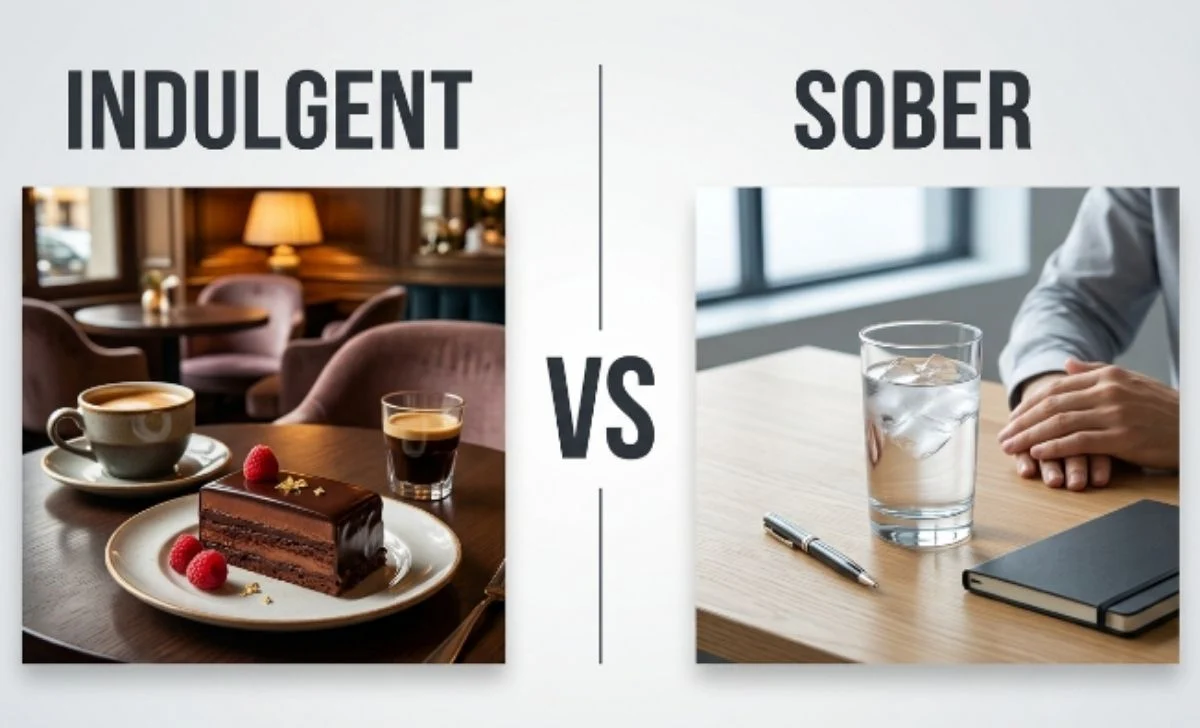
Indulgent and sober describe very different ways of behaving, thinking, or living. Indulgent suggests allowing yourself or someone else to enjoy something freely, often without strict limits.
Sober usually means not affected by alcohol or drugs, but it can also describe someone or something serious, restrained, calm, or plain.
The words are not direct opposites in every context. Their meanings depend on how they are being used.
Indulgent vs Sober: Quick Answer
Indulgent means permissive, self-gratifying, luxurious, or willing to allow pleasure without strict limits.
Sober means not intoxicated or, in a broader sense, serious, restrained, sensible, or subdued.
| Word | Main meaning | Example |
|---|---|---|
| Indulgent | Allowing or enjoying pleasure freely; permissive | She was indulgent with her children. |
| Sober | Not intoxicated; serious or restrained | He remained sober throughout the evening. |
Simple distinction
Indulgent = allowing or enjoying more pleasure
Sober = restrained, serious, or not intoxicated
What Does Indulgent Mean?
Indulgent is an adjective related to the verb indulge.
It describes someone who allows themselves or another person to have what they want, especially when that involves pleasure, comfort, or something that might normally be limited.
Indulgent toward someone
Her parents were very indulgent with her.
This means they were generous or permissive and did not impose many restrictions.
The teacher was indulgent toward the young students.
Here, the teacher was patient and forgiving rather than strict.
Indulgent toward yourself
Indulgent can also describe treating yourself to something enjoyable.
I had an indulgent weekend at a luxury hotel.
The dessert was rich and indulgent.
Here, the word suggests pleasure, luxury, or excess.
What Does Sober Mean?
Sober has several meanings, but its most familiar meaning is not drunk or intoxicated.
He stayed sober while his friends were drinking.
However, sober can also describe someone’s mood, behavior, appearance, or judgment.
Sober meaning serious
She gave a sober assessment of the situation.
This means her assessment was serious, realistic, and free from excessive emotion or excitement.
Sober meaning restrained
He chose a sober suit for the interview.
Here, sober means plain, conservative, or not flashy.
Sober meaning calm and sensible
We need to take a sober look at the evidence.
This suggests a careful, rational approach rather than an emotional or exaggerated one.
Indulgent vs Sober: Main Difference
The two words often suggest contrasting attitudes toward pleasure and restraint, but they are not strict opposites.
Indulgent emphasizes permission, pleasure, generosity, or excess.
Sober emphasizes restraint, seriousness, moderation, or clear judgment.
Compare:
The restaurant offered an indulgent chocolate dessert.
The dessert is rich, luxurious, and designed for pleasure.
The restaurant had a sober interior.
The interior was restrained, simple, or serious.
The words describe different qualities rather than simply forming a direct opposite pair.
Indulgent vs Sober in Personality
The words can describe someone’s personality or behavior.
An indulgent person
An indulgent person may be generous, permissive, or willing to overlook mistakes.
His grandmother was indulgent, often giving him whatever he wanted.
It can be positive when it suggests kindness and generosity.
However, it can also imply excessive permissiveness.
The manager was too indulgent with employees who repeatedly missed deadlines.
Here, the word suggests that the manager was not strict enough.
A sober person
A sober person may be serious, practical, restrained, or thoughtful.
She is known for her sober and careful judgment.
In a different context, it can simply mean that the person is not under the influence of alcohol.
He has been sober for several years.
Indulgent vs Sober in Food
Indulgent is very common when describing food.
It suggests something rich, luxurious, satisfying, or unusually enjoyable.
Examples
- an indulgent chocolate cake
- an indulgent dessert
- an indulgent breakfast
- an indulgent meal
- an indulgent treat
The cheesecake was rich, creamy, and incredibly indulgent.
Sober is not normally used to describe food in this sense.
You would not normally say:
❌ a sober chocolate cake
Instead, sober might describe the atmosphere or presentation:
The restaurant had a sober atmosphere.
Indulgent vs Sober in Lifestyle
The contrast becomes clearer when discussing lifestyles.
An indulgent lifestyle may involve luxury, comfort, entertainment, expensive food, travel, or other pleasures.
He enjoys an indulgent lifestyle filled with fine dining and travel.
A sober lifestyle can suggest restraint, simplicity, or seriousness.
She adopted a more sober lifestyle after years of excessive spending.
However, if sober specifically means abstaining from alcohol or drugs, the context should make that meaning clear.
Indulgent vs Sober in Writing
The two words can also describe writing or communication.
Indulgent writing
An indulgent tone may be overly generous, forgiving, or focused on pleasure and emotion.
The review takes an indulgent view of the celebrity’s mistakes.
This means the writer is treating those mistakes leniently.
Sober writing
Sober writing is serious, restrained, and measured.
The report provides a sober analysis of the economic situation.
This suggests the writer avoids exaggeration and emotional language.
Indulgent vs Sober in Fashion and Design
Indulgent can describe luxurious design.
The hotel suite has an indulgent interior with velvet furniture and marble bathrooms.
Sober can describe a restrained or conservative style.
He chose a sober color palette for the office.
Here, sober does not mean “not drunk.” It means subdued or serious.
Is Indulgent the Opposite of Sober?
Not exactly.
This is an important distinction.
The opposite of indulgent depends on the context.
Possible opposites include:
- strict
- restrained
- disciplined
- austere
- self-denying
- sparing
The opposite of sober can also depend on the meaning.
If sober means not intoxicated, its opposite is:
- drunk
- intoxicated
If sober means serious or restrained, possible opposites include:
- playful
- frivolous
- flashy
- exuberant
- carefree
So indulgent and sober can contrast in certain contexts, but they are not universal antonyms.
Indulgent Synonyms
Depending on context, synonyms for indulgent include:
- permissive
- lenient
- forgiving
- generous
- tolerant
- lavish
- luxurious
- self-gratifying
- pleasurable
Example
She was indulgent toward her children.
Possible alternatives:
She was lenient with her children.
She was permissive with her children.
But these words are not identical in every context.
Sober Synonyms
Depending on its meaning, sober can mean:
- serious
- restrained
- sensible
- calm
- solemn
- subdued
- moderate
- clear-headed
- temperate
- abstinent
Example
He gave a sober assessment.
Possible alternatives:
He gave a serious assessment.
He gave a measured assessment.
If sober refers to alcohol, however, serious is not a synonym.
He is sober.
means he is not intoxicated.
Common Mistakes With Indulgent and Sober
Mistake 1: Assuming sober always means “not drinking”
Although this is one of its main meanings, sober can also mean serious, restrained, or subdued.
The article takes a sober approach to the issue.
This sentence has nothing to do with alcohol.
Mistake 2: Assuming indulgent always means excessive
Indulgent can have a positive meaning.
Her grandmother was indulgent and affectionate.
But it can also suggest excessive permissiveness.
The parents were overly indulgent.
Context determines whether the word sounds positive or critical.
Mistake 3: Treating the words as direct antonyms
They can contrast in some situations, but they do not cover the same semantic field.
For example:
an indulgent dessert
does not have a natural opposite called a sober dessert.
The appropriate opposite might be:
a light dessert
or
a simple dessert.
Real-Life Examples of Indulgent
Parenting
His parents were quite indulgent and rarely said no.
Food
We ordered an indulgent chocolate dessert.
Shopping
She allowed herself an indulgent shopping spree.
Travel
They spent an indulgent week at a luxury resort.
Behavior
The coach was indulgent about minor mistakes.
Real-Life Examples of Sober
Alcohol
He remained sober throughout the party.
Judgment
We need a sober evaluation of the risks.
Mood
The news created a sober mood in the room.
Clothing
He wore a sober black suit.
Design
The building has a sober, minimalist appearance.
Indulgent vs Lenient
These words can overlap, especially when describing someone’s treatment of other people.
Lenient means not strict or not severe.
Indulgent means allowing someone to have what they want or overlooking faults, often because of affection or generosity.
Compare:
The judge was lenient with the first-time offender.
Her grandmother was indulgent with her grandchildren.
Lenient focuses on a lack of strictness.
Indulgent often carries an idea of affection, generosity, or pleasure.
Indulgent vs Excessive
These words are not synonyms either.
Indulgent can suggest allowing or enjoying more than usual.
Excessive simply means more than necessary, appropriate, or reasonable.
The meal was indulgent.
This can be positive.
The meal was excessive.
This usually suggests criticism.
Sober vs Serious
These words overlap, but sober often adds the idea of restraint or seriousness without excitement.
She gave a serious answer.
She gave a sober assessment of the risks.
The second sentence suggests a calm, realistic, measured judgment.
Sober vs Somber
Sober can mean serious, restrained, or not intoxicated.
Somber means dark, gloomy, or sad in mood.
Compare:
He gave a sober assessment of the situation.
The funeral had a somber atmosphere.
A sober assessment can be realistic without being sad.
Word Origin of Indulgent
Indulgent comes from the Latin indulgere, meaning to be kind, yield, or give way.
The related verb indulge developed the sense of giving in to a desire or allowing something freely.
That history helps explain its modern meanings involving permission, generosity, and pleasure.
Word Origin of Sober
Sober entered English through Old French and ultimately traces back to Latin sobrius, meaning free from intoxication.
Over time, its meaning expanded beyond alcohol to include ideas such as seriousness, moderation, restraint, and clear judgment.
That is why modern English uses sober in contexts that have nothing to do with drinking.
Frequently Asked Questions
What is the difference between indulgent and sober?
Indulgent suggests generosity, permissiveness, pleasure, or luxury. Sober can mean not intoxicated, serious, restrained, or subdued.
Are indulgent and sober opposites?
Not strictly. They can contrast when discussing pleasure versus restraint, but they have several meanings and are not universal antonyms.
What is the opposite of indulgent?
Depending on context, possible opposites include strict, restrained, disciplined, austere, and self-denying.
What is the opposite of sober?
If sober means not intoxicated, the opposite is drunk or intoxicated. If it means serious or restrained, possible opposites include playful, frivolous, or exuberant.
What does indulgent mean in food?
When describing food, indulgent usually means rich, luxurious, satisfying, or especially pleasurable.
What does sober mean in personality?
A sober personality may be serious, restrained, practical, calm, or thoughtful.
Does sober always mean not drunk?
No. Sober can also mean serious, sensible, restrained, or subdued.
Does indulgent have a negative meaning?
Not necessarily. It can suggest generosity or affection, but it can also criticize someone for being excessively permissive.
Is sober the same as somber?
No. Sober can mean serious or restrained, while somber usually means dark, gloomy, or sad.
Can indulgent describe a person?
Yes. An indulgent person may be generous, forgiving, or permissive, especially toward someone they care about.
Indulgent vs Sober: Final Verdict
Both describe very different qualities.
Indulgent is associated with pleasure, generosity, permissiveness, luxury, or giving in to desires.
Sober is associated with not being intoxicated, seriousness, restraint, moderation, and clear judgment.
They can contrast when you’re talking about a life of pleasure versus a restrained or serious approach, but they are not exact opposites in every context.
Remember
Indulgent = permissive or pleasure-seeking
It was an indulgent dessert.
Sober = restrained, serious, or not intoxicated
She gave a sober assessment of the situation.

Hi, I’m Safdar Ali, an English language teacher with 26 years of teaching experience. My expertise is in English linguistics, grammar, and the differences between British and American English.
Through Gramiffy, I share practical, research-based guides to help students, writers, and English learners improve their language skills. My goal is to make English simple, accurate, and easy for everyone to understand.