You send an email to the wrong person, delete an important file, or make a mistake you never intended to make. When you explain what happened, you type accidently—but is that spelling actually correct?
Accidentally is the standard spelling in American, British, Australian, and other major varieties of English. Accidently appears as a rare variant in some references, but it is not the recommended choice for everyday or professional writing.
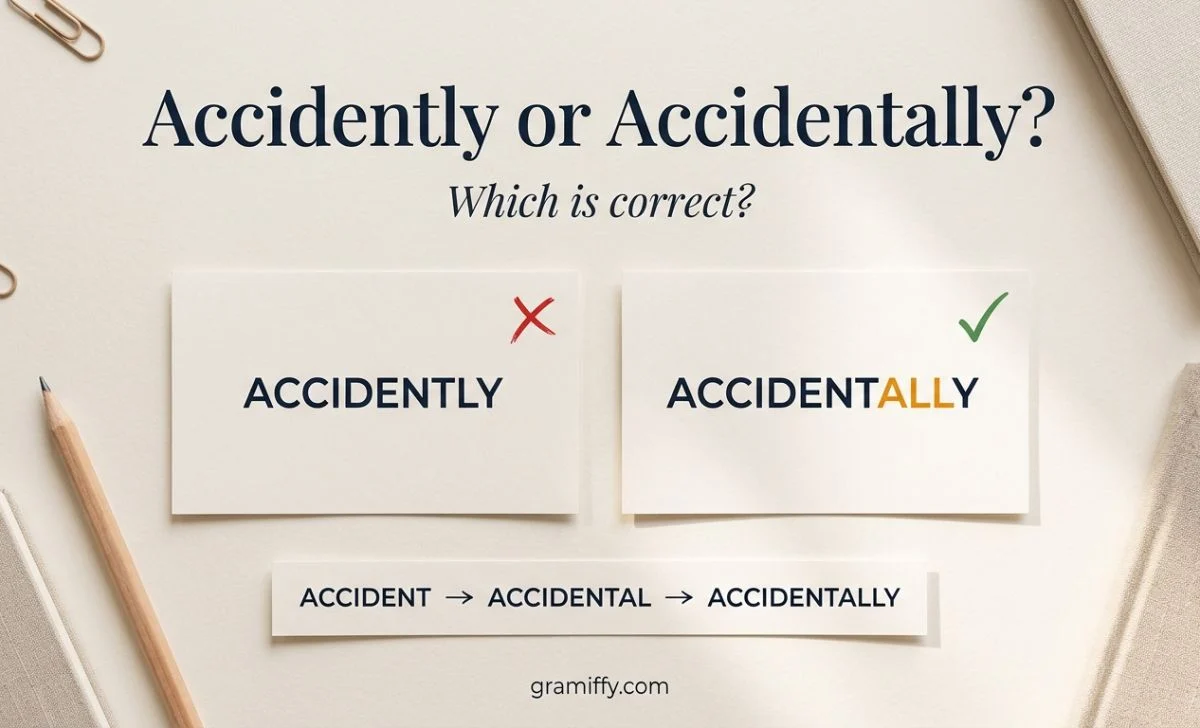
The easiest way to remember the correct form is to look at the word it comes from: accidental. Add -ly, and you get accidentally. Once you understand this simple pattern, the spelling becomes much easier to remember.
Quick Answer: Accidently or Accidentally?
Accidentally is the preferred spelling. It means doing something unintentionally or by mistake.
| Spelling | Status | Recommendation |
|---|---|---|
| Accidentally | Standard spelling | Use it |
| Accidently | Rare variant recorded in some references | Avoid it in formal writing |
Examples:
- I accidentally deleted the document.
- She accidentally sent the message to the wrong group.
- He accidentally left his wallet at home.
In each sentence, accidentally describes an action that happened unintentionally.
The same spelling applies in American and British English. Unlike pairs such as color/colour or organize/organise, this is not a standard US-versus-UK spelling difference.
Why Is Accidentally the Correct Spelling?
The spelling becomes easier when you break the word into its parts.
Accident + -al = accidental
Accidental + -ly = accidentally
The adjective accidental means unintentional or not planned. Adding -ly forms the adverb accidentally, which describes how an action happens.
Notice that the letters al remain when you add the adverb ending:
- Accident
- Accidental
- Accidentally
The incorrect-looking form accidently skips the al found in accidental. That is why the longer spelling is the one to remember.
Compare these sentences:
- Adjective: It was an accidental mistake.
- Adverb: She accidentally made the mistake.
In the first sentence, accidental describes the noun mistake. In the second, accidentally describes the action made.
Why Do People Write Accidently?
The main reason is that the word can sound shorter when spoken quickly.
When people pronounce accidentally in everyday conversation, the middle vowel may become weak or almost disappear. As a result, the word can sound as though it were spelled accidently.
This is a common spelling trap: people often write words according to how they hear them rather than how they are constructed.
Other factors can contribute to the mistake:
- Typing quickly: The shorter form may slip through when writing fast.
- Unfamiliarity with the word family: Some writers do not recognize that accidentally comes from accidental.
- Autocorrect and spellcheck: Some dictionaries and writing tools treat rare variants differently, so a missing warning does not necessarily mean a spelling is recommended.
The solution is to remember the base adjective. If you know how to spell accidental, you can form accidentally correctly.
Is Accidently a Real Word?
This question needs a little nuance.
Accidently has appeared in published writing and is recorded as a variant in some reference sources. However, accidentally is overwhelmingly the safer standard choice for modern writing.
There is an important distinction between a spelling being recorded and a spelling being recommended.
Dictionaries describe language usage, including uncommon forms. A dictionary entry does not automatically mean that every spelling is equally common, equally appropriate, or preferred by editors.
For school assignments, business emails, website content, academic papers, and professional reports, use accidentally.
You do not need to worry about choosing between an American spelling and a British spelling here. The standard form is the same in both.
How to Remember the Spelling of Accidentally
If you frequently type accidently, use one of these simple memory tricks.
1. Remember the Word Inside the Word
The word accidentally contains accidental.
Think of the spelling in two steps:
ACCIDENT → ACCIDENTAL → ACCIDENTALLY
Keep the complete word accidental and add -ly. Do not remove the al.
2. Use the Double-L Rule
The correct spelling contains two consecutive Ls:
accidenta + lly = accidentally
More precisely, the complete adjective accidental already ends in L, and adding -ly contributes another L.
That is why the ending is -ally, not simply -ly attached directly to accident.
3. Connect It With Similar Words
Think about other familiar adverbs:
- Accidental → accidentally
- Incidental → incidentally
- Occasional → occasionally
- Intentional → intentionally
- Emotional → emotionally
- Fundamental → fundamentally
These examples share the -al adjective ending followed by -ly. Recognizing the pattern makes the spelling easier to recall.
Accidentally in a Sentence: Examples of Correct Usage
The best way to understand a word is to see how it works in everyday situations.
Everyday situations
- I accidentally left my phone in the taxi.
- She accidentally spilled coffee on the table.
- We accidentally took the wrong train.
- He accidentally locked himself out of the house.
Work and education
- The employee accidentally attached the wrong document.
- I accidentally submitted the assignment before checking it.
- The editor accidentally removed an important paragraph.
- A student accidentally entered the wrong answer.
Technology and digital communication
- I accidentally deleted the original file.
- She accidentally shared the private link.
- The developer accidentally changed the wrong setting.
- He accidentally sent the message before finishing it.
In all these examples, accidentally describes something that happened unintentionally.
A related expression is accidentally on purpose. It is used humorously or critically when someone claims an action was accidental but may have intended it.
For example: “He knocked the cup over accidentally on purpose.”
Accidental or Accidentally: What’s the Difference?
These words belong to the same word family, but they perform different grammatical jobs.
| Word | Part of speech | Meaning | Example |
|---|---|---|---|
| Accidental | Adjective | Unintentional or not planned | It was an accidental discovery. |
| Accidentally | Adverb | In an unintended manner | She accidentally found the answer. |
| Accident | Noun | An unintended event or an unfortunate incident | The accident delayed traffic. |
Use accidental when describing a person, event, discovery, or other noun.
Use accidentally when explaining how an action happened.
Compare:
- Correct: He made an accidental error.
- Correct: He accidentally made an error.
- Incorrect: He made an accidentally error.
The last sentence uses an adverb where an adjective is needed.
Accidentally vs Incidentally: Are They the Same?
No. Although the words look similar, their meanings are different.
Accidentally means unintentionally or by mistake.
Incidentally usually means as a secondary matter, in connection with something else, or as a way of introducing an additional point in conversation.
Consider these examples:
- I accidentally deleted the photograph.
The deletion was unintended. - The new software incidentally improved battery life.
The improvement occurred as an additional result, rather than necessarily being the main objective. - Incidentally, have you seen my keys?
Here, incidentally introduces another point in the conversation.
The distinction is useful because accidentally describes a lack of intention, while incidentally often describes something secondary or an aside.
On Accident or By Accident: Which Is Correct?
Both on accident and by accident appear in modern English, but by accident is the traditional and widely accepted choice for formal writing.
Examples:
- I deleted the file by accident.
- She broke the glass by accident.
- They met by accident at the station.
You can also avoid the expression entirely by using accidentally:
- I accidentally deleted the file.
- She accidentally broke the glass.
- They accidentally met at the station.
On accident is common in informal speech, particularly in some varieties of American English. Its acceptability and frequency vary by speaker and context.
For an academic essay, professional email, or formal article, choose by accident or accidentally.
Why Your Spellchecker May Not Flag Accidently
A spellchecker is useful, but it is not a perfect guide to standard usage. Some spelling tools rely on dictionaries that include uncommon variants, while others may suggest a correction only in certain contexts.
If your software accepts accidently, do not assume that it is the best spelling for your sentence.
Try these practical steps:
- Search your document for the exact word
accidently. - Replace unintended occurrences with
accidentally. - Check your writing tool’s language and proofreading settings.
- Review the sentence to ensure that you need the adverb accidentally, not the adjective accidental.
For website owners, a final spelling check before publishing can catch this kind of mistake even when automated tools do not.
Common Spelling and Grammar Mistakes
1. Writing Accidently Instead of Accidentally
Incorrect: I accidently deleted the email.
Correct: I accidentally deleted the email.
Remember the complete adjective accidental before adding -ly.
2. Writing Accidentaly
Incorrect: She accidentaly sent the wrong file.
Correct: She accidentally sent the wrong file.
The correct spelling has two consecutive Ls.
3. Writing Acidentally
Incorrect: He acidentally broke the glass.
Correct: He accidentally broke the glass.
The word begins with acc-, containing two Cs.
4. Confusing the Adjective and Adverb
Incorrect: She made an accidentally decision.
Correct: She made an accidental decision.
The adjective accidental describes the noun decision.
5. Assuming Accidently Is the British Version
Incorrect assumption: Americans write accidentally, but British writers use accidently.
Correct explanation: Accidentally is the standard spelling in both American and British English. Accidently is not the regular British alternative.
Quick Quiz: Accidently or Accidentally?
Test your understanding with these five questions.
1. I ______ sent the confidential email to the wrong person.
- A. Accidently
- B. Accidentally
2. It was an ______ discovery.
- A. Accidentally
- B. Accidental
3. Which spelling is standard in both American and British English?
- A. Accidently
- B. Accidentally
4. She deleted the document ______.
- A. By accident
- B. By accidentally
5. Which word means something happened unintentionally?
- A. Incidentally
- B. Accidentally
Quiz Answers
- B — Accidentally. It describes how the email was sent.
- B — Accidental. An adjective is needed to describe discovery.
- B — Accidentally. It is the standard spelling in both varieties.
- A — By accident. This is the correct expression.
- B — Accidentally. It means unintentionally or by mistake.
FAQs
Is It Accidently or Accidentally?
Accidentally is the standard spelling. It means that something happened unintentionally. Use it in formal, academic, and everyday writing.
Is Accidently a Word?
Accidently is recorded as a rare variant in some references, but it is not the recommended standard form. Use accidentally to avoid spelling problems.
Is Accidently British or American?
Neither. Accidently is not the standard regional spelling in either variety. Both American and British English use accidentally.
How Do You Spell Accidentally?
Spell it a-c-c-i-d-e-n-t-a-l-l-y. Remember the word accidental and add -ly.
Why Does Accidentally Have Two Ls?
The adjective accidental ends in L. Adding the adverb-forming suffix -ly introduces another L, producing accidentally.
What Is the Difference Between Accidental and Accidentally?
Accidental is an adjective describing something unintentional, as in “an accidental discovery.” Accidentally is an adverb describing an action, as in “she accidentally discovered it.”
Is By Accident Better Than On Accident?
By accident is the traditional and widely accepted expression, especially in formal writing. On accident is also used in informal speech, but by accident is the safer choice for professional documents.
What Is the Difference Between Accidentally and Incidentally?
Accidentally means unintentionally. Incidentally means as an additional or secondary matter, or it introduces a related point in conversation.
Conclusion: Accidently or Accidentally?
Accidentally is the spelling you should use.
The easiest way to remember it is to start with accidental and add -ly. This preserves the al and produces the correct ending, -ally.
Although accidently appears in some references as a rare variant, it is not the preferred spelling for professional writing. The same standard form applies in American and British English.
When in doubt, remember the word family:
Accident → Accidental → Accidentally
Learn that pattern once, and you will be much less likely to make the same spelling mistake again.
Read More:

Hi, I’m Safdar Ali, an English language teacher with 26 years of teaching experience. My expertise is in English linguistics, grammar, and the differences between British and American English.
Through Gramiffy, I share practical, research-based guides to help students, writers, and English learners improve their language skills. My goal is to make English simple, accurate, and easy for everyone to understand.