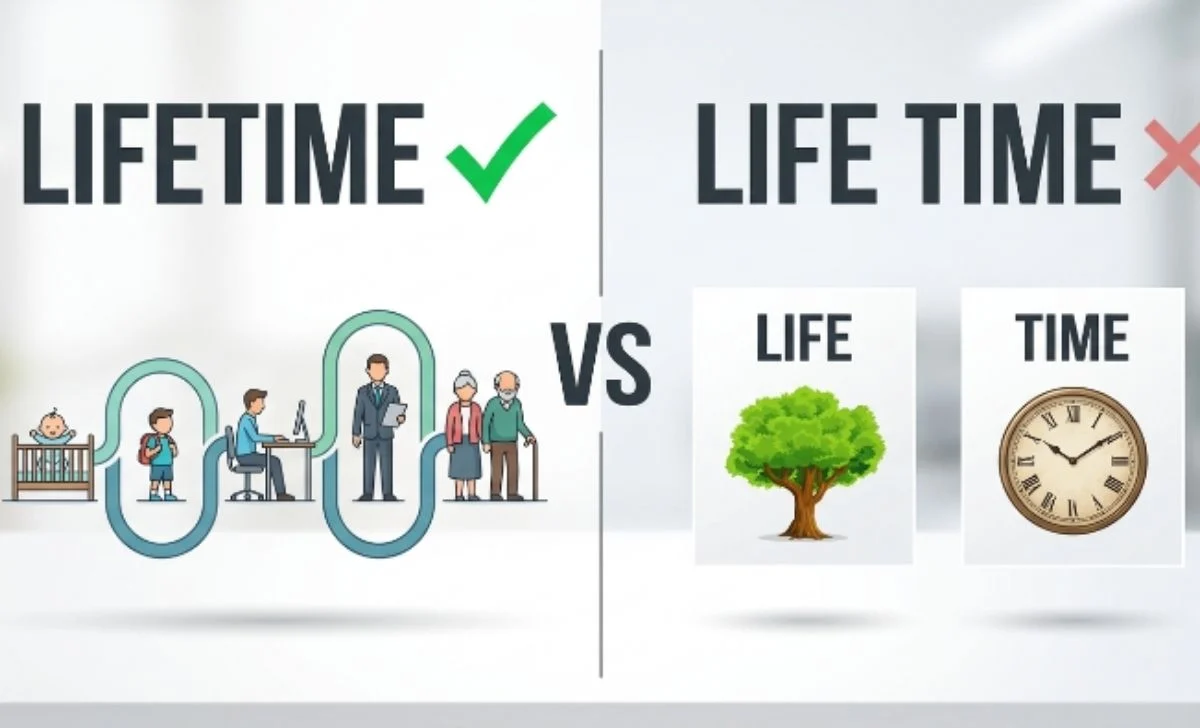
Lifetime is usually the correct spelling when you mean the entire period of a person’s life or the duration something exists or remains active. Life time can occasionally appear when life and time are being used as two separate nouns, but this is much less common.
For most everyday writing, use lifetime as one word.
Lifetime or Life Time: Quick Answer
Lifetime is the standard form in modern English.
She achieved a lot in her lifetime.
This product comes with a lifetime warranty.
Life time is not normally used as a compound noun in these sentences.
| Form | Correct? | Main use | Example |
|---|---|---|---|
| lifetime | Yes | Entire duration of a life or existence | He spent his lifetime studying history. |
| life time | Rare/special use | Life and time functioning separately | The machine’s life time was measured during testing. |
The safest rule is simple:
Use “lifetime” when the two words express one idea.
What Does Lifetime Mean?
Lifetime is a noun meaning the period during which a person lives or the period during which something exists, operates, or remains useful.
Lifetime of a person
She wrote many books during her lifetime.
He traveled to more than 30 countries in his lifetime.
Here, lifetime means the whole period of the person’s life.
Lifetime of a thing
The word can also describe how long something lasts.
The battery has a lifetime of about five years.
The company offers a lifetime warranty.
Regular maintenance can extend the lifetime of the machine.
In these examples, lifetime refers to the useful or expected duration of something.
What Does Life Time Mean?
Life time written as two words is uncommon when it means “the period of a life.”
Modern English normally uses the compound noun lifetime.
However, there are situations where life and time can appear next to each other naturally because they have separate grammatical roles.
For example:
The life time of the battery was measured under controlled conditions.
In highly technical writing, some authors may use life time as a literal combination of the noun life and the noun time. However, lifetime is usually the more established form when referring to duration.
Another natural construction is:
The time of his life was unforgettable.
Here, life and time are separate words because they perform different grammatical functions.
Lifetime as a Noun
The most common use of lifetime is as a noun.
It can mean the complete period of a person’s life.
Examples
She learned three languages in her lifetime.
During his lifetime, he became a respected teacher.
The discovery changed science during her lifetime.
He never forgot that experience for the rest of his lifetime.
In each sentence, lifetime refers to the span of a person’s life.
Lifetime as an Adjective
Lifetime can also work as an adjective before another noun.
This is extremely common.
Examples
- lifetime achievement
- lifetime membership
- lifetime warranty
- lifetime access
- lifetime subscription
- lifetime earnings
- lifetime opportunity
- lifetime ban
For example:
The museum gave him a lifetime membership.
The software includes lifetime access.
The company offers a lifetime warranty.
Here, lifetime describes the duration or extent of the noun that follows it.
Lifetime vs Life Span
Both are related, but they are not always interchangeable.
Lifetime usually refers to the period of a particular person’s life or the duration of something.
Lifespan often refers to the expected or actual length of time that a living thing or object lasts.
Compare:
He achieved a great deal during his lifetime.
The average lifespan of the species is 15 years.
You can also say:
The battery has a long lifespan.
But:
The battery has a long lifetime.
is also possible, especially in technical or commercial contexts.
Lifetime vs Lifelong
These two words are also easy to confuse.
Lifetime is mainly a noun or a modifier describing duration.
Lifelong is an adjective meaning lasting throughout a person’s life.
Compare
She has a lifetime of experience.
She has been a lifelong learner.
The company offers lifetime access.
He has a lifelong interest in music.
A useful distinction is:
Lifetime = the whole period of life
Lifelong = lasting throughout life
Common Expressions With Lifetime
Lifetime appears in many established English expressions.
Lifetime achievement
A lifetime achievement is an important accomplishment recognized after many years of work.
She received a lifetime achievement award.
Lifetime warranty
A lifetime warranty promises coverage for a specified lifetime, although the exact meaning depends on the company’s warranty terms.
The tool comes with a lifetime warranty.
Lifetime membership
A lifetime membership normally means membership that continues for the member’s lifetime or for the period defined by the organization.
He purchased a lifetime membership.
Lifetime access
Lifetime access means access that is intended to continue for the relevant lifetime or duration specified by the provider.
The course includes lifetime access.
Once-in-a-lifetime
This phrase describes something extremely unusual or special.
Winning the championship was a once-in-a-lifetime experience.
Notice that lifetime remains one word.
Once in a Lifetime or Once in a Life Time?
The standard expression is:
once in a lifetime
Not:
❌ once in a life time
Examples:
Seeing the northern lights was a once-in-a-lifetime experience.
You may only get an opportunity like this once in a lifetime.
When the phrase functions as an adjective before a noun, hyphens are normally used:
a once-in-a-lifetime opportunity
When it appears after the verb, the usual form is:
This may happen once in a lifetime.
Lifetime or Life-Time?
You may occasionally see life-time with a hyphen, especially in older or specialized writing.
In modern standard English, lifetime is normally written as one word.
So for ordinary writing:
lifetime ✅
life-time → generally unnecessary
life time → generally not the standard compound form
Lifetime in British and American English
There is no major British-American spelling difference here.
Both British English and American English normally use:
lifetime
Examples:
a lifetime achievement
a lifetime warranty
a lifetime of memories
The spelling does not change to life time in British English.
| English variety | Standard form |
|---|---|
| American English | lifetime |
| British English | lifetime |
| Canadian English | lifetime |
| Australian English | lifetime |
This is different from words such as colour/color or tyre/tire, where regional spelling conventions differ.
Common Mistakes With Lifetime
Writing “life time” as the compound noun
Incorrect in most ordinary contexts:
I have a life time membership.
Better:
I have a lifetime membership.
Using a hyphen unnecessarily
Less standard:
She received a life-time award.
Standard modern form:
She received a lifetime award.
Confusing lifetime with lifelong
Incorrect meaning:
He has a lifetime passion for photography.
If you mean that his passion has continued throughout his life, lifelong is usually more natural:
He has a lifelong passion for photography.
But lifetime is correct when referring to a period or duration:
He has gained a lifetime of experience.
Lifetime in Real-Life Examples
Business
The company offers a lifetime warranty on selected products.
Education
The course provides lifetime access to its lessons.
Personal experience
She collected thousands of photographs during her lifetime.
Science
Researchers estimated the lifetime of the material under different conditions.
Entertainment
The actor received a lifetime achievement award.
Travel
Visiting Antarctica was a once-in-a-lifetime experience.
These examples show why lifetime is much more common than life time.
Is Lifetime Always One Word?
Almost always when it functions as the established compound noun or adjective.
Use:
lifetime warranty
lifetime membership
lifetime achievement
lifetime earnings
during his lifetime
once in a lifetime
The separate form life time should generally be avoided unless you have a specific technical or grammatical reason for treating life and time as separate words.
How to Remember Lifetime
Think of lifetime as one complete concept:
life + time = the whole period of a life → lifetime
When the phrase means the duration of someone’s life or the duration of something’s existence, write it as one word.
Easy memory trick
One idea → one word: lifetime
a lifetime of memories
lifetime access
lifetime warranty
once in a lifetime
Frequently Asked Questions
Is it lifetime or life time?
Lifetime is the standard spelling when you mean the entire period of a person’s life or the duration of something.
Is life time ever correct?
It can occur when life and time are functioning as separate words, particularly in some technical contexts, but lifetime is the normal compound form.
Is lifetime one word?
Yes. Lifetime is normally written as one word.
Is lifetime hyphenated?
No. The standard modern spelling is lifetime, without a hyphen.
Is lifetime a noun or an adjective?
It can be both. As a noun, it means the duration of a life. As a modifier, it appears in phrases such as lifetime warranty and lifetime membership.
What is the difference between lifetime and lifelong?
Lifetime refers to a period or duration, while lifelong describes something that continues throughout a person’s life.
Is “once in a lifetime” correct?
Yes. Once in a lifetime is the standard expression.
Is “once in a life time” correct?
No, not in the standard expression. Write once in a lifetime.
Is lifetime the same as lifespan?
They can overlap in meaning, but lifespan often emphasizes the length of time something lives or lasts, while lifetime can refer to a person’s entire life or the duration of something.
What is the plural of lifetime?
The plural is lifetimes.
People can have very different lifetimes.
Lifetime or Life Time: Final Verdict
Lifetime is the correct and standard form in most situations.
Use lifetime when you mean:
- the entire period of a person’s life
- the duration of something’s existence
- a period of useful operation
- a fixed duration in phrases such as lifetime warranty
- expressions such as once in a lifetime
Life time is generally not the form you want for these meanings.
Remember
Lifetime = standard compound word
She achieved a lot in her lifetime.
Life time = usually two separate nouns only when grammar or technical usage requires it
For normal English writing, when you’re unsure, lifetime is almost certainly the form you need.
Read More:

Hi, I’m Safdar Ali, an English language teacher with 26 years of teaching experience. My expertise is in English linguistics, grammar, and the differences between British and American English.
Through Gramiffy, I share practical, research-based guides to help students, writers, and English learners improve their language skills. My goal is to make English simple, accurate, and easy for everyone to understand.