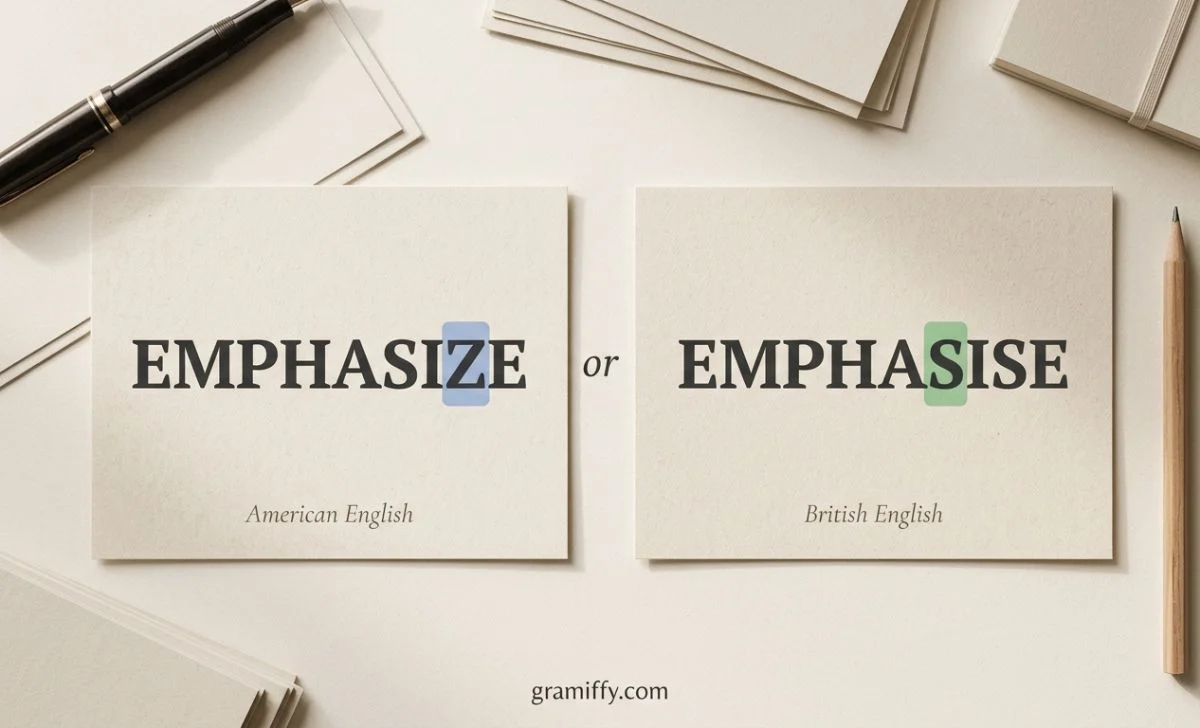
You’re writing an essay, preparing a presentation, or polishing an important email when your spellchecker flags emphasize. You switch the Z to an S, only to wonder whether you’ve made the right choice.
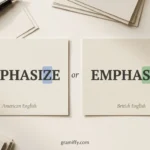
Here’s the answer: both emphasize and emphasise are correct spellings of the same verb. The main difference is regional spelling convention, not meaning.
Emphasize is standard in American English and is also used in Oxford-style British English. Emphasise is the more familiar choice in traditional British-style writing, including many Australian and New Zealand publications.
The right spelling depends on your audience and the style guide you’re following. Once you understand the difference, choosing between the two becomes straightforward.
Quick Answer: Emphasize or Emphasise?
Use emphasize in American English. Use emphasise when following a British-style spelling convention that prefers -ise. Both forms mean to give something special importance, attention, or prominence.
| Situation | Preferred spelling |
|---|---|
| American English | Emphasize |
| British English using -ise | Emphasise |
| British English using Oxford spelling | Emphasize |
| Canadian English | Emphasize is a common choice |
| Australian and New Zealand English | Emphasise is common |
| Academic or professional writing | Follow the required style guide |
Neither spelling is inherently incorrect. Consistency matters more than choosing one form for every English-speaking country.
What Does Emphasize or Emphasise Mean?
Both emphasize and emphasise mean to give something particular importance, attention, or prominence. They can describe highlighting a point in speech, stressing an idea in writing, or drawing attention to a particular feature.
For example:
- The teacher emphasized the importance of regular practice.
- The report emphasises the need for better public transport.
- The designer used lighting to emphasize the building’s unique features.
- The manager emphasised the deadline during the meeting.
All four sentences use the verb correctly. The spelling changes, but the meaning and grammatical function remain the same.
Pronunciation: Both spellings are pronounced identically in standard English: EM-fuh-size.
Word type: Both are verbs.
Related noun: Emphasis is the noun form.
Related adjective: Emphatic describes something expressed with force or conviction.
Emphasize vs Emphasise: What’s the Difference?
The difference is primarily a matter of spelling convention.
American English generally uses Z in verbs such as emphasize, organize, and realize. Traditional British-style spelling generally uses S in emphasise, organise, and realise.
However, British English does not universally reject Z. Oxford spelling deliberately retains -ize in many verbs while keeping other British spellings, such as colour and centre.
Consider these examples:
| American English | British-style English |
|---|---|
| emphasize | emphasise |
| emphasizes | emphasises |
| emphasized | emphasised |
| emphasizing | emphasising |
| organize | organise |
| recognize | recognise |
The important point is that these differences usually reflect editorial preference and regional convention. They do not create differences in meaning.
Which Spelling Is More Common in Different Countries?
Spelling preferences vary by country, publisher, and writing context. American publications generally favor emphasize, while many British, Australian, and New Zealand publications favor emphasise.
| Country or region | Common preference |
|---|---|
| United States | Emphasize |
| Canada | Emphasize |
| United Kingdom | Emphasise in many publications; emphasize in Oxford-style writing |
| Australia | Emphasise in traditional British-style writing |
| New Zealand | Emphasise in traditional British-style writing |
| Ireland | Both occur; follow the publication’s convention |
| India | Both occur; emphasize is widely used |
| Pakistan | Both occur; follow the institution or publication’s style |
These are general conventions, not rules that every writer or organization follows. English spelling preferences can vary within the same country.
If you are writing for a Pakistani university, an international journal, or a UK-based employer, check its instructions before assuming that one spelling is required.
The Oxford Spelling Exception Explained
One of the most confusing aspects of this comparison is that emphasize can be correct in British English.
Oxford spelling is a British English convention associated with Oxford University Press. It generally favors the -ize ending in certain verbs, including:
- Emphasize
- Organize
- Recognize
- Realize
- Specialize
At the same time, Oxford spelling retains British forms such as colour, favour, and centre.
This means a sentence such as the following can follow Oxford-style British spelling:
“The report emphasizes the importance of clear communication.”
A publication using traditional -ise spellings might instead write:
“The report emphasises the importance of clear communication.”
Both sentences are correct.
The history explains why the distinction exists. The suffix -ize ultimately derives from Greek -izein, while the -ise spelling became established through historical developments in French and English. Both forms have a long history in English usage.
The practical lesson is simple: do not assume that every British publication requires S or that every use of Z indicates American English.
Which Style Guides Should You Follow?
If you’re writing for an editor, university, newspaper, or academic journal, its style guide should take priority over a general regional rule.
| Writing context | What to do |
|---|---|
| American academic writing | Use the required guide’s spelling, commonly emphasize |
| Oxford University Press publications | Check the relevant Oxford house style, which uses -ize in applicable words |
| British newspaper or website | Follow its house style; many prefer -ise |
| Canadian professional writing | Follow the publisher’s Canadian spelling policy |
| University assignment | Follow your instructor’s requirements |
| International website | Choose one convention and apply it consistently |
Emphasize or Emphasise: All Verb Forms
Once you’ve chosen a spelling convention, use it consistently across the related verb forms.
| Word form | American spelling | British-style -ise spelling |
|---|---|---|
| Base verb | Emphasize | Emphasise |
| Third-person singular | Emphasizes | Emphasises |
| Past tense | Emphasized | Emphasised |
| Past participle | Emphasized | Emphasised |
| Present participle | Emphasizing | Emphasising |
| Noun | Emphasis | Emphasis |
| Plural noun | Emphases | Emphases |
| Adjective | Emphatic | Emphatic |
| Adverb | Emphatically | Emphatically |
Notice that emphasis, emphases, emphatic, and emphatically do not change to match the Z or S convention.
Here are the forms in natural sentences:
- Emphasizes: The coach emphasizes teamwork.
- Emphasised: The article emphasised the risks.
- Emphasizing: She is emphasizing the most important point.
- Emphasis: The presentation places emphasis on safety.
- Emphatic: He gave an emphatic response.
A common mistake is to confuse the noun and the verb. You should write “The teacher emphasizes the rule,” not “The teacher emphasis the rule.”
Similarly, write “The main emphasis is accuracy,” not “The main emphasize is accuracy.”
How to Remember Emphasize vs Emphasise
Use the audience as your memory aid rather than relying on pronunciation.
Choose Z for American English: Write emphasize, organize, and realize when following standard American spelling.
Choose S for traditional British-style spelling: Write emphasise, organise, and realise when your chosen convention uses -ise.
Remember Oxford spelling: British spelling can use Z in these words, so the country alone does not always settle the question.
One useful rule is to choose your spelling convention before writing and keep it throughout the document. Your word processor’s language settings can also help identify unintended inconsistencies.
Words That Keep -ise in Both American and British English
Be careful not to change every word ending in -ise to -ize. Some words are normally spelled with S in both American and British English.
Examples include:
- Advertise
- Advise
- Apprise
- Compromise
- Despise
- Devise
- Exercise
- Improvise
- Revise
- Supervise
- Surprise
These words should not be treated as simple variations of emphasize and emphasise. Their spelling follows different word histories and conventions.
There are also words that retain Z regardless of the usual -ize versus -ise debate, including size, seize, and capsize.
The safest approach is to learn common exceptions and consult a reputable dictionary when you’re uncertain.
Common Mistakes to Avoid
1. Writing “Emphasize on”
This is a common grammatical error. In standard English, emphasize normally takes a direct object without on.
Incorrect: The teacher emphasized on the importance of revision.
Correct: The teacher emphasized the importance of revision.
You can use on with the noun phrase place emphasis on:
“The teacher placed emphasis on the importance of revision.”
2. Mixing Z and S Spellings
Incorrectly mixing regional conventions can make an article look unedited.
For example, a document might use emphasize, organise, and realized without a deliberate reason.
Choose a consistent convention and check related forms throughout the document.
3. Assuming Emphasise Is Always Wrong
Emphasise is a valid spelling. It is widely used in British-style writing and is not a spelling mistake simply because an American spellchecker prefers emphasize.
4. Assuming Emphasize Is Exclusively American
Oxford-style British English also uses emphasize. The Z spelling is not restricted to the United States.
5. Confusing Emphasis With Emphasize
Emphasis is a noun, while emphasize and emphasise are verbs.
Correct: “The speaker emphasized the point.”
Correct: “The speaker placed emphasis on the point.”
Incorrect: “The speaker emphasis the point.”
Quick Quiz: Test Your Knowledge
Choose the correct answer for each sentence.
1. An American university newsletter says, “The dean wants to ___ research.”
- A. Emphasise
- B. Emphasize
2. A British publication following traditional -ise spelling writes, “The report ___ the need for reform.”
- A. Emphasizes
- B. Emphasises
3. “The speaker placed great ___ on honesty.”
- A. Emphasise
- B. Emphasis
4. Which sentence is grammatically correct?
- A. The manager emphasized on the deadline.
- B. The manager emphasized the deadline.
5. What is the plural of emphasis?
- A. Emphasises
- B. Emphases
6. Which word is normally spelled with S in both American and British English?
- A. Advertise
- B. Organize
Quiz Answers
- B — Emphasize. This is the standard American spelling.
- B — Emphasises. This follows the stated British-style convention.
- B — Emphasis. The sentence requires a noun.
- B — The manager emphasized the deadline. The verb takes a direct object without on.
- B — Emphases. The plural changes the ending from -is to -es.
- A — Advertise. Organize has a regional -ize/-ise spelling variation.
FAQs
Is Emphasise Wrong in American English?
No. Emphasise is an established English spelling, but emphasize is the standard American form. American editors and spellcheckers will generally prefer the Z spelling.
Is Emphasize Wrong in British English?
No. Emphasize is accepted in British English, particularly in Oxford-style spelling. However, many British publications and writers prefer emphasise.
Which Is More Common: Emphasize or Emphasise?
Emphasize is standard in American English and is also used in other English varieties. Emphasise is common in traditional British-style writing. Overall frequency depends on the countries, publications, and datasets being compared.
Can I Use Both Spellings on the Same Website?
You can, but maintaining one consistent spelling convention is usually better for editorial quality. Choose a style that suits your audience and apply it across your articles.
Does Emphasize Mean Something Different From Emphasise?
No. Both words have the same meaning, pronunciation, and grammatical function. The difference is spelling convention.
What Is the Past Tense of Emphasize?
The American form is emphasized. The British-style -ise form is emphasised. Both are correct within their respective conventions.
Is Emphasis a Verb or a Noun?
Emphasis is a noun. The corresponding verbs are emphasize and emphasise.
Should I Use Emphasize or Emphasise in an Academic Essay?
Follow your institution’s or instructor’s spelling requirements. If no preference is given, use the spelling convention appropriate to your English variety and remain consistent.
Conclusion: Emphasize or Emphasise?
Both spellings are correct, but your audience determines which one you should use.
Choose emphasize for American English and for writing that follows Oxford spelling. Choose emphasise when using a British-style convention that prefers S.
If you’re publishing an article, writing an academic assignment, or preparing a professional document, check the relevant style guide and keep the spelling consistent throughout.
And remember one grammatical rule regardless of the spelling you choose: write emphasize the point or emphasise the point, not emphasize on the point.
The meaning stays the same. Only the spelling convention changes.
Read More:

Hi, I’m Safdar Ali, an English language teacher with 26 years of teaching experience. My expertise is in English linguistics, grammar, and the differences between British and American English.
Through Gramiffy, I share practical, research-based guides to help students, writers, and English learners improve their language skills. My goal is to make English simple, accurate, and easy for everyone to understand.