One tiny letter can make you question your English: should you write likeable or likable?
Imagine describing your favorite movie character as easy to like, only to stop mid-sentence because you are suddenly unsure which spelling is right.
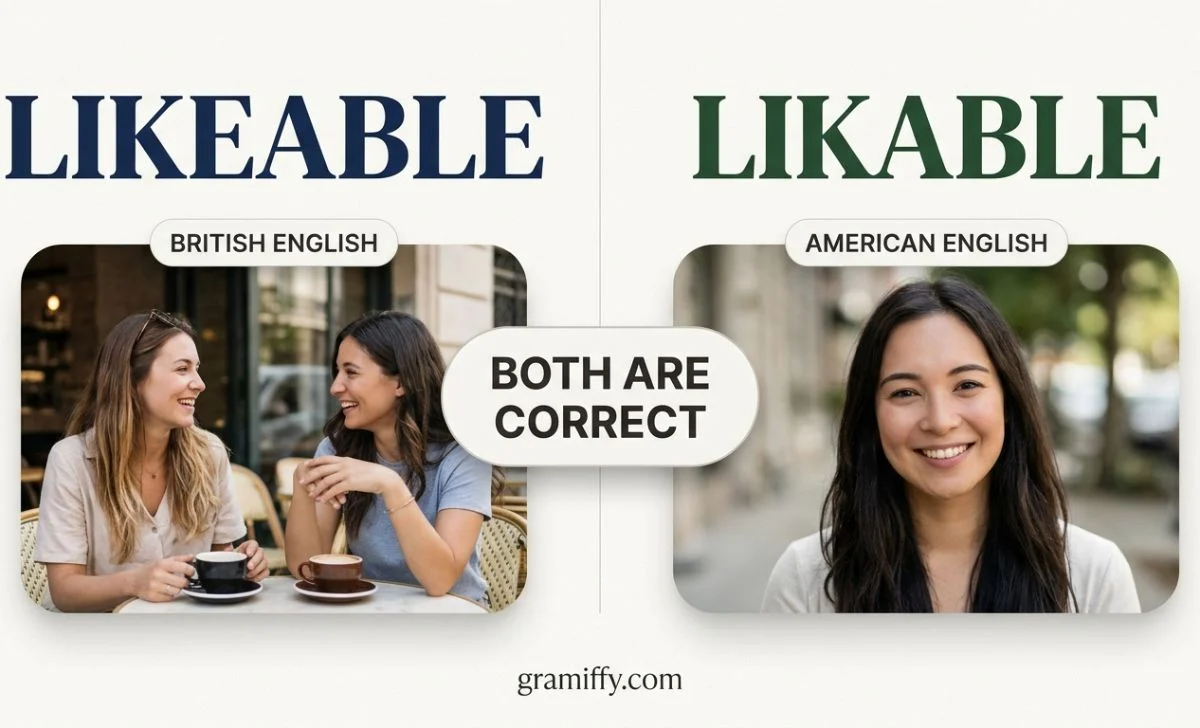
The twist is that you don’t have to choose between correct and incorrect—both spellings are accepted. The real difference lies in regional preference: British English generally favors likeable, while American English usually prefers likable.
Both words describe someone or something pleasant, appealing, or easy to like. So, how do you know which version belongs in your writing?
In this guide, you’ll discover the simple spelling rule, explore natural examples, and learn how to avoid this common writing dilemma with confidence.
Quick Answer: Likeable or Likable?
Both likeable and likable are correct spellings. They have the same meaning, but their preferred usage differs by variety of English.
- Likeable: Generally preferred in British English.
- Likable: Generally preferred in American English.
For example:
- British English: Everyone found the new colleague likeable.
- American English: Everyone found the new colleague likable.
Both sentences are grammatically correct. If you are writing for a British audience, choose likeable. If you are writing for an American audience, choose likable. Most importantly, remain consistent throughout your writing.
Likeable vs. Likable at a Glance
| Feature | Likeable | Likable |
|---|---|---|
| Correct spelling? | Yes | Yes |
| Meaning | Pleasant or easy to like | Pleasant or easy to like |
| Common preference | British English | American English |
| Pronunciation | /ˈlaɪ.kə.bəl/ | /ˈlaɪ.kə.bəl/ |
| Example | She is a likeable person. | She is a likable person. |
| Common alternative form | Likeability | Likability |
The most important point is that the meaning and pronunciation do not change. Only the spelling differs.
What Does Likeable Mean?
Likeable is an adjective used to describe someone or something that people find pleasant, appealing, or easy to enjoy.
A likeable person may be friendly, considerate, approachable, funny, or warm. The word does not mean that everyone must love the person.
It simply suggests that the person has qualities that make others respond positively.
Examples:
- Our new manager is friendly and likeable.
- The main character is likeable despite making a few mistakes.
- Her honest personality makes her especially likeable.
- He became more likeable when he started listening to other people’s opinions.
- The speaker was confident, helpful, and immediately likeable.
You can also use the word when discussing fictional characters, public personalities, or even certain experiences and qualities.
For example:
The film has a likeable hero but a predictable ending.
Here, likeable describes a character the audience can enjoy or relate to.
When Should You Use Likeable?
Use likeable when writing in British English or when your publication follows British spelling conventions.
The spelling retains the e from the base word like before adding -able. Although many English words drop a final silent e before a suffix, some retain it for clarity or convention. This variation is one reason both forms exist.
Examples of likeable in sentences:
- The British author created a likeable character.
- She is intelligent, thoughtful, and likeable.
- His relaxed manner makes him easy to work with and likeable.
- The candidate appeared confident without seeming arrogant or unlikeable.
- It is a warm, funny story with several likeable characters.
Notice that likeable describes a quality. It does not change the meaning of the sentence compared with likable.
Is Likeable Wrong in American English?
No. Likeable is not inherently incorrect in American English. However, likable is generally the preferred spelling in American usage.
You may encounter likeable in American books, websites, and other publications. If you are following a particular publisher’s style guide, use the spelling that guide recommends.
When Should You Use Likable?
Use likable when writing in American English or when your audience and style guide prefer American spelling.
American English often favors simplified spellings in which a final silent e is dropped before a suffix. In this case, like becomes likable.
Examples of likable in sentences:
- The new employee is hardworking and likable.
- The movie’s hero is flawed but still likable.
- His sense of humor makes him more likable.
- The coach is respected because he is honest and likable.
- She wrote a likable character who feels realistic rather than perfect.
These sentences would remain correct if you replaced likable with likeable. The choice depends primarily on your preferred variety of English.
Is Likable Wrong in British English?
No. Likable is understandable and accepted, although likeable is generally more common in British English.
If you are writing an academic paper, a business document, or a website for a specific region, consistency matters more than treating one valid spelling as a universal error.
Likeable or Likable: More Examples
The easiest way to understand the difference is to compare the spellings in identical sentences.
| British-style spelling | American-style spelling |
|---|---|
| She is a very likeable teacher. | She is a very likable teacher. |
| The character is funny and likeable. | The character is funny and likable. |
| He has a likeable personality. | He has a likable personality. |
| The new neighbour seems likeable. | The new neighbor seems likable. |
| It is a likeable little book. | It is a likable little book. |
Notice that other regional spelling differences can appear in the same sentence. For instance, neighbour is the usual British spelling, while neighbor is the usual American spelling.
However, you do not have to change every word in a sentence just because you choose likeable or likable. Follow the spelling conventions appropriate to your audience.
Likeability or Likability: Which Is Correct?
The same spelling variation appears in the noun forms likeability and likability.
Both words are correct. They refer to the quality of being likeable or likable.
- Likeability: Generally preferred in British English.
- Likability: Generally preferred in American English.
Examples:
- Her likeability helped her build strong professional relationships.
- The character’s likability made the audience care about his journey.
- Confidence alone does not guarantee likeability.
- The survey measured the candidate’s likability among voters.
The spelling changes, but the meaning remains the same.
Unlikable or Unlikeable?
The negative forms follow a similar pattern.
Unlikable and unlikeable are both accepted spellings of the adjective meaning difficult to like or unpleasant.
Examples:
- The villain is cruel and unlikable.
- His unlikeable behavior damaged his friendships.
- A character does not have to be perfect to be interesting, but making the character completely unlikable may alienate readers.
American English generally favors unlikable, while British English often uses unlikeable. As with the positive forms, the preference is not an absolute rule.
Common Mistakes to Avoid
Even though both main spellings are correct, a few misunderstandings are worth avoiding.
Mistake 1: Calling likeable incorrect.
Incorrect claim: Likeable is always wrong; only likable is correct.
Correction: Both spellings are valid. The preferred choice depends on regional usage and style.
Mistake 2: Assuming the words have different meanings.
Incorrect claim: Likeable describes a friendly person, while likable describes an attractive person.
Correction: Both words have the same meaning and can describe the same qualities.
Mistake 3: Mixing regional spellings without a reason.
Using likeable in one paragraph and likability in another is not necessarily a grammatical error. However, choosing a consistent spelling style makes a polished article or document easier to read.
Mistake 4: Confusing likeable with popular.
A likeable person is easy to like, but that does not mean the person is popular with everyone. Someone can be likeable without being famous, influential, or widely admired.
A Simple Trick to Remember the Difference
Use this easy memory trick:
British English usually keeps the E: likeable. American English usually drops it: likable.
Think of it as a spelling preference rather than a rule that makes the alternative wrong.
If you are unsure which version to use, ask yourself two questions:
- Who is going to read this?
- Which spelling does my publication or style guide prefer?
For Gramiffy readers, the safest takeaway is simple: both are correct, and consistency is the key.
Quick Practice: Likeable or Likable?
Choose the spelling that best fits each sentence’s intended style.
1. For an article written in British English, which spelling would you generally choose?
- A. Likeable
- B. Likable
Answer: A. Likeable is generally preferred in British English.
2. For an American audience, which spelling would you generally choose?
- A. Likeable
- B. Likable
Answer: B. Likable is generally preferred in American English.
3. Which sentence is correct?
- A. She is a likable person.
- B. She is a likeable person.
Answer: Both sentences are correct.
Frequently Asked Questions
Is likeable or likable the correct spelling?
Both are correct. Likeable is generally preferred in British English, while likable is generally preferred in American English.
Do likeable and likable mean the same thing?
Yes. Both mean pleasant, appealing, or easy to like. There is no difference in their basic meaning.
How do you pronounce likeable and likable?
Both are commonly pronounced /ˈlaɪ.kə.bəl/, approximately “LYE-kuh-buhl.” The spelling difference does not normally affect pronunciation.
Is likeability or likability correct?
Both are correct nouns. Likeability is generally preferred in British English, and likability is generally preferred in American English.
What is the opposite of likeable?
Common opposites include unlikeable, unlikable, unpleasant, and unappealing. The best choice depends on the context.
Which spelling should I use on my website?
Choose the version that matches your target audience and editorial style. For a primarily British audience, likeable is a natural choice. For a primarily American audience, likable is generally preferable. Consistency across your website is more important than treating the alternative as a mistake.
Conclusion: Likeable or Likable?
The choice between likeable and likable is simpler than it first appears. Both spellings are correct, both have the same meaning, and both describe someone or something that is easy to like.
Use likeable when following British English conventions and likable when following American English conventions.
For related words, remember that likeability and likability, as well as unlikeable and unlikable, are also accepted forms.
When in doubt, consider your readers, follow your chosen style guide, and use your spelling consistently. That is the simplest way to make the right choice every time.
Read More:

Hi, I’m Safdar Ali, an English language teacher with 26 years of teaching experience. My expertise is in English linguistics, grammar, and the differences between British and American English.
Through Gramiffy, I share practical, research-based guides to help students, writers, and English learners improve their language skills. My goal is to make English simple, accurate, and easy for everyone to understand.